Sleep Quality Mediating the Relationship between Workload Stress and Emotional Exhaustion in Employed Females
DOI:
https://doi.org/10.61838/kman.jppr.4567Keywords:
Workload Stress, Sleep Quality, Emotional Exhaustion, Mediation, Female Employees, Occupational HealthAbstract
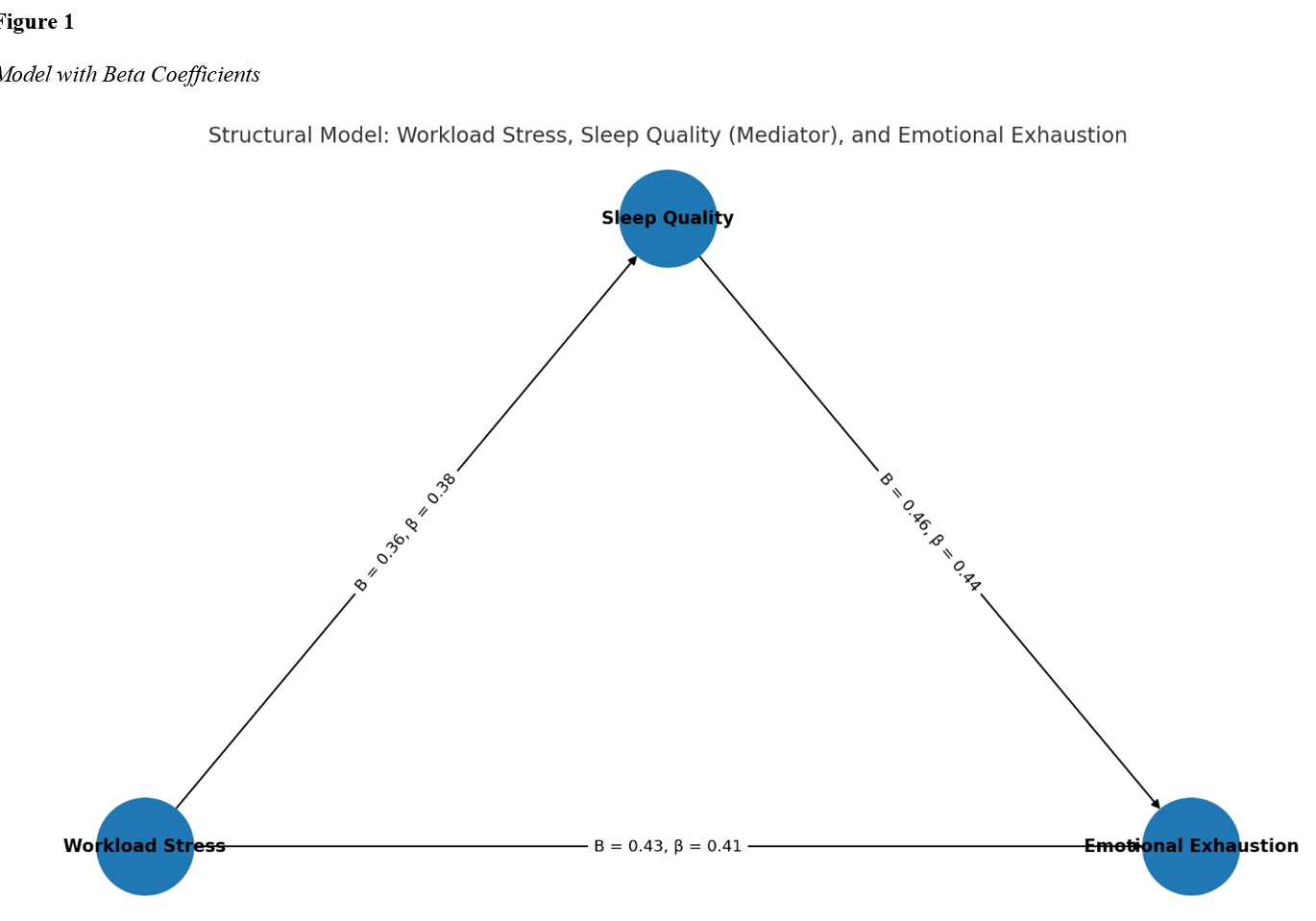
This study aimed to examine the mediating role of sleep quality in the relationship between workload stress and emotional exhaustion among employed females. A descriptive correlational design was adopted, and data were collected from 390 employed women in Canada using standardized self-report instruments. Workload stress was measured by the Workload Subscale of the Occupational Stress Inventory–Revised (Osipow, 1998), sleep quality by the Pittsburgh Sleep Quality Index (Buysse et al., 1989), and emotional exhaustion by the Maslach Burnout Inventory (Maslach & Jackson, 1981). Sampling was determined using the Morgan and Krejcie (1970) table, ensuring representativeness across occupational groups. Data analysis was conducted using SPSS-27 for descriptive and correlational statistics and AMOS-21 for Structural Equation Modeling (SEM) to test the mediation model. Model fit was evaluated through multiple indices, including χ²/df, GFI, AGFI, CFI, TLI, and RMSEA. The results indicated that workload stress significantly predicted emotional exhaustion both directly (β = 0.41, p < .001) and indirectly through sleep quality (β = 0.16, p < .001). Workload stress was positively associated with poor sleep quality (β = 0.38, p < .001), and poor sleep quality was strongly related to higher emotional exhaustion (β = 0.44, p < .001). The total effect of workload stress on emotional exhaustion was substantial (β = 0.57, p < .001). Model fit indices demonstrated an excellent fit (χ²(54) = 87.43, χ²/df = 1.62, GFI = 0.96, AGFI = 0.93, CFI = 0.98, TLI = 0.97, RMSEA = 0.041), confirming the adequacy of the hypothesized model. The study highlights that workload stress significantly contributes to emotional exhaustion among employed females, with sleep quality serving as a crucial mediating mechanism. These findings emphasize the importance of sleep health as a psychological and physiological buffer in occupational stress management. Organizations should prioritize interventions that regulate workload and promote restorative sleep to mitigate emotional exhaustion and enhance employee well-being.
Downloads
References
Bulova, S. J., Noga, V., & Kenderešová, E. (2025). Workload and Stress Among Social Workers Analysed by Perceived Stress Scale. SBCR, 6(1), 37-52. https://doi.org/10.63393/sbcr.28115473.2025.1.03
Cai, H., & Xiu, J. (2023). The Type of Involuntary Overtime and Emotional Exhaustion Among Chinese Medical Staff: The Mediating Role of Job Stress and Moderated Mediation Role of Desire for Control in Machiavellian Leadership. Nurture, 17(2), 112-128. https://doi.org/10.55951/nurture.v17i2.219
Chen, I. S. (2023). Using Leisure Crafting to Reduce Emotional Exhaustion at Home During the COVID‐19 Pandemic Through Better Sleep and Not Thinking About the Pandemic. Stress and Health, 39(5), 1047-1057. https://doi.org/10.1002/smi.3243
Filho, R. R. M., Serafim, J. L., Diniz, P. R., Maria Eduarda da Silva, D., & Rita di Cássia de Oliveira, Â. (2023). Relationships Between Common Mental Disorders, Burnout, and Poor Sleep Quality in Healthcare Professionals Working on the Frontline of COVID-19 Combat. Contribuciones a Las Ciencias Sociales, 16(6), 4933-4954. https://doi.org/10.55905/revconv.16n.6-116
Hong, K. J. (2025). Effects of Work Demands and Rewards of Nurses on Exhaustion and Sleep Disturbance: Focusing on Comparison With Other Shift Workers. Nursing Open, 12(4). https://doi.org/10.1002/nop2.70207
Jiang, R., Zhu, Y., & xiqi, L. (2024). ScholarOne - Can Leadership Be Dynamic? Sleep, Daily Benevolent Leadership, and Employee Deviant Behavior. https://doi.org/10.31124/advance.171215179.91150492/v1
Karimian, M., Dabbagh, A., Sezari, P., Fani, K., Shahrabi, M. A., & Shakeri, A. (2025). The Magnitude of Anesthesiology Residents Burnout at Shahid Beheshti University of Medical Sciences: A Cross-Sectional Study. Anesthesiology and Pain Medicine, 15(2). https://doi.org/10.5812/aapm-159987
Kayumova, M. М., Гафаров, В. В., Bessonova, M., Gorbunova, T., Акимов, А. М., Novoselov, A. V., Lebedev, E. V., & Акимова, Е. В. (2025). Gender Characteristics of Cardiovascular Diseases Psychosocial Risk Factors Associations With Sleep Quality in an Open Urban Population. Profilakticheskaya Meditsina, 28(6), 67. https://doi.org/10.17116/profmed20252806167
Khan, F., Naz, A., & Babar, S. U. (2025). Effect of Workload on Organizational Commitment Among Academicians in Universities: Mediating Effect of Emotional Exhaustion. Jpehss, 3(2), 63-71. https://doi.org/10.63163/jpehss.v3i2.327
Ma, P., Sagara, T., Takase, M., Sugiura, K., Nakamoto, I., Muto, Y., Higashi, K., Fujiwara, Y., & Murayama, H. (2025). Workload and Emotional Exhaustion Among Older Assistant Care Workers in Japan: Buffering Effect of Work Resources. Geriatrics and Gerontology International, 25(2), 273-278. https://doi.org/10.1111/ggi.15058
Ntumi, S., Anovunga, A. A., Sakyi, L., Agbenyo, S., & Abiaw, P. (2025). Sleep Disturbance, Mindfulness, Work-Life Balance, Teaching Demands and Classroom Assessment Practices as Predictors of Burnout Among College of Education Lecturers: Mediating and Moderating Role of Supervision Load and Marking Workload. https://doi.org/10.21203/rs.3.rs-6889331/v1
Potapiuk, I., & Tur, M. (2024). The Role of Professional Burnout in the Staff Conflict Management System of Modern Enterprises. Ukrainian Journal of Applied Economics, 2024(2), 398-402. https://doi.org/10.36887/2415-8453-2024-2-68
Prasetyo, A., Widhiyanto, A., & Laili, N. (2024). The Correlation Between Workload and Work Stress With Sleep Quality of Nurses at Husada Mulia Clinic, Lumajang. Health and Technology Journal (Htechj), 2(6), 620-625. https://doi.org/10.53713/htechj.v2i6.283
Rajbahak, A., Thapaliya, R., Bhattarai, P. C., & Devkota, A. (2025). Understanding the Academic Stress-Sleep Quality: Implications for Academic Performance. Int. J. Atharva, 3(1), 59-72. https://doi.org/10.3126/ija.v3i1.76715
Reyes-Rodriguez, G., Cuellar‐Pompa, L., & Gómez, J. Á. R. (2025). Psycho-Emotional Status Related to Working Conditions Among Nurses: A Scoping Review. JNRCP, 3(1), 58-68. https://doi.org/10.32598/jnrcp.2406.1109
Rozmann, N. (2025). Occupational Stress and Sleep Quality Among Hungarian Nurses in the Post-Covid Era: A Cross-Sectional Study. Healthcare, 13(16), 2029. https://doi.org/10.3390/healthcare13162029
Sanae, N., Abidli, Z., Ahami, A. O. T., Rochdi, A., ElYacoubi, H., & Korab, M. (2025). University Burnout Among Nursing Students in Morocco: The Case of the Cities of Kenitra, Rabat and Casablanca. Acta Neuropsychologica, 23(3), 323-333. https://doi.org/10.5604/01.3001.0055.2371
Sørengaard, T. A., & Saksvik‐Lehouillier, I. (2022). Associations Between Burnout Symptoms and Sleep Among Workers During the COVID-19 Pandemic. Sleep Medicine, 90, 199-203. https://doi.org/10.1016/j.sleep.2022.01.022
Tan, Y., Zhou, J., Zhang, H., Lan, L., Chen, X., Yu, X., Zhong, L., Zhu, L. Q., & Gao, Y. (2025). Effects of Effort-Reward Imbalance on Emergency Nurses’ Health: A Mediating and Moderating Role of Emotional Exhaustion and Work-Family Conflict. Frontiers in Public Health, 13. https://doi.org/10.3389/fpubh.2025.1580501
Tarigan, C. U., Kushartanti, W., Sukarmin, Y., Komarudin, K., & Tarigan, W. P. L. (2024). Relationship of Workload With Fatigue and Sleep Quality in Female Exercisers. Fiz Pol, 24(4), 51-59. https://doi.org/10.56984/8zg020auog
Tello, M., Torres, J. M. D., Ibort, E. G., & Boraita, R. J. (2025). Sleep Quality in Spanish University Professors: Association With Lifestyle Habits and Physical and Mental Health Indicators. PLoS One, 20(4), e0320352. https://doi.org/10.1371/journal.pone.0320352
Wirkkala, M., Wijk, K., Larsson, A., & Engström, M. (2024). Technology Frustration in Healthcare – Does It Matter in Staff Ratings of Stress, Emotional Exhaustion, and Satisfaction With Care? A Cross-Sectional Correlational Study Using the Job Demands-Resources Theory. BMC Health Services Research, 24(1). https://doi.org/10.1186/s12913-024-11906-z
Wu, C., He, C., Zhang, H., Lin, Y., Li, L., He, J., Cheng, F., Ji, Z., & Lang, H. (2024). Trajectories and Predictors of Emotional Exhaustion in Clinical Nurses in the Context of Healthcare Crisis: A Case Study in Xi'an, China. https://doi.org/10.21203/rs.3.rs-3871439/v1
Downloads
Additional Files
Publication Timeline
- Submitted
- Revised
- Accepted