Identifying the Components of Parent–Adolescent Communication Breakdown: A Qualitative Analysis
DOI:
https://doi.org/10.61838/kman.jarac.7.3.23Keywords:
Parent–adolescent communication, Communication breakdownAbstract
Objective: The objective of this study was to explore and identify the key components of communication breakdown between parents and adolescents within the Canadian context.
Methods and Materials: This qualitative research employed an exploratory design using semi-structured, in-depth interviews with 26 participants, including 13 parents and 13 adolescents residing in Canada. Participants were selected through purposive sampling to ensure diversity in gender, age, and family backgrounds. Data collection continued until theoretical saturation was achieved. All interviews, lasting 45–60 minutes, were audio-recorded, transcribed verbatim, and analyzed using thematic analysis. NVivo 14 software was used to facilitate systematic coding, categorization, and theme development. Rigor and trustworthiness were ensured through member checking, audit trails, and peer debriefing.
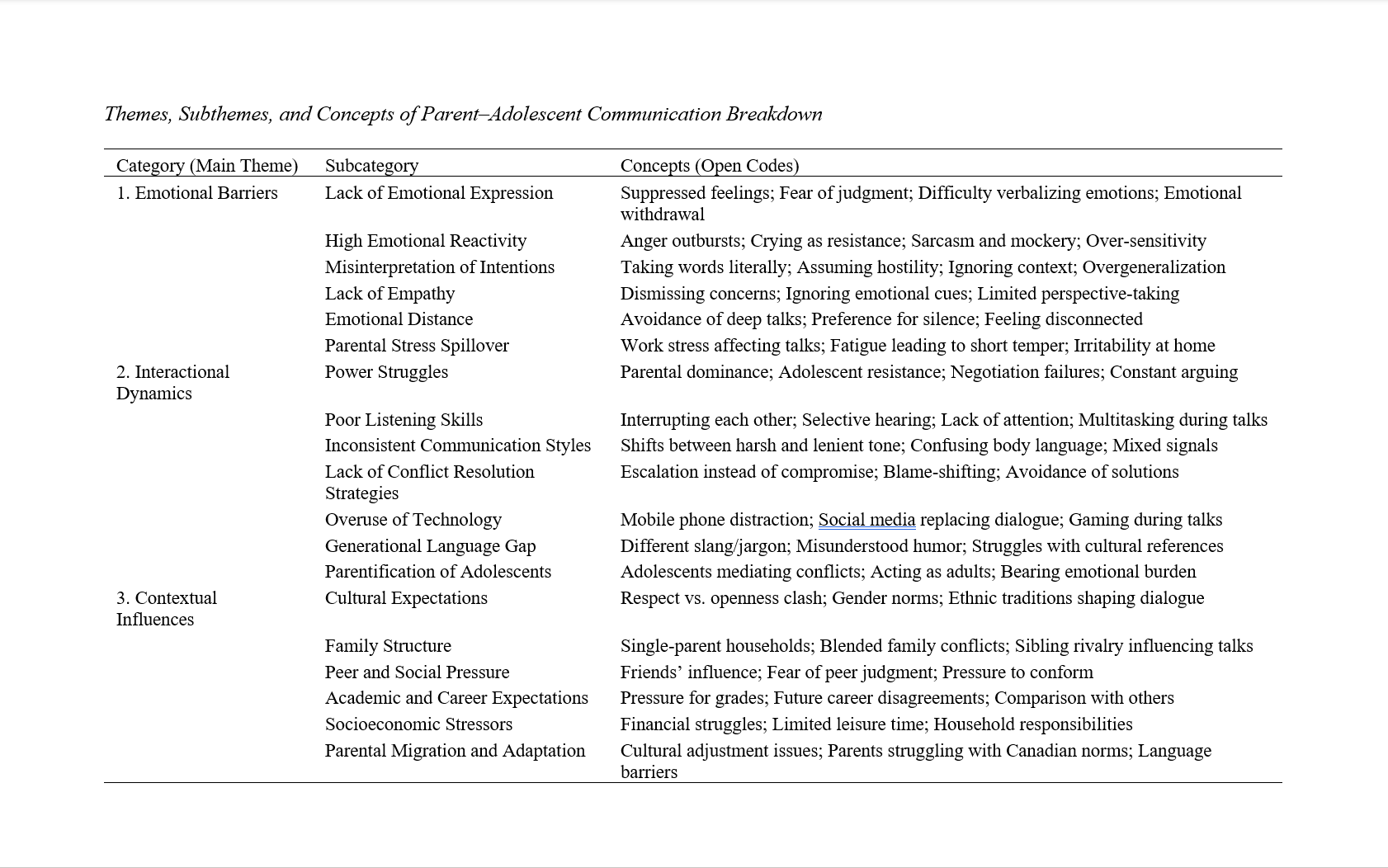
Findings: Analysis revealed three overarching categories of communication breakdown: emotional barriers, interactional dynamics, and contextual influences. Emotional barriers included lack of emotional expression, high reactivity, misinterpretation of intentions, lack of empathy, emotional distance, and spillover of parental stress. Interactional dynamics encompassed power struggles, poor listening skills, inconsistent communication styles, inadequate conflict resolution strategies, technology-related distractions, generational language gaps, and parentification of adolescents. Contextual influences comprised cultural expectations, family structure complexities, peer and social pressures, academic and career demands, socioeconomic stressors, and parental migration and adaptation challenges. Illustrative quotations highlighted how these components disrupted trust, openness, and relational balance within families.
Conclusion: The study concludes that parent–adolescent communication breakdown is a multidimensional phenomenon shaped by emotional regulation challenges, relational dynamics, and broader socio-cultural contexts. Addressing these issues requires interventions that foster emotional literacy, active listening, and culturally responsive dialogue strategies. Findings contribute to a deeper understanding of family communication and provide implications for practitioners, educators, and policymakers seeking to strengthen adolescent well-being and family relationships.
Downloads
References
Agedew, E., Abebe, Z., & Ayelign, A. (2022). Exploring Barriers to Diversified Dietary Feeding Habits Among Adolescents in the Agrarian Community, North West Ethiopia. Frontiers in Nutrition, 9. https://doi.org/10.3389/fnut.2022.955391
Artigues-Barberà, E., Tort‐Nasarre, G., Pollina-Pocallet, M., Suquet, Y. F., Pallés, A. A., Niubó, O. G., Ortega, M., & García‐Martínez, E. (2025). Key Factors in Supporting Adolescents to Achieve High Self-Esteem and a Positive Body Image: A Qualitative Community-Based Study. PLoS One, 20(2), e0318989. https://doi.org/10.1371/journal.pone.0318989
Cao, C., & Lai, Y. (2024). Analysis and Resolution of Parent-Child Conflict Caused by Teenagers' Use of Electronic Devices. British Journal of Philosophy Sociology and History, 4(2), 01-21. https://doi.org/10.32996/pjpsh.2024.4.2.1
Cornelius, J. B., Okoro, F., & Piper, C. N. (2021). A Comparison of the Process and Content of Sexual Communications Among African American Adolescent Children Living in Parent and Grandparent Headed Families. Adolescent Health Medicine and Therapeutics, Volume 12, 1-8. https://doi.org/10.2147/ahmt.s281662
Foster, C., Oster, R., Shrestha, S., & Hidalgo, B. (2025). Evaluation of Recruitment Methodologies for Under-Represented Adolescent Populations in Genetic and Epigenetic Studies of Type 2 Diabetes. Journal of Clinical and Translational Science, 9(s1), 95-95. https://doi.org/10.1017/cts.2024.944
Hamama‐Raz, Y., Frishberg, Y., Ben‐Ezra, M., & Levin, Y. (2023). The Interrelations of Family Relationship, Illness Cognition of Helplessness and Perceived Barriers to Medication Adherence: A Study of Adolescent and Emerging Adult Kidney Recipients and Their Parents. Adolescent Health Medicine and Therapeutics, Volume 14, 205-215. https://doi.org/10.2147/ahmt.s423355
Mugisha, J., Kinyanda, E., Osafo, J., Nalukenge, W., & Knizek, B. L. (2020). Health Care Professionals’ Perspectives on Barriers to Treatment Seeking for Formal Health Services Among Orphan Children and Adolescents With HIV/AIDS and Mental Distress in a Rural District in Central, Uganda. Child and adolescent psychiatry and mental health, 14(1). https://doi.org/10.1186/s13034-020-00332-8
Myers, R. K., Labows, C. G., McDonald, C. C., Yerys, B. E., Sartin, E. B., Carey, M. E., Mollen, C. J., & Curry, A. E. (2024). Preparing to “Live a Life of Possibilities”: Experiences of Healthcare Providers Readying Autistic Adolescents and Their Families for Independent Driving. Journal of Autism and Developmental Disorders, 55(6), 2107-2114. https://doi.org/10.1007/s10803-024-06335-0
Nabugoomu, J., Seruwagi, G., Corbett, K., Kanyesigye, E., Horton, S., & Hanning, R. M. (2018). Needs and Barriers of Teen Mothers in Rural Eastern Uganda: Stakeholders’ Perceptions Regarding Maternal/Child Nutrition and Health. International journal of environmental research and public health, 15(12), 2776. https://doi.org/10.3390/ijerph15122776
Ncube-Murakwani, P. (2021). A Qualitative Investigation of Adolescent Participation in Care Groups for Improved Maternal and Child Nutrition: Experiences From Rural Zimbabwe. World Nutrition, 12(2), 32-47. https://doi.org/10.26596/wn.202112232-47
Noe, M. T. N., Saw, Y. M., Soe, P. P., Khaing, M., Saw, T. N., Hamajima, N., & Win, H. H. (2018). Barriers Between Mothers and Their Adolescent Daughters With Regards to Sexual and Reproductive Health Communication in Taunggyi Township, Myanmar: What Factors Play Important Roles? PLoS One, 13(12), e0208849. https://doi.org/10.1371/journal.pone.0208849
Omoboye, M., & Eneh, N. E. (2024). Engaging Adolescents in Family Therapy: The Role of English Slang and Digital Communication Norms in Therapeutic Settings. Global Journal of Psychology, 3(1), 1-13. https://doi.org/10.51594/gjp.v3i1.913
Parker, J., Veldhuis, C. B., Hughes, T. L., & Haider, S. (2019). Barriers to Contraceptive Use Among Adolescents in Two Semi-Rural Nicaraguan Communities. International Journal of Adolescent Medicine and Health, 32(5). https://doi.org/10.1515/ijamh-2017-0228
Rodríguez, L. (2018). Selective Sharing: The Impact of Patterns of Communication in Young People Experiencing Maternal Cancer. Cancer Reports, 2(1). https://doi.org/10.1002/cnr2.1138
Schwandt, H., Boulware, A., Corey, J., Herrera, A. M. T., Hudler, E., Imbabazi, C., King, I., Linus, J., Manzi, I., Merritt, M., Mezier, L., Miller, A., Morris, H., Musemakweli, D., Musekura, U., Mutuyimana, D., Ntakarutimana, C., Patel, N., Scanteianu, A., . . . Feinberg, S. (2022a). “She Is Courageous Because She Does Not Care What People Think About Her…”: Attitudes Toward Adolescent Contraception Use Among Rwandan Family Planning Providers and Adult Female Modern Contraceptive Users. Reproductive Health, 19(1). https://doi.org/10.1186/s12978-022-01517-4
Schwandt, H., Boulware, A., Corey, J., Herrera, A. M. T., Hudler, E., Imbabazi, C., King, I., Linus, J., Manzi, I., Merritt, M., Mezier, L., Miller, A., Morris, H., Musemakweli, D., Musekura, U., Mutuyimana, D., Ntakarutimana, C., Patel, N., Scanteianu, A., . . . Feinberg, S. (2022b). “She Is Courageous Because She Does Not Care What People Think About Her…”: Attitudes Toward Adolescent Contraception Use Among Rwandan Family Planning Providers and Experienced Adult Female Contraceptive Users. https://doi.org/10.21203/rs.3.rs-1888851/v1
Sidamo, N. B., Kerbo, A. A., Gidebo, K. D., & Wado, Y. D. (2023). Socio-Ecological Analysis of Barriers to Access and Utilization of Adolescent Sexual and Reproductive Health Services in Sub-Saharan Africa: A Qualitative Systematic Review. Open Access Journal of Contraception, Volume 14, 103-118. https://doi.org/10.2147/oajc.s411924
Waleleng, G. J., Rares, J. J., Mamentu, M., & Tumengkol, S. M. (2023). Parent Communication Models in Character Education Teenagers in Manado City. Journal of Asian Multicultural Research for Educational Study, 4(1), 1-9. https://doi.org/10.47616/jamres.v4i1.370
Wilhelm, A. K., Allen, M., & Pratt, R. (2022). Belonging to Three Worlds: Somali Adolescent–Parent Relationships in the United States and Implications for Tobacco Prevention. International journal of environmental research and public health, 19(6), 3653. https://doi.org/10.3390/ijerph19063653
Wu, Y., & Xia, Y. (2024). A Study of Interpersonal Relationships and Mental Health in Adolescence. Lecture Notes in Education Psychology and Public Media, 60(1), 40-47. https://doi.org/10.54254/2753-7048/60/20240473
Wubet, B., Zeru, T., Worku, G., & Abeje, G. (2024). “Change It, Change It” Barriers for Parent–Adolescent Communication About Contraceptives in Bahir Dar City, North West, Ethiopia, 2023. Advances in Public Health, 2024(1). https://doi.org/10.1155/2024/3590582
Downloads
Additional Files
Publication Timeline
- Submitted
- Revised
- Accepted