Conceptualizing Existential Anxiety in High-Achieving Populations: Dimensions and Adaptive Responses
DOI:
https://doi.org/10.61838/kman.jarac.7.3.21Keywords:
existential anxiety, high-achieving individuals, coping strategies, interpretive phenomenological analysis, meaning-making, resilienceAbstract
Objective: This study aimed to explore how high-achieving individuals experience and conceptualize existential anxiety and to identify the adaptive responses they employ to cope with these concerns.
Methods and Materials: A qualitative design grounded in interpretive phenomenological analysis was employed to deeply examine the lived experiences of existential anxiety among high performers. Twenty-five participants from Hungary, recognized for sustained excellence in fields such as academia, business, arts, sports, and science, were selected through purposive sampling. Data were collected using in-depth semi-structured interviews lasting 60–90 minutes, conducted face-to-face or online according to participant preference. Interview questions focused on participants’ perceptions of meaning, identity, mortality, and strategies for coping with existential unease. Interviews continued until theoretical saturation was reached, after which transcripts were analyzed inductively using NVivo 14. An iterative coding process—open, axial, and thematic analysis—was used to develop higher-order categories and ensure rigor through double coding and member checking.
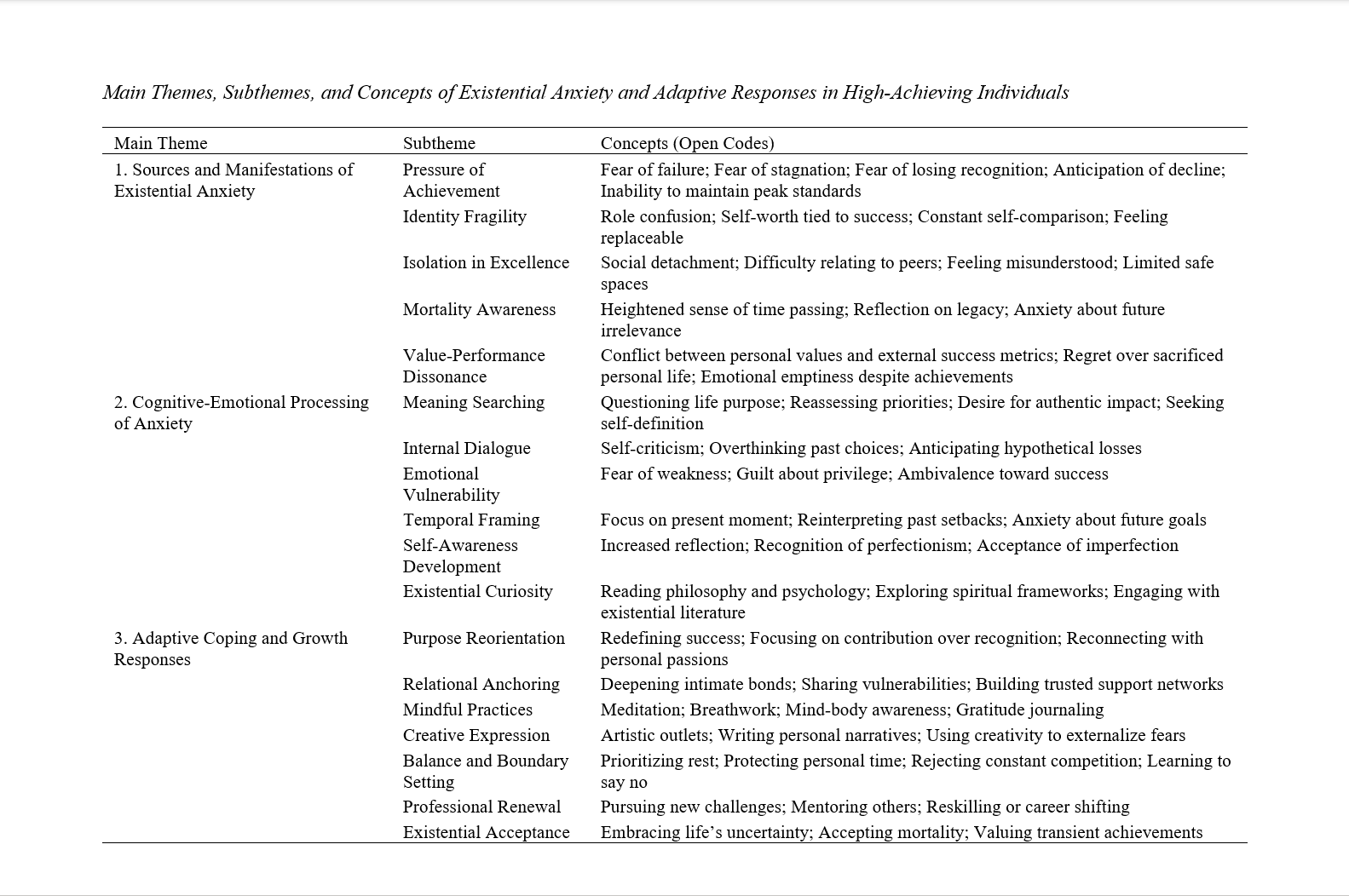
Findings: Analysis revealed three overarching themes: (1) sources and manifestations of existential anxiety, including pressure to maintain achievement, identity fragility, isolation in excellence, mortality awareness, and value–performance dissonance; (2) cognitive–emotional processing, characterized by internal dialogue, meaning searching, existential curiosity, and development of self-awareness; and (3) adaptive coping and growth responses, such as purpose reorientation, relational anchoring, mindfulness, creative expression, boundary setting, professional renewal, and existential acceptance. Participants often described an initial phase of perfectionistic rumination and isolation followed by deliberate meaning reconstruction and connection-seeking, transforming anxiety into growth.
Conclusion: Existential anxiety in high-achieving individuals emerges at the intersection of success-driven identity and existential awareness but can become a powerful driver for personal transformation when supported by reflection, relationships, spirituality, and curiosity. These findings deepen theoretical understanding and inform culturally sensitive, meaning-centered interventions for high performers.
Downloads
References
Amani, C. (2024). The Impact of Existentialism on Contemporary Mental Health Practices. International Journal of Philosophy, 3(3), 14-27. https://doi.org/10.47941/ijp.2088
Bakanova, A. A. (2024). Anxiety During the Pandemic: Existential Grounds and Ways of Coping. Vestnik Universiteta(6), 199-211. https://doi.org/10.26425/1816-4277-2024-6-199-211
Balolong, A. L., Apaya, D. A., Casabella, A. J. S., Tibar, R. M. A., Vecina, A. C., & Paster, A. B. (2025). The Lived Experience of Irregular Students With High Levels of Existential Anxiety and Self-Efficacy. International Journal of Multidisciplinary Research and Growth Evaluation, 6(3), 1416-1422. https://doi.org/10.54660/.ijmrge.2025.6.3.1416-1422
Betrò, S. (2024). From Eco-Anxiety to Eco-Hope: Surviving the Climate Change Threat. Frontiers in Psychiatry, 15. https://doi.org/10.3389/fpsyt.2024.1429571
DurakÇAy, F. A., & Ovali, A. Ş. (2025). West as a Source of Ontological Insecurity: Tracing Continuity and Change in Anti-Western Discourse in Turkish Foreign Policy. Alternatives Global Local Political. https://doi.org/10.1177/03043754251325984
Firdaus, D., & Murtadho, A. (2025). Mental Strengthening in Humanistic Counseling Based on Hadith. International Journal of Research and Innovation in Social Science, IX(XVII), 506-516. https://doi.org/10.47772/ijriss.2025.917psy0046
Gawda, B., & Korniluk, A. (2024). The Protective Role of Curiosity Behaviors in Coping With Existential Vacuum. Behavioral Sciences, 14(5), 391. https://doi.org/10.3390/bs14050391
Gordon, R. M., Groth, T., Choi, E., Galley, J., Marcantuono, J., & Kulzer, R. (2023). An Existential–spiritual Model for Coping During and After COVID-19. Spirituality in Clinical Practice. https://doi.org/10.1037/scp0000357
Hasanah, M. (2025). Religion, Existential Anxiety, and the Search for Lifes Meaning: A Humanistic Psychology Approach in Religious Societies. Al-Ihath Jurnal Bimbingan Dan Konseling Islam, 5(2), 120-131. https://doi.org/10.53915/jbki.v5i2.635
Kanwal, F., Majeed, A., Younis, H., & Aslam, A. (2024). Existential Issues and Coping: A Qualitative Study of Breast Cancer Women. Qlantic Journal of Social Sciences and Humanities, 5(2), 46-57. https://doi.org/10.55737/qjssh.537119380
Lee, K. W., Yap, S. F., Ong, H. T., Pheh, K. S., & Lye, M. S. (2022). Anxiety and Coping Strategies During the COVID-19 Pandemic: A Cross-Sectional Study of Staff and Students From a Tertiary Education Center in Malaysia. Frontiers in Public Health, 10. https://doi.org/10.3389/fpubh.2022.936486
Ma, R. (2023). Background of Anxiety and Existential Angst: A Review of Literature. Appl. Psychol. Res., 1(1), 260. https://doi.org/10.59400/apr.v1i1.260
Mah, A., Syropoulos, S., & Markowitz, E. M. (2024). Caring About One’s Legacy Relates to Constructive Coping With Climate Change. https://doi.org/10.31234/osf.io/yz4u2
Mokhov, V. A., & Babushkina, S. L. (2022). The Role of Existential Experience in Processing Uncertainty. Rsuh/Rggu Bulletin Series Psychology Pedagogics Education(2), 26-46. https://doi.org/10.28995/2073-6398-2022-2-26-46
Monti, W., & Dinero, R. E. (2025). Existential Concerns, Meaning, and College Adjustment Among Undergraduate College Students. Psi Chi Journal of Psychological Research, 30(2), 193-202. https://doi.org/10.24839/2325-7342.jn30.2.193
Özmete, E., Serpen, A. S., Gök, F. A., Özdemir, E. A., Kalayci, E., & Duru, S. (2025). Group Work for Earthquake Survivors: A Randomized Controlled Trial Transforming Crisis Into Hope. Research on Social Work Practice, 35(4), 432-442. https://doi.org/10.1177/10497315251325253
Pavlidis, D. (2025). Living in Limbo: Existential Concerns Among Greek Young Adults. Youth, 5(3), 94. https://doi.org/10.3390/youth5030094
Pourdehghan, M., Akbari, H., & Shariatnia, K. (2024). Investigating the Mediating Role of Personality Functions in the Relationship Between Early Maladaptive Schemas and Existential Anxiety in Individuals With Depression and Anxiety. Jayps, 5(3), 100-109. https://doi.org/10.61838/kman.jayps.5.3.11
Robinson, O., Evans, J., McAlpine, R., Argyri, E. K., & Luke, D. (2025). An Investigation Into the Varieties of Extended Difficulties Following Psychedelic Drug Use: Duration, Severity and Helpful Coping Strategies. Journal of Psychedelic Studies, 9(2), 117-125. https://doi.org/10.1556/2054.2024.00420
Smirnov, E., & Makarova, M. V. (2025). Existential Concerns Arising From a Threat to the Belief in a Just World: A Mixed-Methods Study. Journal of Humanistic Psychology. https://doi.org/10.1177/00221678251322250
Williamson, E., Piedmont, R. L., Fox, J., Rowe, M. M., & Robinson, D. (2024). Spiritual Coping Within Medical Professions: A Psychometric Analysis of the Numinous Motivations Inventory Short Form. Journal of Advanced Nursing, 80(11), 4537-4549. https://doi.org/10.1111/jan.16148
Петренко, О., Баліка, Л. М., & Koval, K. (2024). The Problem of Loneliness and Coping With Stress in the Context of Life Situations Experienced by War Refugees (Based on the Research Conducted in Rivne, Ukraine). 1(50), 69-96. https://doi.org/10.5604/01.3001.0054.7526
Downloads
Additional Files
Publication Timeline
- Submitted
- Revised
- Accepted