Self-Criticism and Emotional Numbness: The Mediating Role of Self-Alienation
DOI:
https://doi.org/10.61838/kman.jarac.7.2.21Keywords:
Self-criticism, Emotional numbness, Self-alienationAbstract
Objective: This study aimed to investigate whether self-alienation mediates the relationship between self-criticism and emotional numbness among adults.
Methods and Materials: A descriptive correlational design was employed with a sample of 415 adults from Mexico, selected based on the Krejcie and Morgan sample size table. Participants completed standardized self-report measures assessing self-criticism, self-alienation, and emotional numbness. Data were analyzed using SPSS-27 for descriptive and inferential statistics, including Pearson correlation, and AMOS-21 for Structural Equation Modeling (SEM). Assumptions of normality, linearity, and multicollinearity were tested and confirmed prior to analysis.
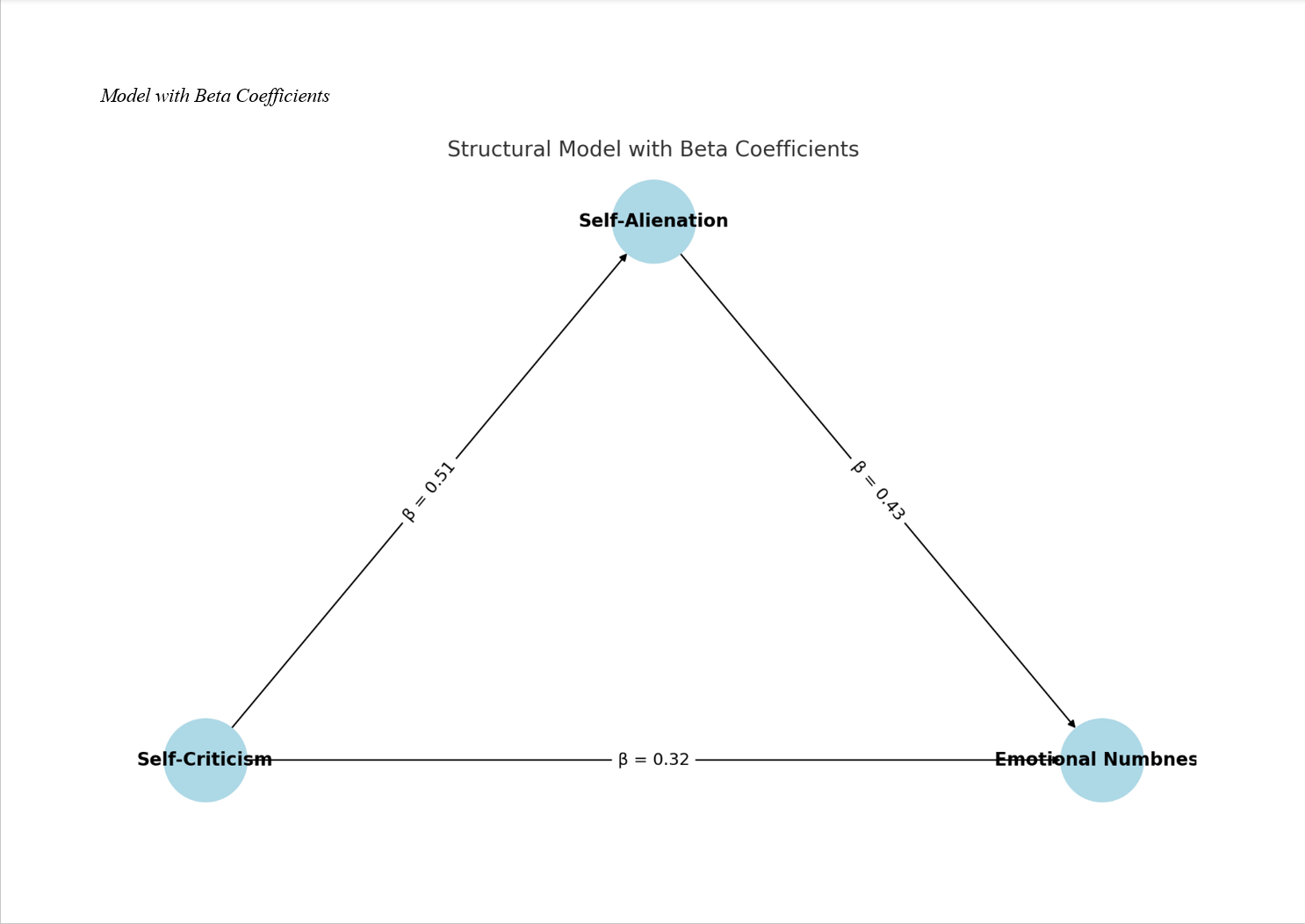
Findings: Pearson correlation results indicated significant positive associations between self-criticism and emotional numbness (r = .47, p < .001), self-criticism and self-alienation (r = .58, p < .001), and self-alienation and emotional numbness (r = .61, p < .001). The SEM analysis demonstrated acceptable model fit indices (χ²/df = 2.35, GFI = 0.95, CFI = 0.96, RMSEA = 0.057). Direct effects were significant for self-criticism on emotional numbness (β = .32, p < .001), self-criticism on self-alienation (β = .51, p < .001), and self-alienation on emotional numbness (β = .43, p < .001). The indirect effect of self-criticism on emotional numbness via self-alienation was also significant (β = .22, p < .001), confirming the partial mediating role of self-alienation.
Conclusion: The findings underscore the critical role of self-alienation as a mediating mechanism between self-criticism and emotional numbness. These results highlight the importance of addressing internal disconnection in interventions aimed at reducing affective disengagement in self-critical individuals. Targeting both self-criticism and self-alienation may enhance emotional re-engagement and psychological well-being.
Downloads
References
Bhalla, A., Bamer, A. M., Temes, C. M., Roaten, K., Carrougher, G. J., Schneider, J. C., Stoddard, F. J., Stewart, B. T., Gibran, N. S., & Wiechman, S. A. (2022). Posttraumatic Stress Disorder Symptom Clusters as Predictors of Pain Interference in Burn Survivors: A Burn Model System National Database Study. Journal of Burn Care & Research, 44(1), 27-34. https://doi.org/10.1093/jbcr/irac088
Carlson, J. M., Rubin, D., & Mujica‐Parodi, L. R. (2017). Lost Emotion: Disrupted Brain-Based Tracking of Dynamic Affective Episodes in Anxiety and Depression. Psychiatry Research Neuroimaging, 260, 37-48. https://doi.org/10.1016/j.pscychresns.2016.12.002
Carper, T. L. M., Mills, M. A., Steenkamp, M. M., Nickerson, A., Salters‐Pedneault, K., & Litz, B. T. (2015). Early PTSD Symptom Sub-Clusters Predicting Chronic Posttraumatic Stress Following Sexual Assault. Psychological Trauma Theory Research Practice and Policy, 7(5), 442-447. https://doi.org/10.1037/tra0000060
Doron‐LaMarca, S., Niles, B. L., King, D. W., King, L. A., Kaiser, A. P., & Lyons, M. J. (2015). Temporal Associations Among Chronic PTSD Symptoms in U.S. Combat Veterans. Journal of Traumatic Stress, 28(5), 410-417. https://doi.org/10.1002/jts.22039
Engel‐Rebitzer, E., Bovin, M. J., Black, S. K., Rosen, R. C., Keane, T. M., & Marx, B. P. (2016). A Longitudinal Examination of Peritraumatic Emotional Responses and Their Association With Posttraumatic Stress Disorder and Major Depressive Disorder Among Veterans. Journal of Trauma & Dissociation, 18(5), 679-692. https://doi.org/10.1080/15299732.2016.1267683
Ferrante, G., Rossini, P. G., Rousset, S., Ostacoli, L., Piccinelli, C., Carletto, S., & Giordano, L. (2022). The Emotional Side of Post-Traumatic Stress Reaction During COVID-19 Pandemic: An Italian Survey. BMC public health, 22(1). https://doi.org/10.1186/s12889-022-12749-1
Ferrarello, S. (2021). Emotional Numbness. 49-69. https://doi.org/10.4324/9781003131380-3-3
Fujiwara, T., Mizuki, R., Miki, T., & Chemtob, C. M. (2015). Association Between Facial Expression and PTSD Symptoms Among Young Children Exposed to the Great East Japan Earthquake: A Pilot Study. Frontiers in psychology, 6. https://doi.org/10.3389/fpsyg.2015.01534
Gallegos, J., & Gasper, K. (2018). Differential Effects of Rejection and Acceptance on Feeling Shocked, Numb, and Neutral. Emotion, 18(4), 536-550. https://doi.org/10.1037/emo0000366
Greenberg, L. S. (2021). Emotion Regulation. 279-307. https://doi.org/10.1037/0000248-012
GÜRler, D., & Büyükceran, İ. (2022). Is the Numbness After Knee Replacement a More Critical Complication Than Thought? A Detailed Analysis of Neuropathic Pain and Functional Outcomes. Medicina, 58(10), 1369. https://doi.org/10.3390/medicina58101369
Hyland, P., Shevlin, M., Hansen, M., Vallières, F., Murphy, J., & Elklit, A. (2016). The Temporal Relations of PTSD Symptoms Among Treatment-Seeking Victims of Sexual Assault: A Longitudinal Study. Journal of Loss and Trauma, 21(6), 492-506. https://doi.org/10.1080/15325024.2015.1117933
Kalogeropoulos, D., & Papadopoulos, E. (2024). Cognitive Avoidance as a Mediator Between Trauma Exposure and Emotional Numbing. Jayps, 5(10), 139-147. https://doi.org/10.61838/kman.jayps.5.10.17
Kerig, P. K., Bennett, D. C., Chaplo, S. D., Modrowski, C. A., & McGee, A. B. (2016). Numbing of Positive, Negative, and General Emotions: Associations With Trauma Exposure, Posttraumatic Stress, and Depressive Symptoms Among Justice‐Involved Youth. Journal of Traumatic Stress, 29(2), 111-119. https://doi.org/10.1002/jts.22087
Kocayörük, E., & Şimşek, Ö. F. (2015). Parental Attachment and Adolescents' Perception of School Alienation: The Mediation Role of Self-Esteem and Adjustment. The Journal of psychology, 150(4), 405-421. https://doi.org/10.1080/00223980.2015.1060185
Korem, N., Duek, O., Spiller, T. R., Ben‐Zion, Z., Levy, I., & Harpaz‐Rotem, I. (2023). High-Threshold-Low-Tolerance: A Model for the Emotionality Paradox in PTSD. https://doi.org/10.31234/osf.io/uev6n
Levi‐Belz, Y., Zerach, G., & Solomon, Z. (2015). Suicide Ideation and Deliberate Self-Harm Among Ex-Prisoners of War. Archives of Suicide Research, 19(2), 231-248. https://doi.org/10.1080/13811118.2013.845123
Li, G., Hampel, A., Li, C., & Hall, B. J. (2023). Emotional Numbing: A Key Construct in the Assessment of Mental Health During COVID-19 Pandemic. Journal of Pacific Rim Psychology, 17. https://doi.org/10.1177/18344909231217649
McGuire, A. P., Rodenbaugh, M., Howard, B. A. N., & Contractor, A. A. (2025). Response Styles to Positive Affect During a Positive Psychology Intervention for Veterans With PTSD and Moral Injury: Preliminary Results From a Moral Elevation Intervention Pilot Trial. Psychological Trauma Theory Research Practice and Policy, 17(2), 457-465. https://doi.org/10.1037/tra0001774
Millard, C. (2015). Introduction: Self-Harm From Social Setting to Neurobiology. 1-39. https://doi.org/10.1007/978-1-137-52962-6_1
Panjwani, A. A., O’Toole, M. S., Applebaum, A. J., Fresco, D. M., & Mennin, D. S. (2019). Emotion Regulation Therapy for Cancer Caregivers. 219-236. https://doi.org/10.1093/med/9780190868567.003.0013
Presseau, C., Contractor, A. A., Reddy, M. K., & Shea, M. T. (2018). Childhood Maltreatment and Post-Deployment Psychological Distress: The Indirect Role of Emotional Numbing. Psychological Trauma Theory Research Practice and Policy, 10(4), 411-418. https://doi.org/10.1037/tra0000329
Schuman, D. L., Bricout, J. C., Peterson, H., & Barnhart, S. (2018). A Systematic Review of the Psychosocial Impact of Emotional Numbing in US Combat Veterans. Journal of Clinical Psychology, 75(4), 644-663. https://doi.org/10.1002/jclp.22732
Stappenbeck, C. A., George, W. H., Staples, J. M., Nguyen, H. V., Davis, K. C., Kaysen, D., Heiman, J. R., Masters, N. T., Norris, J., Danube, C. L., Gilmore, A. K., & Kajumulo, K. F. (2016). In-the-Moment Dissociation, Emotional Numbing, and Sexual Risk: The Influence of Sexual Trauma History, Trauma Symptoms, and Alcohol Intoxication. Psychology of violence, 6(4), 586-595. https://doi.org/10.1037/a0039978
Downloads
Additional Files
Publication Timeline
- Submitted
- Revised
- Accepted
Issue
Section
License

This work is licensed under a Creative Commons Attribution-NonCommercial 4.0 International License.