Cultural Dissonance and Identity Confusion: The Mediating Role of Bicultural Integration
DOI:
https://doi.org/10.61838/kman.jarac.7.2.16Keywords:
Cultural Dissonance, Identity Confusion, Bicultural Identity IntegrationAbstract
Objective: This study aimed to investigate the mediating role of bicultural identity integration in the relationship between cultural dissonance and identity confusion among bicultural individuals residing in Iraq.
Methods and Materials: A descriptive correlational design was employed using a sample of 439 bicultural adults selected based on Morgan and Krejcie’s sample size table. Participants completed standardized self-report instruments measuring cultural dissonance, bicultural identity integration (BII), and identity confusion. Data were analyzed using SPSS-27 for descriptive statistics and Pearson correlation coefficients, and AMOS-21 for structural equation modeling (SEM). The normality, linearity, multicollinearity, and homoscedasticity assumptions were checked and met. The SEM model included direct, indirect, and total paths, and model fit was evaluated using Chi-square, RMSEA, GFI, AGFI, CFI, and TLI indices.
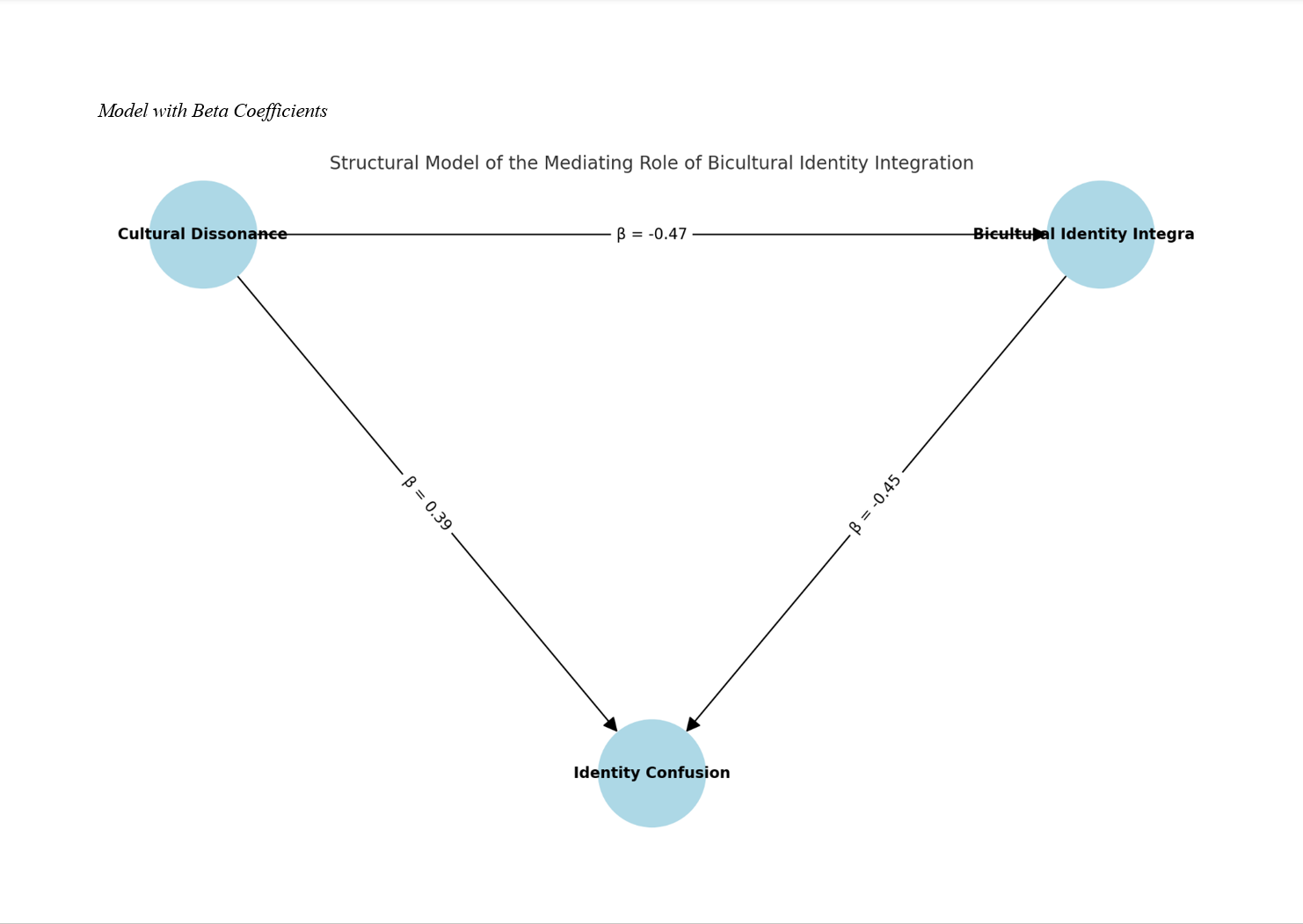
Findings: Cultural dissonance showed a significant positive correlation with identity confusion (r = .52, p < .001), while BII was negatively correlated with both cultural dissonance (r = –.48, p < .001) and identity confusion (r = –.55, p < .001). The structural model demonstrated excellent fit (χ²/df = 1.99, RMSEA = .048, CFI = .96, TLI = .95). Direct paths revealed that cultural dissonance significantly predicted identity confusion (β = .39, p < .001) and negatively predicted BII (β = –.47, p < .001); BII significantly reduced identity confusion (β = –.45, p < .001). The indirect effect of cultural dissonance on identity confusion through BII was significant (β = –.21, p < .001), confirming partial mediation.
Conclusion: The results highlight that bicultural identity integration serves as a critical psychological mechanism that buffers the negative impact of cultural dissonance on identity development. Enhancing BII may therefore serve as a valuable strategy in reducing identity confusion among bicultural individuals, particularly in socioculturally complex environments.
Downloads
References
Chen, W., Lin, Y., Yu, X., Zheng, W., Wu, S., Huang, M., Chen, W., & Zhou, S. (2022). The Relationship Between Bicultural Identity Integration, Self-Esteem, Academic Resilience, Interaction Anxiousness, and School Belonging Among University Students With Vocational Qualifications. International journal of environmental research and public health, 19(6), 3632. https://doi.org/10.3390/ijerph19063632
Deverick, K., & Mooney, H. (2023). Āpiti Hono, Tātai Hono: a Collaborative Bicultural Social Work Research Approach. Aotearoa New Zealand Social Work, 35(1), 21-33. https://doi.org/10.11157/anzswj-vol35iss1id964
Grossu, S. (2024). Identity Discourse - Support for Overcoming Identity Confusion. Studia MSU. St. Econ. Com.(11(3)), 118-130. https://doi.org/10.59295/sum11(3)2024_20
Houghton-Katipa, J. (2024). He Awa Whiria: Braiding Social and Emotional Learning With Bicultural and Intentional Teaching. Teachers Work, 21(2), 175-196. https://doi.org/10.24135/teacherswork.v21i2.629
Hu, X., Zuo, H., Lai, C., Zhu, G., Guo, J., & Tan, H. (2023). Is Social Media Use for Math Learning Beneficial for Ethnic Minority Students' Math Identity? A Socialization Perspective. British Journal of Educational Technology, 55(1), 363-378. https://doi.org/10.1111/bjet.13359
Lin, M., & Ramírez‐Esparza, N. (2024). Checking Multiple Boxes: Themes Associated With Bicultural Identities. Journal of Cross-Cultural Psychology, 55(5), 466-489. https://doi.org/10.1177/00220221241249999
Mok, A. (2022). Feeling at Home in Two Cultural Worlds: Bicultural Identity Integration Moderates Felt Authenticity. Journal of Cross-Cultural Psychology, 53(2), 179-212. https://doi.org/10.1177/00220221211072798
Petkanopoulou, K., Wildschut, T., & Sedikides, C. (2021). Nostalgia and Biculturalism: How Host-Culture Nostalgia Fosters Bicultural Identity Integration. Journal of Cross-Cultural Psychology, 52(2), 184-191. https://doi.org/10.1177/0022022120988345
Potiki, M., O’Brien, R., Macmillan, A., Roy, G. G., Stephenson, J. S., & Thompson‐Fawcett, M. (2024). Whakato Te Pu Harakeke - Embedding Bicultural Principles Into a Design Process. Mai Journal a New Zealand Journal of Indigenous Scholarship, 13(1), 89-102. https://doi.org/10.20507/maijournal.2024.13.1.8
Purpuri, S., Treccani, B., Filippi, R., & Mulatti, C. (2024). Bicultural Bilinguals: Juggling Languages, Shifting ‘Personalities’, Destroying Barriers. International Journal of Bilingualism. https://doi.org/10.1177/13670069241292496
Rodas, M. A., John, D. R., & Torelli, C. J. (2021). Building Brands for the Emerging Bicultural Market: The Appeal of Paradox Brands. Journal of Consumer Research, 48(4), 633-650. https://doi.org/10.1093/jcr/ucab037
Shein, B., & Zhou, X. (2023). Understanding the Relations Between Family Cultural Socialization and Bicultural Identity Integration in Burmese College Students of Refugee Background. Asian American Journal of Psychology, 14(4), 383-390. https://doi.org/10.1037/aap0000316
Soliman, J. (2022). Improving Bicultural Identity Integration in Bicultural and Biracial Individuals. https://doi.org/10.17605/osf.io/azjpg
Stogianni, M., Bender, M., Sleegers, W. W. A., Benet-Martinez, V., & Nguyen, A. M. D. (2021). Sample Characteristics and Country Level Indicators Influencing the Relationship Between Biculturalism and Adjustment: An Updated Meta-Analysis. https://doi.org/10.31234/osf.io/8qymv
Tan, E., Cheng, C.-Y., Leung, A. K., & Wee, S. X. R. (2024). To Whom Thou Art Bound: Bicultural Identity Integration Moderates the Influence of Conspiracy Beliefs on Chinese Americans’ Ingroup Bias. Journal of Cross-Cultural Psychology, 55(6), 600-618. https://doi.org/10.1177/00220221241263921
Trifiletti, E., Shamloo, S. E., Ferrari, L., Dusi, P., Huynh, Q. L., Rosnati, R., & Benet‐Martínez, V. (2022). Bicultural Identity in Childhood: Preliminary Validation of the Bicultural Identity Integration Scale for Children (BIIS-C). Cultural Diversity and Ethnic Minority Psychology, 28(1), 72-79. https://doi.org/10.1037/cdp0000504
Weisskopf, C., & Uhrich, S. (2024). Tackling International Markets: Bicultural Brand Positioning of Sport Leagues in Foreign Countries. Journal of Sport Management, 38(4), 271-286. https://doi.org/10.1123/jsm.2023-0245
Williams, N., Fletcher, J., & Ma, T. (2023). Advice From Māori Experts for Bicultural Early Childhood Education in Aotearoa New Zealand. New Zealand Journal of Educational Studies, 58(2), 271-290. https://doi.org/10.1007/s40841-023-00294-3
Xiao, Q. (2024). A Review on Integration of Bicultural Identity. Journal of Social Science and Humanities, 6(12), 46-50. https://doi.org/10.53469/jssh.2024.6(12).11
Zong, X., Cheah, C. S. L., & Ren, H. (2021). Chinese American Adolescents’ Experiences of COVID‐19‐Related Racial Discrimination and Anxiety: Person‐Centered and Intersectional Approaches. Journal of Research on Adolescence, 32(2), 451-469. https://doi.org/10.1111/jora.12696
Downloads
Additional Files
Publication Timeline
- Submitted
- Revised
- Accepted
Issue
Section
License

This work is licensed under a Creative Commons Attribution-NonCommercial 4.0 International License.