Rumination as a Mediator Between Peer Rejection and Depressive Symptoms in Teens
DOI:
https://doi.org/10.61838/kman.jarac.7.3.16Keywords:
Peer rejection, rumination, depressive symptoms, adolescenceAbstract
Objective: This study aimed to examine whether rumination mediates the relationship between peer rejection and depressive symptoms in adolescents.
Methods and Materials: A descriptive correlational design was employed with a sample of 380 adolescents aged 13 to 18 from secondary schools in London. The sample size was determined based on the Morgan and Krejcie sample size table to ensure statistical power. Standardized self-report instruments were used to assess peer rejection, rumination, and depressive symptoms. Data were analyzed using Pearson correlation coefficients in SPSS-27 and Structural Equation Modeling (SEM) in AMOS-21 to test the hypothesized mediation model. Model fit was assessed using χ²/df, CFI, GFI, AGFI, TLI, and RMSEA.
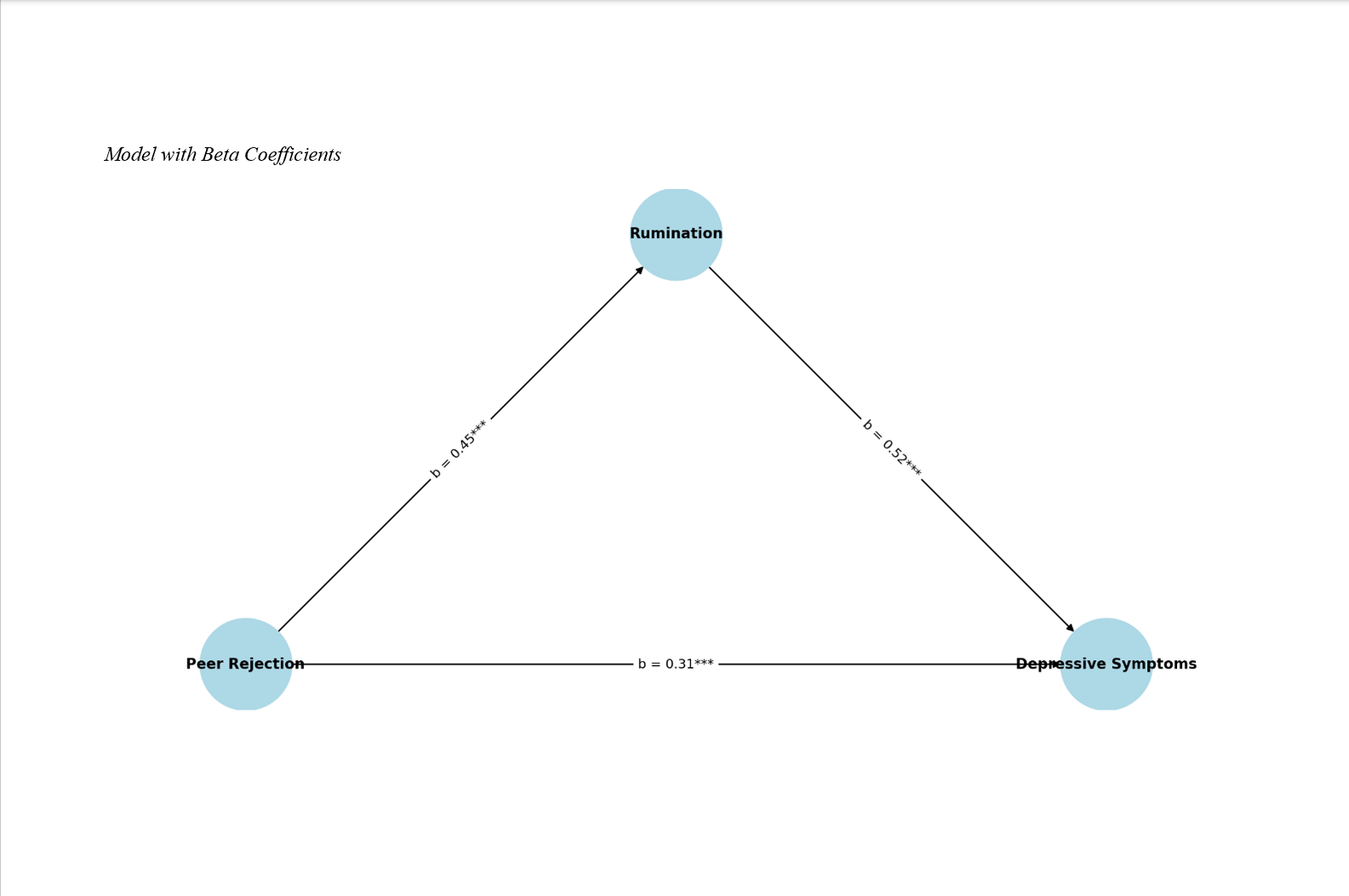
Findings: Descriptive statistics indicated moderate levels of depressive symptoms (M = 22.84, SD = 6.73), rumination (M = 30.42, SD = 5.26), and peer rejection (M = 18.67, SD = 4.89). Pearson correlation results revealed significant positive correlations between depressive symptoms and both rumination (r = .54, p < .001) and peer rejection (r = .46, p < .001). Rumination was also positively correlated with peer rejection (r = .39, p < .001). SEM showed good model fit (χ² = 104.23, df = 48, χ²/df = 2.17, CFI = .97, RMSEA = .056), and confirmed that rumination significantly mediated the relationship between peer rejection and depressive symptoms (indirect effect: b = 0.23, β = .17, p < .001). The total effect of peer rejection on depressive symptoms was b = 0.54, β = .45, p < .001.
Conclusion: The findings suggest that rumination plays a significant mediating role in the association between peer rejection and depressive symptoms in adolescents. Interventions aimed at reducing ruminative thought patterns may mitigate the impact of peer-related stressors on adolescent mental health.
Downloads
References
Alba, J., & Calvete, E. (2019). Bidirectional Relationships Between Stress, Depressive Symptoms, and Cognitive Vulnerabilities in Adolescents. Journal of Social and Clinical Psychology, 38(2), 87-112. https://doi.org/10.1521/jscp.2019.38.2.87
Caouette, J. D., & Guyer, A. E. (2016). Cognitive Distortions Mediate Depression and Affective Response to Social Acceptance and Rejection. Journal of affective disorders, 190, 792-799. https://doi.org/10.1016/j.jad.2015.11.015
Copeland, M. (2021). The Long Shadow of Peers: Adolescent Networks and Young Adult Mental Health. Social Sciences, 10(6), 231. https://doi.org/10.3390/socsci10060231
Criss, M. M., Houltberg, B. J., Cui, L., Bosler, C. D., Morris, A. S., & Silk, J. S. (2016). Direct and Indirect Links Between Peer Factors and Adolescent Adjustment Difficulties. Journal of Applied Developmental Psychology, 43, 83-90. https://doi.org/10.1016/j.appdev.2016.01.002
Dorio, N. B., Fredrick, S. S., & Demaray, M. K. (2018). School Engagement and the Role of Peer Victimization, Depressive Symptoms, and Rumination. The Journal of Early Adolescence, 39(7), 962-992. https://doi.org/10.1177/0272431618797007
Evans, S. C., & Fite, P. J. (2018). Dual Pathways From Reactive Aggression to Depressive Symptoms in Children: Further Examination of the Failure Model. Journal of abnormal child psychology, 47(1), 85-97. https://doi.org/10.1007/s10802-018-0426-6
Fan, C., Chu, X., Mingzhong, W., & Zhou, Z. (2016). Interpersonal Stressors in the Schoolyard and Depressive Symptoms Among Chinese Adolescents: The Mediating Roles of Rumination and Co-Rumination. School Psychology International, 37(6), 664-679. https://doi.org/10.1177/0143034316678447
Faro, L. B. R., Silva, L. d. S., & Faro, A. (2025). Depressive Symptoms and Fear of COVID-19 in Brazilian Women During the COVID-19 Pandemic: Data From May 2022. Scientia Plena, 21(1). https://doi.org/10.14808/sci.plena.2025.017101
Fussner, L. M., Luebbe, A. M., Mancini, K., & Becker, S. P. (2016). Emotion Dysregulation Mediates the Longitudinal Relation Between Peer Rejection and Depression. International Journal of Behavioral Development, 42(2), 155-166. https://doi.org/10.1177/0165025416669062
Giovazolias, T. (2023). The Relationship of Rejection Sensitivity to Depressive Symptoms in Adolescence: The Indirect Effect of Perceived Social Acceptance by Peers. Behavioral Sciences, 14(1), 10. https://doi.org/10.3390/bs14010010
Harmon, S. L., Stephens, H. F., Repper, K. K., Driscoll, K. A., & Kistner, J. A. (2017). Children’s Rumination to Sadness and Anger: Implications for the Development of Depression and Aggression. Journal of Clinical Child & Adolescent Psychology, 48(4), 622-632. https://doi.org/10.1080/15374416.2017.1359788
Masuya, J., Kikkawa, M., Ono, M., Morishita, C., Ito, S., Nibuya, R., Tamada, Y., Takashio, O., Honyashiki, M., & Inoue, T. (2025). Effects of Parental Nurturing Attitudes, Peer Victimization, and Depressive Rumination on Anxiety in Japanese Adults. Psychiatry International, 6(1), 10. https://doi.org/10.3390/psychiatryint6010010
McGuire, T. C., McCormick, K. C., Koch, M. K., & Mendle, J. (2019). Pubertal Maturation and Trajectories of Depression During Early Adolescence. Frontiers in psychology, 10. https://doi.org/10.3389/fpsyg.2019.01362
Monti, J. D., Rudolph, K. D., & Miernicki, M. E. (2017). Rumination About Social Stress Mediates the Association Between Peer Victimization and Depressive Symptoms During Middle Childhood. Journal of Applied Developmental Psychology, 48, 25-32. https://doi.org/10.1016/j.appdev.2016.11.003
Noda, S., Masaki, M., Kishimoto, T., & Kaiya, H. (2022). Effect of Rejection Sensitivity on the Development of Anxious-Depressive Attack in Japanese Outpatients: The Mediating Roles of Rumination, Social Anxiety, and Depressive Symptoms. Frontiers in psychology, 13. https://doi.org/10.3389/fpsyg.2022.1016879
Perron-Gélinas, A., Brendgen, M., & Vitaro, F. (2017). Can Sports Mitigate the Effects of Depression and Aggression on Peer Rejection? Journal of Applied Developmental Psychology, 50, 26-35. https://doi.org/10.1016/j.appdev.2017.03.006
Polat, K. (2025). Relationships Between Health Anxiety, Intolerance of Uncertainty, Rumination and Self-Compassion: A Structural Equation and Latent Profile Analysis. International Journal of Eurasia Social Sciences, 16(59), 290-313. https://doi.org/10.70736/ijoess.552
Rose, A. J., Glick, G. C., Smith, R. L., Schwartz‐Mette, R. A., & Borowski, S. K. (2016). Co-Rumination Exacerbates Stress Generation Among Adolescents With Depressive Symptoms. Journal of abnormal child psychology, 45(5), 985-995. https://doi.org/10.1007/s10802-016-0205-1
Spyropoulou, E., & Giovazolias, T. (2022). The Scarring Effects of Depression Symptoms on Sadness Rumination and Peer Victimization in Greek Early Adolescents: Evidence for an Integrated Symptoms-Driven Model. The Journal of Early Adolescence, 42(7), 845-884. https://doi.org/10.1177/02724316221078827
Stone, L. B., & Gibb, B. E. (2017). Brief Report: Preliminary Evidence That Co-Rumination Fosters Adolescents’ Depression Risk by Increasing Rumination. https://doi.org/10.31234/osf.io/yqgxk
Stone, L. B., Silk, J. S., Siegle, G. J., Dahl, R., & Jones, N. D. (2017). Depressed Adolescents' Pupillary Response to Peer Acceptance and Rejection: The Role of Rumination. https://doi.org/10.31234/osf.io/jfgvq
Tajabadi, Z., Dehghani, F., & Saehzadeh, M. (2020). The Role of Time Perspective and Peer Rejection in Predicting High-Risk Behaviors of Adolescents of Yazd City. Ranian Journal of Health Education and Health Promotion, 8(2), 129-141. https://doi.org/10.29252/ijhehp.8.2.129
Wang, Y. (2025). Exploring the Relations Between Body Dissatisfaction, Rumination, Physical Activity, and Restrained Eating: A Latent Moderated Structural Equation Approach. Journal of eating disorders, 13(1). https://doi.org/10.1186/s40337-025-01229-7
Wang, Z. J., Liu, C. Y., Wang, Y. M., & Wang, Y. (2024). Childhood psychological maltreatment and adolescent depressive symptoms: Exploring the role of social anxiety and maladaptive emotion regulation strategies. Journal of affective disorders, 344, 365-372. https://doi.org/10.1016/j.jad.2023.10.046
Wright, M. F., & Wachs, S. (2019). Does Peer Rejection Moderate the Associations Among Cyberbullying Victimization, Depression, and Anxiety Among Adolescents With Autism Spectrum Disorder? Children, 6(3), 41. https://doi.org/10.3390/children6030041
Zhao, S. (2025). Relationship Between Purposeful Rumination and Post-Traumatic Growth of College Students Who Experienced Childhood Trauma: A Regulated Intermediary Model. https://doi.org/10.20944/preprints202501.1481.v1
Zheng, H., Cai, Y., Liu, L., & Peng, B. (2024). The Effect of Childhood Sexual Abuse on Depressive Symptoms in Female College Students: A Serial Mediation Model. Frontiers in psychology, 15. https://doi.org/10.3389/fpsyg.2024.1306122
Downloads
Additional Files
Publication Timeline
- Submitted
- Revised
- Accepted
Issue
Section
License

This work is licensed under a Creative Commons Attribution-NonCommercial 4.0 International License.