Distress Tolerance and Rejection Sensitivity as Predictors of Borderline Traits
DOI:
https://doi.org/10.61838/kman.jarac.7.3.13Keywords:
Borderline personality traits, distress tolerance, rejection sensitivityAbstract
Objective: This study aimed to examine the predictive roles of distress tolerance and rejection sensitivity in borderline personality traits among Japanese adults.
Methods and Materials: A correlational descriptive design was used to explore the relationships between psychological predictors and borderline traits. The sample consisted of 500 adults from Japan, selected based on the Morgan and Krejcie sample size table. Participants completed the Borderline Features Scale of the Personality Assessment Inventory (PAI-BOR), the Distress Tolerance Scale (DTS), and the Adult Rejection Sensitivity Questionnaire (A-RSQ). Data analysis was conducted using SPSS-27. Descriptive statistics were first calculated, followed by Pearson correlation coefficients to examine bivariate relationships. A multiple linear regression analysis was then performed to assess the combined and independent predictive effects of distress tolerance and rejection sensitivity on borderline traits.
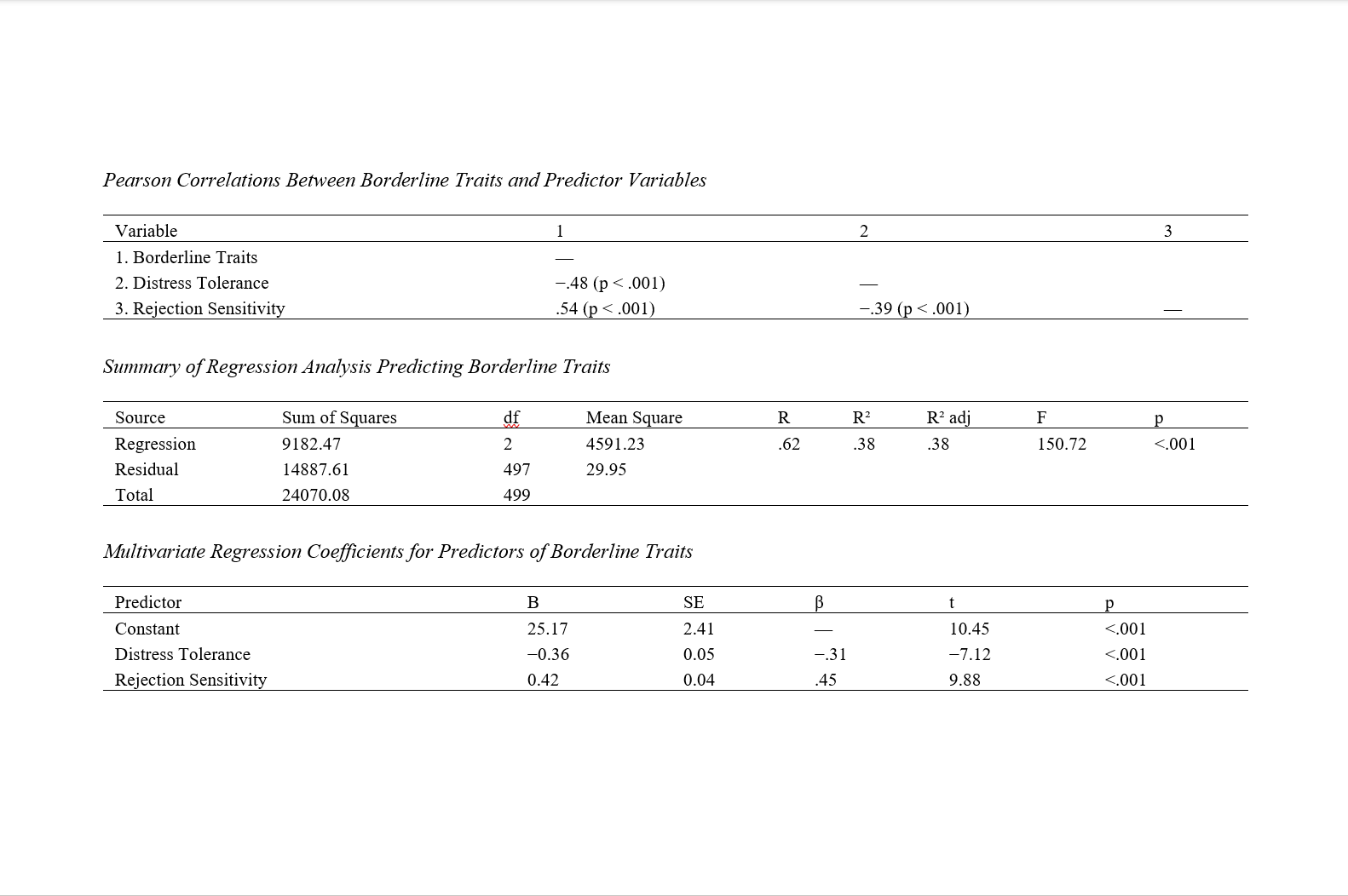
Findings: Pearson correlation results revealed that borderline traits were significantly negatively correlated with distress tolerance (r = −.48, p < .001) and positively correlated with rejection sensitivity (r = .54, p < .001). The regression model was statistically significant, F(2, 497) = 150.72, p < .001, with an R² value of .38, indicating that 38% of the variance in borderline traits was explained by the two predictors. Both distress tolerance (β = −.31, p < .001) and rejection sensitivity (β = .45, p < .001) independently and significantly contributed to the prediction of borderline traits.
Conclusion: These results highlight the importance of incorporating assessments and interventions targeting emotional regulation and interpersonal sensitivity in efforts to prevent or reduce borderline symptomatology, particularly within culturally specific contexts such as Japan.
Downloads
References
Amini, M., Pourshahbaz, A., Mohammadkhani, P., Ardakani, M. R. K., & Lotfi, M. (2015). The DSM-5 Levels of Personality Functioning and Severity of Iranian Patients With Antisocial and Borderline Personality Disorders. Iranian Red Crescent Medical Journal, 17(8). https://doi.org/10.5812/ircmj.17(5)2015.19885
Asad, V. (2025). Rejection Sensitivity, Urgency, and Interpersonal Difficulties in Young Adults. Pakistan Journal of Humanities and Social Sciences, 13(1), 46-55. https://doi.org/10.52131/pjhss.2025.v13i1.2590
Baranskaya, L. (2024). Borderline Personality Disorder in Adolescents as a Predictor of Social Anxiety. European Psychiatry, 67(S1), S468-S469. https://doi.org/10.1192/j.eurpsy.2024.971
Brahim, S., Aoun, M., Charaa, O., Henia, M., Abid, A., & Zarrouk, L. (2021). Factors for Suicide Attempt Recurrence Among Patients With Borderline Personality Disorder. European Psychiatry, 64(S1), S585-S585. https://doi.org/10.1192/j.eurpsy.2021.1561
Dadashzadeh, H., Hekmati, I., Gholizade, H., & Abdi, R. (2016). Schema Modes in Cluster B Personality Disorders. Archives of Psychiatry and Psychotherapy, 18(2), 22-28. https://doi.org/10.12740/app/63535
Farajİ, H. (2024). Dream Themes and Rejection Sensitivity of Individuals With and Without Borderline Personality Disorder: A Comparative Study. The European Research Journal, 10(1), 25-36. https://doi.org/10.18621/eurj.1357324
Feledyn, S., Demianowska, A., & Kucharska, K. (2024). Mediation Models of the Interaction Between Internet Gaming Disorder and Psychological Pain and Symptoms of Anxiety, Depression, and Borderline Personality Disorder. Kwartalnik Naukowy Fides et Ratio, 59(3), 101-109. https://doi.org/10.34766/fer.v59i3.1295
Fumagalli, G., & Margola, D. (2021). Is Personality the Key in Cognitive‐behavioural Therapy for Eating Disorders? A Review. Clinical Psychology & Psychotherapy, 29(1), 164-177. https://doi.org/10.1002/cpp.2627
Henriques‐Calado, J., Duarte‐Silva, M. E., Campos, R. C., Junqueira, D., Sacoto, C., & Keong, A. M. (2014). Personality Disorders as an Expression of the Dimensional Polarity in Personality Development in Late Adulthood Women. Bulletin of the Menninger clinic, 78(4), 283-300. https://doi.org/10.1521/bumc.2014.78.4.283
Henriques‐Calado, J., Pires, R., Paulino, M., Marques, J. G., & Gonçalves, B. (2023). Psychotic Spectrum Features in Borderline and Bipolar Disorders Within the Scope of the DSM-5 Section III Personality Traits: A Case Control Study. Borderline personality disorder and emotion dysregulation, 10(1). https://doi.org/10.1186/s40479-022-00205-w
Juul, S., Lunn, S., Poulsen, S., Sørensen, P. S., Salimi, M. L., Jakobsen, J. C., Bateman, A., & Simonsen, S. (2019). Short-Term Versus Long-Term Mentalization-Based Therapy for Outpatients With Subthreshold or Diagnosed Borderline Personality Disorder: A Protocol for a Randomized Clinical Trial. Trials, 20(1). https://doi.org/10.1186/s13063-019-3306-7
Kawada, T. (2018). Predictors of Borderline Personality Disorder. Early Intervention in Psychiatry, 12(6), 1250-1250. https://doi.org/10.1111/eip.12736
Knapen, S., Mensink, W., Hoogendoorn, A. W., Swildens, W., Duits, P., Hutsebaut, J., & Beekman, A. T. (2025). Associations Between Childhood Trauma and Epistemic Trust, Attachment, Mentalizing, and Symptoms of Borderline Personality Disorder. Psychopathology, 1-22. https://doi.org/10.1159/000542919
Lis, E., & Myhr, G. (2016). The Effect of Borderline Personality Pathology on Outcome of Cognitive Behavior Therapy. Journal of Psychiatric Practice, 22(4), 270-282. https://doi.org/10.1097/pra.0000000000000167
Meaney, R., Hasking, P., & Reupert, A. (2016). Borderline Personality Disorder Symptoms in College Students: The Complex Interplay Between Alexithymia, Emotional Dysregulation and Rumination. PLoS One, 11(6), e0157294. https://doi.org/10.1371/journal.pone.0157294
Mishra, M., & Allen, M. S. (2025). Face, Construct and Criterion Validity, and Test-Retest Reliability, of the Adult Rejection Sensitivity Questionnaire. European Journal of Psychological Assessment, 41(2), 144-153. https://doi.org/10.1027/1015-5759/a000782
Mohamadi, M., & Jabalameli, s. (2024). The Effectiveness of Group Schema Therapy on Self-Criticism and Distress Tolerance in Women with Substance-Dependent Spouses. etiadpajohi, 17(70), 221-244. https://doi.org/10.61186/etiadpajohi.17.70.221
Pierro, R. D., Amelio, S., Macca, M., Madeddu, F., & Sarno, M. D. (2022). What if I Feel Rejected? Borderline Personality, Pathological Narcissism, and Social Rejection in Daily Life. Journal of personality disorders, 36(5), 559-582. https://doi.org/10.1521/pedi.2022.36.5.559
Pongpitpitak, N., Wongpakaran, N., Wongpakaran, T., & Nuansri, W. (2022). Buffering Effect of Perseverance and Meditation on Depression Among Medical Students Experiencing Negative Family Climate. Healthcare, 10(10), 1895. https://doi.org/10.3390/healthcare10101895
Pope, H. G., Bedics, J. D., & Hooper, E. (2022). The Association Between the Invalidating Environment Exposure, Rejection Sensitivity and Borderline Personality Traits. https://doi.org/10.31237/osf.io/uyxhq
Pucker, H. E., Temes, C. M., & Zanarini, M. C. (2019). Description and Prediction of Social Isolation in Borderline Patients Over 20 Years of Prospective Follow-Up. Personality Disorders Theory Research and Treatment, 10(4), 383-388. https://doi.org/10.1037/per0000337
Saidi, B., Narimani, M., & Hosseini, S. (2024). Effectiveness of Compassion-Focused Art Therapy on Distress Tolerance in Female Adolescents from Dysfunctional Families: A Quasi-Experimental Study. Journal of Medical Sciences, Rafsanjan University of Medical Sciences, 23(3), 91-104. https://doi.org/10.61186/jrums.23.3.91
Saldanha‐Silva, R., Nunes, F. L., Rezende, H. A. d., & Mansur‐Alves, M. (2019). Maladaptive Beliefs as Mediators of the Relationship Between Personality Traits and Borderline Personality Disorder Symptoms. Estudos De Psicologia (Campinas), 36. https://doi.org/10.1590/1982-0275201936e180016
Scalzo, F., Hulbert, C., Betts, J., Cotton, S., & Chanen, A. M. (2018). Predictors of Substance Use in Youth With Borderline Personality Disorder. Personality Disorders Theory Research and Treatment, 9(4), 390-396. https://doi.org/10.1037/per0000257
Schittek, A., Roskam, I., & Mikolajczak, M. (2023). Parental Burnout and Borderline Personality Stand Out to Predict Child Maltreatment. Scientific reports, 13(1). https://doi.org/10.1038/s41598-023-39310-3
Shi, C., Sun, P., Shi, J., & Hao-sheng, Y. E. (2024). The Effect of Cyber-Ostracism on Social Anxiety Among Undergraduates: The Mediating Effects of Rejection Sensitivity and Rumination. https://doi.org/10.20944/preprints202410.0803.v1
Vakili, J., Kimiaee, S.A., & Salehi-Fadardi, J. (2016). The Effectiveness of Dialectical Behavior Therapy on Borderline Personality Disorder Symptoms of prisoners. Journal of Clinical Psychology, 8(3), 97-106. https://doi.org/10.22075/jcp.2017.2248
Walton, C. C., Lewis, K. J., Kirby, J. N., Purcell, R., Rice, S., & Osborne, M. S. (2024). Self-Compassionate Motivation and Athlete Well-Being: The Critical Role of Distress Tolerance. Journal of Clinical Sport Psychology, 18(1), 131-149. https://doi.org/10.1123/jcsp.2022-0009
Woo, J., Shahid, H., Hillmer, A., Abdullah, A., Deshpande, S., Panesar, B., Sanger, N., & Samaan, Z. (2020). Factors Affecting Participant Recruitment and Retention in Borderline Personality Disorder Research: A Feasibility Study. https://doi.org/10.21203/rs.3.rs-56682/v1
Zanarini, M. C., Frankenburg, F. R., Reich, D. B., Wedig, M. M., Conkey, L. C., & Fitzmaurice, G. M. (2014). Prediction of Time‐to‐attainment of Recovery for Borderline Patients Followed Prospectively for 16 years. Acta Psychiatrica Scandinavica, 130(3), 205-213. https://doi.org/10.1111/acps.12255
Zanarini, M. C., Temes, C. M., Frankenburg, F. R., Reich, D. B., & Fitzmaurice, G. M. (2018). Description and Prediction of Time-to-Attainment of Excellent Recovery for Borderline Patients Followed Prospectively for 20 Years. Psychiatry research, 262, 40-45. https://doi.org/10.1016/j.psychres.2018.01.034
Романов, Д. В., Nasonova, T. I., Исайкин, А. И., Filileeva, O. V., Sheyanov, A. M., Iuzbashian, P. G., Voronova, E. I., & Парфенов, В. А. (2023). Personality Disorders and Traits of ABC Clusters in Fibromyalgia in a Neurological Setting. Biomedicines, 11(12), 3162. https://doi.org/10.3390/biomedicines11123162
Downloads
Additional Files
Publication Timeline
- Submitted
- Revised
- Accepted
Issue
Section
License

This work is licensed under a Creative Commons Attribution-NonCommercial 4.0 International License.