Exploring the Intersection of Faith and Mental Health in Religious Clients
DOI:
https://doi.org/10.61838/kman.jarac.6.3.25Keywords:
Faith and mental health, religious coping, mental health stigma, faith-sensitive therapy, spiritual bypassing, clergy training, GreeceAbstract
Objective: This study aims to explore the intersection of faith and mental health among religious clients, focusing on how spiritual beliefs influence mental health experiences, coping strategies, and help-seeking behaviors.
Methods and Materials: A qualitative research design was employed, involving semi-structured interviews with 29 religious individuals from Greece. Participants were selected based on their self-identified religious affiliation and personal experiences with mental health. Data collection was conducted until theoretical saturation was reached, and NVivo software was used for data analysis. The study utilized thematic analysis to identify and interpret key themes related to the role of faith in mental health.
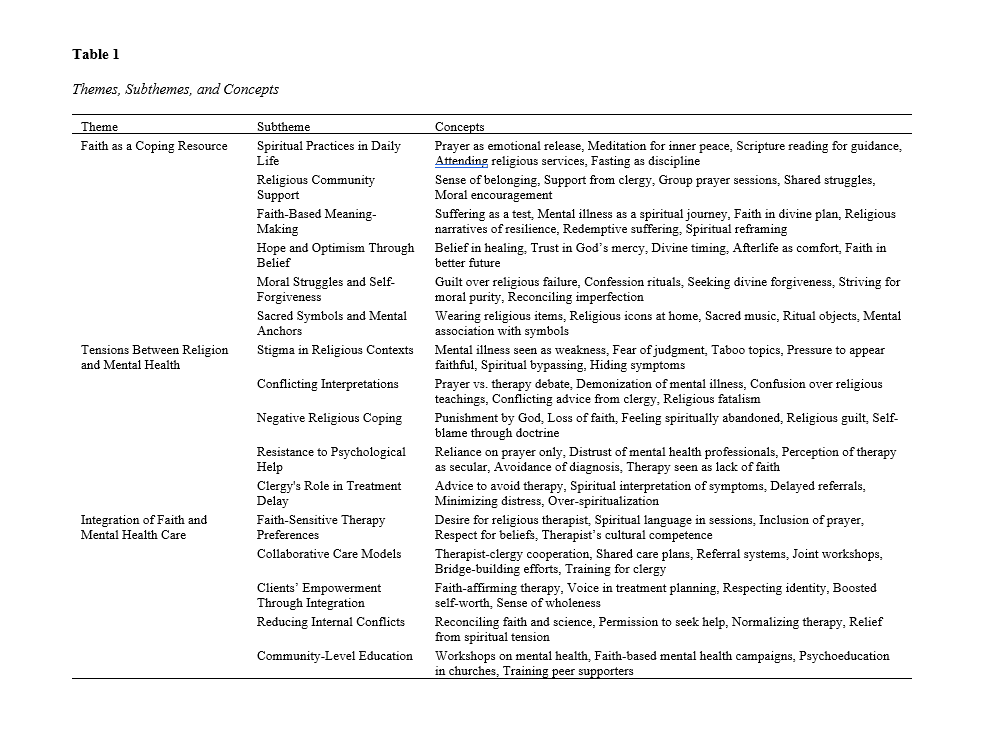
Findings: The findings revealed that faith played a dual role in participants’ mental health experiences. Religious beliefs were a significant source of strength and resilience, with practices such as prayer, scripture reading, and community support serving as coping mechanisms. However, participants also reported tensions between religious beliefs and mental health care, particularly regarding stigma, spiritual interpretations of mental illness, and reluctance to seek professional help. Many participants expressed a desire for faith-sensitive mental health care that respects their spiritual needs. The study also highlighted the need for clergy to receive training in mental health awareness to reduce stigma and promote help-seeking behaviors.
Conclusion: The study concludes that while faith can be a powerful resource for coping with mental health challenges, it can also create barriers to seeking professional care due to stigma and spiritual bypassing. Integrating faith-sensitive approaches in mental health care is essential for improving outcomes for religious clients, with recommendations for training clergy and enhancing faith-based mental health initiatives.
Downloads
References
Alemi, Q., Panter‐Brick, C., Oriya, S., Ahmady, M., Alimi, A. Q., Faiz, H., Hakim, N., Hashemi, S. A. S., Manaly, M. A., Naseri, R., Parwiz, K., Sadat, S. J., Sharifi, M. Z., Shinwari, Z., Ahmadi, S. J., Amin, R., Azimi, S., Hewad, A., Musavi, Z., . . . Ventevogel, P. (2023). Afghan Mental Health and Psychosocial Well-Being: Thematic Review of Four Decades of Research and Interventions. BJPsych Open, 9(4). https://doi.org/10.1192/bjo.2023.502
Badu, E., Mitchell, R., Gu, J., & O’Brien, A. (2023). Pathways to Mental Health Treatment: Biomedical Versus Faith- Healing. https://doi.org/10.21203/rs.3.rs-2800271/v1
Bowers, D., Colón, M., Morgan, C., & Wood, T. (2024). Impact of Dialectical Behavioral Therapy on Anxiety Levels Among African American Adolescents. Journal of Psychosocial Nursing and Mental Health Services, 62(8), 7-10. https://doi.org/10.3928/02793695-20240111-01
Bridi, L., Kaki, D. A., Albahsahli, B., Baker, D. A., Khan, X., Aljenabi, R., Bencheikh, N., Schiaffino, M. K., Moore, A., & Al‐Rousan, T. (2023). The Influences of Faith on Illness Representations and Coping Procedures of Mental and Cognitive Health Among Aging Arab Refugees: A Qualitative Study. Frontiers in Psychiatry, 14. https://doi.org/10.3389/fpsyt.2023.1083367
Chakawa, A. (2023). Bridging the Gap: A Pilot Study of a Lay Health Worker Model to Decrease Child Mental Health Stigma and Promote Parents’ Professional Help-Seeking for Black/African American Children. Psychological Services, 20(Suppl 1), 64-77. https://doi.org/10.1037/ser0000620
Churchman, A. (2023). Online Faith-Based CBT During the Covid-19 Pandemic. Waverley Abbey College Journal, 3(1). https://doi.org/10.52456/wacjo313
Codjoe, L., Barber, S., Ahuja, S., Thornicroft, G., Henderson, C., Lempp, H., & N’Danga-Koroma, J. (2021). Evidence for Interventions to Promote Mental Health and Reduce Stigma in Black Faith Communities: Systematic Review. Social Psychiatry and Psychiatric Epidemiology, 56(6), 895-911. https://doi.org/10.1007/s00127-021-02068-y
Codjoe, L., N’Danga-Koroma, J., Henderson, C., Lempp, H., & Thornicroft, G. (2023). Pilot Study of a Manualised Mental Health Awareness and Stigma Reduction Intervention for Black Faith Communities in the UK: ON TRAC Project. Social Psychiatry and Psychiatric Epidemiology, 58(11), 1687-1697. https://doi.org/10.1007/s00127-023-02492-2
Dixon, S., & Bell, J. (2022). Shedding Light on a Forbidden Topic: The Need for Mental Health Professionals to Accommodate the Faith-Based Practices of Immigrant Clients. 78-79. https://doi.org/10.52987/icsp.2022.009
Harris, S., Green, J. F., Tao, H., & Robinson, P. (2021). Examining Associations With Mental, Well-Being and Faith in Nurses (LIFT). Jona the Journal of Nursing Administration, 51(2), 106-113. https://doi.org/10.1097/nna.0000000000000978
Istratii, R., & Ali, P. (2023). A Scoping Review on the Role of Religion in the Experience of IPV and Faith-Based Responses in Community and Counseling Settings. Journal of Psychology and Theology, 51(2), 141-173. https://doi.org/10.1177/00916471221143440
Jacobi, C. J., Charles, J., Vaidyanathan, B., Frankham, E., & Haraburda, B. (2022). Stigma Toward Mental Illness and Substance Use Disorders in Faith Communities: The Roles of Familiarity and Causal Attributions. Stigma and Health, 7(2), 234-246. https://doi.org/10.1037/sah0000373
Mildaeni, I. N., & Huda, T. N. (2024). Faith and Mental Health: Islamic Psychology Perspective. International Journal of Multicultural and Multireligious Understanding, 11(2), 441. https://doi.org/10.18415/ijmmu.v11i2.5540
Nanji, N., & Olivier, J. (2024). Providing Mental Healthcare Through Faith-Based Entities in Africa: A Systematic Review. Christian Journal for Global Health, 11(1), 148-176. https://doi.org/10.15566/cjgh.v11i1.795
Ossai, O. V., & Eseadi, C. (2022). Supporting People With Depressive and Anxiety Disorders. International journal of health sciences, 6(S1), 797-808. https://doi.org/10.53730/ijhs.v6ns1.4832
Pahlewi, R. M. (2024). The Impact of Islamic Counseling on the Mental Health of Prisoners in Yogyakarta Correctional Institution. Journal of Social Sciences and Humanites, 20-28. https://doi.org/10.56943/jssh.v3i3.599
Rassool, G. H. (2021). Re-Examining the Anatomy of Islamic Psychotherapy and Counselling: Envisioned and Enacted Practices. Islamic Guidance and Counseling Journal, 4(2), 133-143. https://doi.org/10.25217/igcj.v4i2.1840
Rayes, D., Karnouk, C., Churbaji, D., Walther, L., & Bajbouj, M. (2021). Faith-Based Coping Among Arabic-Speaking Refugees Seeking Mental Health Services in Berlin, Germany: An Exploratory Qualitative Study. Frontiers in Psychiatry, 12. https://doi.org/10.3389/fpsyt.2021.595979
Rivera, K. J., Zhang, J. Y., Mohr, D. C., Wescott, A., & Pederson, A. B. (2021). A Narrative Review of Mental Illness Stigma Reduction Interventions Among African Americans in the United States. Journal of Mental Health and Clinical Psychology, 5(2), 20-31. https://doi.org/10.29245/2578-2959/2021/2.1235
Saad Alghamdi Sami Eid Abdullah Alkaff Waleed, A. (2022). Culturally Appropriate Interventions for Prevention and Treatment of Mental Health in Saudi Arabia. Journal of Namibian Studies History Politics Culture, 32, 1606-1618. https://doi.org/10.59670/11jha254
Saha, S., Chauhan, A., Hamlai, M., Saiyad, V., Makwana, S., Shah, K., & Pandya, A. (2021). Unique Collaboration of Modern Medicine and Traditional Faith-Healing for the Treatment of Mental Illness. Journal of Family Medicine and Primary Care, 10(1), 521-526. https://doi.org/10.4103/jfmpc.jfmpc_979_19
Singh, S. P., Jilka, S., Abdulmalik, J., Bouliotis, G., Chadda, R. K., Egbokhare, O., Huque, R., Hundt, G. L., Iyer, S. N., Jegede, O., Khera, N., Lilford, R., Madan, J., Omigbodun, A., Omigbodun, O., Raja, T., Read, U. M., Siddiqi, B., Sood, M., . . . Ahmed, H. U. (2022). Transforming Access to Care for Serious Mental Disorders in Slums (The TRANSFORM Project): Rationale, Design and Protocol. BJPsych Open, 8(6). https://doi.org/10.1192/bjo.2022.584
Wilson, A., Keefe, B., & Emery-Tiburcio, E. (2024). From Knowledge to Practice: Training Faith Leaders in Aging and Mental Health. Innovation in Aging, 8(Supplement_1), 1044-1044. https://doi.org/10.1093/geroni/igae098.3358
Winiger, F., & Goodwin, E. (2023). “Faith-Sensitive” Mental Health and Psychosocial Support in Pluralistic Settings: A Spiritual Care Perspective. Religions, 14(10), 1321. https://doi.org/10.3390/rel14101321
Downloads
Additional Files
Publication Timeline
- Submitted
- Revised
- Accepted
Issue
Section
License
Copyright (c) 2024 Nikos Antoniou (Author); Dimitra Kalogeropoulos (Corresponding Author)

This work is licensed under a Creative Commons Attribution-NonCommercial 4.0 International License.