Predicting Marital Stability Among Divorcing Couples in Ilam Based on Social Networksiin Marital Relationships
DOI:
https://doi.org/10.61838/kman.jarac.3612Keywords:
Marital Stability, Social NetworksAbstract
Objective: This study aims to explain the relationship between social networks in marital relationships and ADHD with marital stability among divorcing couples in Ilam.
Methods and Materials: The research is applied in terms of purpose and employs a descriptive-correlational method. The statistical population of this study includes all divorcing couples in Ilam who visited family courts, counseling centers, and divorce registration offices during 2019-2020. The sampling method used in this study was convenience sampling, selecting 351 individuals meeting the inclusion criteria as participants. Given the nature of the study, data were collected using a researcher-designed questionnaire on social networks in marital relationships and the Marital Instability Questionnaire by Edwards et al. (1987). Data analysis involved descriptive and inferential statistics. Descriptive statistics were used to calculate frequency, percentage, mean, and standard deviation, while the Kolmogorov-Smirnov test was applied to ensure data normality. Inferential statistics, including correlation coefficients and multivariate regression analysis, were conducted using SPSS 22 software.
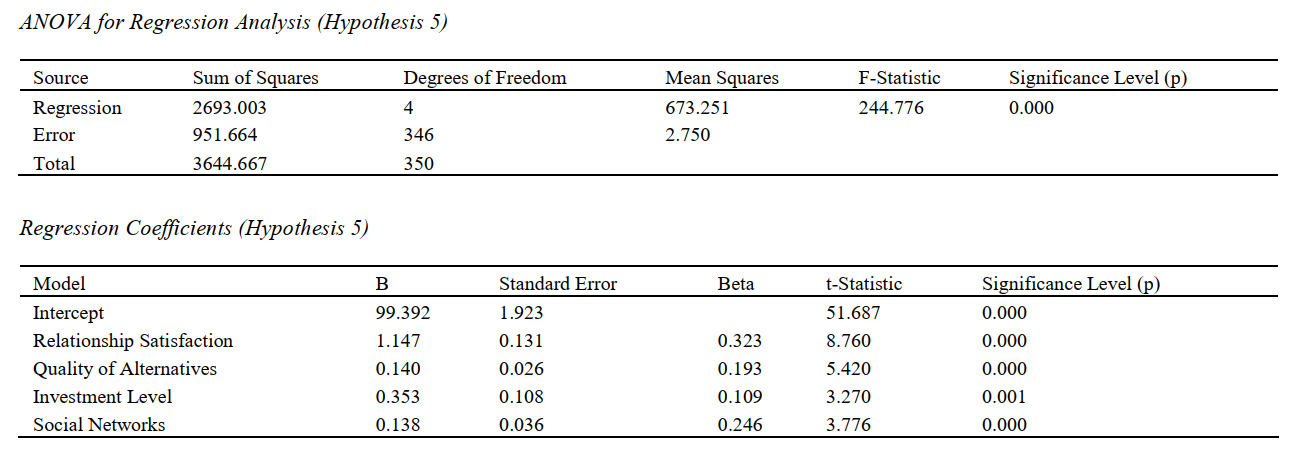
Findings: The findings indicated a correlation coefficient of 0.860 between social networks in marital relationships and marital stability among divorcing couples in Ilam. The coefficient of determination was calculated as 0.739, indicating that 73.9% of the changes in marital stability among divorcing couples in Ilam can be attributed to social networks in marital relationships.
Conclusion: The findings highlight the significant role of social networks and subjective norms in marital stability, emphasizing their predictive value within the investment model framework for divorcing couples in Ilam.
Downloads
References
Arriaga, X. B. (2004). Beyond the individual: Concomitants of closeness in the social and physical environment. In Handbook of closeness and intimacy (pp. 287-303). https://www.taylorfrancis.com/chapters/edit/10.4324/9781410610010-25/beyond-individual-concomitants-closeness-social-physical-environment-ximena-arriaga-wind-goodfriend-andrew-lohmann
Arriaga, X. B., & Agnew, C. R. (2001). Being committed: Affective, cognitive, and conative components of relationship commitment. Personality and Social Psychology Bulletin, 27(9), 1190-1203. https://doi.org/10.1177/0146167201279011
Batool, A., Bajwa, R. S., Farooq, S., & Ayub, M. (2023). The Impact of Marital Instability and Psychological Distress on Quality of Life Among Married Women, Pakistan. Pakistan Journal of Humanities and Social Sciences, 11(2), 2447-2454. https://doi.org/10.52131/pjhss.2023.1102.0536
Broujeni, M. M., Sajjadian, I., & Golparvar, M. (2024). The Effectiveness of the Narrative-Based Acceptance and Commitment Counseling Package on Experiential Avoidance, Affective Capital and Desire to Divorce in Women on the Verge of Divorce. PWJ, 5(1), 23-35. https://doi.org/10.61838/kman.pwj.5.1.3
Caryl, E. (2011). The investment model of commitment processes. In Handbook of theories of social psychology (Vol. 2, pp. 218). https://psycnet.apa.org/record/2011-21802-012
Chow, C. M., & Tan, C. C. (2013). Attachment and commitment in dyadic friendships: Mediating roles of satisfaction, quality of alternatives, and investment size. Journal of Relationships Research, 4. https://doi.org/10.1017/jrr.2013.4
Etcheverry, P. E. (2013). Attachment and the investment model: Predictors of relationship commitment, maintenance, and persistence. Personal Relationships, 20(3), 546-567. https://doi.org/10.1111/j.1475-6811.2012.01423.x
Gaines Jr, S. O., & Agnew, C. R. (2003). Relationship maintenance in intercultural couples: An interdependence analysis. In. https://doi.org/10.4324/9781410606990-11
Ghafari, D., & Seidi, M. S. (2022). Explore the Lived Experience of Women in Kermanshah of Marital Instability. Quarterly Journal of Social Development (Previously Human Development), 16(2), 93-118. https://doi.org/10.22055/qjsd.2022.32781.2180
Givertz, M. (2013). Direct and indirect effects of attachment orientation on relationship quality and loneliness in married couples. Journal of Social and Personal Relationships, 30(8), 1096-1120. https://doi.org/10.1177/0265407513482445
Givertz, M. (2016). Direct and indirect effects of commitment on interdependence and satisfaction in married couples. Journal of Family Psychology, 30(2), 214. https://doi.org/10.1037/fam0000174
Golrokh, N., Sheykhan, R., & Sajjadi, M. (2024). The relationship between parental emotional divorce and identity crisis, emotional resilience, and social adjustment in adolescents. Health Psychology Journal: Research and Applications, 1(1), 26-39. https://rpp.araku.ac.ir/article_713529.html?lang=en
Haghparast, A. H. (2017). The relationship between capital, social health, and media literacy with the reduction of moral damages in the Instagram social network. Intercultural Studies Quarterly, 13(35), 41-70. https://journals.iau.ir/article_663747.html
Javadi Koma, A., Niknam, M., Sadeghi Afjeh, Z., & Mirzakhani, N. (2024). Development of a Causal Model Predicting Marital Instability Based on Dark Personality and Ego Strength with the Mediation of Empathy in Married Women. Psychology Growth, 13(2), 109-120. http://frooyesh.ir/article-1-4786-fa.html
Lydon, J. E. (2010). How to forego forbidden fruit: The regulation of attractive alternatives as a commitment mechanism. Social and Personality Psychology Compass, 4(8), 635-644. https://doi.org/10.1111/j.1751-9004.2010.00283.x
Lydon, J. E., & Linardatos, L. (2012). Identification: The why of relationship commitment. In The science of the couple (pp. 119-140). Psychology Press. https://psycnet.apa.org/record/2012-03739-007
Mohamadjani, D., & Fazeli, A. (2024). Factors contributing to the rising divorce rate in society and strategies for strengthening family bonds. Modern Advances in Psychology, Educational Sciences, and Teaching, 77(7), 1-9. https://jonapte.ir/fa/showart-3dfcd69acb3fa2ae22c9a91b75d90ecc
Nasir, V. (2017). Testing Rusbult's investment model (marital satisfaction, quality of alternative relationships, investment size, marital commitment, and marital stability) on women on the verge of divorce. Social Work Research Journal, 3(12), 81-106. https://civilica.com/doc/1023425/
Noroozi Azam, M., Monirpour, N., & Mirzahosseini, H. (2022). Marital stability based on the quality of the parent-child relationship and attachment: The mediating role of narcissistic personality, alienation, and the experience of "we-ness". Rooyesh Psychology, 11(5), 74. https://search.proquest.com
Okojide, A., Adekeye, O., Adejumo, G. O., Chenube, O., Omumu, F., Adeusi, S. O., Amoo, E. O., Elegbeleye, A. O., & Agoha, B. E. (2023). Psychological Well-Being as a Predictor of Marital Stability Among Employed Women in Lagos State, Nigeria. Journal of Educational and Social Research, 13(1), 146. https://doi.org/10.36941/jesr-2023-0013
Okonkwo, K. (2024). The Role of Attachment Styles in Marital Stability: A Psychological Approach to Strengthening Relationships. American Journal of Psychology, 6(4), 35-50. https://doi.org/10.47672/ajp.2474
Osei, P. (2022). Examining the Factors Influencing Marital Stability Among Couples in the Kwabre East District, Ashanti Region - Ghana. Jep. https://doi.org/10.7176/jep/13-36-03
Pandya, S. P. (2025). Work‐Related Migration and Couples in Long‐Distance Marriages: Mindfulness, Marital Quality, Satisfaction, and Happiness. Personal Relationships, 32(1). https://doi.org/10.1111/pere.70002
Pflieger, J. C., Richardson, S. M., Stander, V. A., & Allen, E. S. (2022). Risk and protective factors predictive of marital instability in U.S. military couples. Journal of Family Psychology, 36(5), 791-802. https://doi.org/10.1037/fam0000949
Pourrajab Ravari, A., & Kamyabi, M. (2021). The Relationship between Controlling Behaviors and Marital Instability in Female Teachers’ of Kerman Schools. Women and Family Studies, 50(13), 63-79. https://doi.org/10.30495/jwsf.2020.562208.1252
Shahsavari, F., ansary, m., & elmimanesh, N. (2025). The Effectiveness of Reality Therapy on the Life Adjustment after Divorce and Meaning of Life in Divorced Heads of Household Women in Isfahan City. Knowledge & Research in Applied Psychology, 98(25), 175-190. https://doi.org/10.30486/jsrp.2023.1978995.3673
Singh, A., & Shanbhag, T. (2025). Parental Interference and Marital Stability: A Scoping Review of Sociocultural Influences on Indian Families. Indian Journal of Community Medicine. https://doi.org/10.4103/ijcm.ijcm_470_24
Surjadi, F. F., Wickrama, K. A. S., & Lorenz, F. O. (2022). Do couple- and individual-level ambivalence predict later marital outcomes? The mediating role of marital conflict. Journal of Social and Personal Relationships, 40(2), 693-713. https://doi.org/10.1177/02654075221122852
Tan, K. (2020). Seeking and ensuring interdependence: Desiring commitment and the strategic initiation and maintenance of close relationships. Personality and Social Psychology Bulletin, 46(1), 36-50. https://doi.org/10.1177/0146167219841633
Wang, X., Li, Q., Chen, Z., & Fang, X. (2025). Stress Perception and Marital Instability Across the Family Life Cycle: An Actor‐Partner Perspective. Family Process, 64(1). https://doi.org/10.1111/famp.70018
Yang, J., Yang, H. J., Jung, S. C., Choi, C., & Bum, C.-H. (2024). Comparative Analysis of Stroke, Marital Intimacy, Marital Satisfaction and Divorce Intention According to the Type of Participation in Marital Leisure Sports Activities. Behavioral Sciences, 14(9), 757. https://doi.org/10.3390/bs14090757
Downloads
Additional Files
Publication Timeline
- Submitted
- Revised
- Accepted
Issue
Section
License
Copyright (c) 2026 Zahra Nadi (Author); Shahram Mami (Corresponding Author); Vahid Ahmadi, Korosh Sayemiri (Author)

This work is licensed under a Creative Commons Attribution-NonCommercial 4.0 International License.