Comparison of the Effectiveness of Life Therapy (LT) and Acceptance and Commitment Therapy (ACT) on Distress Tolerance and Zest for Life in Patients with Leukemia
DOI:
https://doi.org/10.61838/kman.jarac.7.3.10Keywords:
Life Therapy, Acceptance and Commitment Therapy, Distress Tolerance, Zest for Life, Leukemia PatientsAbstract
Objective: This study aims to compare the effectiveness of Life Therapy with Acceptance and Commitment Therapy on distress tolerance and zest for life in patients with leukemia.
Methods and Materials: The present research is an experimental study. The statistical population consists of all male patients referred to Imam Hospital in Sari in 2023, who had received a confirmed diagnosis of leukemia. From this population, 45 leukemia patients were selected through non-random convenience sampling and randomly assigned into two experimental groups (Life Therapy and Acceptance and Commitment Therapy) and one control group (15 individuals in each group). Data were collected using the Distress Tolerance Scale (DTS) by Simons and Gaher and the Hasan Zadeh Life Enthusiasm Questionnaire (HLEQ). Data analysis was conducted using SPSS25 statistical software.
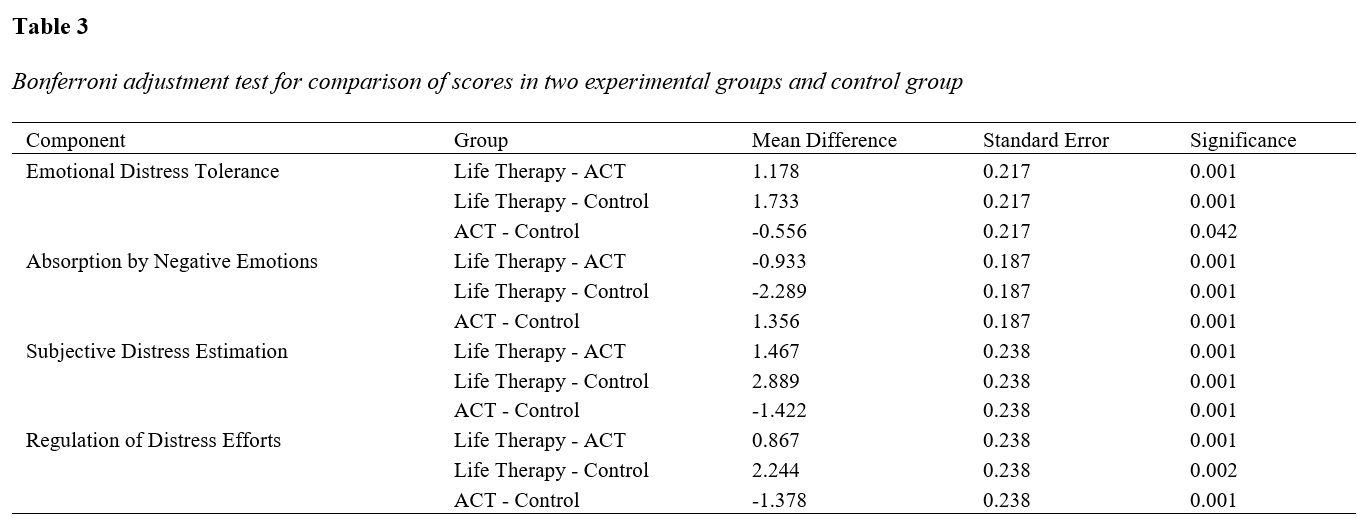
Findings: The results of the study showed that both Life Therapy and Acceptance and Commitment Therapy were effective in improving distress tolerance and zest for life in patients with leukemia.
Conclusion: The focus of Life Therapy on creating motivation and meaning in an individual's present life, more than the emphasis of Acceptance and Commitment Therapy on accepting the current situation, has allowed patients to better tolerate the distress caused by leukemia. Therefore, it can be concluded that Life Therapy, due to its focus on living in the moment and experiencing positive emotions, has a greater impact on improving distress tolerance and increasing resilience in patients with leukemia compared to Acceptance and Commitment Therapy. Additionally, the findings suggest that Life Therapy, by emphasizing the enjoyment of life moments, is more effective in enhancing zest for life and positive emotions in leukemia patients compared to Acceptance and Commitment Therapy.
Downloads
References
Bakhtiari, M., & Pourdel, M. (2024). The Effectiveness of Cognitive-Behavioral Therapy on Distress Tolerance and Resilience in Women with Substance-Dependent Incarcerated Spouses. etiadpajohi, 17(70), 267-288. https://doi.org/10.61186/etiadpajohi.17.70.267
Choi, S. H., Chan, R., & Lehto, R. H. (2019). Relationships between smoking status and psychological distress, optimism, and health environment perceptions at time of diagnosis of actual or suspected lung cancer. Cancer Nurs, 42(2), 156-163. https://doi.org/10.1097/NCC.0000000000000579
Forman, E. M., & Herbert, J. D. (2008). New directions in cognitive behavior therapy: acceptance based therapies. Wiley. https://psycnet.apa.org/record/2009-02305-005
Ghadampour, E., Yusuf Vand, M., Farrokhzadian, A. A., Hassanvand, B., & Yousuf Vand, M. (2016). The effectiveness of quality of life therapy (QOLT) in changing the level of academic resilience and self-differentiation of depressed female students. Cognitive Psychology and Psychiatry, 4(3), 77-90. https://sid.ir/paper/263425/fa
Harris, R. (2019). ACT made simple: An easy-to-read primer on acceptance and commitment therapy. Oakland: New Harbinger Publications. https://www.amazon.com/ACT-Made-Simple-Easy-Read/dp/1572247053
Hassanzadeh, R. (2021). Life Psychology (Life Therapy). Tehran: Publication Virayesh. https://modernpsy.rahman.ac.ir/article_197464_a699f8692ba36a423deead3ccbd651e8.pdf
Hassanzadeh, R., & Talebi, F. (2023). The effectiveness of life therapy on passion for life, life expectancy and quality of life in infertile women. Quarterly Journal of Applied Research in Counseling, 6(20), 1-20. https://www.jarci.ir/article_705015.html
Hayes, S. C., Luoma, J. B., Bond, F. W., Masuda, A., & Lillis, J. (2006). Acceptance and commitment therapy: model, processes and outcomes. Behave Res Ther, 44(1), 1-25. https://doi.org/10.1016/j.brat.2005.06.006
Hayes, S. C., Strosahl, K., Wilson, K. G., Bissett, R. C., Pistorelo, J., & Tormino, D. (2004). Measuring experiential avoidance: A preliminary test of a working model. Psychol Rec, 54(4), 553-578. https://doi.org/10.1007/BF03395492
Hinkle, J. L., & Cheever, K. H. (2018). Brunner and Suddarth's textbook of medical-surgical nursing. Wolters Kluwer India Pvt Ltd. https://www.amazon.com/Brunner-Suddarths-Textbook-Medical-Surgical-Nursing/dp/1496347994
Javanmardi, F., Shafi Abadi, A., & Poshaneh, K. (2024). The Prediction of distress tolerance model in the elderly based on perceived support, experiential avoidance and spiritual intelligence with the mediating role of mindfulness. The Women and Families Cultural-Educational, 19(1), 283-310. https://cwfs.ihu.ac.ir/article_208480_en.html?lang=en
Karimi Baghmolek, A., Joladari, A., & Mahighir, F. (2018). The effectiveness of acceptance and commitment therapy on reducing depression and lack of hedonism in end-stage cancer patients. Clinical Psychology, 11(4), 33-40. https://doi.org/10.22075/jcp.2020.18847.1742
Keykhosravi, A., Neamatshahi, M., Navipour, E., Barabadi, Z., & Neamatshahi, M. (2021). Incidence, Prevalence and Associated Risk Factors for Leukemia and Lyphoma Occurrence in Iran: A Systematic Review and Meta-analysis. Int J Med Rev, 8(2), 57-64. http://ph.sbmu.ac.ir/uploads/EPIDEMIOLOGY-AND-CONTROL-OF-COMMON-DISEASES-IN-IRAN/25-BIOLOGIC-CARCINOGENS.pdf
Koohi, F., Shamlou, R., Eslami, S., Ghojogh, Z. M., Kor, Y., & Rafiemanesh, H. (2015). Leukemia in Iran: epidemiology and morphology trends. Asian Pacific J Cancer Prevent, 16(17), 7759-7763. https://doi.org/10.7314/APJCP.2015.16.17.7759
Mehrparvar, S., Hajloo, N., & Aboolghasemi, A. (2017). The effectiveness of Holographic Reprocessing Therapy on mental adjustment to cancer in women with cancer. Stud Med Sci, 28(5), 343-352. http://umj.umsu.ac.ir/browse.php?a_code=A-10-3264-1&slc_lang=fa&sid=1
Mohammadi, E., Arshadi, F. K., Farzad, V. A., & Salehi, M. (2015). The effectiveness of Acceptance and Commitment Therapy (ACT) on marital satisfaction among depressed women. Knowledge & Research in Applied Psychology, 17(2), 26-35. https://www.researchgate.net/publication/340455871_The_Efficacy_of_Acceptance_and_Commitment_Therapy_ACT_on_Marital_Satisfaction_in_Couples
Moin, Z., Abul Maali Al-Husseini, K., & Sirfi, M. R. (2023). Comparing the effectiveness of spiritual therapy and acceptance and commitment therapy on reducing existential anxiety in women with breast cancer. Counseling and Psychotherapy Culture Quarterly, 14(56), 39-66. https://qccpc.atu.ac.ir/article_15535.html
Royin Tan, S., Sajjad, A., Azadi, S., Afshin, H., & Amini, N. (2018). Effectiveness of combined treatment based on acceptance and commitment and hope therapy on quality of life in cancer patients. Culture of Counseling and Psychotherapy, 10(38), 221-242. https://doi.org/10.22054/qccpc.2019.38404.2043
Shahidi, S., Hassanzadeh, R., & Mirzaian, B. (2022). The effectiveness of treatment based on acceptance and commitment on mental pain and enthusiasm for life in patients with psoriasis. Journal of Health Research in Society, 8(3), 68-77. https://jhc.mazums.ac.ir/article-1-754-fa.html
Siegel, R. L., Miller, K. D., Fuchs, H. E., & Jemal, A. (2022). Cancer statistics, 2022. CA Cancer J. Clin., 72, 7-33. https://doi.org/10.3322/caac.21708
Simons, J. S., & Gaher, R. M. (2005). The distress tolerance scale: development & validation of a self-report measure. Motivation & emotion, 20(9), 83-102. https://doi.org/10.1007/s11031-005-7955-3
Washington, C. M., & Leaver, D. T. (2015). Principles and Practice of Radiation Therapy-E-Book. Elsevier Health Sciences. https://shop.elsevier.com/books/principles-and-practice-of-radiation-therapy/washington/978-0-323-28752-4
Downloads
Additional Files
Publication Timeline
- Submitted
- Revised
- Accepted
Issue
Section
License
Copyright (c) 2024 Seyedehsaeideh Ghoreishiseyedmahaleh (Author); Ramezan Hassanzadeh (Corresponding Author); Asghar Norouzi (Author)

This work is licensed under a Creative Commons Attribution-NonCommercial 4.0 International License.