Philosophical Dimensions of Music Therapy: Bridging the Gap Between Art and Psychology
DOI:
https://doi.org/10.61838/kman.jarac.3281Keywords:
Music therapy, philosophical dimensions, emotional expression, cognitive restructuring, existential reflectionAbstract
Objective: This study explores the philosophical dimensions of music therapy, focusing on how it bridges the gap between art and psychology.
Methods and Materials: A qualitative research design was used, employing semi-structured interviews with 22 participants from Iran. The participants included both music therapists and individuals with personal experience in music therapy. The interviews were conducted until theoretical saturation was achieved, and the data were analyzed using NVivo software for thematic analysis. The analysis revealed key themes related to the therapeutic and philosophical aspects of music therapy.
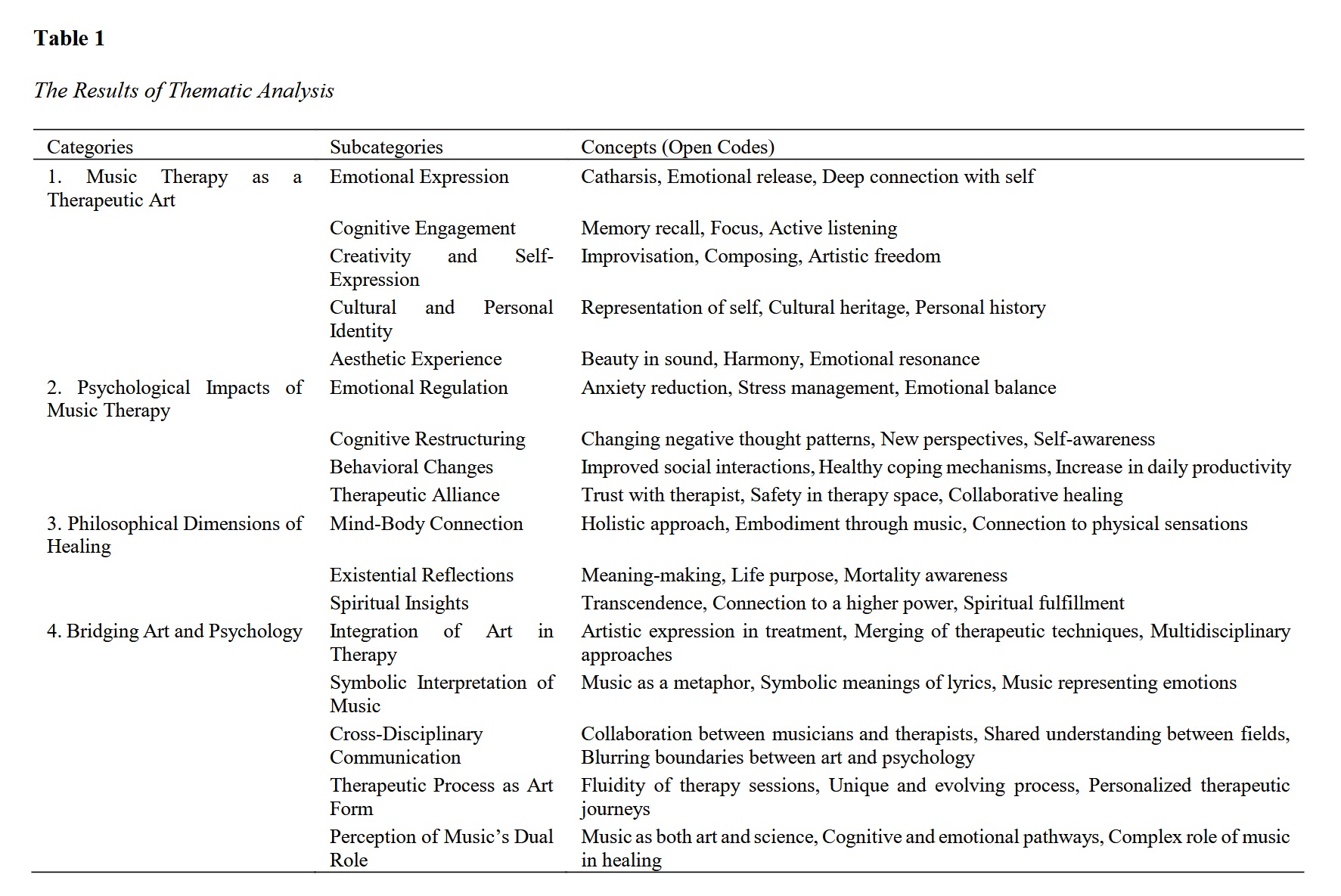
Findings: Four main themes emerged from the analysis: (1) Music therapy as a therapeutic art, facilitating emotional expression, creativity, and personal identity; (2) Psychological impacts of music therapy, including emotional regulation, cognitive restructuring, and behavioral changes; (3) Philosophical dimensions of healing, such as the mind-body connection, existential reflections, and spiritual insights; and (4) Bridging art and psychology, where music therapy integrates artistic expression with psychological healing, blurring the boundaries between the two fields.
Conclusion: Music therapy plays a unique role in bridging the gap between art and psychology by providing a space for emotional, cognitive, and spiritual exploration. Its ability to evoke emotions, stimulate cognitive engagement, and foster existential reflection makes it a powerful therapeutic tool. The study highlights the importance of understanding music therapy not only as a therapeutic practice but also as an art form that promotes holistic healing. Further research is needed to explore the cross-cultural applicability of these findings and the role of technology in music therapy.
Downloads
References
Aigen, K. (2008). The Religious Dimensions of Popular Music and Their Implications for Music Therapy. British Journal of Music Therapy, 22(1), 24-34. https://doi.org/10.1177/135945750802200104
Aigen, K. (2013). The Study of Music Therapy: Current Issues and Concepts. https://doi.org/10.4324/9781315882703
Alperson, P. (2009). Facing the Music: Voices From the Margins. Topoi, 28(2), 91-96. https://doi.org/10.1007/s11245-009-9052-9
Bartel, C. (2017). The Ontology of Musical Works and the Role of Intuitions: An Experimental Study. European Journal of Philosophy, 26(1), 348-367. https://doi.org/10.1111/ejop.12247
Bonde, L. O. (2019). Five Approaches to Music as Health Promotion. Biomedical Journal of Scientific & Technical Research, 15(3). https://doi.org/10.26717/bjstr.2019.15.002696
Burns, D. S., Perkins, S. M., Tong, Y., Hilliard, R. E., & Cripe, L. D. (2015). Music Therapy Is Associated With Family Perception of More Spiritual Support and Decreased Breathing Problems in Cancer Patients Receiving Hospice Care. Journal of Pain and Symptom Management, 50(2), 225-231. https://doi.org/10.1016/j.jpainsymman.2015.02.022
Cochrane, T. (2010). Music, Emotions and the Influence of the Cognitive Sciences. Philosophy Compass, 5(11), 978-988. https://doi.org/10.1111/j.1747-9991.2010.00337.x
Curtis, S. L. (2012). Music Therapy and Social Justice: A Personal Journey. The Arts in Psychotherapy, 39(3), 209-213. https://doi.org/10.1016/j.aip.2011.12.004
Curtis, S. L., & Mercado, C. S. (2004). Community Music Therapy for Citizens With Developmental Disabilities. Voices a World Forum for Music Therapy, 4(3). https://doi.org/10.15845/voices.v4i3.185
Fujianti, M. E. Y. (2024). Comparison of Music Therapy and Listening to the Holy Quran in the Management of Breast Cancer Patients: A Scoping Review. GSC Advanced Research and Reviews, 18(2), 252-260. https://doi.org/10.30574/gscarr.2024.18.2.0044
Ghetti, C. (2012). Music Therapy as Procedural Support for Invasive Medical Procedures: Toward the Development of Music Therapy Theory. Nordic Journal of Music Therapy, 21(1), 3-35. https://doi.org/10.1080/08098131.2011.571278
Gold, C., Voracek, M., & Wigram, T. (2004). Effects of Music Therapy for Children and Adolescents With Psychopathology: A Meta‐analysis. Journal of Child Psychology and Psychiatry, 45(6), 1054-1063. https://doi.org/10.1111/j.1469-7610.2004.t01-1-00298.x
Gold, C., Wigram, T., & Voracek, M. (2007). Effectiveness of Music Therapy for Children and Adolescents With Psychopathology: A Quasi-Experimental Study. Psychotherapy Research, 17(3), 289-296. https://doi.org/10.1080/10503300600607886
Gooding, L. F., & Springer, D. G. (2020). Music Therapy Knowledge and Interest: A Survey of Music Education Majors. Journal of Music Therapy, 57(4), 455-474. https://doi.org/10.1093/jmt/thaa020
Haire, N. (2020). Book Review: Karette Stensaeth, Responsiveness in Music Therapy Improvisation: A Perspective Inspired. British Journal of Music Therapy, 34(2), 117-120. https://doi.org/10.1177/1359457520967330
Haire, N., & MacDonald, R. (2019). Humour in Music Therapy: A Narrative Literature Review. Nordic Journal of Music Therapy, 28(4), 273-290. https://doi.org/10.1080/08098131.2019.1577288
Haire, N., & Oldfield, A. (2009). Adding Humour to the Music Therapist's Tool-Kit: Reflections on Its Role in Child Psychiatry. British Journal of Music Therapy, 23(1), 27-34. https://doi.org/10.1177/135945750902300104
Huang, D. (2023). Analysis of National Music and Music Therapy. Journal of Humanities Arts and Social Science, 7(2), 475-479. https://doi.org/10.26855/jhass.2023.02.043
Kern, P., & Tague, D. B. (2022). Students’ Perception of Online Learning During COVID-19: A U.S.-Based Music Therapy Survey. Journal of Music Therapy, 59(2), 127-155. https://doi.org/10.1093/jmt/thac003
Klyve, G. P., Rolvsjord, R., & Elgen, I. B. (2023). Polyphonic Perspectives: A Focus Group Study of Interprofessional Staff’s Perceptions of Music Therapy at an Inpatient Unit for Children in Mental Health Care. International Journal of Qualitative Studies on Health and Well-Being, 18(1). https://doi.org/10.1080/17482631.2023.2197750
Konečni, V. J. (2013). Music, Affect, Method, Data: Reflections on the Carroll Versus Kivy Debate. The American journal of psychology, 126(2), 179-195. https://doi.org/10.5406/amerjpsyc.126.2.0179
Krout, R. E. (2003). Music Therapy With Imminently Dying Hospice Patients and Their Families: Facilitating Release Near the Time of Death. American Journal of Hospice and Palliative Medicine®, 20(2), 129-134. https://doi.org/10.1177/104990910302000211
Ledger, A., Edwards, J., & Morley, M. J. (2013). A Change Management Perspective on the Introduction of Music Therapy to Interprofessional Teams. Journal of Health Organization and Management, 27(6), 714-732. https://doi.org/10.1108/jhom-04-2012-0068
Matravers, D. (2007). Musical Expressiveness. Philosophy Compass, 2(3), 373-379. https://doi.org/10.1111/j.1747-9991.2007.00078.x
Moreno, J. (2016). The Music Therapist: Creative Arts Therapist and Contemporary Shaman. International Journal of Psychotherapy Counselling and Psychiatry Theory Research & Clinical Practice, 2. https://doi.org/10.35996/1234/2/arttherapyshaman
Ng, W. F. (2005). Music Therapy, War Trauma, and Peace: A Singaporean Perspective. Voices a World Forum for Music Therapy, 5(3). https://doi.org/10.15845/voices.v5i3.231
O'Callaghan, C., McDermott, F., Michael, N., Daveson, B. A., Hudson, P., & Zalcberg, J. (2013). “A Quiet Still Voice That Just Touches”: Music’s Relevance for Adults Living With Life-Threatening Cancer Diagnoses. Supportive Care in Cancer, 22(4), 1037-1047. https://doi.org/10.1007/s00520-013-2059-1
Preissler, P., Kordovan, S., Ullrich, A., & Bokemeyer, C. (2016). Favored Subjects and Psychosocial Needs in Music Therapy in Terminally Ill Cancer Patients: A Content Analysis. BMC Palliative Care, 15(1). https://doi.org/10.1186/s12904-016-0122-7
Ragone, G., Good, J., & Howland, K. (2021). How Technology Applied to Music-Therapy and Sound-Based Activities Addresses Motor and Social Skills in Autistic Children. Multimodal Technologies and Interaction, 5(3), 11. https://doi.org/10.3390/mti5030011
Rensya, S. (2023). Christian Spiritual Music Therapy Against Patient Anxiety in the Emergency Room. Jurnal Keperawatan Silampari, 7(1), 209-216. https://doi.org/10.31539/jks.v7i1.5927
Vajari, S. M. (2024). The Effectiveness of Active Music Therapy on Anxiety and Sleep Quality in Adolescents Aged 11-14 With Stargardt Disease. Jayps, 5(1), 19-26. https://doi.org/10.61838/kman.jayps.5.1.3
Downloads
Additional Files
Publication Timeline
- Submitted
- Revised
- Accepted
Issue
Section
License
Copyright (c) 2025 Ali Kian Hatami (Author); Sadeq Rashidi (Corresponding Author); Ali Moradkhani (Author)

This work is licensed under a Creative Commons Attribution-NonCommercial 4.0 International License.