Modeling Psychological Well-Being Based on Attachment Styles, Personality Traits, and Defense Mechanisms with the Mediation of Coping Strategies in Emergency Medical Service Personnel
DOI:
https://doi.org/10.61838/kman.jarac.7.3.7Keywords:
Psychological Well-being, Attachment Style, Defense Mechanisms, Coping StrategiesAbstract
Objective: The objective of this study was to model psychological well-being based on attachment styles, personality traits, and defense mechanisms, with the mediating role of coping strategies among emergency medical service personnel.
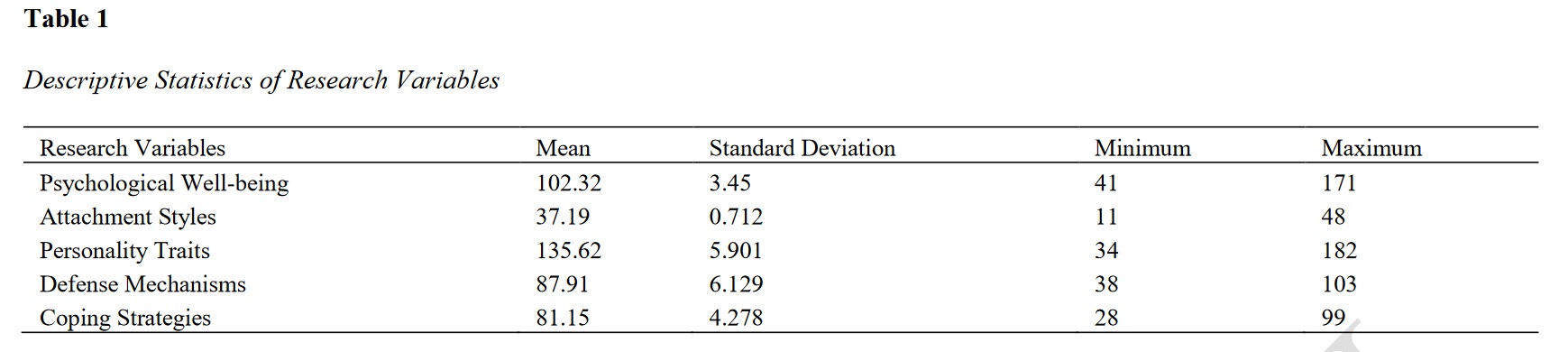
Methods and Materials: The research sample consisted of 210 emergency medical service personnel from the southwest region of Tehran province, selected using purposive sampling. The study utilized a correlational design, and data were collected using standardized questionnaires, including the Ryff Psychological Well-being Scale, the Revised Adult Attachment Scale (RAAS), the Big Five Personality Traits Questionnaire, the Defense Style Questionnaire (DSQ-40), and the Lazarus and Folkman Coping Strategies Questionnaire. Data were analyzed using SPSS version 26 and AMOS version 24 for structural equation modeling (SEM), and bootstrapping was employed to test the mediating effects of coping strategies.
Findings: The results showed that attachment styles significantly predict psychological well-being with the mediation of coping strategies. A negative relationship was found between anxious and avoidant attachment styles and psychological well-being, while a positive relationship existed between secure attachment and psychological well-being. Personality traits also significantly predicted psychological well-being, with neuroticism negatively impacting it and traits such as openness, agreeableness, extraversion, and conscientiousness enhancing it. Additionally, defense mechanisms had a significant relationship with psychological well-being through coping strategies, with emotion-focused coping strategies negatively affecting well-being.
Conclusion: The findings highlight the significant role of attachment styles, personality traits, and defense mechanisms in predicting psychological well-being through coping strategies among emergency medical service personnel. Training programs that focus on enhancing effective coping strategies and resilience could improve their psychological well-being and overall life satisfaction. These results suggest that psychological interventions should consider individual differences in attachment styles and personality traits to promote better mental health outcomes.
Downloads
References
Abedi, G., Ataeifar, R., & Ghamari, M. (2024). The Effectiveness of Group Marital Conflict Resolution Training Based on Choice Theory on Emotional Divorce and Hope for Life in Married Women. International Journal of Education and Cognitive Sciences, 5(3), 136-146. https://doi.org/10.61838/kman.ijecs.5.3.10
Akbari, B., Doupour, R., Kohansal, S., & Karimi'an, Z. (2018). The Relationship Between Social Support and Attachment Styles with Psychological Well-Being in Students. https://journals.iau.ir/article_665114.html
Alborzi, M. M., & Khosh Lahjeh Sedgh, A. (2023). Prediction of sensation seeking and coping strategies based on emotional intelligence with the mediation of metacognitive beliefs in Qom province students. Iranian Journal of Neurodevelopmental Disorders, 2(2), 26-37. https://maherpub.com/jndd/article/view/27
Alnuaimi, A. S. M., Yousefi, Z., Aayedi, A. E. Z., & Golparvar, M. (2024). Prediction of Wisdom Based on Executive Function, Attachment Style, and Personality Traits. Journal of Adolescent and Youth Psychological Studies (JAYPS), 5(4), 1-10. https://journals.kmanpub.com/index.php/jayps/article/view/2283
Andrews, E., & Hicks, R. E. (2017). Dealing with anxiety: relationships among interpersonal attachment style, psychological wellbeing and trait anxiety. International Journal of Psychological Studies, 9(4), 53-64. https://www.ccsenet.org/journal/index.php/ijps/article/view/71823
Annalakshmi, N. (2019). Resilience and Academic Achievement Among Rural Adolescents At-Risk: Role of Self-Regulation and Attachment Style. Indian Journal of Positive Psychology, 10(4), 260-266. https://www.proquest.com/scholarly-journals/resilience-academic-achievement-among-rural/docview/2342434338/se-2
Awosika, A., & Adeniyi, M. J. (2023). Occupation-Related Stress and Stress-Related Risk Factors Among Nurses in West Africa. https://doi.org/10.36348/merjms.2023.v03i01.002
Bigdeli, I., Najafy, M., & Rostami, M. (2013). The Relation of Attachment Styles, Emotion Regulation, and Resilience to Well-being among Students of Medical Sciences [Original research article]. Iranian Journal of Medical Education, 13(9), 721-729. http://ijme.mui.ac.ir/article-1-2694-en.html
Davis, T. J., Morris, M., & Drake, M. M. (2016). The moderation effect of mindfulness on the relationship between adult attachment and wellbeing. Personality and individual differences, 96, 115-121. https://www.sciencedirect.com/science/article/pii/S0191886916301350
Dehghani, Y., Asghari, F., Saeedpour, F., & Jokar, E. (2017). Prediction of Burnout in Nurses Based on Job Satisfaction, Personality Traits, and Psychological Well-Being. Nursing Research Journal, 12(5), 61-70. https://doi.org/10.21859/ijnr-12059
Demircioğlu, Z. I., & Göncü Köse, A. (2021). Effects of Attachment Styles, Dark Triad, Rejection Sensitivity, and Relationship Satisfaction on Social Media Addiction: A Mediated Model. Current Psychology, 40, 414-428. https://doi.org/10.1007/s12144-018-9956-x
Eichenberg, C. (2024). Social Media Addiction: Associations With Attachment Style, Mental Distress, and Personality. BMC psychiatry, 24(1). https://doi.org/10.1186/s12888-024-05709-z
Haji Adineh, S., Mahmoodi, A., & Maredpour, A. (2024). Predicting Children's Behavioral Disorders Based on Mothers' Parenting Styles with the Mediation of Children's Attachment Styles. Journal of Psychological Dynamics in Mood Disorders (PDMD), 3(1), 212-221. https://doi.org/10.22034/pdmd.2024.449186.1064
Hazan, C., & Shaver, P. R. (1987). Romantic Love Conceptualized as an Attachment Process. Journal of personality and social psychology, 52, 511-524. https://doi.org/10.1037//0022-3514.52.3.511
Jodaki, H., Sabet, M., & Ahadi, H. (2023). The effectiveness of positive treatment on rumination and coping strategies of women with uterine cancer. Applied Family Therapy Journal (AFTJ), 4(5), 478-491. https://doi.org/10.61838/kman.aftj.4.5.28
Karantzas, G. C., Younan, R., & Pilkington, P. D. (2023). The Associations Between Early Maladaptive Schemas and Adult Attachment Styles: A Meta-Analysis. Clinical Psychology: Science and Practice, 30(1). https://doi.org/10.1037/cps0000108
Karbasi, F., Shahnifeiz, K., Rezaie, V. a., & Ostovarzadeh, M. (2024). Effectiveness of Positive Mindfulness Therapy on Mental Well-being, Quality of Life and Stress Coping Strategies in women With Bipolar Disorder. Psychology of Woman Journal, 5(2). https://doi.org/10.61838/
Kaur, J. (2024). Romantic Relationship Satisfaction, Attachment Style and Love Style Among College Going Students. Eatp. https://doi.org/10.53555/kuey.v30i5.4252
Khalatbari, J., Hemmati Sabet, V., Tabibzadeh, F., & Hemmati Sabet, A. (2019). The Relationship Between Personality Traits and Psychological Well-Being in Individuals with Irritable Bowel Syndrome: The Mediating Role of Emotion Regulation. Journal Of Shahid Sadoughi University Of Medical Sciences, 27(6), 1612-1627. https://doi.org/10.18502/ssu.v27i6.1597
Khorrami Nobandi, S., & Yaghoubi Pour, A. (2024). Structural Model of Predicting Marital Commitment Based on Attachment Styles and Early Maladaptive Schemas in Individuals with Emotional Extramarital Relationships. 8th International Conference on Law, Psychology, Educational and Behavioral Sciences, Tehran.
Luo, M., & Hancock, J. T. (2020). Self-Disclosure and Social Media: Motivations, Mechanisms and Psychological Well-Being. Current opinion in psychology, 31, 110-115. https://doi.org/10.1016/j.copsyc.2019.08.019
Masa'Deh, R., Alhalaiqa, F., AbuRuz, M. E., Al-Dweik, G., & Al-Akash, H. Y. (2017). Perceived Stress in Nurses: A Comparative Study. Global journal of health science, 9(6), 195-202. https://doi.org/10.5539/gjhs.v9n6p195
Miri, S. S., & Zahiri, H. (2024). Investigating the Relationship Between Coping Styles, Alexithymia, and Management Styles with Job Satisfaction (Case Study: The Employees of the Maad Group). Journal of Assessment and Research in Applied Counseling (JARAC), 6(2), 1-10. https://journals.kmanpub.com/index.php/jarac/article/view/1917
Monajem, A, Monirpour, N, & Mirzahosseini, H. (2018). Structural Relationships of the Personality Organization, Object Relations and Defense Mechanisms with Pathological Eating Disorder. Journal of Clinical Psychology, 10(2), 1-14. https://doi.org/10.22075/jcp.2018.14593.1413
Morento, I. P. (2024). Level of Stress, Coping Strategies and Academic Achievement of College Students During HyFlex Learning. Diversitas Journal, 9(1). https://doi.org/10.48017/dj.v9i1.2913
Myrick, A. C., Green, E. J., & Crenshaw, D. (2014). The Influence of Divergent Parental Attachment Styles on Adolescent Maturation: Implications for Family Counseling Practitioners. The Family Journal, 22(1), 35-42. https://doi.org/10.1177/1066480713491217
Nourialeagha, B., Ajilchi, B., & Kisely, S. (2020). The Mediating Role of Gratitude in the Relationship Between Attachment Styles and Psychological Well-Being. Australasian Psychiatry, 28(4), 426-430. https://doi.org/10.1177/1039856220930672
Parchment, S. (2023). Analyzing Stress Appraisals, Coping Strategies and Defense Mechanisms of Adults in Jamaica and in the United States: A Cross-Cultural Study [Doctoral Dissertation, Harvard University]. https://search.proquest.com/openview/e47b31267be6c1e3c19eba737c66542c/1.pdf?pq-origsite=gscholar&cbl=18750&diss=y
Porcerelli, J. H., Huth-Bocks, A., Huprich, S. K., & Richardson, L. (2016). Defense Mechanisms of Pregnant Mothers Predict Attachment Security, Social-Emotional Competence, and Behavior Problems in Their Toddlers. American Journal of Psychiatry, 173(2), 138-146. https://doi.org/10.1176/appi.ajp.2015.15020173
Rahgoi, A. (2024). The Relationship Between Perceived Social Support, Psychological Capital, Job Burnout, and Work Engagement in Nurses Working on the Front Line of the Fight Against the Coronavirus. https://doi.org/10.21203/rs.3.rs-4281322/v1
Randall, K., Isaacson, M., & Ciro, C. (2017). Validity and Reliability of the Myers-Briggs Personality Type Indicator: A Systematic Review and Meta-Analysis. Journal of Best Practices in Health Professions Diversity, 10(1), 1-27. https://gwern.net/doc/psychology/personality/2017-randall.pdf
Ren, Z., Zhang, X., Li, X., He, M., Shi, H., Zhao, H., & Liu, H. (2021). Relationships of Organisational Justice, Psychological Capital and Professional Identity with Job Burnout Among Chinese Nurses: A Cross‐Sectional Study. Journal of clinical nursing, 30(19-20), 2912-2923. https://doi.org/10.1111/jocn.15797
Rothe, J. P. (2017). The Scientific Analysis of Personality. Routledge. https://www.taylorfrancis.com/books/mono/10.4324/9781315134772/scientific-analysis-personality-peter-rothe
Sagone, E., Commodari, E., Indiana, M. L., & La Rosa, V. L. (2023). Exploring the Association Between Attachment Style, Psychological Well-Being, and Relationship Status in Young Adults and Adults-A Cross-Sectional Study. European Journal of Investigation in Health, Psychology and Education, 13(3), 525-539. https://doi.org/10.3390/ejihpe13030040
Sepehvand, Z., Yeganeh Jam, H., & Sepehvand, M. (2020). The Relationship Between Personality Traits and Perfectionism with Psychological Well-Being in Students of Lorestan University. Second Congress of New Findings in Family, Mental Health, Disorders, Prevention, and Education, Tehran.
Shahla, R., Koochek Entezar, R., Salehi, M., & Ghanbaripanah, A. (2022). Developing a Model of Psychological Well-Being in Adolescents with Obsessive Beliefs Based on Defensive Styles, Ego Identity Status, and Parent-Child Relationship. Health Psychology and Social Behavior Quarterly, 2(1), 1-16. https://journals.iau.ir/article_690984.html
Shahrokhi, A., Elikai, N., Yekefallah, L., & Barikani, A. (2018). The Relationship Between Perceived Stress and Spiritual Intelligence in Nurses of Critical Care Units. Qazvin University of Medical Sciences Journal, 22(3), 40-49. https://doi.org/10.29252/qums.22.3.40
Shen, Y., Zhan, Y., Zheng, H., Liu, H., Wan, Y., & Zhou, W. (2021). Anxiety and its Association with Perceived Stress and Insomnia Among Nurses Fighting Against COVID‐19 in Wuhan: A Cross‐Sectional Survey. Journal of clinical nursing, 30(17-18), 2654-2664. https://doi.org/10.1111/jocn.15678
Tang, X. (2024). The Effects of Attachment Styles on Resilience and Emotion Regulation. Journal of Education Humanities and Social Sciences, 26, 755-759. https://doi.org/10.54097/shp3g660
Trudel-Fitzgerald, C., Millstein, R. A., von Hippel, C., Howe, C. J., Tomasso, L. P., Wagner, G. R., & VanderWeele, T. J. (2019). Psychological Well-Being as Part of the Public Health Debate? Insight into Dimensions, Interventions, and Policy. BMC public health, 19(1), 1-11. https://doi.org/10.1186/s12889-019-8029-x
Young, L., Kolubinski, D. C., & Frings, D. (2020). Attachment style moderates the relationship between social media use and user mental health and wellbeing. Heliyon, 6(6). https://doi.org/10.1016/j.heliyon.2020.e04056
Zargar Kharazi Esfahani, E., Abedi, M. R., & Namdarpoor, F. (2023). The Role of Personality Traits and Life Narratives in Psychological Well-Being, Job Adaptability, Emotional Intelligence, and Productivity in Iranian Adults Aged 22 to 65 During 2020-2021. Health System Research, 19(1), 61-67. https://hsr.mui.ac.ir/browse.php?a_id=1405&sid=1&slc_lang=fa&ftxt=0
Zhang, X. (2024). The Relationship Between Psychological Capital, Burnout and Perceived Stress in Junior Nurses: A Latent Profile Analysis. Frontiers in Public Health, 12. https://doi.org/10.3389/fpubh.2024.1374941
Downloads
Additional Files
Publication Timeline
- Submitted
- Revised
- Accepted
Issue
Section
License
Copyright (c) 2024 Mahboube Keshtkar (Author); Alireza Aghayousefi (Corresponding Author); Abdolvahid Davoodi (Author)

This work is licensed under a Creative Commons Attribution-NonCommercial 4.0 International License.