Comparison of the Effectiveness of Residential Group Therapy Based on Acceptance and Commitment Therapy and Cognitive Behavioral Therapy on Meaning in Life and Marital Adjustment in Couples
DOI:
https://doi.org/10.61838/kman.jarac.3188Keywords:
Residential Group Therapy, Acceptance and Commitment Therapy , Cognitive Behavioral Therapy , Meaning in Life, Marital AdjustmentAbstract
Objective: The aim of this research was to compare the effectiveness of residential group therapy based on Acceptance and Commitment Therapy (ACT) and Cognitive Behavioral Therapy (CBT) on meaning in life and marital adjustment in couples.
Methods and Materials: This research utilized a quasi-experimental method with a pre-test, post-test, and control group design. The study population consisted of couples who visited family counseling centers and health homes in Birjand city in 2021. From this population, 45 individuals were selected through convenience sampling and randomly assigned to three groups: control group (15 individuals), ACT group (15 individuals), and CBT group (15 individuals). Intervention sessions for the ACT group were conducted over eight 45-minute sessions within one month (two sessions per week), while CBT sessions were conducted weekly for nine weeks, with each session lasting one and a half hours in a group setting. After the intervention sessions, the Meaning in Life and Marital Adjustment Questionnaires were administered as post-tests, and three months after the end of the intervention as follow-up. The results of the three groups were compared again. In this study, considering the assumptions for parametric tests, and analysis of covariance (ANCOVA) were employed.
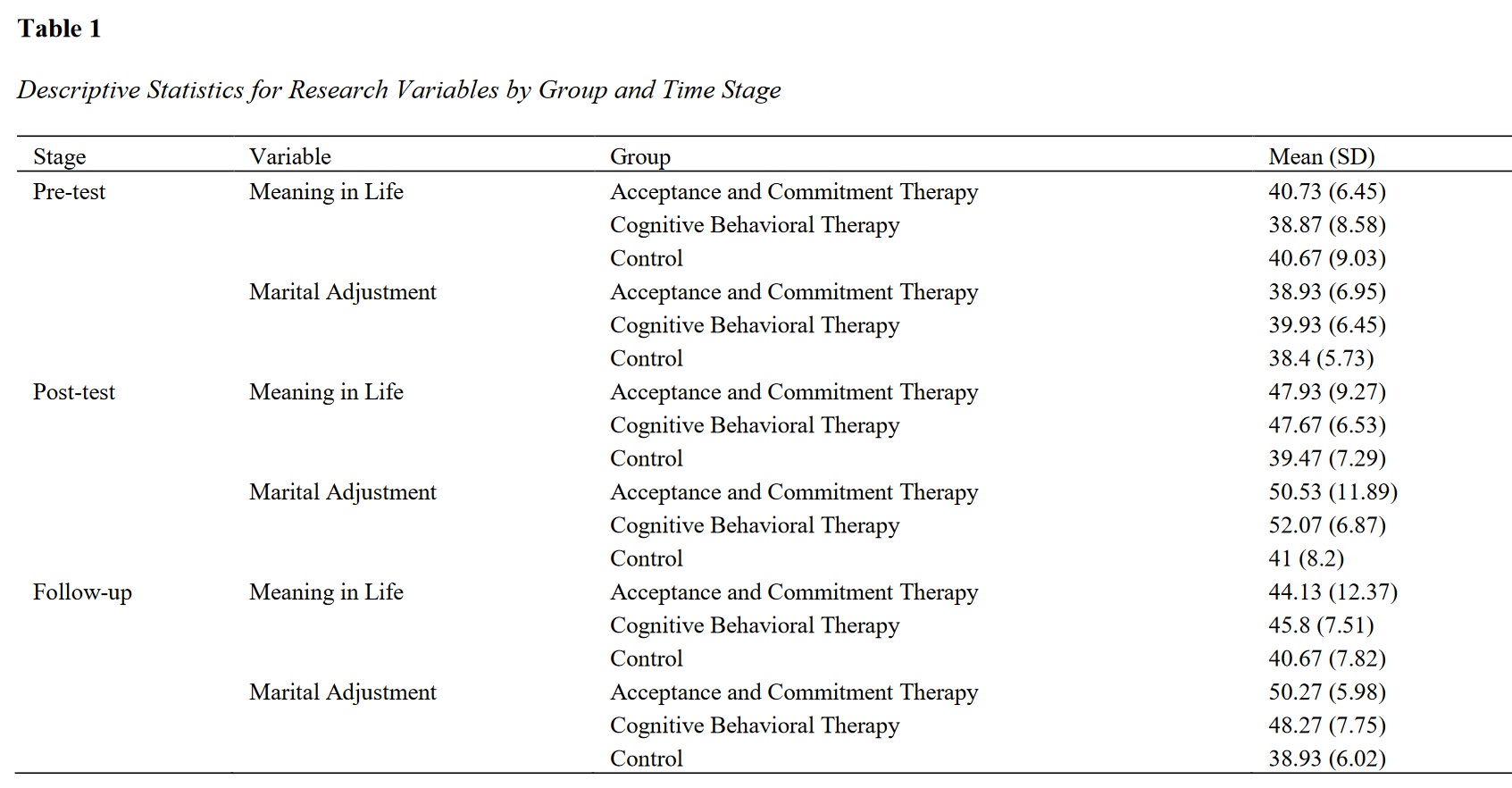
Findings: The results indicated no significant difference in the effectiveness of ACT and CBT group therapies in increasing the variables of meaning in life and marital adjustment. Comparison of the mean scores of the experimental groups in the post-test and follow-up stages also showed that the effects of the independent variables persisted during the follow-up stage, and no significant difference was observed between the post-test and follow-up stages.
Conclusion: The findings indicated no significant difference between Acceptance and Commitment Therapy (ACT) and Cognitive Behavioral Therapy (CBT) in improving meaning in life and marital adjustment among couples. Both therapies demonstrated effectiveness in enhancing psychological flexibility and addressing cognitive distortions, contributing to improved well-being and relational satisfaction.
Downloads
References
Adare, A. A., Zhang, Y., Hu, Y., & Wang, Z. (2021). Relationship between parental marital conflict and social anxiety symptoms of Chinese college students: mediation effect of attachment. Frontiers in psychology, 12(2), 640-770. https://doi.org/10.3389/fpsyg.2021.640770
Alizadeh, F., & Azami, Y. (2022). Prediction of Marital Satisfaction of Couples based on Basic Psychological Needs and Narcissism. Rooyesh, 11(10), 171-180. http://frooyesh.ir/article-۱-۴۱۱۴-fa.html
Araqiyan, S., Nejat, H., Tozandejani, H., & Baqerzadeh, Z. (2023). Comparing the effectiveness of life quality improvement-based skills therapy and compassion-based therapy on distress tolerance and meaning in life among women with conflict. Psychological Methods and Models, 11(39), 121-138. https://jcp.semnan.ac.ir/article_4819.html
Asfaw, L. S., & Alene, G. D. (2023). Effectiveness of a marital relationship skills training intervention on marital adjustment among individuals in Hosanna Town, Southwest Ethiopia: a randomized‐controlled trial. J Marital Fam Ther, 49(3), 541-560. https://doi.org/10.1111/jmft.12641
Azarosh, L., Azmoudeh, M., Rezaei, A., & Moheb, N. (2023). Determining the effectiveness of reality therapy-based counseling on empathy and marital adjustment in women at risk of divorce. Journal of Disability Studies, 13(145), 1-9. https://jdisabilstud.org/article-1-3265-fa.html
Bergman, M., & Keitel, M. A. (2023). At the heart of meaning-making: an acceptance and commitment approach to developing adaptive meaning following acute cardiac events Navigating Life Transitions for Meaning. Academic Press. https://www.ncbi.nlm.nih.gov/pmc/articles/PMC10340097/
Besharat, M. A., & Rafiezadeh, B. (2023). Prediction of sexual satisfaction and marital adjustment levels according to job variables, commitment, intimacy, and sexual knowledge and attitude. Journal of Family Psychology, 3(1), 31-46. https://www.ijfpjournal.ir/article_245509.html?lang=en
Besharat Qaramaleki, R., PanahAli, A., & Hosseini Nasab, D. (2022). Comparison of the effectiveness of group reality-based couple therapy and forgiveness therapy on marital adjustment, emotional differentiation and intimacy of couples with emotional divorce. Journal of counseling research, 20(80), 129-157. https://doi.org/10.18502/qjcr.v20i80.8490
Birditt, K. S., Turkelson, A., Polenick, C. A., Cranford, J. A., & Blow, F. C. (2022). Alcohol Use and Blood Pressure Among Older Couples: The Moderating Role of Negative Marital Quality. The Journals of Gerontology: Series B. https://doi.org/10.1093/geronb/gbac015
Ciarrochi, J., Bilich, L., & Godsell, C. (2020). Psychological flexibility as a mechanism of change in acceptance and commitment therapy. In J Assessing Mindfulness (pp. 51-75). https://www.researchgate.net/publication/223996406_Psychological_flexibility_as_a_mechanism_of_change_in_Acceptance_and_Commitment_Therapy
Deb, S., Thomas, S., Bose, A., & Aswathi, T. (2024). Happiness, meaning, and satisfaction in life as perceived by Indian university students and their association with spirituality. Journal of religion and health, 59(5), 2469-2485. https://doi.org/10.1007/s10943-019-00806-w
El-Mneizel, A., Al Gharaibeh, F., & Al Ali, M. M. (2022). Marital Compatibility in the UAE Society among a Sample of Households in the Emirate of Abu Dhabi (UAE). International Journal of Islamic and Middle Eastern Finance and Management. https://doi.org/10.18576/isl/110422
Eshtad, E. (2009). Examining the effectiveness of cognitive group therapy on the mental well-being of students Master's thesis in Clinical Psychology, Tehran Institute of Psychiatry]. https://elmnet.ir/doc/10474983-42511
Fernández-Rodríguez, C., Coto-Lesmes, R., Martínez-Loredo, V., González-Fernández, S., & Cuesta, M. (2023). Is activation the active ingredient of transdiagnostic therapies? A randomized clinical trial of behavioral activation, acceptance and commitment therapy, and transdiagnostic cognitive-behavioral therapy for emotional disorders. Behavior Modification, 47(1), 3-45. https://doi.org/10.1177/01454455221083309
Forman, E. M., & Herbert, J. D. (1991). New directions in cognitive behavior therapy: acceptance based therapies. In W. O'Donohue & J. E. Fisher (Eds.), Cognitive Behavior Therapy: Applying Empirically Supported Treatments in Your Practice (pp. 263-265). Wiley. https://www.researchgate.net/publication/230745913_New_directions_in_cognitive_behavior_therapy_Acceptance-based_therapies
Ghojavand, K., & Bang, Z. (2016). Group Training acceptance and commitment on reducing loneliness girls Islamic Azad University of Khomeini Shahr master's thesis]. https://socialworkmag.ir/article-1-165-fa.pdf
Ghomian, S., & Shairi, M. R. (2014). The Effectiveness of Acceptance and Commitment Therapy for Children with Chronic Pain on the Quality of Life on 7 to 12 Year-Old Children. International Journal of Pediatrics (Supplement 4), 2(2-3), 20-28. https://jcps.atu.ac.ir/article_8312.html
Gopal, C. R., & Valarmathi, D. (2020). Marital Compatibility and Their Relationship To Personality Among Arranged Marriage Couples And Love Marriage Couples-A Pilot Study. Annals of Tropical Medicine and Public Health, 23, 231-503. https://doi.org/10.36295/ASRO.2020.231503
Görmezoğlu, M., Bouwens van der Vlis, T., Schruers, K., Ackermans, L., Polosan, M., & Leentjens, A. F. (2020). Effectiveness, timing and procedural aspects of cognitive behavioral therapy after deep brain stimulation for therapy-resistant obsessive compulsive disorder: A systematic review. Journal of clinical medicine, 9(8), 2383. https://doi.org/10.3390/jcm9082383
Grau, P. P., Sripada, R. K., Ganoczy, D., Weinstein, J. H., & Pfeiffer, P. N. (2023). Outcomes of Acceptance and Commitment Therapy for depression and predictors of treatment response in Veterans Health Administration patients. Journal of affective disorders, 323, 826-833. https://doi.org/10.1016/j.jad.2022.12.025
Harahsheh, S. (2021). The Marital Compatibility of Married Students in Jordan’s Private Universities Located in the Northern Region, and Its Relation to Some Variables. Asian Social Science, 17(1), 118-118. https://doi.org/10.5539/ass.v17n1p118
Hashemizadeh, F., Rezaei, S., & Montajebiyan, Z. (2021). The effectiveness of meaning-centered therapy combined with the meaning of life based on Mulla Sadra's philosophy on marital conflict. Islamic Women and Family Studies Journal, 9(24), 9-27. https://www.sid.ir/paper/1031619/fa
Hong, F. Y., Chiu, S. I., & Huang, D. H. (2023). A model of the relationship between psychological characteristics, mobile phone addiction and use of mobile phones by Taiwanese university female students. J Comput Hum Behav, 28(6), 2152-2159. https://doi.org/10.1016/j.chb.2012.06.020
Hoppen, L. M., Kuck, N., Bürkner, P. C., Karin, E., Wootton, B. M., & Buhlmann, U. (2021). Low intensity technology-delivered cognitive behavioral therapy for obsessive-compulsive disorder: a meta-analysis. BMC psychiatry, 21(1), 1-17. https://doi.org/10.1186/s12888-021-03272-5
Korporaal, M., Broese Van Groenou, M. I., & Tilburg, T. G. V. (2023). Health problems and marital satisfaction among older couples. Journal of Aging and Health, 25(8), 1279-1298. https://doi.org/10.1177/0898264313501387
Lewin, A. B., Peris, T. S., Bergman, R. L., McCracken, J. T., & Piacentini, J. (2021). The role of treatment expectancy in youth receiving exposure-based CBT for obsessive compulsive disorder. Behaviour Research and Therapy, 49(9), 536-543. https://doi.org/10.1016/j.brat.2011.06.001
Manber, R., Bei, B., Simpson, N., Asarnow, L., Rangel, E., Sit, A., & Lyell, D. (2019). Cognitive behavioral therapy for prenatal insomnia: a randomized controlled trial. Obstetrics and Gynecology, 133(5), 911-919. https://doi.org/10.1097/AOG.0000000000003216
Mardani, M., Marashi, S. A., & Abbaspour, Z. (2022). On the Causal Relationship Between Attachment Styles and Marital Satisfaction: Mediating Role of Gottman's Marital Communication Model. Iranian journal of psychiatry and behavioral sciences, 15(2), 1-8. https://doi.org/10.5812/ijpbs.108339
Mohammadi, N., Darbani, S. A., & Parsakia, K. (2021). The role of psychological capital and career success in marital adjustment. International Journal of Innovation Management and Organizational Behavior (IJIMOB), 1(3), 66-78. https://journals.kmanpub.com/index.php/ijimob/article/view/318
Montajebiyan, Z., & Rezaei Dehnavi, S. (2021). The effectiveness of metacognitive interpersonal therapy on improving couples' dysfunctional communication patterns and increasing marital adjustment. Ravanshenasi Growth (Psychology Growth), 10(8), 135-148. https://frooyesh.ir/article-1-2770-fa.html
Peterson, B. D., Eifert, G. H., Feingold, T., & Davidson, S. (2011). Using acceptance and commitment therapy to treat distressed couples: A case study with two couples. Cognitive and Behavioral Practice, 16(4), 430-442. https://doi.org/10.1016/j.cbpra.2008.12.009
Rezapour Mirsaleh, Y., Mosayebi, M., Khandaghi, Z., & Nazemi, B. (2022). Identifying and Ranking the Factors Affecting Early Marital Conflicts in Newly Married Couples with Interpretive Structural Modeling (ISM) Approach. Journal of Family Research, 17(4), 541-560. https://doi.org/10.52547/JFR.17.4.541
Safa kermanshahi, Y., Nikooei, F., & Hayati, G. (2022). The effectiveness of dialectical behavior therapy on marital adjustment and intimacy of women with marital conflicts. Rooyesh, 10(12), 169-178. http://frooyesh.ir/article-۱-۳۰۹۰-fa.html
Salehi, A., & NajafiSoulari, F. (2016). Based on acceptance and commitment therapy on post divorce adjustment, emotional well-being, loneliness and hope for divorced women Master's thesis in Clinical Psychology, Islamic Azad University of Najaf Abad]. https://journals.iau.ir/article_665274.html
Shadkam, H., Abolqasem, Y., Firoozeh Zangeneh, M., Zabih, P., & Hossein, M. (2022). Designing an academic vitality model based on meaning and hope in life with the mediation of happiness among female high school students in Hamedan city. Islamic lifestyle with a focus on health, 6(4), 187-195. https://www.islamiilife.com/article_185703.html
Shakerinasab, M., Azimzadeh Tehrani, N., Rostami, T., & Parsa Nejad, M. (2022). The Effectiveness of Cognitive-Behavioral Therapy Based on Marlatt's Model on Craving and Addiction Quitting Self-Efficacy in Patients under Treatment with Methadone. etiadpajohi, 16(64), 241-258. https://doi.org/10.52547/etiadpajohi.16.64.241
Spanier, G. B. (1976). Measuring dyadic adjustment: new scales for assessing the quality of marriage and similar dyads. J Marriage Fam, 38(1), 15-22. https://doi.org/10.2307/350547
Tamimi, Y., Soleymani Zadeh, N., Eftekhari, N., & Nemati, Z. (2023). Acceptance and commitment therapy on social adjustment and anxiety in mothers of children with autism. Middle Eastern Journal of Disability Studies, 10(1), 42. https://www.sid.ir/paper/986971/en
Tehrani Azad, L., & Mojtabayi, M. (2019). Structural relationships between marital satisfaction and conflict resolution based on the mediating role of couples' psychological capital. Journal of Applied Psychology, 13(3), 475-496. https://apsy.sbu.ac.ir/article_97257.html
Travezaño-Cabrera, A., Vilca, L. W., Quiroz-Becerra, J., Huerta, S. L., Delgado-Vallejos, R., & Caycho-Rodríguez, T. (2022). Meaning of life questionnaire (MLQ) in peruvian undergraduate students: study of its psychometric properties from the perspective of classical test theory (CTT). BMC psychology, 10(1), 206-214. https://doi.org/10.1186/s40359-022-00913-6
Vowles, K. E., Witkiewitz, K., Sowden, G., & Ashworth, J. (2018). Acceptance and commitment therapy for chronic pain: evidence of mediation and clinically significant change following an abbreviated interdisciplinary program of rehabilitation. J Pain, 15(1), 101-113. https://doi.org/10.1016/j.jpain.2013.10.002
Wilhelm, S., Steketee, G., Siev, J., Yovel, I., & Lit, K. (2019). Predictors and Moderators of Cognitive and Behavioral Therapy Outcomes for OCD: A Patient-Level Mega-Analysis of Eight Sites. Behavior therapy, 50(1), 165-176. https://doi.org/10.1016/j.beth.2018.04.004
Zaheri, F., Dolatian, M., Shariati, M., Simbar, M., Ebadi, A., & Azghadi, S. B. H. (2021). The concept and aspects of a successful marriage as stated by successful Iranian couples and experts: A qualitative study. Crescent Journal of Medical and Biological Sciences, 7(2), 159-169. https://www.researchgate.net/publication/340654390_The_Concept_and_Aspects_of_a_Successful_Marriage_as_Stated_by_Successful_Iranian_Couples_and_Experts_A_Qualitative_Study
Zhang, P., Ye, L., Fu, F., & Zhang, L. G. (2021). The influence of gratitude on the meaning of life: the mediating effect of family function and peer relationship. Frontiers in psychology, 12(7), 680-795. https://doi.org/10.3389/fpsyg.2021.680795
Downloads
Additional Files
Publication Timeline
- Submitted
- Revised
- Accepted
Issue
Section
License
Copyright (c) 2025 Fatemeh Sadat Sedighi (Author); Tahmoores Aghajani Hashjin (Corresponding Author); Mohsen Jadidi (Author)

This work is licensed under a Creative Commons Attribution-NonCommercial 4.0 International License.