The Structural Model of Resilience Based on Role Overload and Job Stress with the Mediation of Difficulty in Emotion Regulation
DOI:
https://doi.org/10.61838/kman.jarac.7.2.9Keywords:
Resilience, Role Overload, Job Stress, Emotion Regulation Difficulty, Military Personnel, Structural ModelAbstract
Objective: This study aimed to develop a structural model of resilience based on role overload, job stress, and job control with the mediation of difficulty in emotion regulation among the special unit employees of the Law Enforcement Command of Tehran City.
Methods and Materials: This study was descriptive-correlational and utilized structural equation modeling (SEM). The statistical population consisted of all special unit employees of the Law Enforcement Command of Tehran City in 2022 (413 individuals). Sampling was conducted using a convenience (voluntary) method, and based on the Morgan table, the sample size was determined to be 200 participants. Research tools included questionnaires on resilience, role overload, job stress, and difficulty in emotion regulation. Data were analyzed using SPSS and AMOS software, version 24.
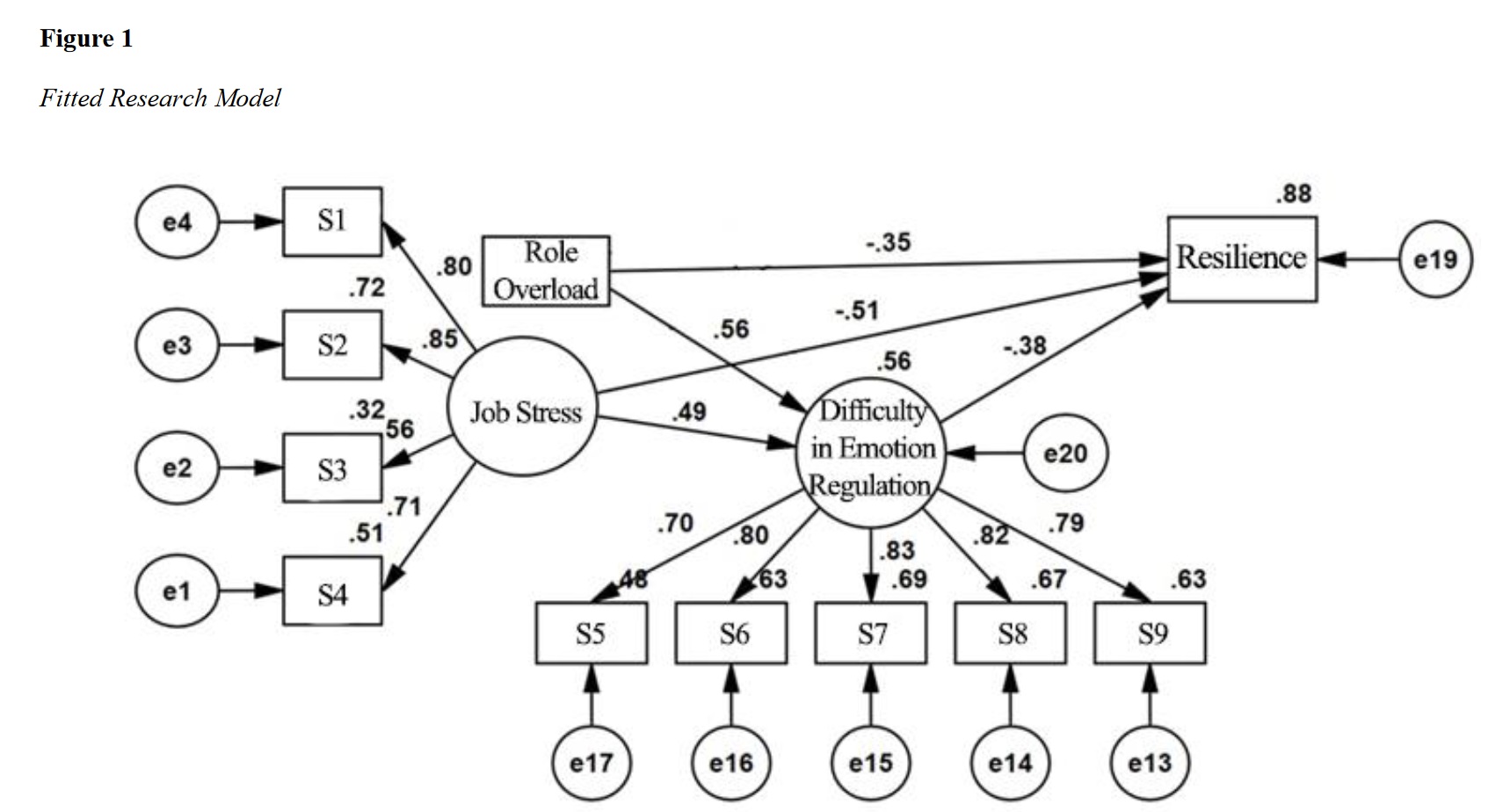
Findings: The results indicated that role overload, job stress, and difficulty in emotion regulation all had a significant negative impact on resilience (β=-0.349, β=-0.513, β=-0.380, p<0.01, respectively). Additionally, role overload and job stress directly and significantly affected difficulty in emotion regulation (β=0.564, β=0.491, p<0.01). Model fit indices showed that the proposed research model had an acceptable fit (RMSEA=0.029, CFI=0.991).
Conclusion: The structural model of resilience based on role overload, job stress, and job control with the mediation of difficulty in emotion regulation among the special unit employees of the Law Enforcement Command of Tehran City was confirmed. This model can help identify factors affecting resilience and improve the psychological well-being of these employees.
Downloads
References
Abhari, M., & Esmaili Shad, B. (2018). Examining the relationship between role overload and emotional exhaustion with emphasis on the mediating role of emotional intelligence (Case study: Khorasan Razavi Regional Water Company). Journal of Psychological Research in Management, 4(1), 33-60. https://civilica.com/doc/1388199/
Chang, E., & Hancock, K. (2003). Role stress and role ambiguity in new nursing graduates in Australia. Nursing & Health Sciences, 5(2), 155-163. https://doi.org/10.1046/j.1442-2018.2003.00147.x
Firoozkouhi Berenj Abadi, M., & Pourhossein, M. (2022). Examining the role of job engagement on job stress and resilience among nurses. Nursing Management Quarterly, 11(3), 26-37. https://ijnv.ir/browse.php?a_code=A-10-1487-1&sid=1&slc_lang=fa
Gharibi, V., Malakouti, J., Arsenjang, S., & Gholami, A. (2013). Examining the prevalence of job stress and its relationship with personal characteristics of workers in a tunneling industry. Journal of Health System Research, 9(1), 57-65. https://hsr.mui.ac.ir/article-1-588-fa.html
Gratz, K. L., Forbes, C. N., Wheeless, L. E., Richmond, J. R., & Tull, M. T. (2020). Self-report assessment of emotion dysregulation. The Oxford Handbook of Emotion Dysregulation, 395-409. https://doi.org/10.1093/oxfordhb/9780190689285.013.28
Gratz, K. L., & Roemer, L. (2004). Multidimensional assessment of emotion regulation and dysregulation: Development, factor structure, and initial validation of the difficulties in emotion regulation scale. Psychopathology and Behavioral Assessment, 26(1), 41-54. https://doi.org/10.1023/B:JOBA.0000007455.08539.94
Hezavahai, S. M. M., Hosseini, Z., Moeini, B., Moghimbeygi, A., & Hamidi, Y. (2012). Job stress and coping strategies among nurses in hospitals in Hamadan city based on the PRECEDE model. Horizon of Medical Sciences, 18(2), 78-86. https://www.sid.ir/paper/68591/fa
Jahanbakhsh-Ganjeh, S., & Arizi, H. (2012). The relationship between job demands, job control, job stress, positive affect, and negative affect among employees. Journal of Cognitive and Behavioral Sciences Research, 2(2), 75-90. https://cbs.ui.ac.ir/article_17297.html
Khalili, A., & Hosseini Mahboob, S. R. (2020). The relationship between meritocracy, job stress, job control, and perceived organizational support with employee performance. Journal of Human Capital Empowerment, 3(3), 175-184. https://journals.iau.ir/article_678421.html
Kılıç, C., Yüksel Doğan, R., & Metin, E. N. (2024). Exploring the Relationship between Turkish Mothers' Parenting and Psychological Well-Being in Early Childhood: The Role of Child Emotion Regulation and Dysregulation. Behavioral Sciences, 14(6), 426-436. https://doi.org/10.3390/bs14060426
Lovelace, K. J., Manz, C. C., & Alves, J. C. (2007). Work stress and leadership development: The role of self-leadership, shared leadership, physical fitness and flow in managing demands and increasing job control. Human Resource Management Review, 17(4), 374-387. https://doi.org/10.1016/j.hrmr.2007.08.001
Mosavi, S. A., Alvani, J. a., & Ghasemi Panah, M. (2021). Investigating the Relationship between Emotional Adjustment and Cognitive Emotion Regulation with Resilience in Military Nurses [Original Article]. Journal of Marine Medicine, 3(1), 39-45. https://doi.org/10.30491/3.1.39
Rancher, C., & Moreland, A. D. (2023). Adverse childhood experiences, stress, and resilience among early childhood teachers. Early Childhood Research Quarterly, 62(1), 186-193. https://doi.org/10.1016/j.ecresq.2022.08.007
Rezaei, M., & Esmaili Shad, B. (2018). The relationship between role overload and job control with emphasis on the mediating role of psychological capital among employees. Journal of Psychological Research in Management, 4(2), 9-32. https://jom.hmu.ac.ir/article_243684.html
Samadirad, B., Nazari, J., Hasirchi, N., & Baybordi, F. (2020). Investigating factors causing job stress among employees of various units of forensic centers in the northwestern provinces of Iran. Journal of Occupational Health and Safety, 10(3), 189-200. https://jhsw.tums.ac.ir/article-1-6367-fa.html
Smith, J. E., Brinkman, H. R., Aston, E. R., Zvolensky, M. J., Leyro, T. M., & Farris, S. G. (2023). Difficulties in emotion regulation and ad libitum smoking topography: A secondary analysis. Addictive behaviors, 137(1), 1-10. https://doi.org/10.1016/0306-4603(92)90047-Y
Sotiriadis, M., & Galanakis, M. (2022). Self-regulation and emotional resilience in the workplace. A systematic review. Psychology, 12(12), 957-964. https://doi.org/10.17265/2159-5542/2022.12.007
Springstein, T., & English, T. (2024). Distinguishing emotion regulation success in daily life from maladaptive regulation and dysregulation. Personality and Social Psychology Review, 28(2), 209-224. https://doi.org/10.1177/10888683231199140
Ta'an, W., Hijazi, D., Suliman, M., Abu Al Rub, R., & Albashtawy, M. (2024). Exploring the relationships between stress, resilience and job performance among nurses in Jordan. Nursing Management-UK, 31(3), 1-10. https://doi.org/10.7748/nm.2023.e2112
Taherifar, Z., Ferdowsi, S., Mootabi, F., Mazaheri, M. A., & Fata, L. (2015). The mediating role of emotion dysregulation strategies on the relationship between negative emotion intensity and safety motivation with generalized anxiety symptoms. Contemporary psychology, 10(2), 51-66. https://www.magiran.com/paper/1513283
Thompson, R. A. (2019). Emotion dysregulation. https://sedlpubs.faculty.ucdavis.edu/wp-content/uploads/sites/192/2020/04/Thompson2019DevPsychopath.pdf
Tull, M. T., Vidaña, A. G., & Betts, J. E. (2020). Emotion regulation difficulties in PTSD. In Emotion in posttraumatic stress disorder (pp. 295-310). Elsevier. https://www.sciencedirect.com/science/article/pii/B9780128160220000107
Tummers, G. E. R., Landeweerd, J. A., Janssen, P. P. M., & van Merode, G. G. (2006). Organizational characteristics, work characteristics, and relationships with psychologic work reactions in nursing: A longitudinal study. International Journal of Stress Management, 13(2), 201-227. https://doi.org/10.1037/1072-5245.13.2.201
Zare, F., Khademian, M., Behjati Ardakani, M., Zare, M., Parvizi, R., & Bagheraei, A. (2015). Job stress and its relationship with job satisfaction among control room staff of one of the oil refineries in southern Iran. Journal of Preventive Medicine, 2(3), 47-55. https://jpm.hums.ac.ir/article-1-89-fa.html
Downloads
Additional Files
Publication Timeline
- Submitted
- Revised
- Accepted
Issue
Section
License
Copyright (c) 2024 Hossein Rostami, Gholamreza Chalabianloo, Hassan Bafandeh Gharamaleki (Author); Rasoul Karimi (Corresponding Author)

This work is licensed under a Creative Commons Attribution-NonCommercial 4.0 International License.