The Structural Model of Marital Conflicts Based on Gender Stereotypes and Emotional Needs with the Mediation of Coping Styles
DOI:
https://doi.org/10.61838/kman.jarac.7.2.5Keywords:
Marital Conflicts, Gender Stereotypes, Emotional Needs, Coping StylesAbstract
Objective: The aim of this study was to determine the fit of the model of marital conflicts based on gender stereotypes and emotional needs with the mediation of coping styles.
Methods and Materials: This research was applied in terms of its objective and correlational in terms of its methodology, specifically using structural equation modeling (SEM). The statistical population consisted of all couples experiencing marital conflicts who sought counseling services in Tehran. From this population, a total of 500 individuals were purposefully selected through voluntary sampling as the study sample. The participants responded to the Marital Conflict Questionnaire (MCQ), Bem Sex Role Inventory (1982), Young-Rigg Escape Questionnaire (1994), and Primary Emotional Needs Questionnaire. The collected data were analyzed using Pearson correlation regression and structural equation modeling via PLS software.
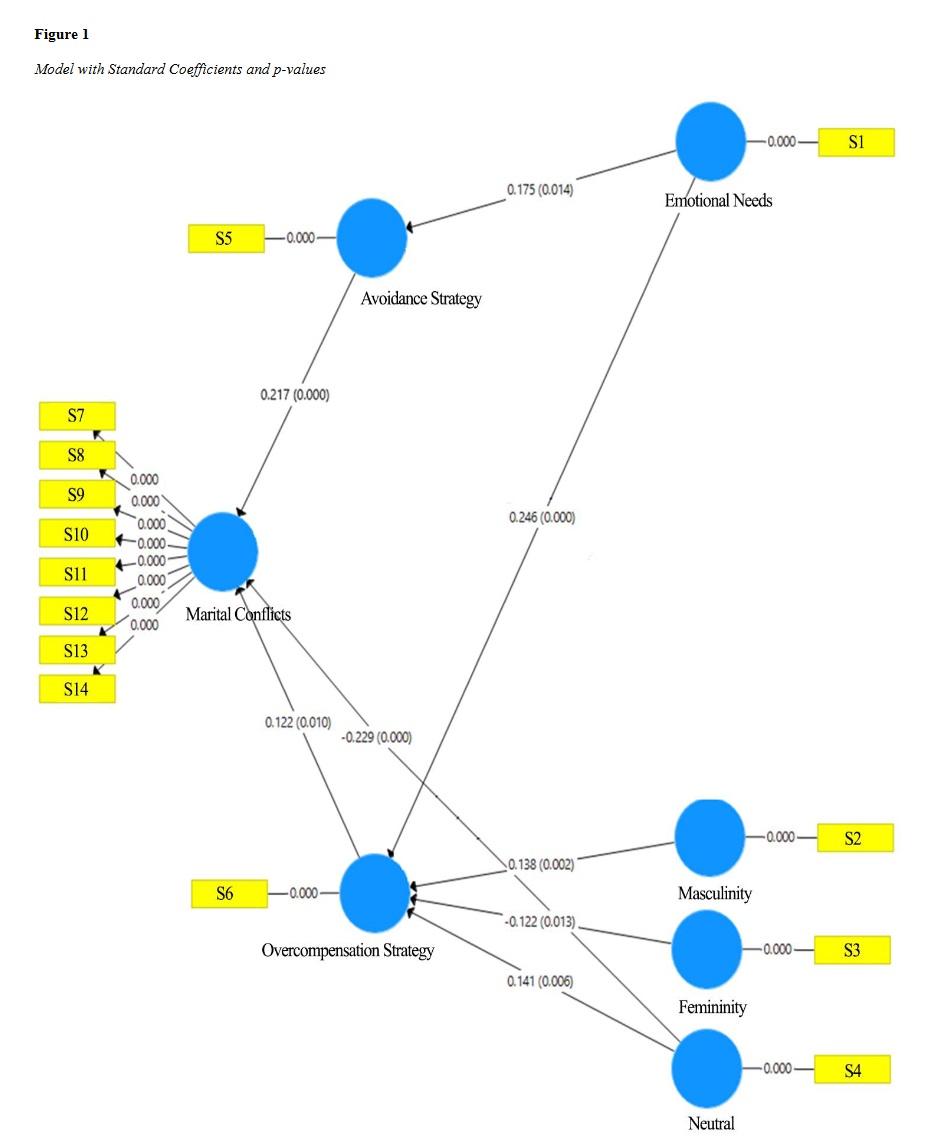
Findings: The study’s findings indicated that among the gender roles, only the neutral gender role had a significant direct effect on marital conflicts with a standardized beta coefficient of -0.229. The feminine and masculine gender roles did not have significant direct effects on marital conflicts. Emotional needs, with a standardized beta coefficient of 0.069, did not have a significant direct effect on marital conflicts. The feminine, masculine, and neutral gender roles did not have significant indirect effects on marital conflicts through the mediation of avoidance and overcompensation coping strategies. Emotional needs had an indirect effect on marital conflicts through the mediation of avoidance coping strategies, with a standardized coefficient of 0.037. Emotional needs also had a significant indirect effect on marital conflicts through the mediation of overcompensation coping strategies, with a standardized coefficient of 0.030.
Conclusion: The study concluded that the neutral gender role has a significant and direct effect on reducing marital conflicts, while femininity and masculinity roles do not have a direct impact. Emotional needs did not show a significant direct influence on marital conflicts, but they do contribute indirectly through avoidance and overcompensation coping strategies, which in turn can exacerbate conflicts. These findings highlight the importance of considering gender roles and coping strategies in addressing marital conflicts, suggesting that interventions should focus on these factors to enhance marital satisfaction and stability.
Downloads
References
Algorani, E. B., & Gupta, V. (2023). Coping mechanisms. In StatPearls. StatPearls Publishing. https://www.ncbi.nlm.nih.gov/books/NBK559031/
Arabpour, S., Khosravi, Z., & Sarrami, G. (2018). Investigating gender differences in early maladaptive schemas and coping styles: A schema-focused approach. Women's Social-Psychological Studies Quarterly, 16(1), 13-22. https://jwsps.alzahra.ac.ir/article_3596.html?lang=fa
Balsamo, M., Murdock, K. K., & Carlucci, L. (2022). Psychological factors in adherence to COVID-19 public health restrictions in Italy: A path model testing depressed mood, anxiety, and co-rumination via cellphone. PLoS One, 17(12), e0278628. https://doi.org/10.1371/journal.pone.0278628
Ben-Zur, H. (2009). Coping styles and affect. International Journal of Stress Management, 16(2), 87. https://doi.org/10.1037/a0015731
Butler, J. (2020). Performative acts and gender constitution: An essay in phenomenology and feminist theory. In Feminist theory reader (pp. 353-361). Routledge. https://doi.org/10.4324/9781003001201-42
Cassidy, J., & Shaver, P. R. (1999). Handbook of attachment: Theory, research, and clinical applications. Rough Guides. https://books.google.com/books?hl=en&lr=&id=haEfq-nKqjgC&oi=fnd&pg=PA3&dq=%5B1%5D%09Handbook+of+attachment:+Theory,+research,+and+clinical+applications:+Rough+Guides%3B+1999.+&ots=Tn3L1hbpmQ&sig=1M8QrbhZyNz1CGNN86U5nFbXzHo
Chodorow, N. J. (2012). Individualizing gender and sexuality: Theory and practice. Routledge. https://doi.org/10.4324/9780203816066
Fisher, W. A. (2022). A psychological approach to human sexuality: The sexual behavior sequence. In Alternative Approaches To the Study of Sexual Behavior (pp. 131-171). Psychology Press. https://doi.org/10.4324/9781315792637-6
Ghasemi Moghaddam, K., Shafiabadi, A., & Sharifi, A. (2020). Marital conflicts and basic needs: The mediating role of spirituality. Clinical Psychology and Personality, 18(2), 55-65. https://cpap.shahed.ac.ir/article_3224_en.html
Halford, W. K., & Pepping, C. A. (2019). What every therapist needs to know about couple therapy. Behaviour Change, 36(3), 121-142. https://doi.org/10.1017/bec.2019.12
Jafari Manesh, M., Zehrakar, K., & Taghvaei, D. (2021). The impact of "Acceptance and Commitment Therapy" on marital burnout in couples with marital conflict. 18(4). https://sjsph.tums.ac.ir/article-1-5964-fa.html
Lotfi, B., Jajarmi, M., & Mohammadi Pour, M. (2020). The effectiveness of therapy based on Relational Frame Theory on differentiation and marital conflicts of couples. Nursing and Midwifery Journal, 18(4), 330-340. https://unmf.umsu.ac.ir/article-1-4069-fa.html
Mohammadi, N., Darbani, S. A., & Parsakia, K. (2021). The role of psychological capital and career success in marital adjustment. International Journal of Innovation Management and Organizational Behavior (IJIMOB), 1(3), 66-78. https://journals.kmanpub.com/index.php/ijimob/article/view/318
Moradi, A., Ghiaasi, M., Karimi, S., Yedalehi, S., Izadi, S., Sadri, M., Mohammadi, F., Zohreh Jafarzadeh, J., & Zahra, P. (2022). The impact of parenting styles on early maladaptive schemas with the mediating role of overcompensation and avoidance coping strategies. New Ideas in Psychology Quarterly, 17, 0-17. https://civilica.com/doc/1990732/
Munsch, C. L. (2018). Correction: "Her Support, His Support: Money, Masculinity, And Marital Infidelity" American Sociological Review 80 (3): 469-95. American Sociological Review, 83(4), 833-838. https://doi.org/10.1177/0003122418780369
Nemat Zadeh Getabi, S., Vaziri, S., & Lotfi Kashani, F. (2022). Investigating modeling of communication patterns and marital intimacy based on attachment styles and object relations with the mediation of coping styles. Applied Family Therapy, 3(2). https://doi.org/10.61838/kman.aftj.3.2.2
Panah Azadeh, A., Sajadian, E., & Nadi, M. A. (2020). The mediating role of marital conflicts in the relationship between communication beliefs, emotional disorders, marital communications, and marital satisfaction in women with addicted husbands. Addiction Research Quarterly, 14(55), 9-28. https://doi.org/10.29252/etiadpajohi.14.55.9
Park, T. Y., & Park, Y. (2019). Contributors influencing marital conflicts between a Korean husband and a Japanese wife. Contemporary Family Therapy, 41, 157-167. https://doi.org/10.1007/s10591-018-9475-9
Ponzetti, J. J., & Cate, R. M. (2021). The developmental course of conflict in the marital dissolution process. In The Divorce Process (pp. 1-15). Routledge. https://doi.org/10.4324/9781315859965-2
Rahimi Ahmadabadi, S., Kalantari, M., Abedi, M. R., & Modarres Gharavi, S. M. (2020). The role of gender stereotypes in predicting irrational beliefs and mental health in individuals with gender dissatisfaction. Disability Studies, 10(1), 10-25. https://jdisabilstud.org/browse.php?a_code=A-10-1411-1&slc_lang=fa&sid=1
Thornes, B., & Collard, J. (2023). Who divorces? Taylor & Francis. https://doi.org/10.4324/9781003384168
Trombello, J. M., Post, K. M., & Smith, D. A. (2019). Depressive symptoms, criticism, and counter-criticism in marital interactions. Family Process, 58(1), 165-178. https://doi.org/10.1111/famp.12349
Yeon, E. M., & Choi, H. S. (2020). Trajectories of Mothers' Perceived Marital Conflict and its Relationship to Depression and Children'School Readiness, Self-esteem, and Happiness. Journal of the Korea Academia-Industrial Cooperation Society, 21(5), 344-352. https://koreascience.kr/article/JAKO202016151585326.page
Young, J. E. (1995). Young compensation inventory. Cognitive Therapy Center of New York. https://nzdr.ru/data/media/biblio/kolxoz/B/BH/Lebow%20J.%20(ed.)%20Twenty-first%20century%20psychotherapies%20(Wiley,%202008)(ISBN%200471752231)(O)(520s)_BH_.pdf#page=53
Zeraat Pisheh, R., Shiri, A., Najafi Abrand Abadi, A. H., & Mahmoudi Janki, F. (2020). Gender stereotypes influencing the occurrence of sexual assault in the components of Iranian culture. Criminal Law Research Quarterly, 9(32), 151-177. https://jclr.atu.ac.ir/article_11780.html
Downloads
Additional Files
Publication Timeline
- Submitted
- Revised
- Accepted
Issue
Section
License
Copyright (c) 2024 Hossein Siri (Author); Mohsen Mohammadi (Corresponding Author); Majid Zargham Hajebi (Author)

This work is licensed under a Creative Commons Attribution-NonCommercial 4.0 International License.