The Effectiveness of Academic Buoyancy Training on Academic Burnout, Self-Destructive Behavior, and Thought Control Strategies in High School Students
DOI:
https://doi.org/10.61838/kman.jarac.7.2.3Keywords:
Academic Buoyancy, Academic Burnout, Self-Destructive Behavior, Thought Control Strategies, High School Students, Psychological ResilienceAbstract
Objective: This study aimed to evaluate the effectiveness of academic buoyancy training in reducing academic burnout, self-destructive behaviors, and enhancing thought control strategies among high school students.
Methods and Materials: A quasi-experimental design with a pre-test, post-test, and follow-up was employed, involving 60 female high school students from District 2 of Karaj city during the 2022-2023 academic year. Participants were randomly assigned to either the academic buoyancy training group (n= 15) or the control group (n= 15). The intervention consisted of 12 sessions of academic buoyancy training. Data were collected using the Academic Burnout Questionnaire, Cunningham's Self-Destructive Behavior Scale, and the Wells and Davies Thought Control Questionnaire. Data analysis included ANCOVA to assess the effectiveness of the intervention, with assumptions of normality, homogeneity of variances, and linearity confirmed.
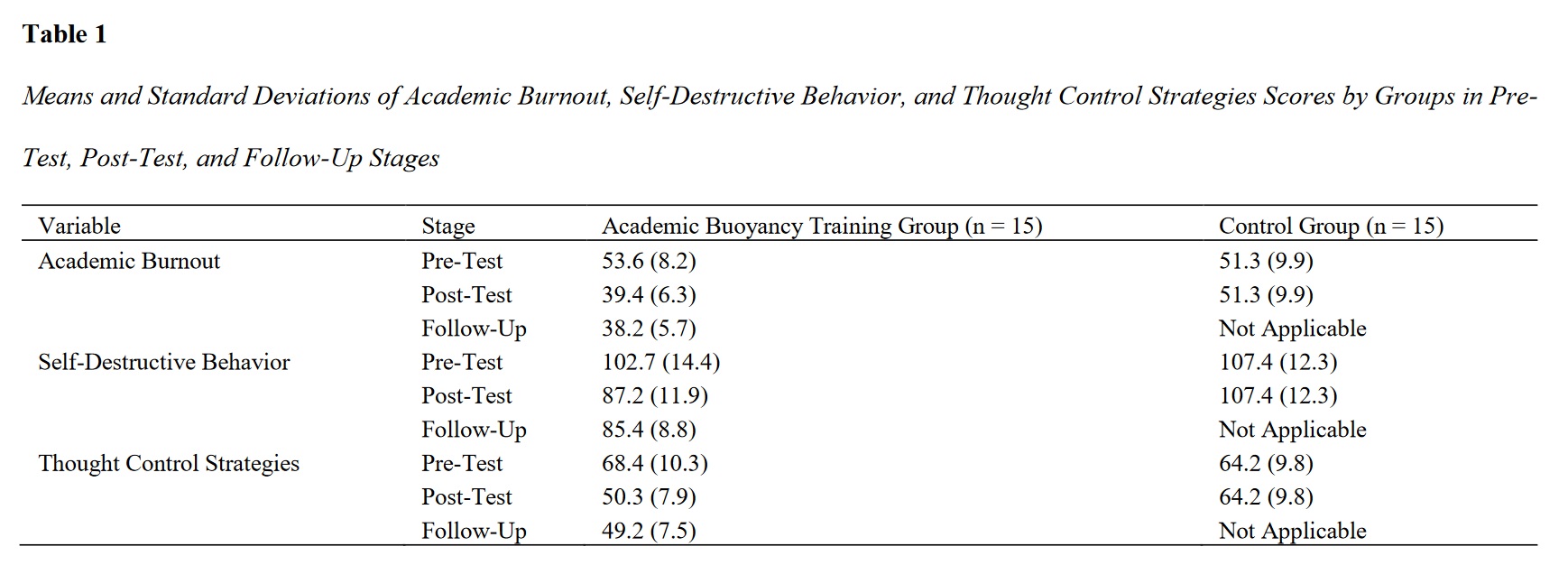
Findings: The results demonstrated significant reductions in academic burnout, self-destructive behaviors, and improvements in thought control strategies in the training group compared to the control group. Specifically, academic burnout scores decreased from M= 53.6 (SD= 8.2) in the pre-test to M= 39.4 (SD= 6.3) in the post-test (p < .001, η²= .724). Self-destructive behavior scores reduced from M= 102.7 (SD= 14.4) to M= 87.2 (SD= 11.9) (p < .001, η²= .627), and thought control strategies improved from M= 68.4 (SD= 10.3) to M= 50.3 (SD= 7.9) (p < .001, η²= .614).
Conclusion: Academic buoyancy training significantly reduces academic burnout and self-destructive behaviors while enhancing thought control strategies among high school students. These findings suggest that academic buoyancy training is an effective intervention to promote psychological resilience and academic success in adolescents.
Downloads
References
Abdellatif, M. S. (2022). Academic buoyancy of university students and its relationship to academic average in light of some demographic variables. Kıbrıslı Eğitim Bilimleri Dergisi, 17(7), 2361-2369. https://www.ceeol.com/search/article-detail?id=1074945
Abdi, A., & Zandipayam, A. (2020). The Model of Academic Performance based on Academic Identity, Academic Vitality and Flourishing of Students, and Academic Selfefficacy. https://www.sid.ir/paper/410011/en
Abdolpour, G., Khanjani, Z., Aliloo, M., & Fakhari, A. (2019). The effectiveness of meta-cognitive therapy on thought control strategies in patients with post-traumatic stress disorder. Psychological Achievements, 26(1), 151-168. https://doi.org/10.22055/psy.2019.24714.1987
Ahmadpour, R., Armand, M., & Najari, M. (2021). The effectiveness of the social adjustment curriculum on academic buoyancy, academic identity and cognitive flexibility of gairl students. Cultural Psychology, 4(2), 74-90. http://jcp.samt.ac.ir/article_119491.html?lang=en
Amiri, A., BahramAbadi, M. Z., Heydari, H., & Davoodi, H. (2019). The Mediating Role of Academic Motivation in Explaining the Relationship between Academic Self-efficacy and Academic Self-Regulation with Academic Burnout in Female Students. medical journal of mashhad university of medical sciences, 62(3), 1562-1573. https://doi.org/10.22038/mjms.2019.14269
Andrade, D., Ribeiro, I. J. S., & Máté, O. (2023). Academic burnout among master and doctoral students during the COVID-19 pandemic. Scientific reports, 13(1), 4745. https://doi.org/10.1038/s41598-023-31852-w
Bai, Q., Bai, S., Dan, Q., Lei, L., & Wang, P. (2020). Mother phubbing and adolescent academic burnout: The mediating role of mental health and the moderating role of agreeableness and neuroticism. Personality and individual differences, 155, 109622. https://doi.org/10.1016/j.paid.2019.109622
Biwer, F., de Bruin, A., & Persky, A. (2023). Study smart – impact of a learning strategy training on students’ study behavior and academic performance. Advances in Health Sciences Education, 28(1), 147-167. https://doi.org/10.1007/s10459-022-10149-z
Chen, Z.-h., Ma, Y.-y., Feng, X.-h., & Lin, Y. (2023). Correlation analysis of self-directed learning ability, self-efficacy and academic burnout of junior nursing college students in closed management colleges. Nursing Open, 10(4), 2508-2518. https://doi.org/10.1002/nop2.1509
Dong, H., Li, W., & Ye, D. (2022). The Influence of English as a Foreign Language Teachers’ Positive Mood and Hope on Their Academic Buoyancy: A Theoretical Review [Mini Review]. Frontiers in psychology, 12. https://doi.org/10.3389/fpsyg.2021.801435
Einy, S., Narimani, M., & Basharpoor, S. (2019). Prediction of Academic Achievement based on Academic Buoyancy and Self-Directed Learning of Female Students. Biquarterly Journal of Cognitive Strategies in Learning, 7(12), 33-45. https://doi.org/10.22084/j.psychogy.2018.13800.1603
Fakharian, J., Yaghoobi, A., Zargham Hajebi, M., & Mohagheghi, H. (2020). Predicting Academic Buoyancy based on Family Emotional Climate, Academic Engagement, and Academic Self-Efficacy. medical journal of mashhad university of medical sciences, 63(2), 2391-2401. https://doi.org/10.22038/mjms.2020.16166
Farid, A., & Ashrafzade, T. (2021). Causal explanation of academic buoyancy based on teacher-student interaction, self-efficacy and academic hope. The Journal of New Thoughts on Education, 17(2), 203-227. https://jontoe.alzahra.ac.ir/article_5548.html?lang=en
Ghadampour, E. (2021). Effectiveness of meta-cognitive therapy on of test anxiety in high school girl students of Khorramabad city. Educational Psychology, 17(62), 131-144. https://doi.org/10.22054/jep.2022.7151.1279
Ghamari, m. (2022). Predicating the academic buoyancy and academic performance of college students based on Islamic lifestyle. Cultural Psychology, 6(1), 179-198. https://doi.org/10.30487/jcp.2022.303996.1309
Ghods, A. A., Ebadi, A., Sharif Nia, H., Allen, K.-A., & Ali-Abadi, T. (2023). Academic burnout in nursing students: An explanatory sequential design. Nursing Open, 10(2), 535-543. https://doi.org/10.1002/nop2.1319
Hadad Ranjbar, S., Sadipour, E., Dortaj, F., Delavar, A., & Ebrahimi Qavam, S. (2020). The Effectiveness of Acceptance and Commitment Training prgram on motivational beliefs and future time perspective for students with academic self-defeating behaviors. Clinical Psychology and Personality, 17(2), 31-45. https://cpap.shahed.ac.ir/article_2906_en.html?lang=fa
Heydarnejad, T., Ibrahim, K. A. A.-A., Abdelrasheed, N. S. G., & Rezvani, E. (2022). The effect of academic emotion regulation on EFL learners’ core of self-assessment and academic buoyancy: a structural equation modeling. Language testing in Asia, 12(1), 57. https://doi.org/10.1186/s40468-022-00207-z
Hoferichter, F., Hirvonen, R., & Kiuru, N. (2021). The development of school well-being in secondary school: High academic buoyancy and supportive class- and school climate as buffers. Learning and Instruction, 71, 101377. https://doi.org/10.1016/j.learninstruc.2020.101377
Javadi Elmi, L., Asadzadeh, H., Delavar, A., & Dortaj, F. (2020). Structural Equation Modeling of Students' academic engagement based on Academic Self-efficacy, transformational teaching with the Mediation Role of Academic Buoyancy. Biquarterly Journal of Cognitive Strategies in Learning, 8(14), 1-19. https://doi.org/10.22084/j.psychogy.2019.16774.1798
Karimi, M. N., & Fallah, N. (2021). Academic burnout, shame, intrinsic motivation and teacher affective support among Iranian EFL learners: A structural equation modeling approach. Current Psychology, 40(4), 2026-2037. https://doi.org/10.1007/s12144-019-0138-2
Kent, L., Nelson, B., & Northoff, G. (2023). Can disorders of subjective time inform the differential diagnosis of psychiatric disorders? A transdiagnostic taxonomy of time. Early Intervention in Psychiatry, 17(3), 231-243. https://doi.org/10.1111/eip.13333
Laketa, S., & Côte, M. (2023). Discomforts in the academy: from ‘academic burnout’ to collective mobilisation. Gender, Place & Culture, 30(4), 574-587. https://doi.org/10.1080/0966369X.2021.2014405
Lei, W., Wang, X., Dai, D. Y., Guo, X., Xiang, S., & Hu, W. (2022). Academic self-efficacy and academic performance among high school students: A moderated mediation model of academic buoyancy and social support. Psychology in the Schools, 59(5), 885-899. https://doi.org/10.1002/pits.22653
Leupold, C. R., Lopina, E. C., & Erickson, J. (2020). Examining the Effects of Core Self-Evaluations and Perceived Organizational Support on Academic Burnout Among Undergraduate Students. Psychological Reports, 123(4), 1260-1281. https://doi.org/10.1177/0033294119852767
Mansournia, S., & Karimi, K. (2020). The Relationship between Academic Achievement and Self-Handicapping due to Mediating Effect of Academic Burnout among University Students. The Scientific Journal of Rehabilitation Medicine, 9(3), 254-264. https://doi.org/10.22037/jrm.2020.111571.2066
Nurjamin, A., Salazar-Espinoza, D.-E., Saenko, N., & Bina, E. (2023). Learner-oriented assessment matters: testing the effects of academic buoyancy, reflective thinking, and learner enjoyment in self-assessment and test-taking anxiety management of the EFL learners. Language testing in Asia, 13(1), 30. https://doi.org/10.1186/s40468-023-00247-z
Park, I.-J., Rie, J., Kim, H. S., & Park, J. (2018). Effects of a Future Time Perspective–Based Career Intervention on Career Decisions. Journal of Career Development, 47(1), 96-110. https://doi.org/10.1177/0894845318781043
Platania, S., Di Nuovo, S., Caruso, A., Digrandi, F., & Caponnetto, P. (2020). Stress among university students: The psychometric properties of the Italian version of the SBI-U 9 scale for Academic Burnout in university students. Health Psychology Research, 8(2). https://www.ncbi.nlm.nih.gov/pmc/articles/PMC7588845/
Putwain, D. W., Beaumont, J., & Gallard, D. (2023). Adaptability vs. buoyancy: Which offers the greater protection against test anxiety and could relations be reciprocal? Learning and Individual Differences, 101, 102247. https://doi.org/10.1016/j.lindif.2022.102247
Rönnlund, M., Koudriavtseva, A., Germundsjö, L., Eriksson, T., Åström, E., & Carelli, M. G. (2019). Mindfulness Promotes a More Balanced Time Perspective: Correlational and Intervention-Based Evidence. Mindfulness, 10(8), 1579-1591. https://doi.org/10.1007/s12671-019-01113-x
Salavera, C., Usán, P., & Jarie, L. (2020). Styles of humor and social skills in students. Gender differences. Current Psychology, 39(2), 571-580. https://doi.org/10.1007/s12144-017-9770-x
Samari Safa, J., & Poordel, M. (2022). Developing an Academic Burnout model based on Family Emotional Climate, psychological capital, purposefulness, procrastination and academic involvement of graduate students. Counseling Culture and Psycotherapy, 13(49), 131-162. https://doi.org/10.22054/qccpc.2021.58418.2628
Senobar, A., Kasir, S., TaghaviNasab, A., & Raeisi, E. (2018). The Role of Cognitive and Metacognitive Learning Strategies, Academic Optimism and Academic Engagement in Predicting Academic Vitality of Nursing Students. Edu-Str-Med-Sci, 11(2), 149-155. https://doi.org/10.29252/edcbmj.11.02.19
Stolarski, M., Zajenkowski, M., Jankowski, K. S., & Szymaniak, K. (2020). Deviation from the balanced time perspective: A systematic review of empirical relationships with psychological variables. Personality and individual differences, 156, 109772. https://doi.org/10.1016/j.paid.2019.109772
Talwar, A., Magliano, J. P., Higgs, K., Santuzzi, A., Tonks, S., O’Reilly, T., & Sabatini, J. (2023). Early Academic Success in College: Examining the Contributions of Reading Literacy Skills, Metacognitive Reading Strategies, and Reading Motivation. Journal of college reading and learning, 53(1), 58-87. https://doi.org/10.1080/10790195.2022.2137069
Teng, M. F., & Yue, M. (2023). Metacognitive writing strategies, critical thinking skills, and academic writing performance: A structural equation modeling approach. Metacognition and Learning, 18(1), 237-260. https://doi.org/10.1007/s11409-022-09328-5
Theiyab Alazemi, A. F., Heydarnejad, T., Ismail, S. M., & Gheisari, A. (2023). A model of academic buoyancy, L2 grit, academic emotion regulation, and personal best: An evidence from EFL context. Heliyon, 9(2). https://doi.org/10.1016/j.heliyon.2023.e13149
Wang, J., Bu, L., Li, Y., Song, J., & Li, N. (2021). The mediating effect of academic engagement between psychological capital and academic burnout among nursing students during the COVID-19 pandemic: A cross-sectional study. Nurse Education Today, 102, 104938. https://doi.org/10.1016/j.nedt.2021.104938
Weißenfels, M., Hoffmann, D., Dörrenbächer-Ulrich, L., & Perels, F. (2023). Linking academic buoyancy and math achievement in secondary school students: Does academic self-efficacy play a role? Current Psychology, 42(27), 23422-23436. https://doi.org/10.1007/s12144-022-03488-y
Xu, J., & Wang, Y. (2024). The impact of academic buoyancy and emotions on university students’ self-regulated learning strategies in L2 writing classrooms. Reading and Writing, 37(1), 49-67. https://doi.org/10.1007/s11145-023-10411-9
Xu, X., & Wang, B. (2022). EFL Students’ Academic Buoyancy: Does Academic Motivation and Interest Matter? [Mini Review]. Frontiers in psychology, 13. https://doi.org/10.3389/fpsyg.2022.858054
Downloads
Additional Files
Publication Timeline
- Submitted
- Revised
- Accepted
Issue
Section
License
Copyright (c) 2024 Saeb Seifi, Faezeh Jahan, Nemat Sotoudeh Asl, Noor Mohammad Rezaei (Author)

This work is licensed under a Creative Commons Attribution-NonCommercial 4.0 International License.