Tracking Scientific Output in Robotic Soccer and AI: A Bibliometric Overview
DOI:
https://doi.org/10.61838/kman.aitech.3.3.5Keywords:
Artificial Intelligence, Robotic Soccer, Bibliometric Analysis, Multi-Agent Systems, RoboCup ResearchAbstract
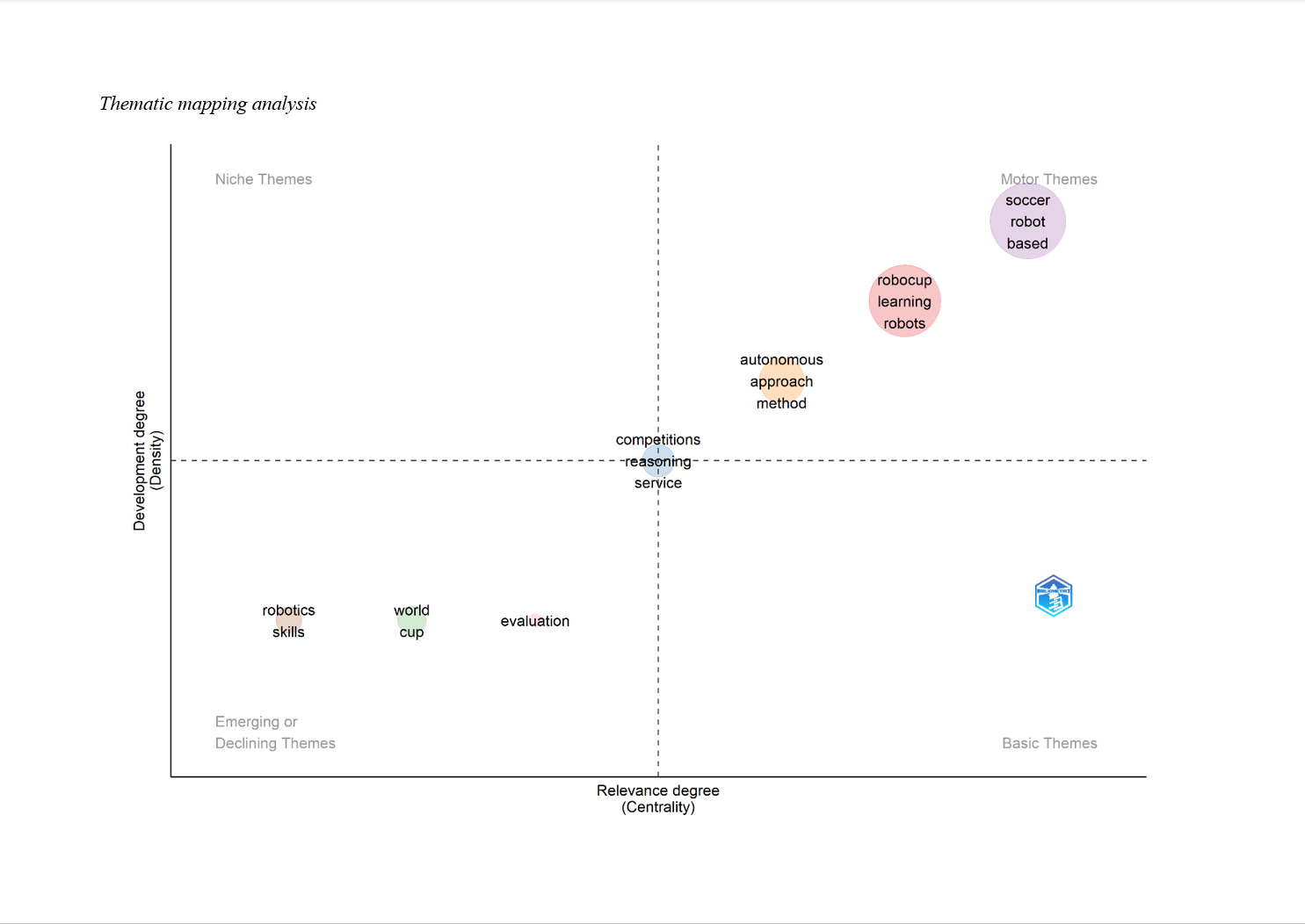
This study provides a bibliometric analysis of research related to the topic of robotic soccer and artificial intelligence (AI), mapping the intellectual and thematic landscape of a rapidly evolving interdisciplinary field. Drawing on 79 peer-reviewed articles from the Web of Science database spanning 1997 to 2024, we examine publication trends, citation impact, prolific contributors, institutional output, and core research themes. Utilizing the bibliometrix R package and biblioshiny interface, our analysis reveals that research on robotic soccer has experienced episodic growth, with notable surges linked to global competitions such as RoboCup. Results indicate that topics such as multi-agent collaboration, learning algorithms, autonomous decision-making, and human-robot interaction dominate the field's motor themes. Influential institutions include Islamic Azad University and Sapienza University of Rome, while key authors such as Peter Stone and Hiroaki Kitano shape the domain’s scholarly foundation. Despite the dominance of technical publications, there remains a research gap in addressing sociotechnical dimensions and integrative AI strategies. This study not only clarifies the structure of the field but also identifies emerging trajectories, offering a strategic foundation for future research on intelligent autonomous systems in sports contexts.
Downloads
References
Abreu, M., Reis, L. P., & Lau, N. (2019). Learning to run faster in a humanoid robot soccer environment through reinforcement learning. In Robot World Cup (pp. 3-15). Springer. https://doi.org/10.1007/978-3-030-35699-6_1
Ahamed, M. S., Pey, J., Samarakoon, S. B. P., Muthugala, M. V. J., & Elara, M. R. (2025). Reinforcement Learning for Reconfigurable Robotic Soccer. IEEE Access. https://doi.org/10.1109/ACCESS.2025.3536497
Antonioni, E., Suriani, V., Riccio, F., & Nardi, D. (2021). Game strategies for physical robot soccer players: a survey. IEEE Transactions on Games, 13(4), 342-357. https://doi.org/10.1109/TG.2021.3075065
Aria, M., & Cuccurullo, C. (2017). bibliometrix: An R-tool for comprehensive science mapping analysis. Journal of informetrics, 11(4), 959-975. https://doi.org/10.1016/j.joi.2017.08.007
Asada, M., & Kitano, H. (1999). The robocup challenge. Robotics and Autonomous Systems, 29(1), 3-12. https://doi.org/10.1016/S0921-8890(99)00033-0
Atasoy, B., Efe, M., & Tutal, V. (2021). Towards the artificial intelligence Management in sports. International Journal of Sport Exercise and Training Sciences-IJSETS, 7(3), 100-113. https://doi.org/10.18826/useeabd.845994
Baker, A. (2023). The Most Watched Sporting Events in The World. Roadtrips. com. https://www. roadtrips. com/blog/the-most-watched-sporting-events-in-theworld. https://www.roadtrips.com/blog/the-most-watched-sporting-events-in-the-world/
Bianchi, R. A. C., Martins, M. F., Ribeiro, C. H. C., & Costa, A. H. R. (2014). Heuristically-Accelerated Multiagent Reinforcement Learning. IEEE Transactions on Cybernetics, 44(2), 252-265. https://doi.org/10.1109/TCYB.2013.2253094
Budiharto, W., Cahyani, A. D., Rumondor, P. C., & Suhartono, D. (2017). EduRobot: intelligent humanoid robot with natural interaction for education and entertainment. Procedia computer science, 116, 564-570. https://doi.org/10.1016/j.procs.2017.10.064
Casadei, P., Bloom, M., Camerani, R., Masucci, M., Siepel, J., & Ospina, J. V. (2023). Mapping the state of the art of creative cluster research: a bibliometric and thematic analysis. European Planning Studies, 31(12), 2531-2551. https://doi.org/10.1080/09654313.2022.2158722
Cherubini, A., Giannone, F., Iocchi, L., Lombardo, M., & Oriolo, G. (2009). Policy gradient learning for a humanoid soccer robot. Robotics and Autonomous Systems, 57(8), 808-818. https://doi.org/10.1016/j.robot.2009.03.006
de Almeida Martins, H. M. N. (2023). FCPortugal-machine learning for a flexible kicking robotic soccer skill. https://repositorio-aberto.up.pt/bitstream/10216/155819/2/651795.pdf
de Boer, R., & Kok, J. (2002). The incremental development of a synthetic multi-agent system: The uva trilearn 2001 robotic soccer simulation team Master’s thesis, University of Amsterdam, The Netherlands]. https://staff.fnwi.uva.nl/a.visser/research/ias/alumni/m.sc.theses/theses/JelleKokRemcoDeBoer.pdf
Donthu, N., Kumar, S., Mukherjee, D., Pandey, N., & Lim, W. M. (2021). How to conduct a bibliometric analysis: An overview and guidelines. Journal of Business Research, 133, 285-296. https://doi.org/10.1016/j.jbusres.2021.04.070
Eguchi, A. (2016). RoboCupJunior for promoting STEM education, 21st century skills, and technological advancement through robotics competition. Robotics and Autonomous Systems, 75, 692-699. https://doi.org/10.1016/j.robot.2015.05.013
Evripidou, S., Georgiou, K., Doitsidis, L., Amanatiadis, A. A., Zinonos, Z., & Chatzichristofis, S. A. (2020). Educational Robotics: Platforms, Competitions and Expected Learning Outcomes. IEEE Access, 8, 219534-219562. https://doi.org/10.1109/ACCESS.2020.3042555
Frias, F. J. L., & Triviño, J. L. P. (2017). Will robots ever play sports? In 1st (Ed.), Sport and Play in a Digital World (pp. 67-82). Routledge. https://doi.org/10.4324/9781315142050-7
Golmohammadi, H., & Pashaie, S. (2024). Navigating the Scholarly Arena: Examining Disparate Research Trends and Discrepancies Across Management, Economics, Sport Management, and Sports Economics Fields [Navigating the Scholarly Arena: Examining Disparate Research Trends and Discrepancies Across Management, Economics, Sport Management, and Sports Economics Fields]. Spor Bilimleri Araştırmaları Dergisi, 9(1), 50-61. https://doi.org/10.25307/jssr.1402430
Hägele, M., Nilsson, K., Pires, J. N., & Bischoff, R. (2016). Industrial robotics. In Springer handbook of robotics (pp. 1385-1422). Springer, Cham. https://doi.org/10.1007/978-3-319-32552-1_54
Hameed, I. A., Sorrenson, C. G., Bochtis, D., & Green, O. (2011). Field robotics in sports: automatic generation of guidance lines for automatic grass cutting, striping and pitch marking of football playing fields. International Journal of Advanced Robotic Systems, 8(1), 10. https://doi.org/10.5772/10534
Hong, C., Jeong, I., Vecchietti, L. F., Har, D., & Kim, J.-H. (2021). AI world cup: robot-soccer-based competitions. IEEE Transactions on Games, 13(4), 330-341. https://doi.org/10.1109/TG.2021.3065410
Iocchi, L., Holz, D., Ruiz-del-Solar, J., Sugiura, K., & Van Der Zant, T. (2015). RoboCup@ Home: Analysis and results of evolving competitions for domestic and service robots. Artificial Intelligence, 229, 258-281. https://doi.org/10.1016/j.artint.2015.08.002
Iocchi, L., Nardi, D., Piaggio, M., & Sgorbissa, A. (2003). Distributed Coordination in Heterogeneous Multi-Robot Systems. Autonomous Robots, 15(2), 155-168. https://doi.org/10.1023/A:1025589008533
Ju, F., Wang, Y., Xie, B., Mi, Y., Zhao, M., & Cao, J. (2023). The use of sports rehabilitation robotics to assist in the recovery of physical abilities in elderly patients with degenerative diseases: A literature review. Healthcare,
Kalia, P., Mladenović, D., & Acevedo-Duque, Á. (2022). Decoding the trends and the emerging research directions of digital tourism in the last three decades: a bibliometric analysis. Sage Open, 12(4), 21582440221128179. https://doi.org/10.1177/21582440221128179
Kitano, H., Asada, M., Kuniyoshi, Y., Noda, I., Osawa, E., & Matsubara, H. (1997). RoboCup: A Challenge Problem for AI. AI Magazine, 18(1), 73. https://doi.org/10.1609/aimag.v18i1.1276
Kitano, H., Asada, M., Kuniyoshi, Y., Noda, I., Osawai, E., & Matsubara, H. (1998, 1998//). RoboCup: A challenge problem for AI and robotics. RoboCup-97: Robot Soccer World Cup I, Berlin, Heidelberg.
Kitano, H., & Tadokoro, S. (2001). RoboCup Rescue: A Grand Challenge for Multiagent and Intelligent Systems. AI Magazine, 22(1), 39. https://doi.org/10.1609/aimag.v22i1.1542
Kondratenko, Y. P. (2014). Robotics, automation and information systems: future perspectives and correlation with culture, sport and life science. Decision Making and Knowledge Decision Support Systems: VIII International Conference of RACEF, Barcelona, Spain, November 2013 and International Conference MS 2013, Chania Crete, Greece, November 2013,
Merigó, J. M., & Yang, J. B. (2017). Accounting research: A bibliometric analysis. Australian Accounting Review, 27(1), 71-100. https://doi.org/10.1111/auar.12109
Michel, O., Bourquin, Y., & Baillie, J.-C. (2008). Robotstadium: Online humanoid robot soccer simulation competition. In Robot Soccer World Cup (pp. 580-590). Springer. https://doi.org/10.1007/978-3-642-02921-9_50
Nardi, D., Noda, I., Ribeiro, F., Stone, P., von Stryk, O., & Veloso, M. (2014). RoboCup soccer leagues. AI Magazine, 35(3), 77-85. https://doi.org/10.1609/aimag.v35i3.2549
Niu, J., Tang, W., Xu, F., Zhou, X., & Song, Y. (2016). Global research on artificial intelligence from 1990–2014: Spatially-explicit bibliometric analysis. ISPRS International Journal of Geo-Information, 5(5), 66. https://doi.org/10.3390/ijgi5050066
Noda, I., Hitoshi, M., Kazuo, H., & and Frank, I. (1998). Soccer server: A tool for research on multiagent systems. Applied Artificial Intelligence, 12(2-3), 233-250. https://doi.org/10.1080/088395198117848
Pashaie, S., Mohammadi, S., & Golmohammadi, H. (2024). Unlocking athlete potential: The evolution of coaching strategies through artificial intelligence. Proceedings of the Institution of Mechanical Engineers, Part P: Journal of Sports Engineering and Technology, 17543371241300889. https://doi.org/10.1177/17543371241300889
Rajan, K., & Saffiotti, A. (2017). Towards a science of integrated AI and Robotics. In (Vol. 247, pp. 1-9): Elsevier.
Reis, L. P. (2023). Coordination and Machine Learning in Multi-Robot Systems: Applications in Robotic Soccer. arXiv preprint arXiv:2312.16273. https://doi.org/10.48550/arXiv.2312.16273
Rossi, A., Paetzel-Prüsmann, M., Keijsers, M., Anderson, M., Anderson, S. L., Barry, D., Gutsche, J., Hart, J., Iocchi, L., & Kokkelmans, A. (2024). The human in the loop Perspectives and challenges for RoboCup 2050. Autonomous Robots, 48(2), 8. https://doi.org/10.1007/s10514-024-10159-3
Roy, S. B., & Basak, M. (2013). Journal of Documentation: a bibliometric study. Library Philosophy and Practice (e-Journal). Paper, 945. https://digitalcommons.unl.edu/libphilprac/945/
Sheridan, T. B. (2016). Human–robot interaction: status and challenges. Human factors, 58(4), 525-532. https://doi.org/10.1177/0018720816644364
Siegel, J., & Morris, D. (2020). Robotics, automation, and the future of sports. In 21st (Ed.), 21st Century Sports: How Technologies Will Change Sports in the Digital Age (pp. 53-72). Springer, Cham. https://doi.org/10.1007/978-3-030-50801-2_4
Stone, P. (2007). Intelligent autonomous robotics: A robot soccer case study. Morgan & Claypool Publishers. https://link.springer.com/content/pdf/10.1007/978-3-031-01544-1.pdf
Stone, P., & and Veloso, M. (1998). Layered approach to learning client behaviors in the robocup soccer server. Applied Artificial Intelligence, 12(2-3), 165-188. https://doi.org/10.1080/088395198117811
Stone, P., & Veloso, M. (2000). Multiagent Systems: A Survey from a Machine Learning Perspective. Autonomous Robots, 8(3), 345-383. https://doi.org/10.1023/A:1008942012299
Tzagkaraki, E., Papadakis, S., & Kalogiannakis, M. (2021, 2021//). Exploring the Use of Educational Robotics in Primary School and Its Possible Place in the Curricula. Education in & with Robotics to Foster 21st-Century Skills, Cham.
Urieli, D., MacAlpine, P., Kalyanakrishnan, S., Bentor, Y., & Stone, P. (2011). On optimizing interdependent skills: a case study in simulated 3D humanoid robot soccer. AAMAS, https://www.ifaamas.org/Proceedings/aamas2011/papers/A6_B69.pdf
Van Eck, N. J., & Waltman, L. (2014). Visualizing bibliometric networks. In Measuring scholarly impact: Methods and practice (pp. 285-320). Springer. https://doi.org/10.1007/978-3-319-10377-8_13
Zhang, B., Ma, L., & Liu, Z. (2020). Literature trend identification of sustainable technology innovation: A bibliometric study based on co-citation and main path analysis. Sustainability, 12(20), 8664. https://doi.org/10.3390/su12208664
Downloads
Additional Files
Publication Timeline
Issue
Section
License
Copyright (c) 2024 Sajjad Pashaie (Corresponding Author); Timothy Jung, Hamed Golmohammadi (Author)

This work is licensed under a Creative Commons Attribution-NonCommercial 4.0 International License.