Integrating Behavioral and Cognitive Psychological Theories with AI for Employee Performance Evaluation
DOI:
https://doi.org/10.61838/kman.aitech.3.2.11Keywords:
Artificial intelligence, employee performance evaluation, behavioral psychology, cognitive psychology, AI ethics, human resource managementAbstract
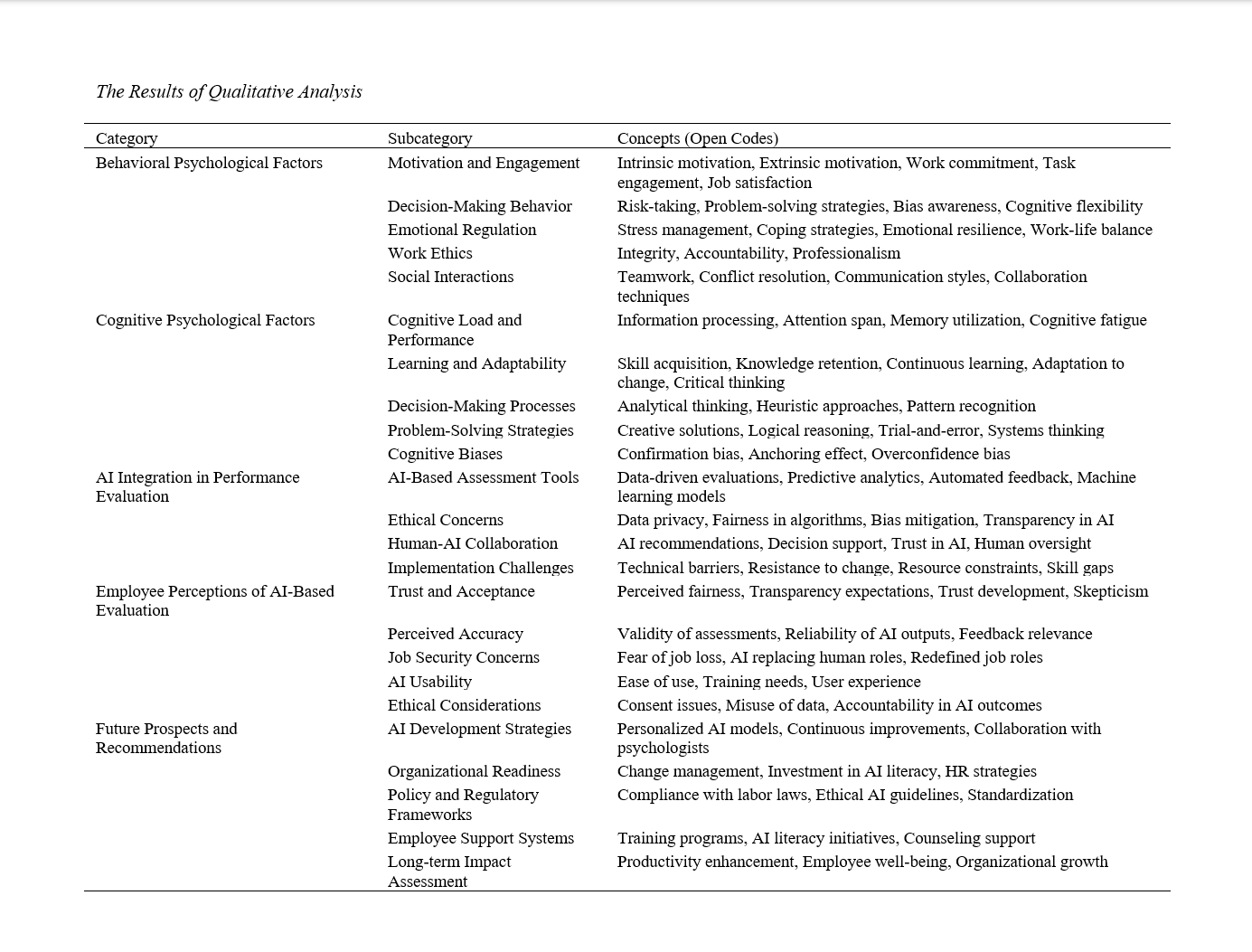
This study aims to explore the integration of behavioral and cognitive psychological theories with artificial intelligence (AI) in employee performance evaluation. A qualitative research approach was adopted, utilizing semi-structured interviews to gather in-depth insights from 27 employees in Tehran across various industries. Participants were selected using purposive sampling, ensuring relevance to the research objectives. Data collection continued until theoretical saturation was achieved. The collected data were analyzed thematically using NVivo software to identify key themes related to employee perceptions, cognitive and behavioral responses, and the ethical implications of AI in performance evaluations. The study identified several key themes, including the impact of AI evaluations on motivation and engagement, cognitive load, trust and acceptance, ethical considerations, and job security concerns. While AI-based performance evaluation systems were perceived to enhance objectivity and decision-making efficiency, participants raised concerns about fairness, emotional well-being, and the lack of human oversight. Transparency and explainability emerged as critical factors influencing employees' trust in AI-generated feedback. Furthermore, the study found that AI evaluations contributed to cognitive overload and stress, highlighting the need for balanced AI-human collaboration in performance assessment processes. The findings suggest that AI-driven performance evaluations offer significant benefits in terms of data accuracy and efficiency; however, their successful implementation requires careful consideration of psychological and ethical factors. Organizations should integrate behavioral and cognitive principles into AI evaluation systems to enhance acceptance, trust, and overall effectiveness. A hybrid approach that combines AI insights with human judgment is recommended to ensure fair and comprehensive employee evaluations.
Downloads
References
Angelova, M. (2024). Pros and Cons of Using Algorithmic Management in Human Resource. Environment Technology Resources Proceedings of the International Scientific and Practical Conference, 2, 22-28. https://doi.org/10.17770/etr2024vol2.8031
Bhattacharjee, S. (2024). The Introspective Role of Artificial Intelligence Tools for Remote Performance Management. Anveshak-International Journal of Management, 119-138. https://doi.org/10.15410/aijm/2024/v13i2/173219
Biswas, M. I. (2024). Who Do You Choose? Employees' Perceptions of Artificial Intelligence Versus Humans In performance Feedback. China Accounting and Finance Review, 26(4), 512-532. https://doi.org/10.1108/cafr-08-2023-0095
Chen, S. (2024). Innovative Work Behavior and Job Performance of Corporate Employees in the Age of Artificial Intelligence. Applied Mathematics and Nonlinear Sciences, 9(1). https://doi.org/10.2478/amns-2024-0856
Chin, Y. S. (2024). Harnessing the Power of Artificial Intelligence (AI): A Paradigm Shift in HRM Practices for Employee Sustainable Performance. Global Knowledge Memory and Communication. https://doi.org/10.1108/gkmc-06-2024-0355
Durairaj, S. (2024). The Effect of AI (Artificial Intelligence) in Employee Performance Evaluation on Employee Retention in the Information Technology Sector. 88-108. https://doi.org/10.2991/978-94-6463-433-4_8
Dwianto, A. (2024). Artificial Intelligence in Performance Evaluation (Case Study of PT. Pos Indonesia Employees). Bit-Tech, 7(2), 348-356. https://doi.org/10.32877/bt.v7i2.1817
Ghorbanzadeh, D. (2024). Role of Innovative Behaviour as a Missing Linchpin in Artificial Intelligence Adoption to Enhancing Job Security and Job Performance. Systems Research and Behavioral Science. https://doi.org/10.1002/sres.3076
Gorantla, B. (2023). Harnessing AI for Optimized Decision-Making a COPRAS Analysis. Jdaai, 2(3), 70-77. https://doi.org/10.46632/jdaai/2/3/13
Gričnik, A. M. (2024). Socially Responsible Application of Artificial Intelligence in Human Resources Management. 82-143. https://doi.org/10.4018/979-8-3693-3334-1.ch004
He, G., Liu, P., Zheng, X., Zheng, L., Hewlin, P. F., & Li, Y. (2023). Being Proactive in the Age of AI: Exploring the Effectiveness Of leaders' AI Symbolization in Stimulating Employee Job Crafting. Management Decision, 61(10), 2896-2919. https://doi.org/10.1108/md-10-2022-1390
Jain, R., Garg, N., & Khera, S. N. (2022). Adoption of AI-Enabled Tools in Social Development Organizations in India: An Extension of UTAUT Model. Frontiers in psychology, 13. https://doi.org/10.3389/fpsyg.2022.893691
Kayla, A. J. (2024). The Influence of the Effectiveness of Accounting Information System Utilization, Work Culture, and Incentives on Employee Performance. Eduvest - Journal of Universal Studies, 4(12), 11274-11289. https://doi.org/10.59188/eduvest.v4i12.50020
Mathur, D. M. (2024). Ethical Implications of AI in HRM: Balancing Efficiency and Privacy in Employee Monitoring Systems. Nanotechnology Perceptions, 4490-4496. https://doi.org/10.62441/nano-ntp.vi.3870
Meeprom, S. (2024). AI- And Employee-Based Customer Services in Restaurants: Customer Engagement Leading to Loyalty During the Covid-19 Pandemic. ABAC Journal, 44(2). https://doi.org/10.59865/abacj.2024.15
Na, S. R. (2024). Application of Artificial Intelligence in Employee Training and Development. Mmaa, 1(1), 26-28. https://doi.org/10.54097/gg5eemnb
Nuriani, N. (2024). Pengaruh Sistem Informasi Akuntansi Dan Pemanfaatan Teknologi Informasi Terhadap Kinerja Karyawan Di Indonesia. Jura-Itb, 2(4), 105-116. https://doi.org/10.54066/jura-itb.v2i4.2615
Pletcher, S. N. (2023). Practical and Ethical Perspectives on AI-Based Employee Performance Evaluation. https://doi.org/10.31219/osf.io/29yej
Riupassa, E. (2023). Impact of Accounting Information Systems, Work Motivation, and Internal Controls on Employee Performance: A Study at PT. Bank Danamon, Ambon Branch. Journal of Corporate Governance Insurance and Risk Management, 10(2), 118-124. https://doi.org/10.56578/jcgirm100202
Rožman, M., Oreški, D., & Tominc, P. (2023). Artificial-Intelligence-Supported Reduction of Employees’ Workload to Increase the Company’s Performance in Today’s VUCA Environment. Sustainability, 15(6), 5019. https://doi.org/10.3390/su15065019
Shao, Y. (2024). Using Augmentation-Based AI Tool at Work: A Daily Investigation of Learning-Based Benefit and Challenge. Journal of Management. https://doi.org/10.1177/01492063241266503
Sharma, S. (2024). Role of Emotional and Artificial Intelligence in Employee Performance: A Perspective From the Indian Service Industry. Abhigyan, 42(1), 43-56. https://doi.org/10.1177/09702385241233078
Tong, S., Jia, N., Luo, X., & Fang, Z. (2021). The Janus Face of Artificial Intelligence Feedback: Deployment Versus Disclosure Effects on Employee Performance. Strategic management journal, 42(9), 1600-1631. https://doi.org/10.1002/smj.3322
Zhu, Y. (2024). Research on the Influence of Artificial Intelligence Technology in Enterprise Human Resource Management on Employee Performance. Frontiers in Business Economics and Management, 15(3), 116-119. https://doi.org/10.54097/gghb5k57
Downloads
Additional Files
Publication Timeline
Issue
Section
License
Copyright (c) 2024 Shahdad Vosoughzadeh (Corresponding Author)

This work is licensed under a Creative Commons Attribution-NonCommercial 4.0 International License.