Strategies for Scaling Micro-Affections to Sustain Long-Term Bonding: A Qualitative Study of Hungarian Couples
DOI:
https://doi.org/10.61838/kman.aftj.6.3.15Keywords:
Micro-affections, marital stability, emotional safety, adaptive bonding, qualitative research, HungaryAbstract
Objective: This study aimed to explore and conceptualize the everyday strategies couples use to scale micro-affections—small, intentional acts of love and care—in order to sustain emotional closeness and long-term relational stability.
Methods and Materials: A qualitative design with an exploratory, interpretive approach was employed. Twenty Hungarian participants (10 couples) in long-term romantic relationships, ranging from 5 to 22 years, were selected through purposive sampling. Semi-structured, in-depth interviews were conducted until theoretical saturation was reached. The interviews, lasting 60–90 minutes, explored couples’ practices for maintaining connection, emotional safety, and adapting to life transitions. Data were audio-recorded, transcribed verbatim, and analyzed using a thematic approach supported by NVivo 14. Open, axial, and selective coding were applied to generate categories and subcategories, while constant comparison, memo writing, and member checking enhanced analytic rigor and trustworthiness.
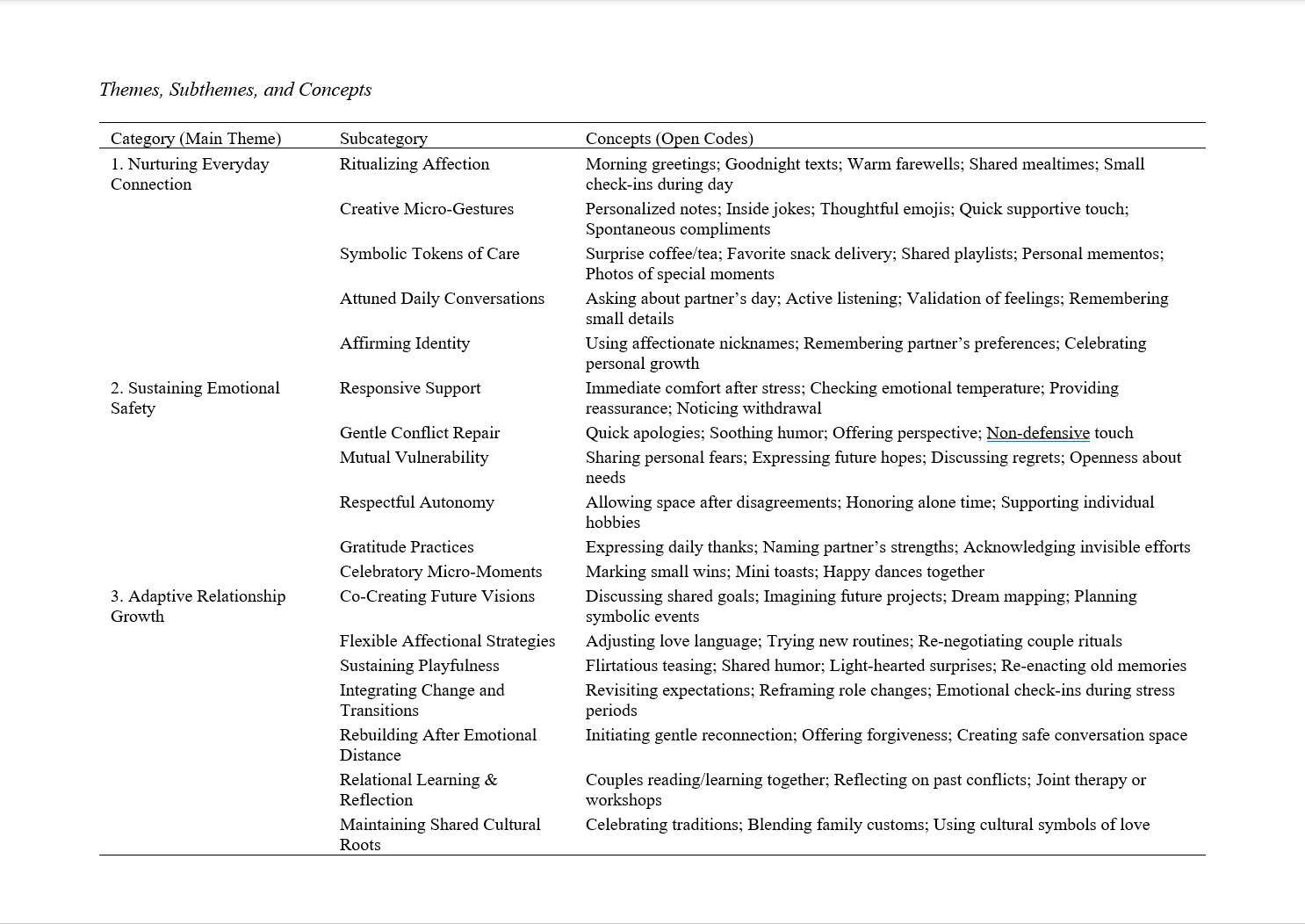
Findings: Three overarching themes emerged: nurturing everyday connection, sustaining emotional safety, and adaptive relationship growth. Couples sustained closeness through daily affectionate rituals, creative micro-gestures, and symbolic tokens of care. Emotional security was reinforced by responsive support, mutual vulnerability, quick conflict repair, gratitude, and respectful autonomy. Adaptive growth was maintained by updating love languages, co-creating future visions, sustaining playfulness, and integrating cultural traditions into evolving relational narratives. These strategies functioned as protective mechanisms against emotional distance and relational stagnation, enabling couples to maintain satisfaction despite external pressures and life transitions.
Conclusion: The findings demonstrate that sustaining long-term romantic stability relies on the intentional, iterative use of small-scale affectionate behaviors embedded within a safe and adaptive relational climate. Understanding these lived strategies enriches theoretical models of marital maintenance and provides culturally informed, actionable insights for couple therapy, relationship education, and prevention of disaffection.
Downloads
References
Acquah, S., Dzakadzie, Y., & Eshun, P. (2024). Level of Education, Marital Longevity and Religion as Determinants of Marital Stability among Couples in Tamale Metropolis, Ghana. Advances in Research, 25(3), 137-147. https://doi.org/10.9734/air/2024/v25i31059
Alquran, N. M. A. (2024). The Degree of Marital Compatibility and Family Stability during the Corona Pandemic according to a Number of Variables among a Sample of Married Couples in Irbid Governorate. Journal of Ecohumanism, 3(8), 353-365. https://doi.org/10.62754/joe.v3i8.4739
Baher Talari, M., Mikaeili, N., Aghajani, S., & Habibi, N. (2024). Prediction of Marital Disaffection Based on Cognitive Distortion, Interpersonal Forgiveness and Emotion Regulation Strategies in Married People. Social Psychology Research, 14(53), 1-16. https://www.socialpsychology.ir/article_198039.html?lang=en
Dalhatu, H. M., & Muhammad, M. A. (2024). Communication Patterns and Financial Stability as Predictors of Marital Adjustment Among Polygamous Couples in Zaria, Kaduna State: Implications for Marital Counselling. Ajhcer, 15(1), 293-310. https://doi.org/10.62154/wmc54b06
Dehghani, M., Atef-Vahid, M. K., & Gharaee, B. (2011). Efficacy of short-term anxiety-regulating psychotherapy on love trauma syndrome. Iran J Psychiatry Behav Sci, 5(2), 18-25. https://www.ncbi.nlm.nih.gov/pmc/articles/PMC3939962/
Del Palacio-González, A., Clark, D. A., & O'Sullivan, L. F. (2017). Cognitive processing in the aftermath of relationship dissolution: Associations with concurrent and prospective distress and posttraumatic growth. Stress and Health, 33(5), 540-548. https://doi.org/10.1002/smi.2738
Ghaedi, A., Rahimi Taganaki, C. H., & Goodarzi, M. A. (2022). Predicting divorce tendency based on marital disaffection, self-differentiation, sexual satisfaction, and mindfulness in divorcing couples Shiraz: Shiraz University]. https://elmnet.ir/article/2444955-41149
Javadi Koma, A., Niknam, M., Sadeghi Afjeh, Z., & Mirzakhani, N. (2024). Development of a Causal Model Predicting Marital Instability Based on Dark Personality and Ego Strength with the Mediation of Empathy in Married Women. Psychology Growth, 13(2), 109-120. http://frooyesh.ir/article-1-4786-fa.html
Jiao, J. (2022). I Came Through You and Belong Not to You: Overparenting, Attachment, Autonomy, and Mental Health at Emerging Adulthood. The University of Arizona.
Kansky, J., Allen, J. P., & Diener, E. (2019). The young adult love lives of happy teenagers: The role of adolescent affect in adult romantic relationship functioning. Journal of research in personality, 80, 1-9. https://www.sciencedirect.com/science/article/pii/S0092656619300285
Karbasian, P., MaghsoudiMehraban, F., & Karbasian, P. (2023). The Effectiveness of Positive Cognitive Behavioral Therapy on Positive and Negative Affection and Academic Progress of Adolescents with Cyberspace Addiction. Journal of Psychology New Ideas, 16(20), 1-10. https://jnip.ir/browse.php?a_id=918&slc_lang=en&sid=1&printcase=1&hbnr=1&hmb=1
Kashdan, T. B., Ferssizidis, P., Farmer, A. S., Adams, L. M., & McKnight, P. E. (2013). Failure to capitalize on sharing good news with romantic partners: Exploring positivity deficits of socially anxious people with self-reports, partner-reports, and behavioral observations. Behaviour Research and Therapy, 51(10), 656-668. https://doi.org/10.1016/j.brat.2013.04.006
Koenig, H. G., VanderWeele, T. J., & Peteet, J. R. (2024). Marital and Family Stability. 254-280. https://doi.org/10.1093/oso/9780190088859.003.0014
Mahmoodian, L., Zanganeh Motlagh, F., & Dehstani, M. (2021). The Effectiveness of "Reality Therapy" on Marital Disaffection and Psychological Welfare of Married Women. jhpm.ir, 10(4), 96-107. http://jhpm.ir/article-1-1363-en.html
Okoiye, E., Anyanwu, C. J., & Agbajor, h. (2025). Marriage Counselling, Self-Disclosure and Commitment as Correlates of Marital Stability Among Married Female Guidance and Counselling Post-Graduate Students in South-East Nigeria. Djerd, 22(1), 169-178. https://doi.org/10.61448/djerd22115
Okonkwo, K. (2024). The Role of Attachment Styles in Marital Stability: A Psychological Approach to Strengthening Relationships. American Journal of Psychology, 6(4), 35-50. https://doi.org/10.47672/ajp.2474
Opekina, T. P., & Saporovskaya, M. V. (2022). Peculiarities of Emotional States of Adults in a Situation of Long-Term Absence of Romantic Relationships. Herald of Omsk University Series Psychology(4), 55-61. https://doi.org/10.24147/2410-6364.2022.4.55-61
Philippe, F. L., Koestner, R., & Lekes, N. (2013). On the directive function of episodic memories in people's lives: A look at romantic relationships. Journal of personality and social psychology, 104(1), 164-179. https://doi.org/10.1037/a0030384
Singh, A., & Shanbhag, T. (2025). Parental Interference and Marital Stability: A Scoping Review of Sociocultural Influences on Indian Families. Indian Journal of Community Medicine. https://doi.org/10.4103/ijcm.ijcm_470_24
Stanley, S. M., Rhoades, G. K., & Whitton, S. W. (2010). Commitment: Functions, Formation, and the Securing of Romantic Attachment. Journal of Family Theory & Review, 2(4), 243-257. https://doi.org/10.1111/j.1756-2589.2010.00060.x
Ueda, R., Yanagisawa, K., Ashida, H., & Abe, N. (2018). Executive control and faithfulness: only longterm romantic relationships require prefrontal control. Experimental Brain Research, 1-8. https://doi.org/10.1007/s00221-018-5181-y
Waldron, V. R., & Farnworth, M. J. (2020). Steeling against midlife adversity: Resilience-promoting practices of long-term romantic pairs. Journal of Family Communication, 20(2), 129-145. https://doi.org/10.1080/15267431.2020.1729158
Wang, X., Li, Q., Chen, Z., & Fang, X. (2025). Stress Perception and Marital Instability Across the Family Life Cycle: An Actor‐Partner Perspective. Family Process, 64(1). https://doi.org/10.1111/famp.70018
Wells, R., Rehman, U. S., & Sutherland, S. (2016). Alexithymia and social support in romantic relationships. Personality and individual differences, 90, 371-376. https://doi.org/10.1016/j.paid.2015.11.029
Downloads
Additional Files
Publication Timeline
- Submitted
- Revised
- Accepted
Issue
Section
License

This work is licensed under a Creative Commons Attribution-NonCommercial 4.0 International License.