Dimensions of Communication Breakdown in Digitally Mediated Relationships
DOI:
https://doi.org/10.61838/kman.aftj.6.3.16Keywords:
Digital intimacy, communication breakdown, relationship maintenance, emotional disconnectionAbstract
Objective: This study aimed to explore the underlying dimensions, triggers, and relational consequences of communication breakdown in digitally mediated romantic relationships.
Methods and Materials: The study employed a qualitative, descriptive–interpretive design based on semi-structured interviews with 25 participants (aged 22–43) residing in Hungary, who were currently or recently engaged in digitally mediated romantic relationships. Participants were selected through purposive sampling to ensure diversity in relationship status and digital communication usage. Data were collected through in-depth, open-ended interviews focusing on experiences of misunderstanding, conflict, and emotional distance in digital interactions. The interviews continued until theoretical saturation was achieved. All interviews were transcribed verbatim and analyzed thematically using NVivo 14 software. Through an inductive coding process, emerging patterns were categorized into main themes and subthemes reflecting the nature and mechanisms of communication breakdown.
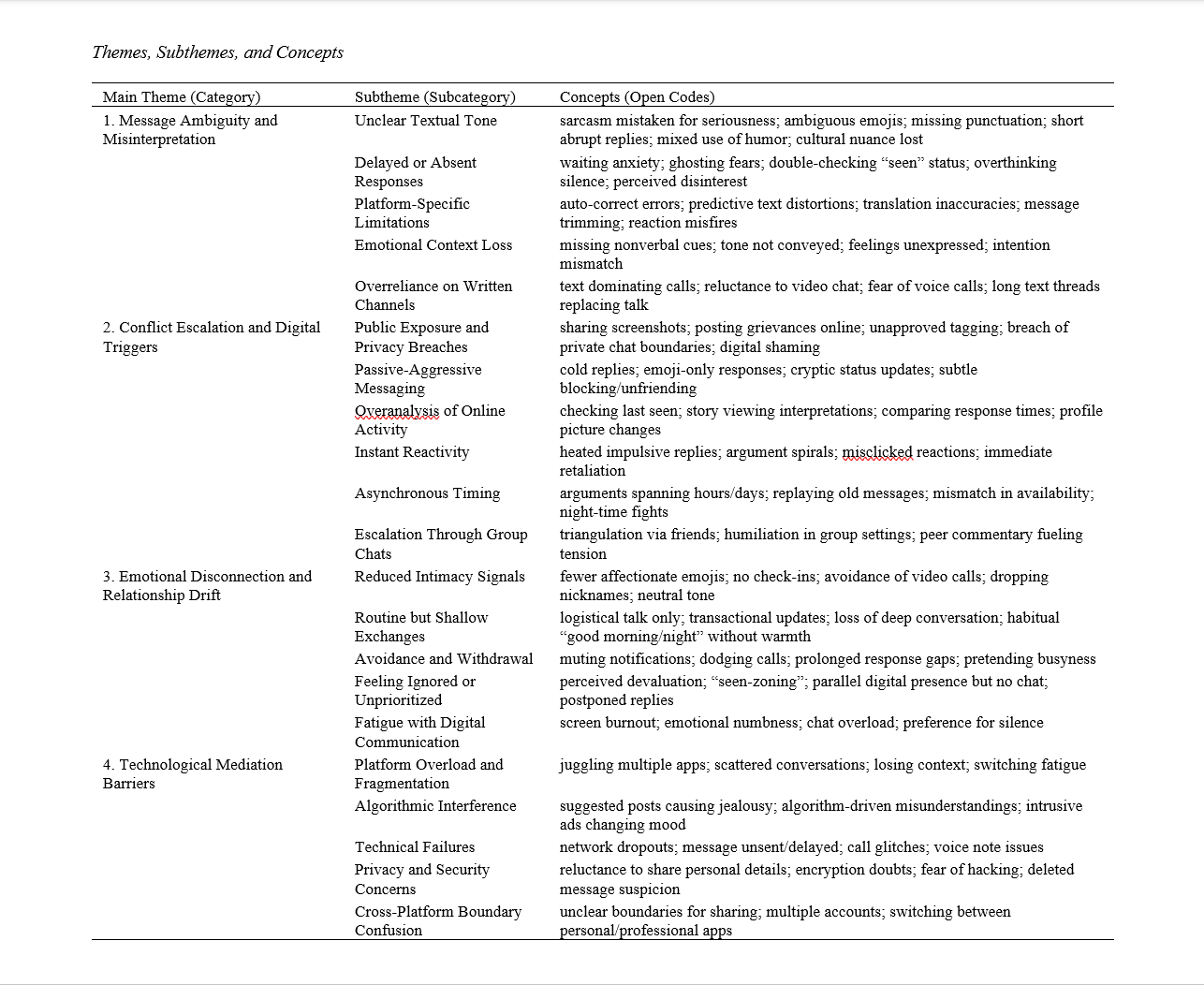
Findings: The thematic analysis yielded four core dimensions of communication breakdown: (1) message ambiguity and misinterpretation, characterized by unclear tone, emotional detachment, and misread digital cues; (2) conflict escalation and digital triggers, including public exposure, reactive messaging, and asynchronous argument cycles; (3) emotional disconnection and relationship drift, reflected in reduced intimacy, digital fatigue, and avoidance behaviors; and (4) technological mediation barriers, involving platform fragmentation, algorithmic interference, and privacy-related constraints. The results indicated that digital communication both enables and destabilizes intimacy by amplifying emotional uncertainty and reducing contextual understanding.
Conclusion: Findings highlight the paradoxical role of technology as both a facilitator and disruptor of intimacy in modern relationships. Effective digital communication requires emotional regulation, boundary awareness, and mindful technology use. Addressing the psychological and technical dimensions of digital interaction can enhance relational stability and prevent emotional estrangement among partners.
Downloads
References
Amber, R., & Carole, P. M. (2009). Long-Distance and Proximal Romantic Relationship Satisfaction: Attachment and Closeness Predictors. Journal of College Counseling, 12(1), 5-17. https://doi.org/10.1002/j.2161-1882.2009.tb00036.x
Inman, J. S. (2023). Evaluating the Influence of Reciprocity of Meeting Partner's Temperament Needs in Terms of Marital Intimacy. https://digitalcommons.liberty.edu/doctoral/4685/
Pandya, S. P. (2025). Work‐Related Migration and Couples in Long‐Distance Marriages: Mindfulness, Marital Quality, Satisfaction, and Happiness. Personal Relationships, 32(1). https://doi.org/10.1111/pere.70002
Parreñas, R. S. (2005). Long Distance Intimacy: Class, Gender and Intergenerational Relations Between Mothers and Children in Filipino Transnational Families. Global Networks. https://doi.org/10.1111/j.1471-0374.2005.00122.x
Parsakia, K., & Rostami, M. (2023). Digital Intimacy: How Technology Shapes Friendships and Romantic Relationships. AI and Tech in Behavioral and Social Sciences, 1(1), 27-34. https://doi.org/10.61838/kman.aitech.1.1.5
Pazil, N. H. A. (2018). Face, Voice and Intimacy in Long-Distance Close Friendships. International Journal of Asian Social Science, 8(11), 938-947. https://doi.org/10.18488/journal.1.2018.811.938.947
Pisor, A. C., Borgerhoff Mulder, M., & Smith, K. M. (2024). Long-distance social relationships can both undercut and promote local natural resource management. Philosophical Transactions of the Royal Society B, 379(1893), 252-269. https://doi.org/10.1098/rstb.2022.0269
Pistole, M. C., Roberts, A., & Chapman, M. L. (2010). Attachment, Relationship Maintenance, and Stress in Long Distance and Geographically Close Romantic Relationships. Journal of Social and Personal Relationships, 27(4), 535-552. https://doi.org/10.1177/0265407510363427
Regas, S. (2019). Infidelity, self-differentiation, and intimacy: The mindful differentiation model of couple therapy. In Integrative couple and family therapies: Treatment models for complex clinical issues. (pp. 71-90). American Psychological Association. https://doi.org/10.1037/0000151-004
Sawai, J. P., Sawai, R. P., Masdin, M., & Aziz, A. R. (2023). Sustaining Long-Distance Relationship Through Love, Trust, and Dedication Among Married Couples. Manu Jurnal Pusat Penataran Ilmu Dan Bahasa (Ppib), 34(1), 63-80. https://doi.org/10.51200/manu.v34i1.4475
Schafer, K., Hanson, T., & Brown, S. (2020). Examining the relationship between marital intimacy and marital satisfaction. Human Relations Journal, 73(4), 543-568. https://digitalcommons.liberty.edu/cgi/viewcontent.cgi?article=5964&context=doctoral
Seifi, E., Ahmadi, A., & Moazzami, M. (2024). Identifying the dimensions and components of the application of new technologies in the fourth generation university. Management and Educational Perspective, 5(4), 24-51. https://doi.org/10.22034/jmep.2024.426783.1282
Smith-Osborne, A., & Jani, J. (2014). Long Distance Military and Civilian Relationships: Women's Perceptions of the Impact of Communication Technology and Military Culture. Military Behavioral Health, 2(4), 293-303. https://doi.org/10.1080/21635781.2014.963759
Timoshkin, D. (2023). Nationalism, Purity, and Danger: “Cross-Border Intimacy” in Russian Digital Media. Sotsiologicheskoe Obozrenie / Russian Sociological Review, 22(2), 154-178. https://doi.org/10.17323/1728-192x-2023-2-154-178
Zhu, Y. (2025). Anonymous Intimacy in the Digital Age: Psychological Mechanisms, Risks, and Potential. Icarss, 2(1), 11-29. https://doi.org/10.33422/icarss.v2i1.1056
Downloads
Additional Files
Publication Timeline
- Submitted
- Revised
- Accepted
Issue
Section
License

This work is licensed under a Creative Commons Attribution-NonCommercial 4.0 International License.