Post-Traumatic Growth and Couple Resilience: Exploring the Mediating Role of Relational Meaning Making
DOI:
https://doi.org/10.61838/kman.aftj.6.3.19Keywords:
Post-traumatic growth, couple resilience, relational meaning making, traumaAbstract
Objective: This study aimed to examine whether relational meaning making mediates the relationship between post-traumatic growth and couple resilience among Brazilian couples who have experienced significant adversity or loss.
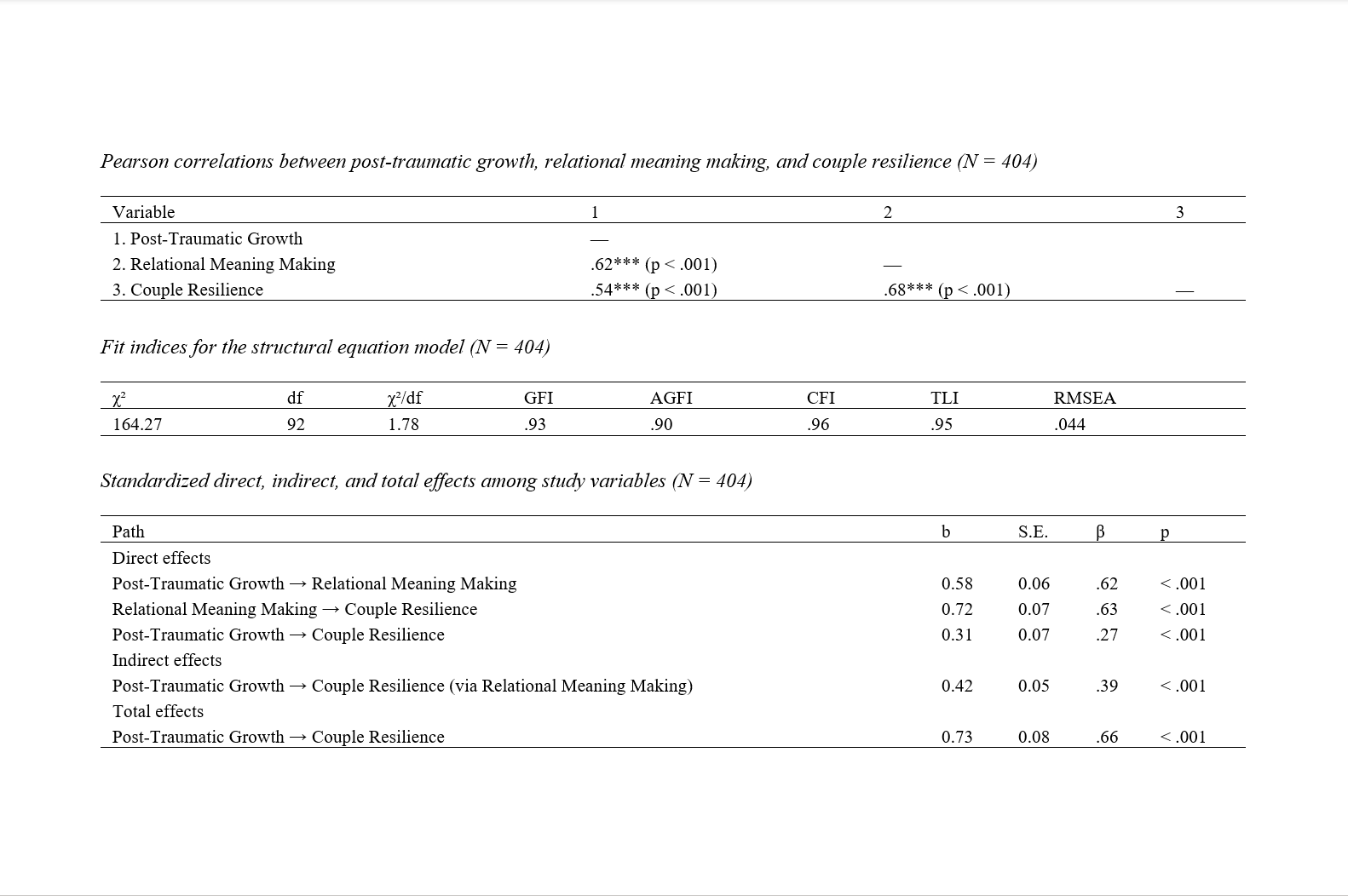
Methods and Materials: A descriptive correlational design was applied with a sample of 404 adult participants from Brazil, recruited using the Morgan and Krejcie sample size guidelines to ensure adequate statistical power. Participants completed standardized instruments: the Posttraumatic Growth Inventory, the Dyadic Meaning-Making Scale, and the Couple Resilience Inventory. Data were analyzed using IBM SPSS Statistics version 27 to compute descriptive statistics and Pearson correlation coefficients and AMOS version 21 for Structural Equation Modeling (SEM) to test the hypothesized mediation model. Model fit was evaluated with multiple indices, including χ²/df, CFI, TLI, GFI, AGFI, and RMSEA.
Findings: Post-traumatic growth showed a significant positive correlation with relational meaning making (r = .62, p < .001) and couple resilience (r = .54, p < .001). Relational meaning making was strongly associated with couple resilience (r = .68, p < .001). SEM results indicated good model fit (χ²/df = 1.78, CFI = .96, TLI = .95, RMSEA = .044). Post-traumatic growth had a direct effect on couple resilience (β = .27, p < .001) and on relational meaning making (β = .62, p < .001). Relational meaning making had a strong direct effect on couple resilience (β = .63, p < .001). The indirect effect of post-traumatic growth on couple resilience through relational meaning making was significant (β = .39, p < .001), increasing the total effect of post-traumatic growth on couple resilience (β = .66, p < .001).
Conclusion: Findings suggest that while post-traumatic growth contributes to couple resilience, its impact is amplified when partners engage in shared sense-making about adversity. Strengthening relational meaning making may be a key therapeutic mechanism for enhancing resilience in couples coping with trauma.
Downloads
References
Afshani, S. A., Ruhani, A., & Naeimi, N. (2019). Deconstruction of Life in the Dualism of Dream/Awakening in Bereaved Women. OMEGA - Journal of Death and Dying, 83(3), 508-524. https://doi.org/10.1177/0030222819855891
Cadell, S., Janzen, L., & Haubrich, D. J. (2019). Engaging With Spirituality. Critical Social Work, 7(1). https://doi.org/10.22329/csw.v7i1.5770
Campling, N., Lund, S., Allam, A., Precious, G., & Myall, M. (2023). “The Person Was Like the Glue in the Cracked Pot Which Was No Longer There”: Family-Focused Support for Bereavement via Co-Production of a Web-Based Intervention. F1000research, 12, 1024. https://doi.org/10.12688/f1000research.134193.1
Campling, N., Lund, S., Allam, A., Precious, G., & Myall, M. (2024). “The Person Was Like the Glue in the Cracked Pot Which Was No Longer There”: Co-Production of the Web-Based Families and Friends in Bereavement Intervention. F1000research, 12, 1024. https://doi.org/10.12688/f1000research.134193.2
Daniel, T. (2023). The Stubborn Persistence of Grief Stage Theory. OMEGA - Journal of Death and Dying. https://doi.org/10.1177/00302228231184290
Hall, C. A., & Ungureanu, I. (2021). “Unbreak My Heart”: Clinical Implications for Working With Bereaved Couples. The Family Journal, 29(3), 299-304. https://doi.org/10.1177/10664807211000067
Hill, J. (2025). The Role of Synchronicity in Meaning Reconstruction: Integrating Synchronicity, Meaning Reconstruction, Terror Management, and Shattered Assumptions Theory in Bereavement. Journal of Humanistic Psychology. https://doi.org/10.1177/00221678251367795
Hooghe, A., Claeys, A., Thompson, B., Neimeyer, R. A., & Rober, P. (2021). Grieving the Loss of a Child in Times of COVID-19. Couple and Family Psychology Research and Practice, 10(4), 313-325. https://doi.org/10.1037/cfp0000180
Keisari, S., Yaniv, D., Gesser‐Edelsburg, A., Palgi, Y., & Neimeyer, R. A. (2023). Meaning Reconstruction 70 Years Later: Processing Older Adults’ Unfinished Business in a Drama Therapy Group. Psychotherapy, 60(4), 573-586. https://doi.org/10.1037/pst0000497
Kennedy, A., Maple, M., McKay, K., & Brumby, S. (2019). Suicide and Accidental Death for Australia’s Farming Families: How Context Influences Individual Response. OMEGA - Journal of Death and Dying, 83(3), 407-425. https://doi.org/10.1177/0030222819854920
Keser, E., & Ișıklı, S. (2021). Investigation of the Relationship Between Continuing Bonds and Adjustment After the Death of a First‐degree Family Member by Using the Multidimensional Continuing Bonds Scale. Journal of Clinical Psychology, 78(2), 218-232. https://doi.org/10.1002/jclp.23210
Kim, S. Y. (2025). Structural Analysis of Growth After Spouse Death of the Elderly: Gender Cross Validation. Journal of Korean Academy of Psychiatric and Mental Health Nursing, 34(3), 246-259. https://doi.org/10.12934/jkpmhn.2025.34.3.246
Knowles, K., Nathanson, A., Sloan, D. H., & Christ, G. (2024). Grief, Loss, and Bereavement in Oncology and Palliative Care. 195-212. https://doi.org/10.1093/oso/9780197607299.003.0015
Lee, J. W., Lyu, J.-Y., & Lee, S. h. (2022). Effectiveness of Loss Healing Program Among Widowed Elderly Women. Korea Academy of Care Management, 45, 125-155. https://doi.org/10.22589/kaocm.2022.45.125
Lee, Y.-H., & Mi-Ha, B. A. K. (2024). A Civic Activist Who Cares for the Bereaved Families of Ferry Sewol in the Neighborhood of Healing Space an Autobiographical Narrative Study on the Experience of Indirect Trauma. The Association of Korea Counseling Psychology Education Welfare, 11(2), 273-296. https://doi.org/10.20496/cpew.2024.11.2.273
Moriconi, V., Menéndez, A., Neimeyer, R. A., & Moggia, D. (2022). Adaptation of the Spanish Grief and Meaning Reconstruction Inventory: An Initial Validation and Network Analysis. OMEGA - Journal of Death and Dying, 90(3), 1229-1249. https://doi.org/10.1177/00302228221118169
Pala, Y. (2021). Therapy Through Theatre: Duncan Macmillan’s Every Brilliant Thing. Hacettepe Üniversitesi Edebiyat Fakültesi Dergisi, 38(2), 348-356. https://doi.org/10.32600/huefd.715238
Patterson, P., McDonald, F. E. J., Kelly‐Dalgety, E., Lavorgna, B., Jones, B. L., Sidis, A., & Powell, T. (2021). Development and Evaluation of the Good Grief Program for Young People Bereaved by Familial Cancer. BMC Palliative Care, 20(1). https://doi.org/10.1186/s12904-021-00752-z
Pitcho‐Prelorentzos, S., Leshem, E., & Mahat‐Shamir, M. (2022). A Trisonance: Identities of Women Whose Mothers Were Murdered by Their Fathers. Violence Against Women, 29(5), 901-924. https://doi.org/10.1177/10778012221092478
Pitcho‐Prelorentzos, S., Leshem, E., Mahat, S., & M. (2021). Shattered Voices: Daughters’ Meaning Reconstruction in Loss of a Mother to Intimate Partner Homicide. Journal of interpersonal violence, 37(17-18), NP15800-NP15825. https://doi.org/10.1177/08862605211021981
Ramano, E. M. R., Pretorius, W. P., Marike de Jager De, J., Oldfield, T. O., Scriba, D. S., & Moriti, B. M. (2022). Occupational Therapy Clinicians' Perspectives on the Impact of COVID-19 on Service Users in South Africa - A Qualitative Retrospective Study. South African Journal of Occupational Therapy, 52(3), 24-33. https://doi.org/10.17159/2310-3833/2022/vol52n3a5
Reitz, A. K., Weidmann, R., Wünsche, J., Buehler, J. L., Burriss, R. P., & Grob, A. (2021). In Good Times and in Bad: A Longitudinal Analysis of the Impact of Bereavement on Self-Esteem and Life Satisfaction in Couples. https://doi.org/10.31234/osf.io/c8k57
Romero, M. (2018). Meaning Reconstruction in Bereaved Family Caregivers of Person’s With Alzheimer’s Disease: A Mixed-Methods Study. OMEGA - Journal of Death and Dying, 82(4), 548-569. https://doi.org/10.1177/0030222818821024
Santarpia, A., Romani-Cesaro, M., Simonds, C., Dionigi, A., Holland, M. L., & Vinit, F. (2022). How the Parents Perceive the Work of Hospital Clowns in the Context of Bereavement: A Qualitative Study. The Humanistic Psychologist, 50(4), 559-576. https://doi.org/10.1037/hum0000253
Sawyer, J. S. (2020). Bereavement Outcomes for Atheist Individuals: The Role of Spirituality, Discrimination, and Meaning. OMEGA - Journal of Death and Dying, 86(2), 395-412. https://doi.org/10.1177/0030222820974536
Tey, M. Q., & Lee, G. L. (2022). Understanding Bereavement Experiences and Coping Among Bereaved Family Caregivers in Singapore: Positive Meaning Reconstruction in the Dual Process Model. OMEGA - Journal of Death and Dying, 91(1), 263-280. https://doi.org/10.1177/00302228221133584
Wehrman, E. C. (2022). “I Don’t Even Know Who I Am”: Identity Reconstruction After the Loss of a Spouse. Journal of Social and Personal Relationships, 40(4), 1250-1276. https://doi.org/10.1177/02654075221127399
Wetangterah, L. (2022). The Lived Religion of Bereaved Parent of Human Trafficking Victims in East Nusa Tenggara. Arumbae Jurnal Ilmiah Teologi Dan Studi Agama, 4(2), 139-149. https://doi.org/10.37429/arumbae.v4i2.857
Yang, A., Washington, K., Benson, J., Bogdewiecz, T., & Rolbiecki, A. J. (2025). Meaning Making During Bereavement as Part of Caregiver Speaks, a Narrative Photo-Elicitation Intervention for Caregivers of Persons Living With Dementia. Dementia. https://doi.org/10.1177/14713012251333484
Zhang, X., Deng, X., Mo, Y., Li, Y., Song, X. Q., & Li, H. (2021). Relationship Between Infertility-Related Stress and Resilience With Posttraumatic Growth in Infertile Couples: Gender Differences and Dyadic Interaction. Human Reproduction. https://doi.org/10.1093/humrep/deab096
Downloads
Additional Files
Publication Timeline
- Submitted
- Revised
- Accepted
Issue
Section
License

This work is licensed under a Creative Commons Attribution-NonCommercial 4.0 International License.