Online Gaming Engagement and Adolescent Social Withdrawal: The Mediating Role of Family Cohesion
DOI:
https://doi.org/10.61838/kman.aftj.4514Keywords:
Online gaming engagement, family cohesion, adolescent social withdrawal, structural equation modeling, GreeceAbstract
Objective: This study aimed to investigate the relationship between online gaming engagement and adolescent social withdrawal, with family cohesion examined as a mediating factor.
Methods and Materials: A descriptive correlational design was employed with a sample of 388 adolescents in Greece, selected based on the Morgan and Krejcie sample size determination table. Standardized instruments measured online gaming engagement, social withdrawal, and family cohesion. Data analysis included Pearson correlation analysis using SPSS-27 to examine bivariate associations and Structural Equation Modeling (SEM) with AMOS-21 to test the hypothesized mediation model. Model fit was evaluated using χ², df, χ²/df, GFI, AGFI, CFI, TLI, and RMSEA indices.
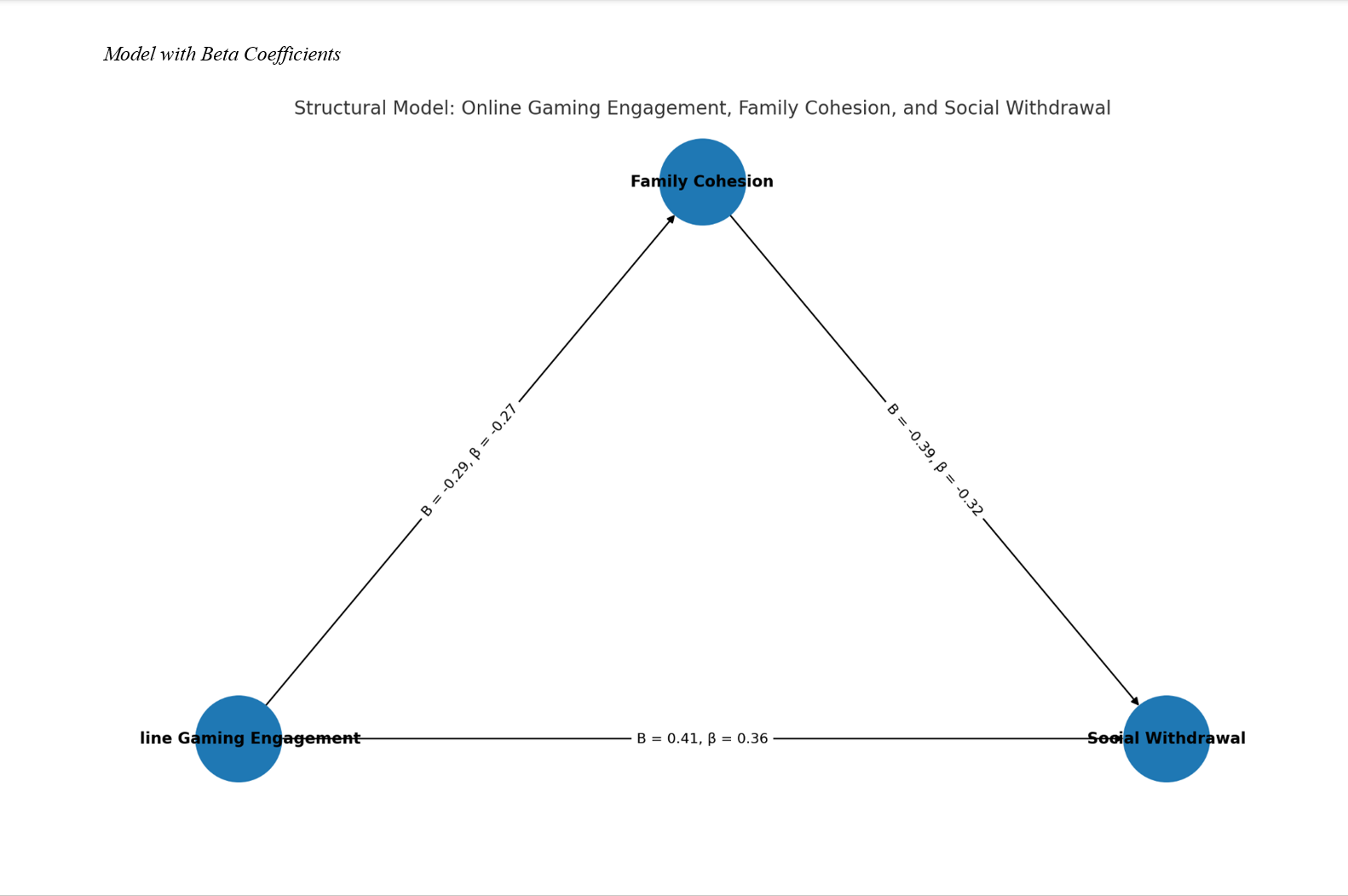
Findings: Pearson correlation results revealed that social withdrawal was positively correlated with online gaming engagement (r = .42, p < .001) and negatively correlated with family cohesion (r = -.36, p < .001). Online gaming engagement was also negatively correlated with family cohesion (r = -.28, p < .001). SEM demonstrated adequate model fit (χ² = 218.73, df = 94, χ²/df = 2.33, GFI = 0.93, AGFI = 0.90, CFI = 0.96, TLI = 0.95, RMSEA = 0.057). Path analysis showed that online gaming directly predicted higher social withdrawal (b = 0.41, β = 0.36, p < .001) and lower family cohesion (b = -0.29, β = -0.27, p < .001). Family cohesion negatively predicted social withdrawal (b = -0.39, β = -0.32, p < .001). Indirect effects confirmed partial mediation (b = 0.11, β = 0.09, p = .008), with a significant total effect of gaming on withdrawal (b = 0.52, β = 0.45, p < .001).
Conclusion: The findings suggest that online gaming engagement contributes to adolescent social withdrawal both directly and indirectly through reduced family cohesion. Strengthening family cohesion may serve as a protective factor, mitigating the adverse psychosocial effects of excessive gaming.
Downloads
References
Adekunle, H. O. (2025). Mental Health and Gaming Addiction Among Youth: A Case Study of Lagos, Nigeria. Global Academic Journal of Humanities and Social Sciences, 7(02), 72-85. https://doi.org/10.36348/gajhss.2025.v07i02.002
Alrahili, N., Alreefi, M., Alkhonain, I. M., Aldakhilallah, M., Alothaim, J. S., Alzahrani, A., Alshargi, A., & Baabbad, N. M. (2023). The Prevalence of Video Game Addiction and Its Relation to Anxiety, Depression, and Attention Deficit Hyperactivity Disorder (ADHD) in Children and Adolescents in Saudi Arabia: A Cross-Sectional Study. Cureus. https://doi.org/10.7759/cureus.42957
Cisamolo, I., Michel, M., Rabouille, M., Dupouy, J., & Escourrou, E. (2020). Perceptions of Adolescents Concerning Pathological Video Games Use: A Qualitative Study. https://doi.org/10.21203/rs.3.rs-32271/v1
Deniz, M. E., KurtuluŞ, H. Y., & Kaya, Y. (2024). Family Communication and Bi‐dimensional Student Mental Health in Adolescents: A Serial Mediation Through Digital Game Addiction and School Belongingness. Psychology in the Schools, 61(11), 4375-4390. https://doi.org/10.1002/pits.23290
El-Rasas, H., Ma, E.-M., Re, K., Soliman, A. M., & Asaad, T. (2022). The Psychiatric Impact of Video Game Addiction in a Sample of Ain Shams University Student. Austinaddictsci, 4(1). https://doi.org/10.26420/austinaddictsci.2022.1015
Fithria, F., Wardani, E., Usman, S., Maulida, R., Darmawati, D., & Husna, C. (2022). The Adverse Effect of Gaming Disorder on the Family System in the Society. Open Access Macedonian Journal of Medical Sciences, 10(E), 531-535. https://doi.org/10.3889/oamjms.2022.7249
García-Gil, M. Á., Bullón, F. F., Gutman, I. R., & Sánchez-Casado, I. (2022). Problematic Video Game Use and Mental Health Among Spanish Adolescents. International journal of environmental research and public health, 20(1), 349. https://doi.org/10.3390/ijerph20010349
Giree, M., & Das, D. (2024). Effectiveness of Structured Intervention Module on Video Game Addiction Among Adolescents in Nepal. Journal of Advanced Academic Research, 11(1), 116-125. https://doi.org/10.3126/jaar.v11i1.65534
Hu, J. (2023). Research on the Relationship Between Video Games Exposure and Adolescents. Lecture Notes in Education Psychology and Public Media, 19(1), 232-238. https://doi.org/10.54254/2753-7048/19/20231445
Joseph, S. (2022). Problematic Gaming Among Adolescents Within a Non-Clinical Population: A Scoping Review. Ecs Transactions, 107(1), 14665-14673. https://doi.org/10.1149/10701.14665ecst
Kumari, S., & Dhiksha, J. (2022). Effect of Intervention for Gaming Addiction Among Adolescents. International journal of health sciences, 10707-10717. https://doi.org/10.53730/ijhs.v6ns3.8718
Labana, R. V., Hadjisaid, J. L., Imperial, A. R., Jumawid, K. E., Lupague, M. J. M., & Malicdem, D. C. (2020). Online Game Addiction and the Level of Depression Among Adolescents in Manila, Philippines. Central Asian Journal of Global Health, 9(1). https://doi.org/10.5195/cajgh.2020.369
Lu, L., Mei, L., Ge, B., Bai, Z., & Liu, Z. (2022). Adolescent Addiction to Short Video Applications in the Mobile Internet Era. Frontiers in psychology, 13. https://doi.org/10.3389/fpsyg.2022.893599
Nagata, J. M. (2025). Beyond Screen Time—Addictive Screen Use Patterns and Adolescent Mental Health. JAMA. https://doi.org/10.1001/jama.2025.8135
Omri, S., Daoud, M., Smaoui, N., Feki, R., Charfi, N., Thabet, J. B., Zouari, L., & Bouali, M. M. (2021). Gaming Addiction Among Tunisian Adolescent. European Psychiatry, 64(S1), S824-S824. https://doi.org/10.1192/j.eurpsy.2021.2178
Ouertani, M., Fredj, S. B., Ghammem, R., Zammit, N., Maatouk, A., Belgacem, W. B., Boujebha, S., Guesmi, N., Maatoug, J., & Ghannem, H. (2022). Video Game Addiction Among Tunisian Adolescents in Sousse: A Cross-Sectional Study in High Schools. European journal of public health, 32(Supplement_3). https://doi.org/10.1093/eurpub/ckac129.520
Özkan, S., & Özkan, E. T. (2023). Health Impacts of Internet Gaming Addiction. 283-297. https://doi.org/10.4018/978-1-6684-8397-8.ch018
Purwaningsih, E., & Nurmala, I. (2021). The Impact of Online Game Addiction on Adolescent Mental Health: A Systematic Review and Meta-Analysis. Open Access Macedonian Journal of Medical Sciences, 9(F), 260-274. https://doi.org/10.3889/oamjms.2021.6234
Raney, J. H., Al-Shoaibi, A. A. A., Ganson, K. T., Testa, A., Jackson, D. B., Singh, G., Sajjad, O. M., & Nagata, J. M. (2023). Associations Between Adverse Childhood Experiences and Early Adolescent Problematic Screen Use in the United States. BMC public health, 23(1). https://doi.org/10.1186/s12889-023-16111-x
Rosales-Navarro, C., & Pérez, I. T. (2025). Parental Behaviors and Video Game Addiction in Adolescents: A Systematic Review. International journal of mental health and addiction. https://doi.org/10.1007/s11469-025-01473-7
Shabih, F., Gohar, A., Ahmed, F., & Danish, H. (2022). Effect of Video Game Addiction on the Physical and Mental Wellbeing of Adolescents of Karachi. Journal of Fatima Jinnah Medical University, 15(3), 106-111. https://doi.org/10.37018/biyk3428
Shrestha, I., Pun, D. P., Basnet, I., Bhandari, J., Koirala, K., & Mahat, D. (2025). Adolescents in the Gaming Zone: A Study on Depression, Anxiety, Loneliness. Ijeps, 3(1), 35-50. https://doi.org/10.59890/ijeps.v3i1.216
Sim, T., Choo, H., Low‐Lim, A., & Lau, J. (2020). Adolescents' and Parents' Perspectives: A Gaming Disorder Intervention in Singapore. Family Relations, 70(1), 90-103. https://doi.org/10.1111/fare.12474
Syam, A., Kasim, J., Yusnaeni, Y., & Syam, A. (2022). Pendampingan Kegiatan Self-Assessment Dan Self-Regulation Adiksi Game Online Berbasis Sekolah Di SMA Negeri 21 Makassar. Mallomo Journal of Community Service, 3(1), 28-36. https://doi.org/10.55678/mallomo.v3i1.804
Tereshchenko, S., Afonicheva, K. V., Марченко, И. В., Shubina, M., & Smolnikova, M. V. (2024). Polymorphic Variants of the Dopamine Receptor Gene DRD2 (Rs6277, Rs1800497) in Adolescents With Problematic Video Game Use. Vavilov Journal of Genetics and Breeding, 28(6), 667-674. https://doi.org/10.18699/vjgb-24-74
Xiao, Y. (2025). Addictive Screen Use Trajectories and Suicidal Behaviors, Suicidal Ideation, and Mental Health in US Youths. JAMA. https://doi.org/10.1001/jama.2025.7829
Yang, Z. (2023). Why Adolescents Are Addicted to Social Media. Journal of Education Humanities and Social Sciences, 8, 1430-1436. https://doi.org/10.54097/ehss.v8i.4498
Yue, Y. (2024). Effects of Video Game Addiction on Mental Health. Lecture Notes in Education Psychology and Public Media, 33(1), 137-144. https://doi.org/10.54254/2753-7048/33/20231573
Zhu, S., Zhuang, Y., Lee, P. H., Li, J. C. M., & Wong, P. (2020). Leisure and Problem Gaming Behaviors Among Children and Adolescents During School Closures Caused by COVID-19 in Hong Kong: Quantitative Cross-Sectional Survey Study (Preprint). https://doi.org/10.2196/preprints.26808
Zhu, S., Zhuang, Y., Lee, P. H., Li, J. C. M., & Wong, P. (2021). Leisure and Problem Gaming Behaviors Among Children and Adolescents During School Closures Caused by COVID-19 in Hong Kong: Quantitative Cross-Sectional Survey Study. JMIR serious games, 9(2), e26808. https://doi.org/10.2196/26808
Downloads
Additional Files
Publication Timeline
- Submitted
- Revised
- Accepted
Issue
Section
License

This work is licensed under a Creative Commons Attribution-NonCommercial 4.0 International License.