The Role of Emotional Disclosure and Vulnerability in the Reconstruction of Marital Intimacy: A Qualitative Perspective
DOI:
https://doi.org/10.61838/kman.aftj.4508Keywords:
Emotional disclosure, Vulnerability, Marital intimacy, Qualitative research, Emotion-Focused Couple Therapy, South AfricaAbstract
Objective: This study aimed to explore how emotional disclosure and vulnerability contribute to the reconstruction of marital intimacy among couples, focusing on the relational processes that foster closeness, resilience, and authentic connection.
Methods and Materials: A qualitative design was employed, using semi-structured, in-depth interviews with 21 married individuals from South Africa. Participants were selected purposively to ensure diverse representation of cultural and socioeconomic backgrounds. Interviews, lasting 60–90 minutes, explored themes of disclosure, vulnerability, and intimacy. Data collection continued until theoretical saturation was achieved. All interviews were transcribed verbatim and analyzed through thematic analysis using NVivo 19 software. The analytic process involved open coding, development of subthemes, and constant comparison across cases, ensuring credibility and trustworthiness through memo writing and peer debriefing.
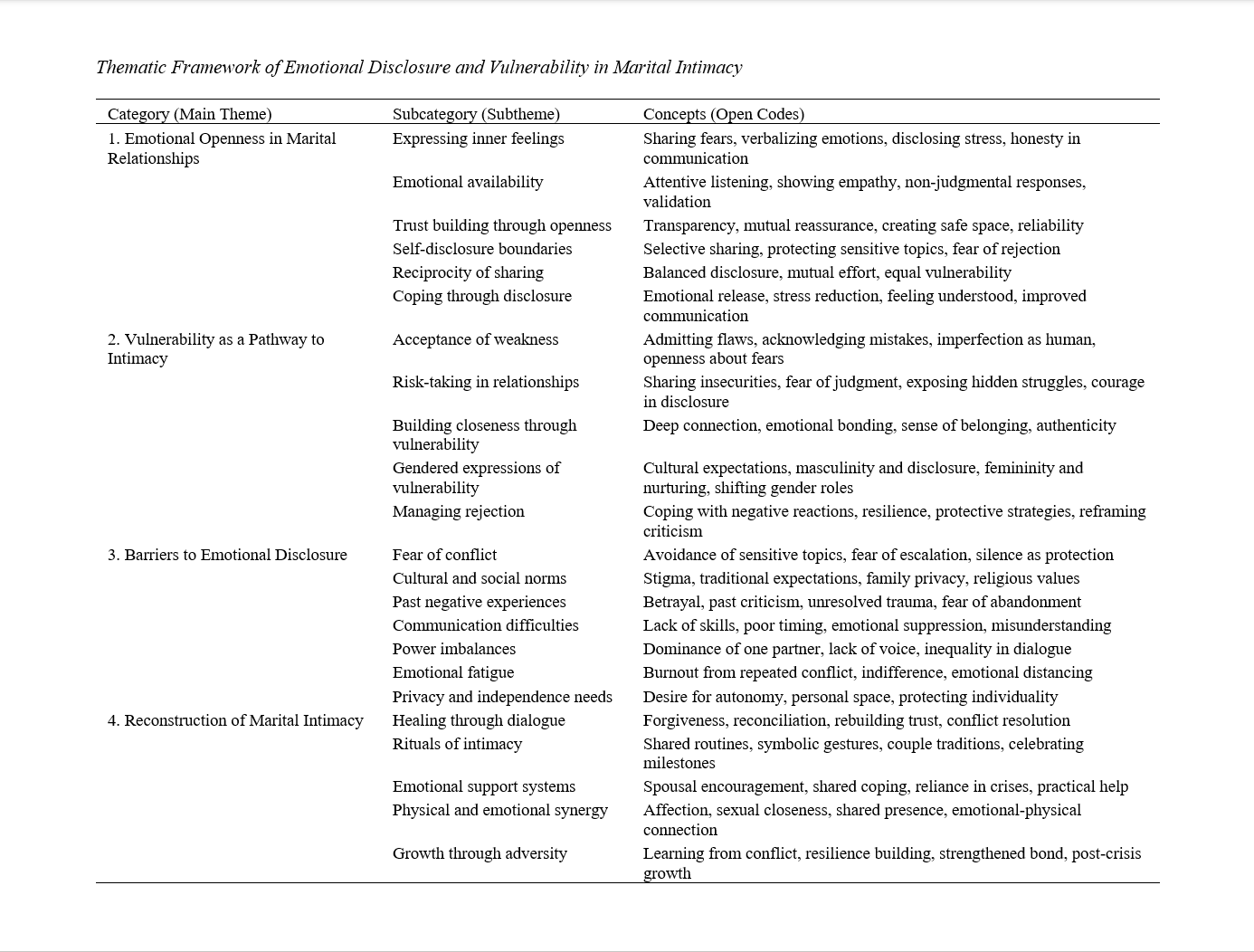
Findings: Four major themes emerged: (1) emotional openness in marital relationships, characterized by trust-building, reciprocity, and coping through disclosure; (2) vulnerability as a pathway to intimacy, where acceptance of weakness and risk-taking enabled deeper connection; (3) barriers to disclosure, including fear of conflict, cultural norms, past negative experiences, and power imbalances; and (4) reconstruction of intimacy, facilitated through healing dialogue, rituals of closeness, emotional support, and growth through adversity.
Conclusion: The study demonstrates that emotional disclosure and vulnerability are central to rebuilding intimacy in marital relationships. By creating safe spaces for openness and re-framing vulnerability as strength, couples can repair relational ruptures and cultivate long-term closeness. These insights provide valuable guidance for therapists and practitioners working with couples seeking to restore intimacy.
Downloads
References
Bradbury, T. N., & Bodenmann, G. (2020). Interventions for Couples. Annual Review of Clinical Psychology, 16(1), 99-123. https://doi.org/10.1146/annurev-clinpsy-071519-020546
Canna, P., & Partinico, M. (2014). The Experience the Gift in a Model of Co-Therapy. Journal for Perspectives of Economic Political and Social Integration, 19(1-2), 47-54. https://doi.org/10.2478/v10241-012-0003-9
Conradi, H. J., Noordhof, A., Dingemanse, P., & Kamphuis, J. H. (2022). Do High‐risk Couples Profit More or Less From Couple Relationship Education Programs Than Low‐risk Couples? Room for Improvement and Vulnerability Effects. Family Process, 62(2), 591-608. https://doi.org/10.1111/famp.12801
Green, E. J. (2008). Individuals in Conflict: An Internal Family Systems Approach. The Family Journal, 16(2), 125-131. https://doi.org/10.1177/1066480707313789
Hershenberg, R., Mavandadi, S., Baddeley, J. L., & Libet, J. (2016). Capitalization in Distressed Couples: A Pilot Study and Outline for Future Research. Personal Relationships, 23(4), 684-697. https://doi.org/10.1111/pere.12154
Knudson‐Martin, C., Kim, L., Gibbs, E., & Harmon, R. (2021). Sociocultural Attunement to Vulnerability in Couple Therapy: Fulcrum for Changing Power Processes in Heterosexual Relationships. Family Process, 60(4), 1152-1169. https://doi.org/10.1111/famp.12635
Kula, O., Machluf, R., Bar‐Kalifa, E., & Shahar, B. (2021). The Relationship Between Therapist Interventions and Couples' Emotional Injury Resolution in Emotion Focused Couples Therapy. Journal of marital and family therapy, 48(3), 726-737. https://doi.org/10.1111/jmft.12560
Lee, B. K., Shi, Y., Ofori-Dei, S., & Miftari, N. (2023). Characteristics of Seekers of Couple Therapy for Alcohol Use or Gambling Disorder. The Canadian Journal of Addiction, 14(2), 32-39. https://doi.org/10.1097/cxa.0000000000000174
Livingston, M. S. (2009). Sustained Empathic Focus and Its Application in the Treatment of Couples. Clinical Social Work Journal, 37(3), 183-189. https://doi.org/10.1007/s10615-009-0206-4
McCarthy, B., & Ross, L. W. (2017). Expanding the Types of Clients Receiving Sex Therapy and Sexual Health Services. Journal of sex & marital therapy, 44(1), 96-101. https://doi.org/10.1080/0092623x.2017.1321599
McKinnon, J. M., & Greenberg, L. S. (2013). Revealing Underlying Vulnerable Emotion in Couple Therapy: Impact on Session and Final Outcome. Journal of Family Therapy, 35(3), 303-319. https://doi.org/10.1111/1467-6427.12015
McKinnon, J. M., & Greenberg, L. S. (2017). Vulnerable Emotional Expression in Emotion Focused Couples Therapy: Relating Interactional Processes to Outcome. Journal of marital and family therapy, 43(2), 198-212. https://doi.org/10.1111/jmft.12229
Meneses, C. W., & Greenberg, L. S. (2019). A Model of the Process of Forgiving in Couples Therapy. 145-166. https://doi.org/10.1037/0000144-008
Meneses, C. W., & McKinnon, J. M. (2019). Emotion-Focused Therapy for Couples. 447-469. https://doi.org/10.1037/0000112-020
O’Brien, T., DeLongis, A., Pomaki, G., Puterman, E., & Zwicker, A. (2009). Couples Coping With Stress. European Psychologist, 14(1), 18-28. https://doi.org/10.1027/1016-9040.14.1.18
Owen, J., & Quirk, K. (2014). Heightening in Couple Therapy. Psychotherapy, 51(1), 7-10. https://doi.org/10.1037/a0032160
Scheinkman, M., Iasenza, S., Ludwig, K., Cronin, T. M., Lemor, S., & Papp, P. (2022). Sexual Intimacy and Aging: An Integrative Framework to Promote Intimacy Resilience in Couple Therapy. Family Process, 61(2), 456-475. https://doi.org/10.1111/famp.12767
Scheinkman, M., & Werneck, D. (2010). Disarming Jealousy in Couples Relationships: A Multidimensional Approach. Family Process, 49(4), 486-502. https://doi.org/10.1111/j.1545-5300.2010.01335.x
Sehgal, A. (2020). Music Therapy With Couples and Families in the United Kingdom: A Review. Couple and Family Psychoanalysis, 10(1), 99-107. https://doi.org/10.33212/cfp.v10n1.2020.99
Smoliak, O., Dechamplain, B., Elliott, R., Rice, C., LeCouteur, A., Tseliou, E., & Davies, A. W. J. (2025). Partner Empathy in Couple Therapy: A Discovery-Phase Task Analytic Study. Couple and Family Psychology Research and Practice, 14(2), 107-121. https://doi.org/10.1037/cfp0000244
Smoliak, O., LaMarre, A., Rice, C., Tseliou, E., LeCouteur, A., Myers, M., Vesely, L. M., Briscoe, C., Addison, M., & Velikonja, L. (2021). The Politics of Vulnerable Masculinity in Couple Therapy. Journal of marital and family therapy, 48(2), 427-446. https://doi.org/10.1111/jmft.12530
Stedje, K., Kvamme, T. S., Johansson, K., Sousa, T. V., Odell–Miller, H., Stensæth, K., Bukowska, A., Tamplin, J., Wosch, T., & Baker, F. A. (2023). The Influence of Home-Based Music Therapy Interventions on Relationship Quality in Couples Living With Dementia—An Adapted Convergent Mixed Methods Study. International journal of environmental research and public health, 20(4), 2863. https://doi.org/10.3390/ijerph20042863
Talmor, S. B., Shahar, B., Sbarra, D. A., & Bar‐Kalifa, E. (2025). The Development of a Brief Session‐Level Process Measure for Emotion‐Focused Couple Therapy. Family Process, 64(1). https://doi.org/10.1111/famp.70000
Timulák, L., Dailey, J., Lunn, J., & McKnight, J. (2024). Transdiagnostic Emotion-Focused Therapy for Couples With Co-Morbid Relational and Mood, Anxiety and Related Difficulties. Journal of Contemporary Psychotherapy, 55(1), 1-10. https://doi.org/10.1007/s10879-024-09645-7
Wiesel, I., Shahar, B., Goldman, R. N., & Bar‐Kalifa, E. (2020). Accuracy and Bias in Vulnerability Perceptions of Partners Undergoing Emotion‐Focused Therapy for Couples. Family Process, 60(2), 377-392. https://doi.org/10.1111/famp.12587
Downloads
Additional Files
Publication Timeline
- Submitted
- Revised
- Accepted
Issue
Section
License

This work is licensed under a Creative Commons Attribution-NonCommercial 4.0 International License.