The Contribution of Personality Macro-Factors in Predicting Marital Satisfaction of Women: A Preliminary Study for Developing a Premarital Counseling Protocol
DOI:
https://doi.org/10.61838/kman.aftj.4486Keywords:
personality macro-factors, marital satisfaction, premarital counselingAbstract
Objective: The present study was conducted with the aim of examining the contribution of personality macro-factors in the variance of women’s marital satisfaction: a preliminary study for developing a premarital counseling protocol.
Methods and Materials: The research method was descriptive-correlational. The statistical population included all married female students aged 25 to 40 who were studying at Islamic Azad Universities in Isfahan during the 2023–2024 academic year. From this population, 128 individuals were selected using Cochran’s formula and the convenience sampling method. They completed the Enrich Marital Satisfaction Questionnaire (1989) and Cattell’s 16 Personality Factors Questionnaire (1993). Data were analyzed using Pearson correlation tests and stepwise multiple regression analysis via SPSS-23.
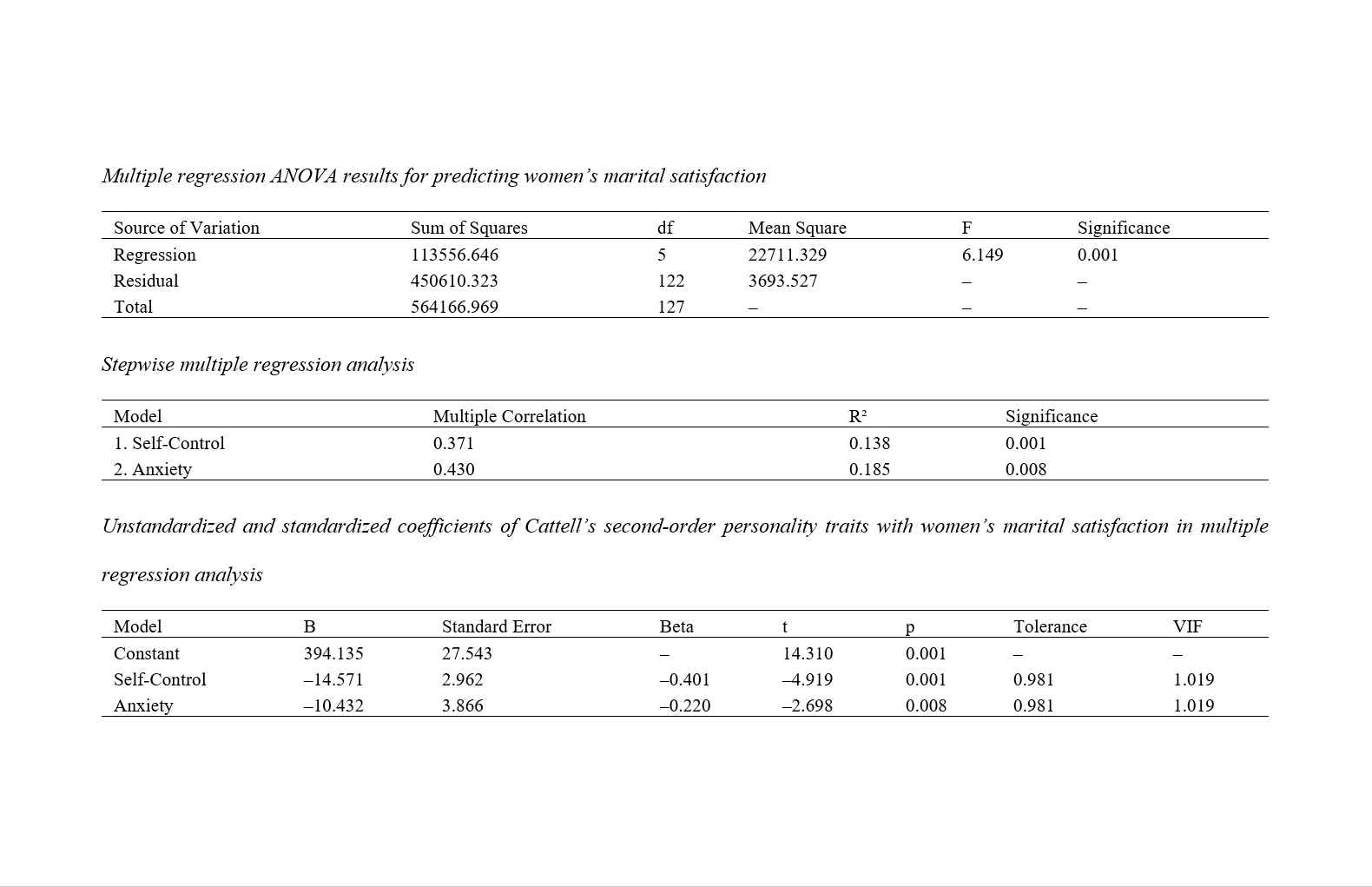
Findings: The results indicated that there was a positive relationship between the personality trait of extraversion and women’s marital satisfaction, and a negative relationship between the personality trait of self-control and women’s marital satisfaction. Moreover, the outcomes of regression analysis showed that the personality traits of self-control and anxiety, with determination coefficients of –0.401 and –0.220 respectively, were able to predict marital satisfaction.
Conclusion: Considering the existence of a relationship between personality traits and marital satisfaction, the findings of this study can be used in premarital counseling. By identifying women’s personality traits, it is possible to predict and enhance their marital satisfaction.
Downloads
References
Bach, K., Koch, M., & Spinath, F. M. (2025). Relationship satisfaction and The Big Five-Utilizing longitudinal data covering 9 years. Personality and individual differences, 233, 112887. https://doi.org/10.1016/j.paid.2024.112887
Barzegar, M. (1996). Norming the Cattell 16 Personality Factor Questionnaire in Students of Shiraz City Allameh Tabatabai University]. https://elmnet.ir/doc/10808180-32861
Bentler, P. M., & Newcomb, M. D. (1978). Longitudinal study of marital success and failure. Journal of consulting and clinical psychology, 46(5), 1053. https://doi.org/10.1037/0022-006X.46.5.1053
Brudek, P., & Kaleta, K. (2023). Marital offence-specific forgiveness as mediator in the relationships between personality traits and marital satisfaction among older couples: Perspectives on Lars Tornstam's theory of gerotranscendence. Ageing & Society, 43(1), 161-179. https://doi.org/10.1017/S0144686X21000465
Brudek, P. J., Steuden, S., & Jasik, I. (2018). Personality traits as predictors of marital satisfaction among older couples. Psychoterapia, 185(2), 5-20. https://www.researchgate.net/publication/328801412_Personality_traits_as_predictors_of_marital_satisfaction_among_older_couples
Burger, J. M. (2019). Personality (10th ed.). Cengage Learning. https://books.google.com/books/about/Personality.html?id=5g9EDwAAQBAJ
Busch, F. N., Rudden, M., & Shapiro, T. (2016). Psychodynamic treatment of depression (2nd ed.). American Psychiatric Publication. https://doi.org/10.1176/appi.books.9781615371013
Cattell, R. B., & Krug, S. E. (1986). The number of factors in the 16PF: A review of the evidence with special emphasis on methodological problems. Educational and psychological measurement, 46(3), 509-522. https://doi.org/10.1177/0013164486463002
Costa, P. T., & McCrae, R. R. (1992). Normal personality assessment in clinical practice: The NEO Personality Inventory. Psychological assessment, 4(1), 5. https://doi.org/10.1037/1040-3590.4.1.5
Czechowska-Bieluga, M., & Lewicka-Zelent, A. (2021). Marital satisfaction-a literature review. Family Upbringing(2). https://doi.org/10.61905/wwr/170384
Elijah, O. S. A. (2024). The Concept And Nature Of Pre-Marital Counselling In Christian Marriage. DTS JOURNAL OF ARTS AND HUMANITIES, AFFILIATED TO HARVEST BIBLE UNIVERSITY, USA. https://gagdm.com/index.php/DTS/article/download/351/346
Girard, J. M., Wright, A., Beeney, J. E., Lazarus, S. A., Scott, L. N., Stepp, S. D., & Pilkonis, P. A. (2017). Interpersonal problems across levels of the psychopathology hierarchy. Comprehensive Psychiatry, 79, 53-69. https://doi.org/10.1016/j.comppsych.2017.06.014
Gottfried, A. E. (2021). Maternal employment in the family setting: Developmental and environmental issues 1. In Employed mothers and their children (pp. 63-84). Routledge. https://doi.org/10.4324/9781315860695-4
Günaydin, H. D. (2022). Marital satisfaction in relation to big five, punitiveness, unrelenting standard and self-compassion. The American Journal of Family Therapy, 50(1), 94-112. https://doi.org/10.1080/01926187.2021.2021830
Hawkins, A. J., Blanchard, V. L., Baldwin, S. A., & Fawcett, E. B. (2008). Does marriage and relationship education work? A meta-analytic study. Journal of consulting and clinical psychology, 76(5), 723. https://doi.org/10.1037/a0012584
Heidarinajad, K., Iranpour, R., & Hakim, M. A. (2018). Feasibility of the Relationship Between Marital Satisfaction and the Big Five Personality Traits. Women and Family Studies, 11(42), 55-69. https://journals.iau.ir/article_667506.html?lang=en
Hemming, L., Taylor, P., Haddock, G., Shaw, J., & Pratt, D. (2019). A systematic review and meta-analysis of the association between alexithymia and suicide ideation and behaviour. Journal of affective disorders, 254, 34-48. https://doi.org/10.1016/j.jad.2019.05.013
Huang, Y., Sundar, S. S., Ye, Z., & Johnson, A. C. (2021). Do women and extroverts perceive interactivity differently than men and introverts? Role of individual differences in responses to HCI vs. CMC interactivity. Computers in human Behavior, 123, 106881. https://doi.org/10.1016/j.chb.2021.106881
Isma, M. N. P., & Turnip, S. S. (2019). Personality traits and marital satisfaction in predicting couples' attitudes toward infidelity. Journal of Relationships Research, 10, e13. https://doi.org/10.1017/jrr.2019.10
Kiani Chalmerdi, A., Shahbazi, N., Hassan-Zadeh, A., & Jamshidian Nayeni, Y. (2021). Predicting Adjustment, Marital Satisfaction, and Psychological Disturbance (Depression and Anxiety) in Married Women Based on Perception of Parents' Marriage and Attachment Styles. Psychology Growth, 10(6), 1-9. https://frooyesh.ir/article-1-2726-en.html
Lavner, J. A., Weiss, B., Miller, J. D., & Karney, B. R. (2018). Personality changes among newlyweds: Patterns, predictors, and associations with marital satisfaction over time. Developmental Psychology, 54(6), 1172-1185. https://doi.org/10.1037/dev0000491
Lui, M., Lau, G. K., Tam, V. C., Chiu, H. M., Li, S. S., & Sin, K. F. (2020). Parents' impact on children's school performance: Marital satisfaction, parental involvement, and mental health. Journal of Child and Family Studies, 29(6), 1548-1560. https://doi.org/10.1007/s10826-019-01655-7
Lynch, T. R., Cheavens, J. S., Morse, J. Q., & Rosenthal, M. Z. (2004). A model predicting suicidal ideation and hopelessness in depressed older adults: the impact of emotion inhibition and affect intensity. Aging & mental health, 8(6), 486-497. https://doi.org/10.1080/13607860412331303775
Maliani, M., Tavoli, A., Khodabakhsh, R., & Bakhtiari, M. (2009). Comparing the Results of the Cattell 16 Personality Factor Test Among Free Volunteers and Job Applicants. Recent Advances in Organizational Industrial Psychology, 1(1), 39-45. https://www.magiran.com/paper/871417/comparative-conclusion-between-about-16-pf-free-and-employment-applicants?lang=en
Moradi, M., Karaminia, R., Hatami, H., & Abul-Maali Al-Hosseini, K. (2018). Examining the Fit of a Conceptual Model for Predicting Marital Satisfaction Based on Socio-Economic Factors and Personality Traits Mediated by Lifestyle in Women in Tehran. Cultural-Educational Journal of Women and Family, 13(43), 7-31. https://en.civilica.com/doc/1396015/
Nars, E. R. (2022). Measuring Family: The Application of Personality Tests for Couples and Families. Sokhan Publications.
Öcalan, D., Ceylantekin, Y., Karslı, T. A., & Dursun-Karslı, P. (2024). Psychosocial adaptation, marital satisfaction and meaning in life between women with high and low-risk pregnancies. Current Psychology, 43(1), 15-27. https://doi.org/10.1007/s12144-023-05407-1
Odinka, J. I., Nwoke, M., Chukwuorji, J. C., Egbuagu, K., Mefoh, P., Odinka, P. C., Amadi, K. U., & Muomah, R. C. (2018). Post-partum depression, anxiety and marital satisfaction: A perspective from Southeastern Nigeria. South African Journal of Psychiatry, 24. https://doi.org/10.4102/sajpsychiatry.v24i0.1109
Ojo Adeshina Akinwumi, E. (2017). Personality traits and sexual satisfaction as determinants of marital satisfaction among couples in Ibadan. Gender and Behaviour, 15(1), 8421-8441. https://journals.co.za/doi/abs/10.10520/EJC-88ebb4689
Orayzi, H. R., Abedi, A., & Amini, M. (2016). A meta-analysis of extroversion and marital satisfaction. Journal of Fundamentals of Mental Health, 305-312. https://jfmh.mums.ac.ir/article_7787.html
Rajabi, G., & Nabgani, K. (2008). Examining the Relationship Between Personality Traits, Components of Love, and Marital Satisfaction Among Employees in Ahvaz. Counseling Research, 7-26. https://www.sid.ir/paper/69959/en
Sadeghi, M., Mousavi, J., Motabi, F., & Dehghani, M. (2015). The Relationship Between Personality Traits of Couples and Marital Satisfaction. Contemporary psychology, 10(2), 67-82. https://bjcp.ir/article-1-899-en.html
Saulter-Carney, D. M. (2024). The Lived Experiences of Premarital Counseling and Its Influence on Martial Satisfaction https://digitalcommons.liberty.edu/doctoral/5210/
Sayehmiri, K., Kareem, K. I., Abdi, K., Dalvand, S., & Ghanei Gheshlagh, R. (2020). The relationship between personality traits and marital satisfaction: a systematic review and meta-analysis. BMC psychology, 8(1), 1-8. https://doi.org/10.1186/s40359-020-0383-z
Tahan, M., Saleem, T., Moshtagh, M., Fattahi, P., & Rahimi, R. (2020). Psychoeducational Group Therapy for sexual function and marital satisfaction in Iranian couples with sexual dysfunction disorder. Heliyon, 6, 1-7. https://doi.org/10.1016/j.heliyon.2020.e04586
Tahmasbi, H., & Khoramabadi, Y. (2024). Predicting Women's Marital Satisfaction Based on Conscientiousness, Marital Empathy, and Marital Forgiveness. Psychology Growth, 13(5), 219-228. https://frooyesh.ir/article-1-5035-en.html
Tahmasebi, S., Maleki, B., Aval, M. R., & Tahmasebi, F. (2016). The relationship between personality types (introvert-extrovert) and perfectionism with marital satisfaction in women employees of Shiraz welfare organization. International Journal of Humanities and Cultural Studies (IJHCS) ISSN 2356-5926, 38-49.
Taqirijah, S., Bahadori Khosroshahi, J., & Khajani, Z. (2016). Predicting Marital Satisfaction of Women Based on Personality Traits and Religiosity. Journal of Family Counseling and Psychotherapy, 2(22), 107-127. https://fcp.uok.ac.ir/article_44542.html
Tolan, Ö. Ç., & KiliÇ, M. (2020). Prediction of Marital Adjustment in the Context of Personality Traits, Relationship Beliefs and Conflict Resolution Styles (Sample of Diyarbakır). Opus Uluslararası Toplum Araştırmaları Dergisi, 18(40), 1-15. https://doi.org/10.26466/opus.854688
Downloads
Additional Files
Publication Timeline
- Submitted
- Revised
- Accepted