Comparison of the Effectiveness of Acceptance and Commitment Therapy and Reality Therapy on the Components of Adaptation in Incompatible Married Individuals
DOI:
https://doi.org/10.61838/kman.aftj.4179Keywords:
Marital Adjustment, Acceptance and Commitment Therapy (ACT), Reality Therapy (RT)Abstract
Methods and Materials: A quasi-experimental design with a pretest-posttest-follow-up framework was employed, involving two experimental groups (ACT and RT) and one control group. The sample consisted of 54 incompatible married individuals (18 per group) recruited from psychological centers in District 7 of Tehran. Participants completed the Spanier Dyadic Adjustment Scale at pretest, posttest, and follow-up stages. The ACT intervention comprised 8 weekly sessions focusing on mindfulness, acceptance, and value-based actions, while the RT intervention consisted of 8 sessions emphasizing need satisfaction and responsible behavior. Data were analyzed using repeated measures ANOVA to assess changes over time and between groups.
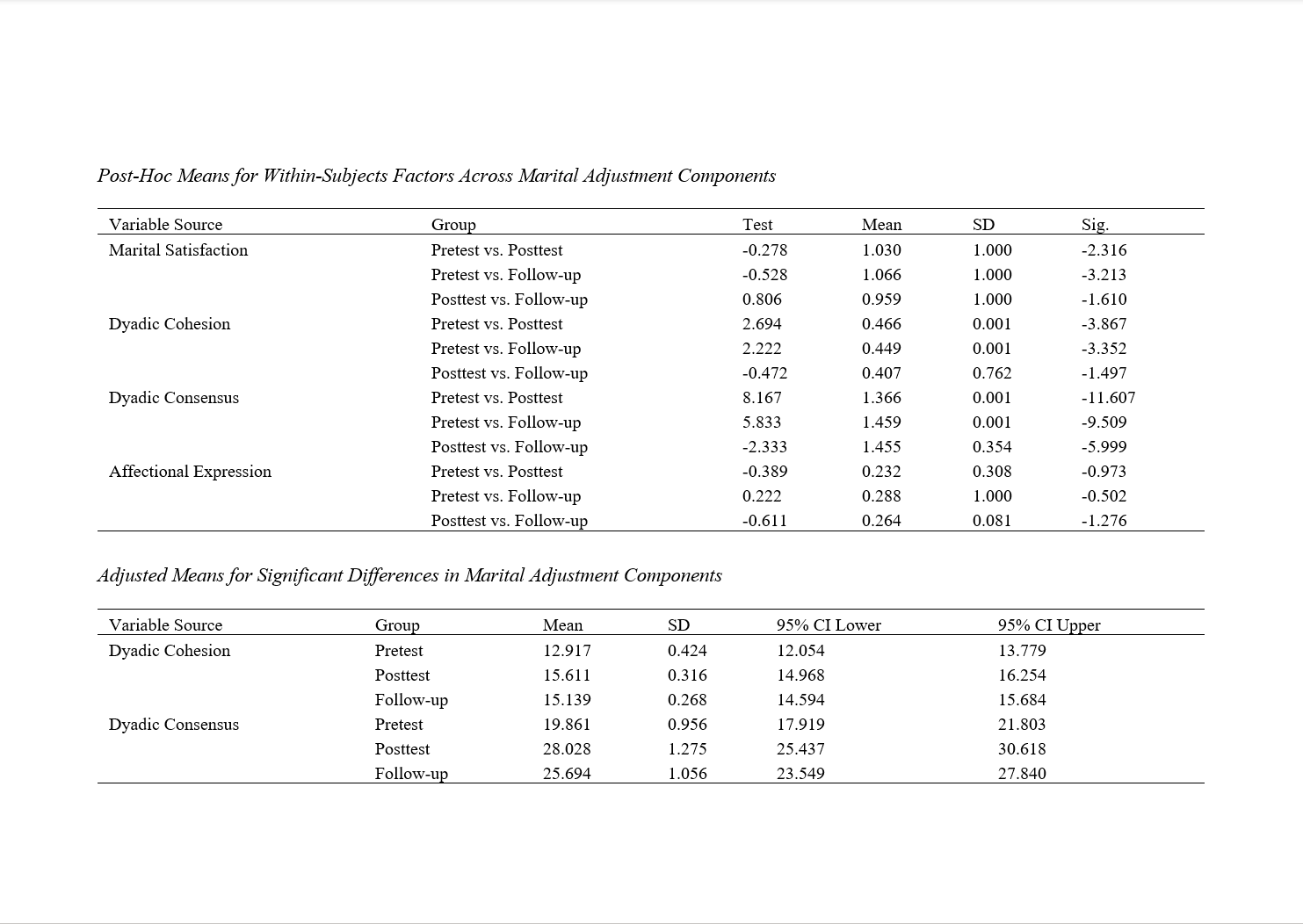
Findings: Both ACT and RT significantly improved overall marital adjustment compared to the control group, with significant interaction effects observed for dyadic cohesion (F = 11.161, p = 0.001, η² = 0.247), dyadic consensus (F = 24.787, p = 0.001, η² = 0.422), and affectional expression (F = 22.477, p = 0.001, η² = 0.398). RT demonstrated greater effectiveness in enhancing dyadic cohesion and consensus, while ACT showed stronger outcomes in improving affectional expression. Post-hoc analyses revealed significant mean differences between pretest and posttest for dyadic cohesion in RT (mean difference = -8.167, p < 0.001) and affectional expression in ACT (mean difference = 2.694, p < 0.001). Follow-up assessments indicated sustained improvements, with RT maintaining higher scores in dyadic cohesion (mean = 15.139) and consensus (mean = 25.694), and ACT in affectional expression (mean = 4.78).
Conclusion: Both ACT and RT are effective interventions for improving marital adjustment, with RT being more beneficial for addressing behavioral and communication aspects of marital conflict, and ACT more effective in fostering emotional intimacy.
Downloads
References
Abedi, G., Ataeifar, R., & Ghamari, M. (2024). The Effectiveness of Group Marital Conflict Resolution Training Based on Choice Theory on Emotional Divorce and Hope for Life in Married Women. International Journal of Education and Cognitive Sciences, 5(3), 136-146. https://doi.org/10.61838/kman.ijecs.5.3.10
Akhavan Bitaghsir, Z., Sanaee Zaker, Bagher, Navabinejad, Shokoh, Farzad, Valy alah. (2017). Comparetive of Emotional Focused Couple Therapy and Acceptance and Commitment Therapy on Marital Adjustment and Marital Satisfaction. Iranian Journal of Health Education and Health Promotion, 5(2), 121-128. https://doi.org/10.30699/acadpub.ijhehp.5.2.121
Akhavan Gholami, H. (2019). Effectiveness of Acceptance and Commitment Therapy (ACT) on dysfunctional relationship beliefs and marital adjustment in maladjusted women. Knowledge & Research in Applied Psychology, 20(3), 31-43. https://journals.iau.ir/article_667724.html
Akrami, S. (2022). Evaluation of the Effectiveness of Acceptance and Commitment-based Education on Emotional Self-disclosure and Marital Commitment of Women Referring to Gonbad Kavous Clinics. International Journal of Education and Cognitive Sciences, 3(2), 23-29. https://doi.org/10.22034/injoeas.2022.160610
Arab Vornusfaderani, M., Fatehi Zadeh, M., Bahrami, F., Jazayeri, R. a.-S., & Ebrahimi, A. (2017). Effectiveness of Acceptance and Commitment-Based Couple Therapy on Marital Adjustment in Men with Bipolar Disorder Type 2. Journal of Behavioral Sciences Research, 15(3), 261-276. https://rbs.mui.ac.ir/article-1-541-fa.html
Basharat Qaramaleki, R., Panah Ali, H., Hosseininasab, D., & Mir, D. (2021). Comparing the effectiveness of couple therapy based on reality therapy and forgiveness therapy in a group way on marital adjustment, emotional differentiation and intimacy of couples with emotional divorce. Counseling Research, 80(20), 130-157. https://doi.org/10.18502/qjcr.v20i80.8490
Besharat Qaramaleki, R., Panahali, A., & Hosseini Nasab, D. (2024). Investigating the Impacts and Continuity of Effects of Group-Based Reality Therapy on Marital Adjustment, Emotion Differentiation, and Intimacy in Couples with Emotional Divorce. Journal of Modern Psychological Researches, 18(72), 61-70. https://psychologyj.tabrizu.ac.ir/article_16930.html?lang=en
Deldadeh, M., & Mo'aven-e-Islami, S. (2020). The effectiveness of reality therapy interventions on improving marital adjustment among couples experiencing emotional divorce. Journal of Innovative Psychology Ideas, 5(9), 10-11. https://jnip.ir/article-1-318-fa.html
Honarparvaran, N. (2014). The efficacy of acceptance and commitment therapy (ACT) on forgiveness and marital adjustment among women damaged by marital infidelity. Quarterly Journal of Woman and Society, 5(19), 135-150. https://jzvj.marvdasht.iau.ir/article_645.html
Joulazadeh Esmaeili, A. A., Karimi, J., Ghodrzi, K., & Asgari, M. (2021). Comparing the Effectiveness of Acceptance and Commitment Couple Therapy and Emotion-focused Therapy on Depression and Marital Adjustment. Clinical Psychology Journal, 13(1), 64-47. https://jcp.semnan.ac.ir/article_4912.html?lang=en
Kamali, M., & Mahdian, H. (2023). Effectiveness of Realistic Acceptance and Commitment Therapy on Marital Adjustment and Satisfaction Among Couples on the Verge of Divorce. Psychological Dynamics in Mood Disorders, 2(2), 10-20. https://www.sid.ir/paper/1363742/en
Peterson, B. D., Eifert, G. H., Feingold, T., & Davidson, S. (2009). Using Acceptance and Commitment Therapy to Treat Distressed Couples: A Case Study With Two Couples. Cognitive and Behavioral Practice, 16(4), 430-442. https://doi.org/10.1016/j.cbpra.2008.12.009
Saadati, N., Rostami, M., & Darbani, S. A. (2021). Comparing the effectiveness of Acceptance and Commitment Therapy (ACT) and Compassion Focused Therapy (CFT) on improving self-esteem and post-divorce adaptation in women. Journal of Family Psychology, 3(2), 45-58. https://www.ijfpjournal.ir/article_245517_28641af9cbb5eb6ff44fe78cdd2d5de8.pdf
Downloads
Additional Files
Publication Timeline
- Submitted
- Revised
- Accepted
Issue
Section
License
Copyright (c) 2025 Azam Matbou (Author); Azam Fattahi Andabil (Corresponding Author); Farideh Dokaneifard (Author)

This work is licensed under a Creative Commons Attribution-NonCommercial 4.0 International License.