The Effectiveness of Marital Distress Tolerance Training on Marital Adjustment in Conflicting Couples in Tehran
DOI:
https://doi.org/10.61838/kman.aftj.4137Keywords:
distress tolerance, marital conflict, conflicting couplesAbstract
Objective: The objective of this study was to evaluate the effectiveness of an educational program based on the Marital Distress Tolerance Model on reducing marital conflicts among conflicting couples in Tehran.
Methods and Materials: This research employed a quasi-experimental design with a pretest-posttest control group. The statistical population included all conflicting couples who visited psychological and counseling centers in Tehran. One center was randomly selected, and 30 couples were chosen through convenience sampling and randomly assigned to experimental and control groups (15 couples each). The experimental group received a 9-session intervention based on a structured educational package developed from the causal model of marital distress tolerance, focusing on cognitive flexibility, family health, and social problem-solving skills. Data were collected using the Barati and Sanaei Marital Conflict Questionnaire and a researcher-developed content validity instrument evaluated by experts. Descriptive statistics and multivariate analysis of covariance (MANCOVA) were used to analyze the data through SPSS software.
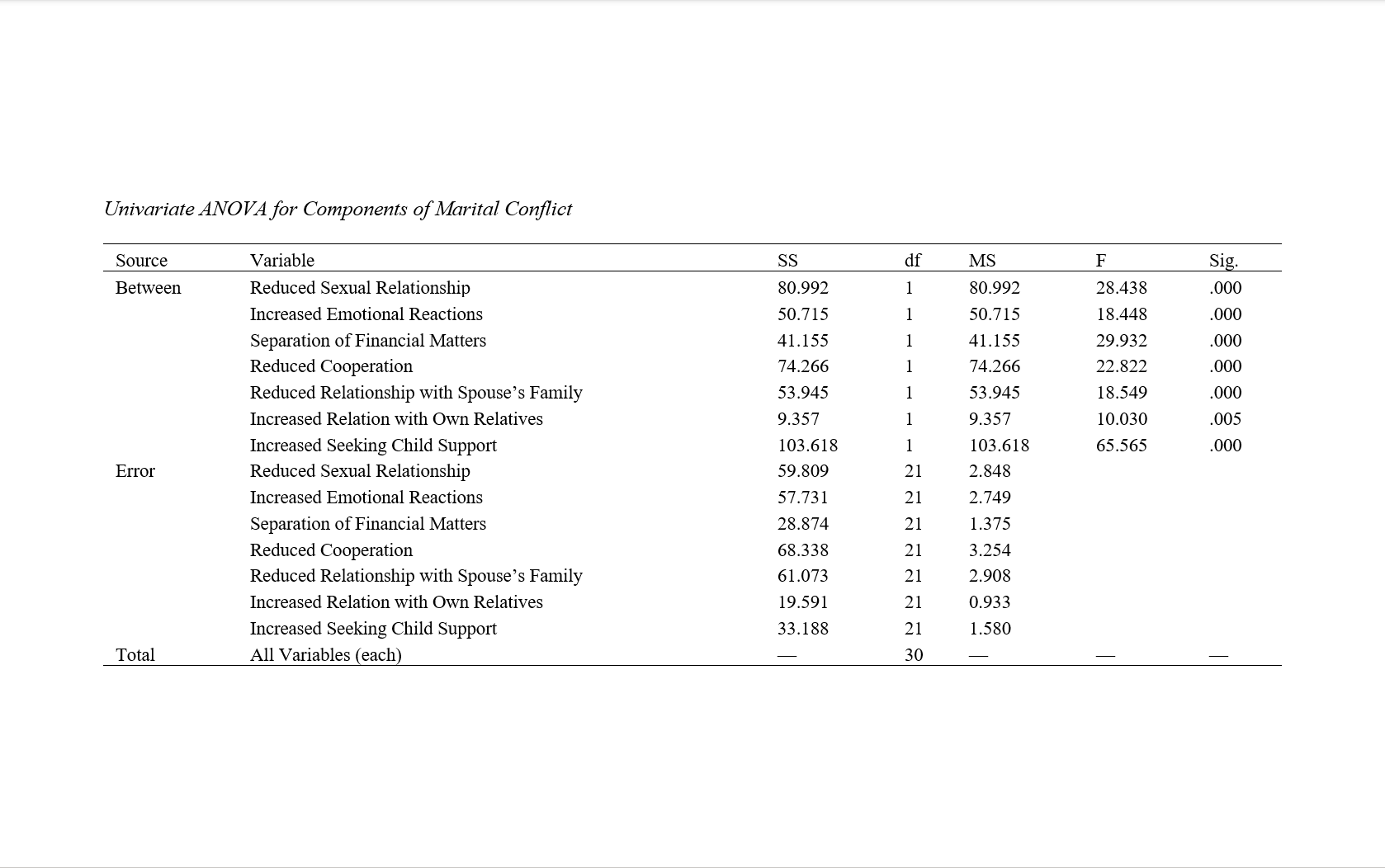
Findings: The results of the MANCOVA indicated that the educational program had a statistically significant effect on all dimensions of marital conflict, including reduced sexual relations (F = 28.438, p < .001), increased emotional reactions (F = 18.448, p < .001), separation of financial matters (F = 29.932, p < .001), reduced cooperation (F = 22.822, p < .001), reduced relationships with spouse’s relatives (F = 18.549, p < .001), increased relationships with one’s own relatives (F = 10.030, p = .005), and increased seeking support from children (F = 65.565, p < .001).
Conclusion: The study confirmed that the educational program based on the marital distress tolerance model significantly reduced marital conflicts across multiple dimensions, supporting the model’s applicability in therapeutic interventions for couples experiencing relational distress.
Downloads
References
Abedi, G., Ataeifar, R., & Ghamari, M. (2024). The Effectiveness of Group Marital Conflict Resolution Training Based on Choice Theory on Emotional Divorce and Hope for Life in Married Women. International Journal of Education and Cognitive Sciences, 5(3), 136-146. https://doi.org/10.61838/kman.ijecs.5.3.10
Amani, A., Isa-Nejad, O., & Alipour, E. (2018). Examining the Effectiveness of Group-Based Acceptance and Commitment Therapy on Marital Distress, Marital Conflict, and Optimism in Married Women Referring to the Counseling Center of the Relief Committee in Kermanshah. Journal of Psychology and Psychiatry Cognition, 1, 43-64. https://doi.org/10.29252/shenakht.5.1.42
Amani, A., Isanejad, O., & Alipour, E. (2018). Effectiveness of Acceptance and Commitment Group Therapy on Marital Distress, Marital Conflict and Optimism in Married Women. Shenakht Journal of Psychology and Psychiatry, 5(1), 42-64. https://doi.org/10.29252/shenakht.5.1.42
Amato, P. R., & Cheadle, J. E. (2008). Parental Divorce, Marital Conflict and Children's behavior Problems: A Comparison of Adopted and Biological Children. Social Forces, 86(3), 1139-1161. https://doi.org/10.1353/sof.0.0025
Araghi, N. Z. (2025). The Effectiveness of Religious Forgiveness Therapy on Reducing Marital Conflicts and Extramarital Behaviors in Married Women Seeking Divorce. KMAN Counsel and Psych Nexus, 3, 1-8. https://doi.org/10.61838/kman.fct.psynexus.3.3
Arshadi, S., Karimi, K., Akbari, M., & Moradi, O. (2021). The effectiveness of marital adjustment training on distress intolerance, difficulty in emotion regulation, and marital conflict in couples referring to counseling centers. Journal of Cognitive Psychology and Psychiatry, 8(5), 140-151. https://doi.org/10.32598/shenakht.8.5.140
Bahari, F., Fatehizadeh, M., Ahmadi, S. A., Molavi, H., & Bahrami, F. (2011). The effect of spousal communication skills training on reducing marital conflicts in conflicted couples applying for divorce. Clinical Psychology and Counseling Research, 1(1), 59-70. https://www.sid.ir/paper/204882/en
Chowdhury, N., Kevorkian, S., Hawn, S. E., Amstadter, A. B., Dick, D., Kendler, K. S., & Berenz, E. C. (2018). Associations between personality and distress tolerance among trauma-exposed young adults. Personality and individual differences, 170-166. https://doi.org/10.1016/j.paid.2017.08.041
Christensen, A., & Shenk, J. L. (1991). Communication, conflict, and psychological distance in nondistressed, clinic, and divorcing couples. Journal of consulting and clinical psychology, 59(3), 458-463. https://doi.org/10.1037/0022-006X.59.3.458
Davoodifar, F., & Esmaeilian, Z. (2024). The Effectiveness of Positive Psychotherapy on Marital Conflicts and Spiritual Wellbeing of Women With Marital Conflicts. PWJ, 5(2), 51-58. https://doi.org/10.61838/kman.pwj.5.2.8
Doorley, J. D., Kashdan, T. B., Alexander, L. A., Blalock, D. V., & McKnight, P. E. (2019). Distress tolerance in romantic relationships: A daily diary exploration with methodological considerations. Motivation and Emotion, 43(3), 505-516. https://doi.org/10.1007/s11031-019-09751-3
Eggeman, K., Moxley, V., & Schumm, W. R. (1985). Assessing Spouses' Perceptions of Gottman's Temporal Form in Marital Conflict. Psychological Reports, 57(1), 171-181. https://doi.org/10.2466/pr0.1985.57.1.171
Farahbakhsh, K. (2004). The effectiveness of couple therapy techniques from Ellis and Glasser's theories and their combination in reducing marital conflict PhD Dissertation, Allameh Tabataba'i University].
Farahbakhsh, K. (2010). Comparing the effectiveness of couple therapy alone versus couple therapy combined with family of origin in reducing marital conflicts. Culture of Counseling, 1(1). https://qccpc.atu.ac.ir/article_5870.html?lang=en
Frankel, L. A., Umemura, T., Jacobvitz, D., & Hazen, N. (2015). Marital conflict and parental responses to infant negative emotions: Relations with toddler emotional regulation. Infant Behavior and Development, 40, 73-83. https://doi.org/10.1016/j.infbeh.2015.03.004
Gao, M., Du, Han, Davies, Patrick T, Cummings, E. Mark. (2019). Marital Conflict Behaviors and Parenting: Dyadic Links Over Time. Family Relations, 68(1), 135-149. https://doi.org/10.1111/fare.12322
Gholili, Z., Ahmadi, S. A., & Fatehizadeh, M. (2006). Couple therapy dialogue for couples in conflict. Journal of Psychotherapy, 11(39-40). https://ensani.ir/fa/article/24481/
Harold, G. T., Osborne, L. N., & Conger, R. D. (1997). Mom and Dad Are at It Again: Adolescent Perceptions of Marital Conflict and Adolescent Psychological Distress. Developmental Psychology, 33(2), 333-350. https://doi.org/10.1037/0012-1649.33.2.333
Kakolian, S., Mashayekh, M., Davaee, M., & Khosravi Babadi, A. A. (2024). The role of marital conflicts and marital expectations in predicting satisfaction with marital relations. Iranian Journal of Rehabilitation Research, 10(2). https://ijrn.ir/browse.php?a_id=821&slc_lang=en&sid=1&printcase=1&hbnr=1&hmb=1
Khayrollahi, M., Jafari, A., Ghamari, M., & Babakhani, V. (2019). Designing a predictive model of cognitive flexibility based on life cycle change analysis in divorce-seeking couples. Culture of Counseling and Psychotherapy, 10(39), 157-180. https://qccpc.atu.ac.ir/article_10144.html
Kim, M. Y., & Kim, H.-J. (2024). The Effects of Mothers’ Work-Family Conflict and Marital Conflict on School Adjustment in Early School-Age Children: The Moderated Mediating Effect of Social Support. Korean Association for Learner-Centered Curriculum and Instruction, 24(20), 1111-1127. https://doi.org/10.22251/jlcci.2024.24.20.1111
Lawrence, T. I. (2022). Parental support, marital conflict, and stress as predictors of depressive symptoms among African American adolescents. Clinical Child Psychology and Psychiatry, 27(3), 630-643. https://doi.org/10.1177/13591045211070163
Leyro, T. M., Zvolensky, M. J., & Bernstein, A. (2010). Distress tolerance and psychopathological symptoms and disorders: a review of the empirical literature among adults. Psychological bulletin, 136(4), 576. https://pmc.ncbi.nlm.nih.gov/articles/PMC2891552/
Liu, D., & Vazsonyi, A. T. (2024). Longitudinal Links Between Parental Emotional Distress and Adolescent Delinquency: The Role of Marital Conflict and Parent-Child Conflict.
Downloads
Additional Files
Publication Timeline
- Submitted
- Revised
- Accepted
Issue
Section
License
Copyright (c) 2025 Marjan Madadi (Author); Omid Moradi (Corresponding Author); Latif Moradveisi (Author)

This work is licensed under a Creative Commons Attribution-NonCommercial 4.0 International License.