Comparative Effectiveness of Reality Therapy and Emotion-Focused Therapy on Love Trauma Syndrome, Self-Worth, and Relationship Beliefs in Divorced Women in Tehran
DOI:
https://doi.org/10.61838/kman.aftj.4119Keywords:
relationship beliefs, self-worth, emotion-focused therapy, women, divorced, love trauma syndrome, reality therapyAbstract
Objective: The present study aimed to compare the effectiveness of reality therapy and emotion-focused therapy (EFT) on love trauma syndrome, self-worth, and relationship beliefs in divorced women residing in Tehran.
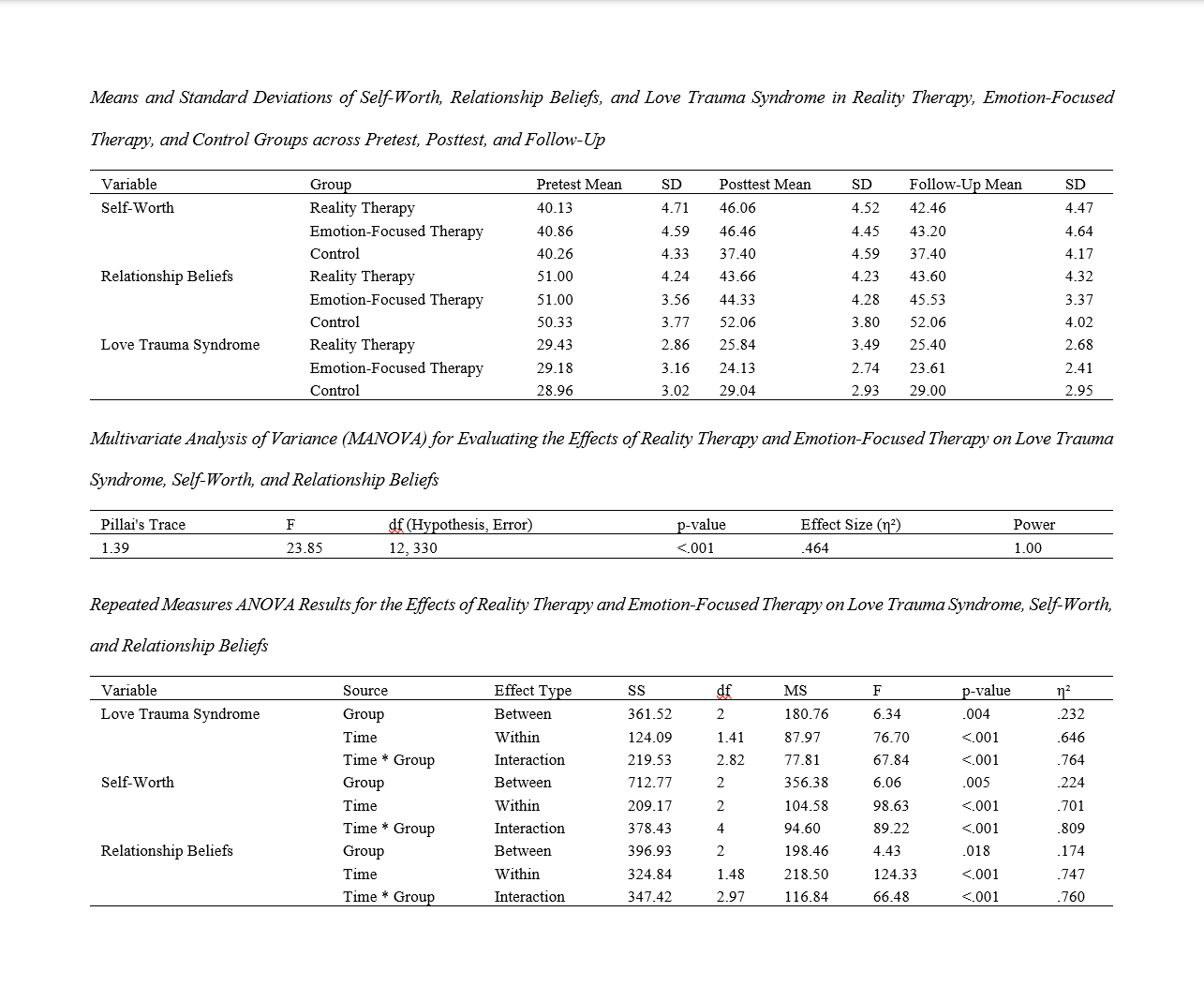
Methods and Materials: This research is applied in terms of purpose and quasi-experimental in terms of data collection, using a pretest-posttest-follow-up design with a control group. The statistical population included all divorced women residing in District 2 of Tehran in 2023, from whom 45 participants were selected through convenience sampling. The participants were randomly assigned, with age-matching, into two intervention groups and one control group. Participants completed the Relationship Beliefs Questionnaire, Ross's Love Trauma Syndrome Questionnaire, and the Self-Worth Questionnaire at pretest, posttest, and follow-up phases. The first intervention group received 8 sessions of reality therapy, while the second group received 10 sessions of emotion-focused therapy. Data were analyzed using repeated measures analysis of variance (ANOVA) with SPSS version 22.
Findings: Both reality therapy and emotion-focused therapy were effective in enhancing self-worth, improving relationship beliefs, and reducing love trauma syndrome symptoms among divorced women in Tehran. Moreover, the effectiveness of both treatments persisted over time. No significant difference was found between the effectiveness of reality therapy and emotion-focused therapy on the studied variables.
Conclusion: Based on the results, it can be concluded that both reality therapy and emotion-focused therapy are effective interventions for improving love trauma syndrome symptoms, enhancing self-worth, and modifying relationship beliefs in divorced women in Tehran
Downloads
References
Abedi, A., Mosayebi, E., & Reza Oreyzi, H. (2013). Meta Analysis of Effectiveness of Psychological Groups Intervention On Rate of Marital Satisfaction (Iran- 1383-1389). Family Counseling and Psychotherapy, 3(2), 233-261. https://fcp.uok.ac.ir/article_9626.html
Allan, R. (2016). The Use of Emotionally Focused Therapy with Separated or Divorced Couples. Canadian Journal of Counselling and Psychotherapy, 50(3). https://psycnet.apa.org/record/2016-59182-005
Amanelahi, A., Tardast, K., & Aslani, K. H. (2015). Prediction of love trauma syndrome based on self compassion among female students having experienced romantic breakups. Journal of Applied Psychology, 8(4), 43-61. https://ensani.ir/fa/article/download/544970
Amani, A., Ahmadi, S., & Hamidi, O. (2018). The Effect of Group Logotherapy on Self- Esteem and Psychological Well-Being of Female Students with Love Trauma Syndrome. Positive Psychology Research, 4(3), 71-86. https://ppls.ui.ac.ir/article_23712.html
Araghi, N. Z. (2025). The Effectiveness of Religious Forgiveness Therapy on Reducing Marital Conflicts and Extramarital Behaviors in Married Women Seeking Divorce. KMAN Counsel and Psych Nexus, 3, 1-8. https://doi.org/10.61838/kman.fct.psynexus.3.3
Canbulat, N., & Aladağ, M. (2023). Emotion-focused group counseling with Turkish divorced women: a mixed design study. Curr Psychol. https://doi.org/10.1007/s12144-023-04651-9
Cherring, E. J., Tamers, F., & Moon, A. (2020). Predicting tendency to divorce based on interpersonal cognitive distortions and self-destruction in couples applying for divorce. Americ Coll Cardio, 53, 936-946.
Choon, M. W., Abu Talib, M., Yaacob, S. N., Awang, H., Tan, J. P., Hassan, S., & Ismail, Z. (2015). Negative automatic thoughts as a mediator of the relationship between depression and suicidal behaviour in an at‐risk sample of Malaysian adolescents. Child and Adolescent Mental Health, 20(2), 89-93. https://doi.org/10.1111/camh.12075
Crespo, F. S., Jaén-Moreno, M. J., Gutiérrez-Rojas, L., Balanzá-Martínez, V., García-Alvarez, L., Martínez, P. A. S., & Bobes, J. (2019). "Readiness to change" predicts efficacy of reduction among smokers with severe mental illness. European Addiction Research, 25(5), 256-262DO - 210.1159/000500450. https://pubmed.ncbi.nlm.nih.gov/31163435/
Deldadeh, M., & Moaveneslami, S. (2020). The effectiveness of reality therapy-based interventions on improving marital adjustment among couples suffering from emotional divorce. jnip, 5(9), 1-10. https://jnip.ir/article-1-318-fa.html
Dobson, K. S., McEpplan, A. M., & Dobson, D. (2019). Empirical Validation and the Cognitive -Behavioral Therapies. In K. S. Dobson & D. G. P. Dozois (Eds.), Handbook of Cognitive -Behavioral Therapies (pp. 32-56).
Dosti, P., Hosseininia, N. P. Y., Eidelson, R. J., & Epstein, N. (1982). Construction and norming of a self-esteem measurement scale Cognition and relationship maladjustment: Development of a measure of dysfunctional relationship beliefs. New Advances in Behavioral Sciences, 5(48), 27-19. https://doi.org/10.1037/0022-006X.50.5.715
Ellis, A. (2003). Overcoming Resistance: A Rational Emotive Behavior Therapy In Degraded Approach. Springier. https://www.amazon.de/-/en/Overcoming-Resistance-Rational-Integrated-Behavioral/dp/0826122140
Epstein, N. (1986). Cognitive marital therapy: Multi level assessment and intervention. Journal of Rational - Emotive Therapy, 4, 68-81. https://doi.org/10.1007/BF01073481
Golec de Zavala, A., Dyduch‐Hazar, K., & Lantos, D. (2019). Collective narcissism: Political consequences of investing self‐worth in the ingroup's image. Political Psychology, 40, 37-74. https://doi.org/10.1111/pops.12569
Henriksen, I. O., Ranøyen, I., Indredavik, M. S., & Stenseng, F. (2017). The role of self-esteem in the development of psychiatric problems: a three-year prospective study in a clinical sample of adolescents. Child and adolescent psychiatry and mental health, 11(1SP - 1), 9. https://doi.org/10.1186/s13034-017-0207-y
Hewitt, B., & Turrell, G. (2011). Short-term functional health and well-being after marital separation: does initiator status make a difference? Am. J. Epidemiol, 173, 1308-1318. https://doi.org/10.1093/aje/kwr007
Hewitt, B., Turrell, G., & Giskes, K. (2012). Marital loss, mental health and the role of perceived social support: findings from six waves of an australian population based panel study. J. Epidemiol. Comm. Health, 66, 308-314. https://doi.org/10.1136/jech.2009.104893
Johnson, S. (2019). Attachment in action-changing the face of 21st century couple therapy. Current opinion in psychology, 25, 101-104. https://doi.org/10.1016/j.copsyc.2018.03.007
Kahraman, S., & Özbay, A. (2025). Examining Mindfulness’s Mediating Role in the Relationship Between Infidelity Tendency and Divorce Anxiety. Psychological Reports. https://doi.org/10.1177/00332941241313436
Kamaly, A., Dehghani, S., & Ghasemi, H. (2014). Meta-analysis of effectiveness of psychological interventions - counseling on enhancing marital satisfaction (Iran: 2002_2012). Counseling Culture and Psycotherapy, 5(19), 70-86. https://qccpc.atu.ac.ir/m/article_618.html?lang=en
Kavanagh, S., & Levenson, J. (2021). Supporting Those Who Love the Loathed: Trauma-Informed Support Groups for Family Members of Registered Sex Offenders. Families in Society. https://doi.org/10.1177/10443894211008846
Monirpour, N., & Mirzahoseini, H. (2022). Predicting couples' sense of happiness based on their differentiation and initial thematic relationshipse. medical journal of mashhad university of medical sciences, 64(6), 4138-4147. https://mjms.mums.ac.ir/article_20193.html
Najafi, M., Soleimani, A. A., Ahmadi, K., Javidi, N., & Kamkar, E. H. (2015). The effectiveness of emotionally focused therapy on enhancing marital adjustment and quality of life among infertile couples with marital conflicts. International journal of fertility & sterility, 9(2), 238. https://ijogi.mums.ac.ir/article_3703_e333fe67d0c0c987500bc72819d84824.pdf
Nikpoor, N., & Rajabi, S. (2017). Predicting love trauma syndrome based on early maladaptive schemas and emotional intelligence among the youth. International journal of psychology, 11(2), 152-174.
Pellón-Elexpuru, I., Van Dijk, R., Van der Valk, I., Martínez-Pampliega, A., Molleda, A., & Cormenzana, S. (2024). Divorce and physical health: A three-level meta-analysis. Social Science & Medicine, 352, 117005. https://doi.org/10.1016/j.socscimed.2024.117005
Preda, M., Mareci, A., Tudoricu, A., Taloș, A. M., Bogan, E., & Lequeux-Dincă, A. I. (2020). Defining the Concept of Family through the Lens of Fertile-Aged Women in Bucharest, Romania-between Traditionalism and Inclusion. Sustainability, 12(7), 2691. https://doi.org/10.3390/su12072691
Sahebdel, H., Jamshidi, A., & Shakory, Z. (2017). Communicational beliefs and degree of marriage instability among the female and male married. FPJ, 2(2), 1-14. https://journals.iau.ir/article_533172.html
Shariat, A., Ghamarani, A., Abedi, A., & Sharifi, T. (2015). meta-analysis of the effectiveness of couple therapy on increasing marriage satisfaction (iran 2006-2012). Journal of Woman and Family Studies, 3(1), 93-109. https://jwfs.alzahra.ac.ir/article_2197.html
Wiebe, S. A., Johnson, S. M., Burgess Moser, M., Dalgleish, T. L., & Tasca, G. A. (2017). Predicting Follow-up Outcomes in Emotionally Focused Couple Therapy: The Role of Change in Trust, Relationship-Specific Attachment, and Emotional Engagement. Journal of marital and family therapy, 43(2), 213-226. https://doi.org/10.1111/jmft.12199
Wubbolding, R. E. (2013). Reality therapy for the 21st century. Routledge. https://doi.org/10.4324/9780203768457
Yao, Y. W., Chen, P. R., Li, R., Ch, S., & Hare, T. A. (2017). Combined Reality Therapy and mindfulness meditation decrease intertemporal decisional impulsivity in young adults with Internet gaming disorder. Journal of Computer in Human Behavior, 68(5), 210-216. https://doi.org/10.1016/j.chb.2016.11.038
Zeytinoglu‐Saydam, S., & Nino, A. (2019). A Tool for Connection: Using the Person‐of‐the‐Therapist Training (POTT) Model in Emotionally Focused Couple Therapy Supervision. Journal of marital and family therapy, 45(2), 233-243. https://doi.org/10.1111/jmft.12349
Zhang, Y., Dong, K., & Zhao, G. (2021). The mediating role of social connectedness in the effect of positive personality, alexithymia and emotional granularity on life satisfaction: analysis based on a structural equation model. Personality and individual differences, 171, 110473. https://doi.org/10.1016/j.paid.2020.110473
Downloads
Additional Files
Publication Timeline
- Submitted
- Revised
- Accepted
Issue
Section
License
Copyright (c) 2025 Fatemeh Souri (Author); Mohammad Mehdi Jahangiri (Corresponding Author); Zabih Pirani (Author)

This work is licensed under a Creative Commons Attribution-NonCommercial 4.0 International License.