Examining the Relationship Between Early Maladaptive Schemas and Alexithymia with Emotional Divorce Among Married Female Students
DOI:
https://doi.org/10.61838/kman.aftj.5.4.26Keywords:
Early maladaptive schemas, emotional divorce, , married female studentsAbstract
Objective: This study aimed to investigate the relationship between early maladaptive schemas (EMS), alexithymia, and emotional divorce among married female students, focusing on their predictive roles in marital detachment.
Methods: A correlational design was employed with 240 married female students recruited via convenience sampling from Islamic Azad University, Tonekabon Branch (2023–2024 academic year). Participants completed validated self-report measures: the Young Schema Questionnaire-Short Form (YSQ-SF; Young, 1995) assessing EMS across five domains (e.g., Impaired Limits, Other-Directedness), the Toronto Alexithymia Scale (TAS-20; Bagby et al., 1994) measuring alexithymia subscales (Difficulty Identifying Feelings, Difficulty Describing Feelings, Externally Oriented Thinking), and the Gottman Emotional Divorce Questionnaire (GEDQ; Gottman, 1997). Data were analyzed using Pearson’s correlation and stepwise regression via SPSS-26, with significance set at *p* < .01.
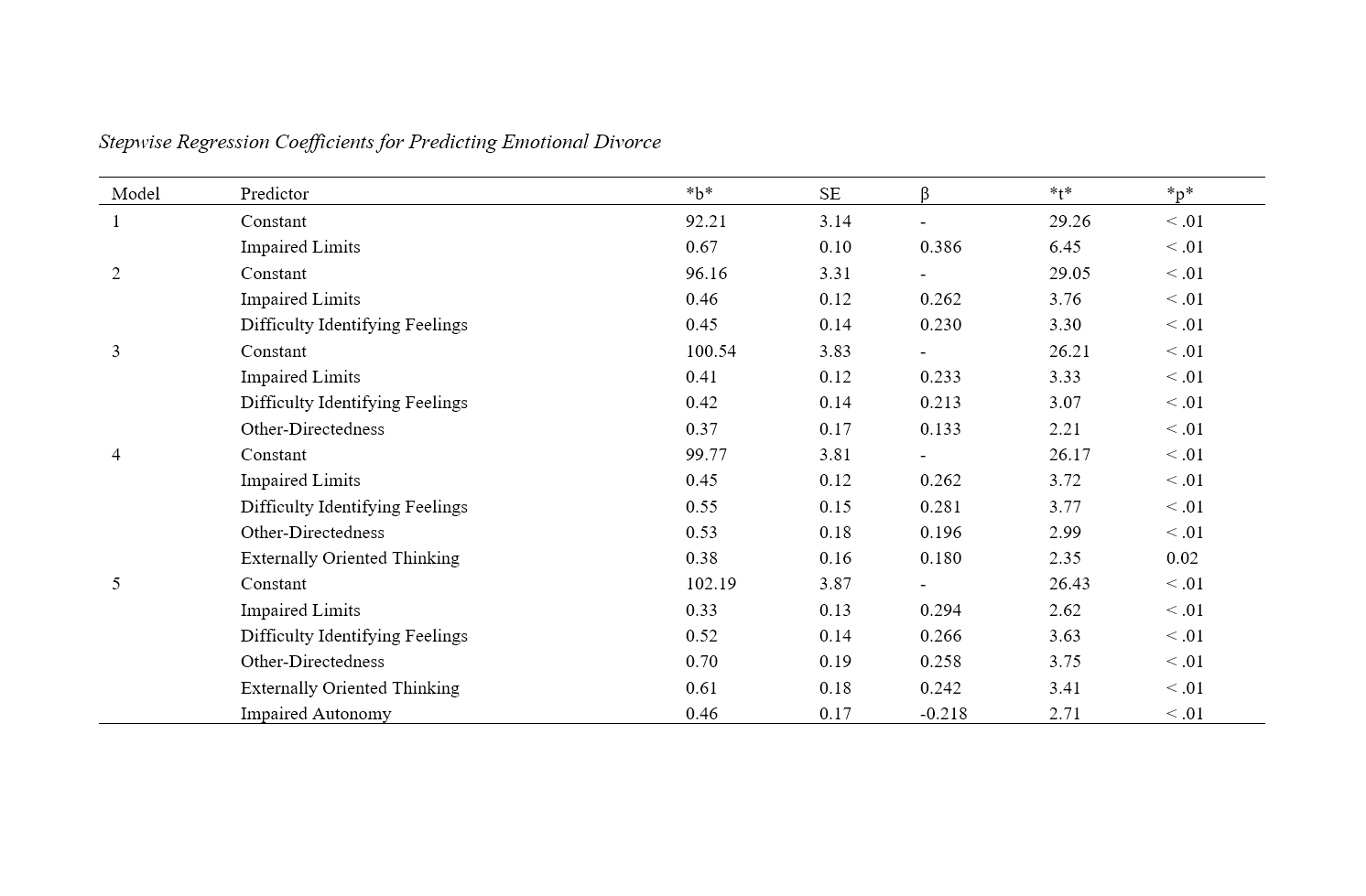
Findings: Significant correlations emerged between EMS domains, alexithymia, and emotional divorce (*r* = 0.18–0.53, *p* < .01). Stepwise regression revealed Impaired Limits as the strongest predictor (β = 0.39, *p* < .01), explaining 15% of variance, followed by incremental contributions from Difficulty Identifying Feelings (ΔR² = 3%, β = 0.23), Other-Directedness (ΔR² = 1%, β = 0.13), Externally Oriented Thinking (ΔR² = 2%, β = 0.18), and Impaired Autonomy (ΔR² = 2%, β = -0.22), cumulatively accounting for 23% of variance (F = 15.16, *p* < .01). Negative β for Impaired Autonomy suggested suppression effects.
Conclusion: EMS and alexithymia significantly predict emotional divorce, with Impaired Limits and emotion-regulation deficits being central drivers. Findings underscore the need for schema-focused interventions (e.g., schema therapy) and emotion-regulation training in marital counseling to mitigate detachment. Future research should explore dyadic interactions and cultural moderators to refine predictive models.
Downloads
References
Al-shahrani, H. F., & Hammad, M. A. (2023). Relationship between emotional divorce and alexithymia among married women in Saudi Arabia. BMC psychology, 11, 217. https://doi.org/10.1186/s40359-023-01236-w
Amir Khosravi, A., Bahrami, H., & Saadati Shamireh, A. (2020). The role of emotional granularity, interpersonal forgiveness, and marital satisfaction in predicting emotional divorce. Journal of the Faculty of Medicine Mashhad, 63(6), 2153-2163. https://mjms.mums.ac.ir/article_18936.html
Besharat, M. A. (2009). Attachment styles and emotional dysregulation. Journal of Psychological Researches, 12(4), 63-80. https://sid.ir/paper/66289/fa
Flink, N., Lehto, S. M., Koivumaa-Honkanen, H., Viinamaki, H., Ruusunen, A., Korhonen, M. V., & Honkalampi, K. (2017). Early maladaptive schemas and suicidal ideation in depressed patients. The European Journal of Psychiatry, 31(3), 87-92. https://doi.org/10.1016/j.ejpsy.2017.07.001
Jalalvand, M., Razazadeh Bahadoran, H. R., Navabi Nejad, S., & Khosravi Babadi, A. A. (2021). Structural equation modeling of emotional divorce based on early maladaptive schemas and marital burnout with the mediation of emotion regulation in married women. Behavioral Sciences (Approved by Azad University), 50, 36-62. https://journals.iau.ir/article_699854.html
Jardine, B., Vannier, S., & Voyer, D. (2022). Emotional intelligence and romantic relationship satisfaction: A systematic review and meta-analysis. Personality and individual differences, 196, 111713. https://doi.org/10.1016/j.paid.2022.111713
Jarwan, A. S., & Al-frehat, B. M. (2020). Emotion divorce and its relationship with psychological. International Journal of Education and Practice, 8(1), 72-85. https://doi.org/10.18488/journal.61.2020.81.72.85
Kalunta-Crumpton, A. (2017). Attitudes and solutions toward intimate partner violence: Immigrant Nigerian women speak. Criminology & Criminal Justice, 17(1), 3-21. https://doi.org/10.1177/1748895816655842
Kinnaird, E., Stewart, C., & Tchanturia, K. (2019). Investigating alexithymia in autism- A systematic review and meta-analysis. European Psychiatry, 55, 80-89. https://doi.org/10.1016/j.eurpsy.2018.09.004
Kover, L., Szollosi, G. J., Frecska, E., Bugan, A., Berecz, R., & Egerhazi, A. (2024). The association between early maladaptive schemas and romantic relationship satisfaction. Frontiers in psychology, 15, 1460723. https://doi.org/10.3389/fpsyg.2024.1460723
Laleh Zadeh, A., Asghari Ebrahimbad, M. J., & Hesarsorkhi, R. (2015). Investigating the role of early maladaptive schemas in predicting emotional divorce. Journal of Clinical Psychology, 7(2), 102-108. https://psyj.ir/volume/xml/77
Lovis-Schmidt, A., Tavener, D., Oestreich, J., & Rindermann, H. (2024). The role of emotional competence in romantic and non-romantic relationships: A meta-analysis. Personality and individual differences, 230, 112813. https://doi.org/10.1016/j.paid.2024.112813
Mousavi, S. F., & Rahimi Nejad, A. (2015). Comparing the levels of interpersonal identity among married women and men concerning emotional divorce status. Applied Psychological Researches, 6(1), 11-23. https://doi.org/10.22059/japr.2015.54571
Munuera, C., Roux, P., Weil, F., Passerieux, C., & M, B. K. (2020). Determinants of the remission heterogeneity in bipolar disorders: The importance of early maladaptive schemas (EMS). Journal of affective disorders, 277, 857-868. https://doi.org/10.1016/j.jad.2020.08.079
Samalpour Baba Ahmadi, M., Heydari, A., Askari, P., & Makvandi, B. (2021). Modeling the relationship between spiritual intelligence and early maladaptive schemas with emotional divorce, with the mediating role of attitudes toward extramarital relationships in women visiting psychological centers in Ahvaz. Journal of Disability Studies, 11(172), 1-9. https://jdisabilstud.org/browse.php?a_code=A-10-1974-1&slc_lang=fa&sid=1
Talebi Zadeh, F., Ranjbar, M., Lotfi, P., & Barvarz Koucheh Galleh, Z. (2023). The role of early maladaptive schemas in emotional divorce among couples. Ninth Scientific Research Conference on the Development and Promotion of Educational and Psychological Sciences of Iran, Tehran.
Tariq, A., Quayle, E., Laqrie, S. M., Reid, C., & Chan, S. W. Y. (2021). Relationship between early maladaptive schemas and anxiety in adolescence and young adulthood: A systematic review and meta-analysis. Journal of affective disorders, 295, 1462-1473. https://doi.org/10.1016/j.jad.2021.09.031
Young, J. E. (1998). Young Schema Questionnaire: Short Form. Cognitive Therapy Center. https://doi.org/10.1037/t12644-000
Young, J. E., Kolsko, J., & Wisshar, M. E. (2003). Schema therapy: A practitioner's guide. Guilford. https://www.guilford.com/books/Schema-Therapy/Young-Klosko-Weishaar/9781593853723?srsltid=AfmBOoofh7-hDX3NHD_8Cmt3S-gqTITxbKuidQpA_aziPSEn_WB_9M-K
Downloads
Additional Files
Publication Timeline
- Submitted
- Revised
- Accepted
Issue
Section
License
Copyright (c) 2024 Soudabeh Poursheykhian (Corresponding Author); Hasan alizadeh darbandi, Reyhaneh Arian (Author)

This work is licensed under a Creative Commons Attribution-NonCommercial 4.0 International License.