Comparison of the Effectiveness of Mindfulness-Based Stress Reduction Training and Acceptance and Commitment Therapy on Affective Control in Pregnant Women in Ilam City in 2019
DOI:
https://doi.org/10.61838/kman.aftj.5.4.25Keywords:
Mindfulness-Based Stress Reduction, Acceptance and Commitment Therapy, Affective Control, PregnancyAbstract
Objective: This study aims to compare the effectiveness of Mindfulness-Based Stress Reduction (MBSR) and Acceptance and Commitment Therapy (ACT) on affective control in pregnant women.
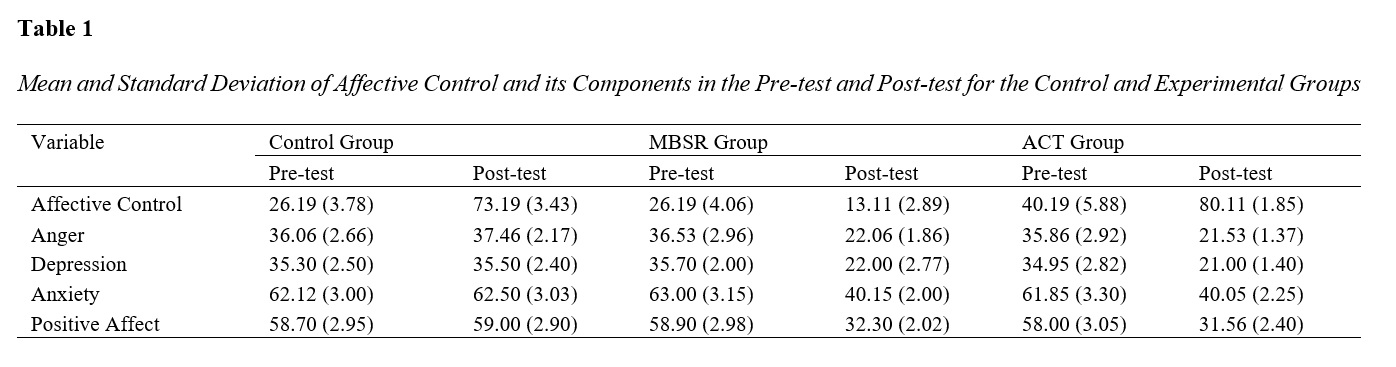
Methods: A randomized controlled trial was conducted with 45 pregnant women from Ilam, Iran, who were randomly assigned to one of three groups: MBSR, ACT, or control. Participants in the experimental groups underwent 8 weekly group sessions of either MBSR or ACT, while the control group received no intervention. Affective control was measured using the Affective Control Scale, which includes subscales for anger, anxiety, depression, and positive affect. Pre-test and post-test assessments were administered to all groups, and data were analyzed using ANCOVA to compare the effects of the interventions across groups.
Findings: The results indicated significant improvements in affective control for both MBSR and ACT groups compared to the control group. The ANCOVA showed significant effects for both MBSR and ACT in reducing anxiety, improving positive affect, and regulating anger, with no significant difference between the two experimental groups. The control group showed no significant changes in any of the emotional regulation variables. Both experimental groups demonstrated a large effect size for affective control (η² = 0.53), with smaller but significant effects on anxiety and positive affect (η² = 0.19 and η² = 0.17, respectively).
Conclusion: Both MBSR and ACT were effective in improving affective control and emotional regulation in pregnant women, with similar outcomes for both interventions. These findings suggest that both therapies could be useful tools for managing stress and enhancing emotional well-being during pregnancy.
Downloads
References
Ahmadi, V., & Valizadeh, H. (2021). The Effectiveness of Acceptance and Commitment-Based Therapy on the Quality of Life and Death Anxiety in the Elderly. Aging Psychology, 7(2), 166-153. https://doi.org/10.22126/jap.2021.6370.1528
Ashok, S., Scott, S., Orth, A., Adaji, B., & Singh, M. (2021). Comparison of the effectiveness Acceptance and Commitment Therapy (ACT) and Mindfulness-Based Cognitive Therapy MBCT and Positive psychology Therapy (PPT) on depression. American Journal Psychotherapy, 4(1), 4-12.
Barghi Irani, Z., & Dehghan Saber, L. (2021). The Comparison of the Effectiveness of Mindfulness Based Therapy and Spiritual Therapy on Irrational Beliefs and Anxiety in the Older Women. Aging Psychology, 6(4), 339-321. https://doi.org/10.22126/jap.2021.5945.1492
Dehghani, Y., Golestaneh, S. M., & Zangouei, S. (2018). The effectiveness of Emotion Regulation Training on Academic Burnout, Social Acceptance and Affective Control of Students with Learning Disabilities. Applied Psychology, 12(2), 163-182. https://apsy.sbu.ac.ir/article_97046_bd463aa65bfb3738b659ce8d0a0c55dc.pdf
Eisazadeh, F., Saffarinia, M., Alipour, A., & Dehkordi, M. A. (2022). Comparison of the effectiveness of acceptance, commitment and mindfulness therapy on increasing psychological well-being and weight control in people with type 2 diabetes. International Journal of Applied Behavioral Sciences, 9(3), 42-53. https://journals.sbmu.ac.ir/ijabs/article/download/38567/29978/
Ghasedi, M., Bagheri, F., & Kiamanesh, A. (2019). Comparing the effectiveness of two group therapy methods based on mindfulness and based on acceptance and commitment on forgiveness, emotion regulation and marital intimacy. Akhlāq-i zīstī, 8(29), 87-98. https://doi.org/10.22037/bioeth.v8i29.22576
Gross, M., Moore, Z. E., Gardner, F. L., Wolanin, A. T., Pess, R., & Marks, D. R. (2018). An empirical examination comparing the Mindfulness-Acceptance-Commitment approach and Psychological Skills Training for the mental health and sport performance of female student athletes. International Journal of Sport and Exercise Psychology, 16(4), 431-451. https://doi.org/10.1080/1612197X.2016.1250802
Han, A., & Kim, T. H. (2022). Efficacy of Internet-Based Acceptance and Commitment Therapy for Depressive Symptoms, Anxiety, Stress, Psychological Distress, and Quality of Life: Systematic Review and Meta-analysis [Review]. J Med Internet Res, 24(12), e39727. https://doi.org/10.2196/39727
Kazemeini, S. E., Ranjbaripour, T., NezhadMohammad Nameghi, A., Sodagar, S., & Peyvandi, P. (2022). Comparison the effectiveness of Acceptance and Commitment therapy with Mindfulness-Based Cognitive therapy on Cognitive Emotion Regulation in Heart Failure Patients. Journal of Assessment and Research in Applied Counseling, 4(3), 11-18. https://doi.org/10.52547/jarac.4.3.30
Mohammadi, R., Zebardast, A., & Rezaei, S. (2022). The Effectiveness Of Existential Psychotherapy On Psychological Capital And Affective Control In Cancer Patients Undergoing Chemotherapy. ijpn, 10(5), 82-95. https://doi.org/10.22034/IJPN.10.5.7
Schweizer, S., Gotlib, I. H., & Blakemore, S. J. (2020). The Role of Affective Control in Emotion Regulation During Adolescence. Emotion, 20(1), 80-86. https://doi.org/10.1037/emo0000695
Schweizer, S., Grahn, J. A., Hampshire, A., Mobbs, D., & Dalgleish, T. (2013). Training the Emotional Brain: Improving Affective Control Through Emotional Working Memory Training. Journal of Neuroscience, 33(12), 5301-5311. https://doi.org/10.1523/jneurosci.2593-12.2013
Shahsavari Googhari, Z., Hafezi, F., Asgari, P., & Heidari, A. (2022). The effectiveness of mindfulness-based cognitive therapy and acceptance and commitment therapy on medical science students’ subjective well-being, psychological distress, and emotion regulation. J Shahrekord Univ Med Sci, 24(1), 35-41. https://doi.org/10.34172/jsums.2022.07
Solimanpour, M., Pirkhaefi, A., & Zahrakar, k. (2022). Comparison of the efficacy of acceptance and commitment therapy (ACT) and compassion-focused therapy (CFT) on quality of life in patients with vitiligo [Research]. Journal of Psychological Science, 21(113), 987-1004. https://doi.org/10.52547/jps.21.113.987
Tofighi Mohamadi, M., Babakhani, V., Ghamari, M., & Pouyamanesh, J. (2020). Comparing the effects of Dialectical behavior therapy and Reality therapy on Affective Control of Mothers of Children with Intellectual Disability. Rooyesh-e-Ravanshenasi Journal (RRJ), 9(10), 59-66. https://frooyesh.ir/article-1-2347-en.html
Vahabi, M., Pui-Hing Wong, J., Moosapoor, M., Akbarian, A., & Fung, K. (2022). Effects of Acceptance and Commitment Therapy (ACT) on Mental Health and Resiliency of Migrant Live-in Caregivers in Canada: Pilot Randomized Wait List Controlled Trial [Original Paper]. JMIR Form Res, 6(1), e32136. https://doi.org/10.2196/32136
Valizadeh, H., & Parandin, S. (2022). Comparing the effectiveness of cognitive therapy based on mindfulness versus acceptance and commitment therapy on quality of life and emotional regulation of women victims of domestic violence. Quarterly Journal of New Psychological Research,
Downloads
Additional Files
Publication Timeline
- Submitted
- Revised
- Accepted
Issue
Section
License
Copyright (c) 2024 Marzieh Mohammadzadeh (Author); Shahram Mami (Corresponding Author); Vahid Ahmadi, Tayebeh Rashidian (Author)

This work is licensed under a Creative Commons Attribution-NonCommercial 4.0 International License.