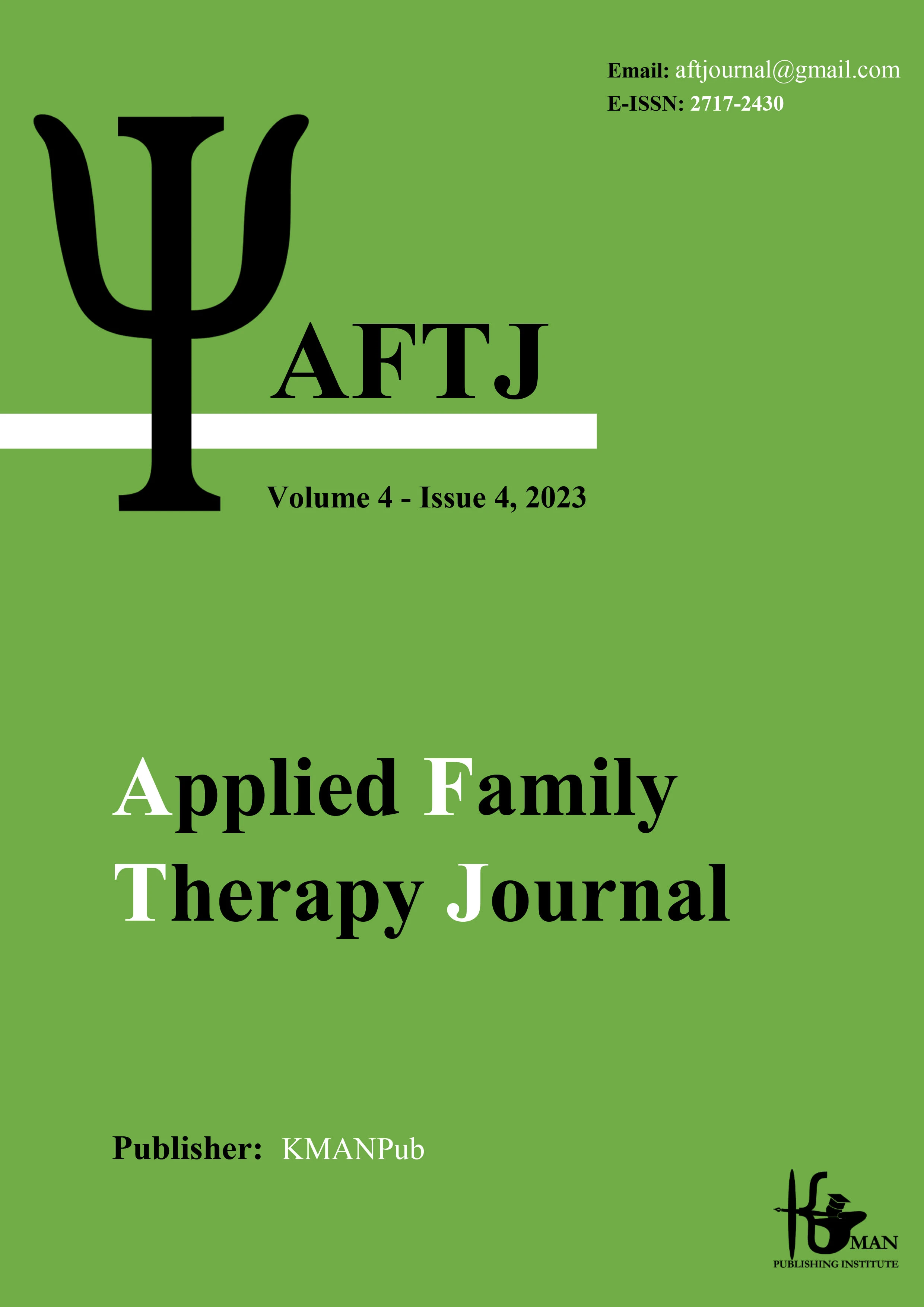
The Effectiveness of Premarital Education Using the Interpersonal Awareness and Choice Method on Marital Stability and Emotional Expressiveness
DOI:
https://doi.org/10.61838/kman.aftj.4013Keywords:
Premarital education, interpersonal awareness, emotional expressiveness, marital stabilityAbstract
Objective: This study aimed to investigate the effectiveness of premarital education based on the Interpersonal Awareness and Choice Method in enhancing marital stability and emotional expressiveness among engaged couples.
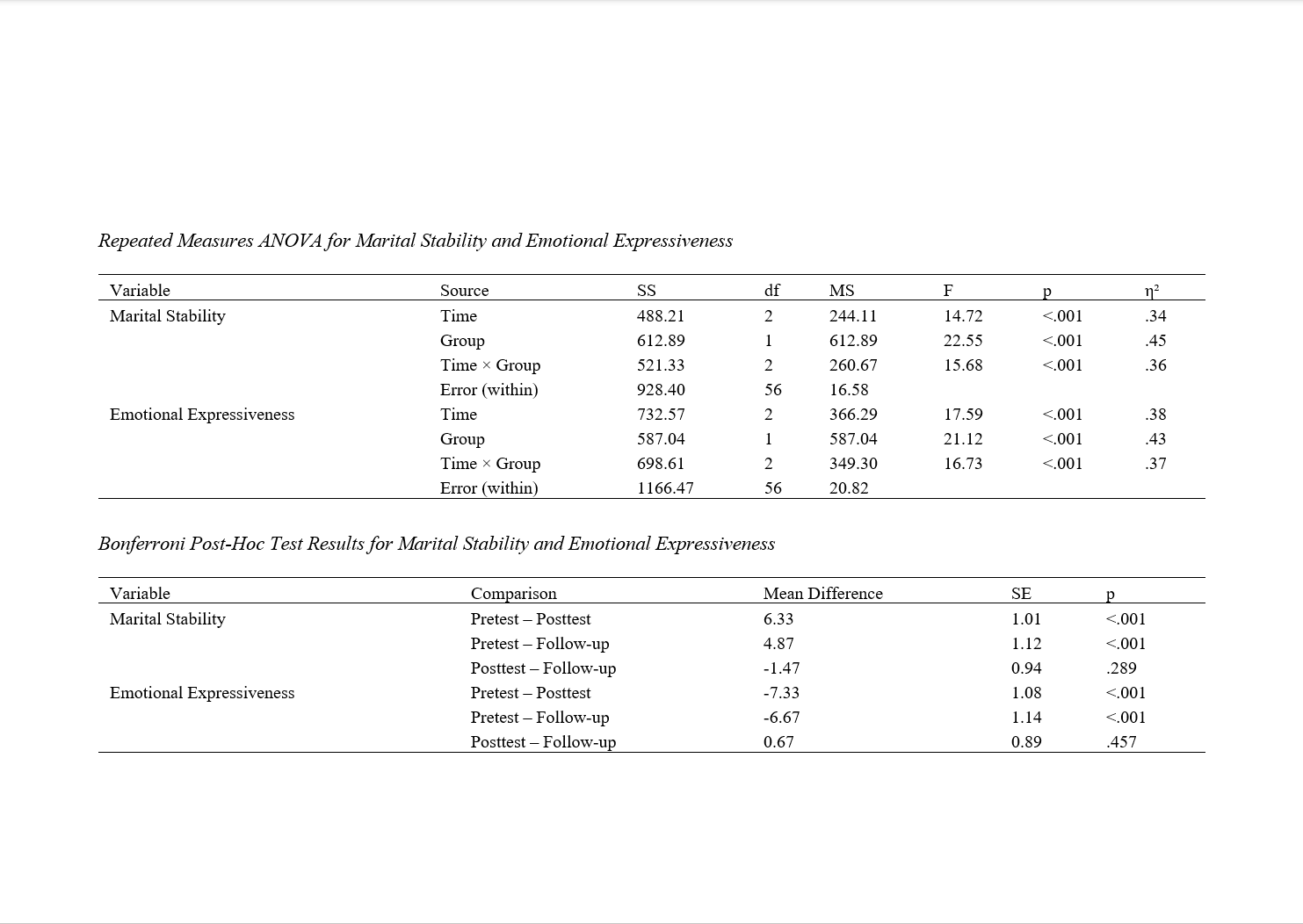
Methods and Materials: A randomized controlled trial design was used involving 30 participants recruited from premarital counseling centers in Tehran. Participants were randomly assigned to an experimental group (n = 15), which received a ten-session premarital education program, and a control group (n = 15), which received no intervention during the study period. The intervention was delivered in weekly 60-minute group sessions focusing on interpersonal awareness, emotional literacy, and decision-making in romantic relationships. Standardized instruments were used to measure marital stability and emotional expressiveness at three time points: pretest, posttest, and five-month follow-up. Data were analyzed using repeated measures ANOVA and Bonferroni post-hoc tests in SPSS-27 to assess within-group and between-group differences over time.
Findings: Results indicated a significant interaction effect between time and group for marital stability (F(2, 56) = 14.72, p < 0.001, η² = 0.34), with the experimental group showing greater improvements compared to the control group. Similarly, emotional expressiveness demonstrated a significant group-by-time interaction (F(2, 56) = 17.59, p < 0.001, η² = 0.38), with post-hoc comparisons revealing that the experimental group had significantly higher scores at both posttest and follow-up phases. All assumptions for repeated measures ANOVA were confirmed prior to analysis.
Conclusion: The findings suggest that premarital education based on the Interpersonal Awareness and Choice Method is an effective intervention for promoting emotional expressiveness and marital stability among engaged individuals. These results highlight the value of incorporating structured emotional and interpersonal training into premarital counseling services to support relationship resilience and long-term satisfaction.
Keywords: Premarital education, interpersonal awareness, emotional expressiveness, marital stability.
Downloads
References
Acquaah, G. E. A. (2023). An Examination of the Phenomenon of Cohabitation: A Case Study of the Fante Tribe of Ghana. E-Journal of Religious and Theological Studies, 472-481. https://doi.org/10.38159/erats.2023995
Adesola, A. A., Lawal, J. S., Akoki, D. M., Oyedokun, A., Agboola, O., Babawale, A. A., & Brown, B. J. (2025). Determinants of Marital Decision Despite Sickle Cell Status Awareness: A Mixed Method Study. https://doi.org/10.21203/rs.3.rs-5922377/v1
Al-shahrani, H. F., & Hammad, M. A. (2023). Relationship Between Emotional Divorce and Alexithymia Among Married Women in Saudi Arabia. BMC psychology, 11(1). https://doi.org/10.1186/s40359-023-01236-w
Araya, S., Urrutia, M., Chávez-Castillo, Y., Zañartu, I., & Zapata-Lamana, R. (2024). Impact of Emotional Education Programs in the Development of Emotional Competence in Secondary Students: A Scoping Review. https://doi.org/10.20944/preprints202409.2266.v1
Bahrami Mashouf, R., Ahmadi, S., & Rasouli, M. (2022). The mediating role of emotional expressiveness in the relationship between cognitive emotion regulation strategies and marital satisfaction in female teachers. Women and Family Studies, 10(3), 32-52. https://doi.org/10.22051/jwfs.2022.30614.2374
Basharpour, S., & Estiri, S. (2024). Predicting Marriage Readiness Based on Identity, Intimacy, Desire for Marriage and Optimism Model. Journal of Family Research, 19(76), 553-566. https://www.magiran.com/paper/2696260
Bijani, J., Hashemi, N., & Saadati Shamir, A. (2023). Determining the contribution of attachment styles and coping styles in predicting the instability of married life with the mediating role of resilience in conflicted couples. Journal of Adolescent and Youth Psychological Studies, 4(3), 60-71. https://www.magiran.com/paper/2592832
Diamare, S., D’Anna, E., Glorioso, A., & Furia, R. (2025). A Path of Empowerment Through the Creative Experience of a Work of Art: Evaluation of Psychophysical Effectiveness. Journal of Advanced Health Care, 7(1). https://doi.org/10.36017/jahc202571405
Ghaffar, Z. A., Hameed, M., Abbas, Z., Nawaz, A., Kainaat, M., Sherif, S., Saber, F., Ali, M. A., & Akbar, N. A. (2024). The Perplexing Role of Emotional Intelligence in Driving; Anger and Violence in Medical Students. International Journal of Membrane Science and Technology, 11(1), 48-59. https://doi.org/10.15379/ijmst.v11i1.3529
Gil, M., Kim, D., & Kim, S. S. (2022). Middle-Aged Couples Educational Needs for Psychological Well-Being: A Mixed Method Study. Journal of Korean Academy of Psychiatric and Mental Health Nursing, 31(1), 1-15. https://doi.org/10.12934/jkpmhn.2022.31.1.1
Hadijah, N. (2024). Developing Emotional Intelligence Through Arts Education. Rijre, 4(3), 1-4. https://doi.org/10.59298/rijre/2024/4314
Hashemi, S., Behboodi, M., & Fard, F. D. (2023). Comparison of the Effectiveness of the Premarital Awareness and Interpersonal Choices Program (PICK) and the SYMBIS Premarital Model on Girls' Attitudes Toward Marriage. Jarac, 5(4), 154-163. https://doi.org/10.61838/kman.jarac.5.4.17
Herasymenko, L., & Muravska, S. (2024). Social-Emotional Learning in Foreign Language Classes at Higher Education Institutions: From Theory to Practice. Sciencerise Pedagogical Education(4(61)), 22-28. https://doi.org/10.15587/2519-4984.2024.311511
Hooshmandi, R., & Atapour, N. (2023). Family Dynamics: The Role of Emotional Expressiveness and Social Connectedness in Problem-Solving. JPRFC, 11-18. https://doi.org/10.61838/kman.jprfc.1.4.3
Indellicato, R. (2024). Artificial Intelligence and Social-Emotional Learning: What Relationship? Journal of Modern Science, 60(6), 460-470. https://doi.org/10.13166/jms/196765
Jeong, J., & Kim, J.-H. (2024). Phenomenological Research on Entrepreneurs’ Start-Up Experiences and Implications for Education. Korean Assoc Pract Arts Edu, 37(2), 153-185. https://doi.org/10.24062/kpae.2024.37.2.153
Kashani Kia, F. (2024). The effectiveness of pre-marriage education based on schema modes in the attitude towards marriage and social maturity of 20-30 year old girls Yazd University of Science and Arts. https://ganj.irandoc.ac.ir/#/search?keywords.
Lee, E., Chung, H., & Ko, K.-J. (2023). The Mediating Effect of Emotional Expressiveness on the Relationship Between Marital Attachment and Stability of Married for More Than 20 Years. Korean Association for Learner-Centered Curriculum and Instruction, 23(20), 221-236. https://doi.org/10.22251/jlcci.2023.23.20.221
Melenets, L., Матвійчук, О., Savchenko, S., Сherpak, Y., & Petroshchuk, N. (2022). The Impact of Using Humour on the Improvement of Teachers’ Emotional Intelligence During Advanced Training Courses. Jett, 13(3). https://doi.org/10.47750/jett.2022.13.03.022
Mousavi, S., Valipourkoleti, A., Tabiban, S., Malekrah, A., & Nouri, B. (2023). The Impact of Heart Failure on Sexual Satisfaction of Sexual Partners: A Cross-Sectional Study in Iran. https://doi.org/10.21203/rs.3.rs-2982081/v1
Nazari, R., Sardaripoor, M., Kakavand, A., & Mansobifar, M. (2020). The Relationship between Personality Traits, Marital Stability, and Equality Perception [Original Research Article]. Middle Eastern Journal of Disability Studies, 10(0), 73-73. http://jdisabilstud.org/article-1-1272-en.html
http://jdisabilstud.org/article-1-1272-en.pdf
Niu, X. (2025). The Origin, Application and Prospect of the Expressive Therapy Continuum (ETC). JMSS, 2(1), 36-42. https://doi.org/10.71113/jmss.v2i1.185
Rajabi, G., Abbasi, G., Sudani, M., & Aslāni, K. (2017). Premarital Education Program Based on Premarital Interpersonal Choices and Knowledge Program on Idealistic Marital Expectation in Single Students. Iranian Journal of Psychiatry and Clinical Psychology, 22(3), 212-221. https://doi.org/10.18869/acadpub.ijpcp.22.3.212
Singh, B. (2022). Cognitive Ability of School Students in Relation to Emotional Intelligence in Punjab. BSSS Journal of Education, 11(1), 52-70. https://doi.org/10.51767/je1105
Udechukwu, P. U., Rev. Fr. Dr. Richard, E., & Gichimu, E. W. (2024). Possible Ways of Enhancing Emotional Intelligence Among Women Religious in Country A. International Journal of Research Publication and Reviews, 5(5), 2452-2460. https://doi.org/10.55248/gengpi.5.0524.1207
Zaheer, S., Mehmood, A., Bukhari, N., Saleem, A., Ansar, M., & Usman, F. (2024). Assessing Interpersonal and Intrapersonal Emotional Insights in Undergraduate Medical Students. Pakistan Journal of Health Sciences, 209-214. https://doi.org/10.54393/pjhs.v5i08.1633
Downloads
Additional Files
Publication Timeline
- Submitted
- Revised
- Accepted
Issue
Section
License
Copyright (c) 2025 Amirhossein Sobhaninia (Corresponding Author); Karim Golpour Golpour, Atefeh Reyhani, Ali Hoseinkhani (Author)

This work is licensed under a Creative Commons Attribution-NonCommercial 4.0 International License.