Co-Parenting Quality and Parenting Stress as Predictors of Child Behavioral Adjustment
DOI:
https://doi.org/10.61838/kman.aftj.6.1.19Keywords:
co-parenting quality, parenting stress, child behavioral adjustment, family functioningAbstract
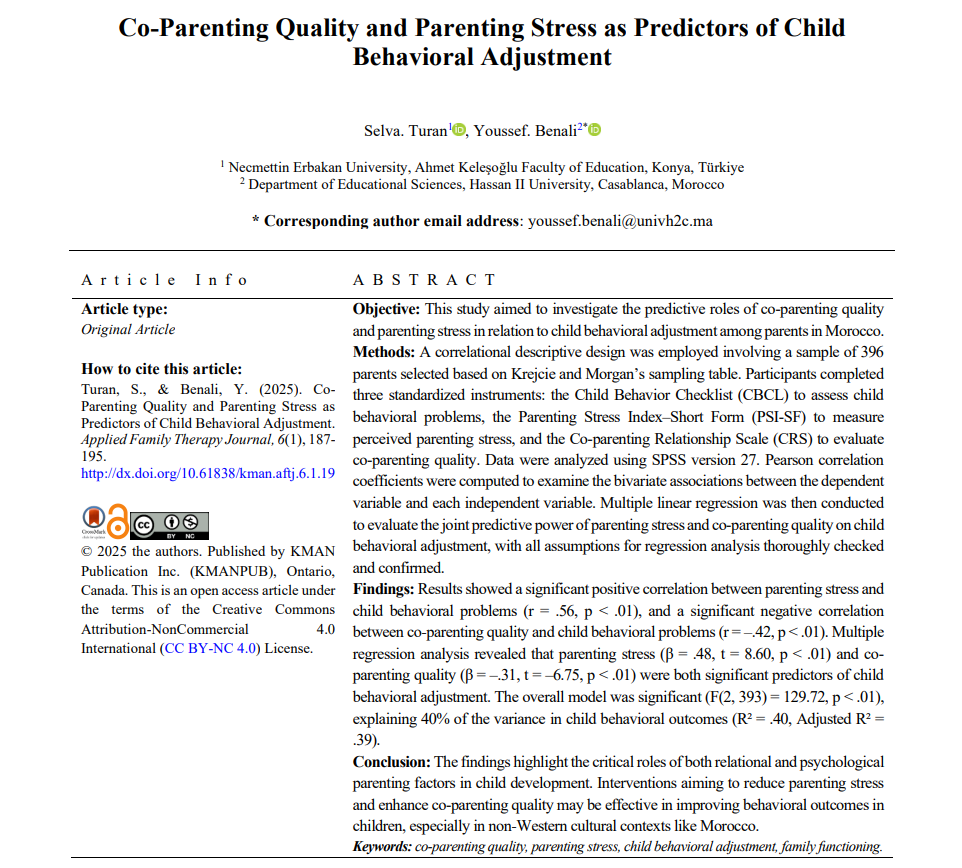
Objective: This study aimed to investigate the predictive roles of co-parenting quality and parenting stress in relation to child behavioral adjustment among parents in Morocco.
Methods: A correlational descriptive design was employed involving a sample of 396 parents selected based on Krejcie and Morgan’s sampling table. Participants completed three standardized instruments: the Child Behavior Checklist (CBCL) to assess child behavioral problems, the Parenting Stress Index–Short Form (PSI-SF) to measure perceived parenting stress, and the Co-parenting Relationship Scale (CRS) to evaluate co-parenting quality. Data were analyzed using SPSS version 27. Pearson correlation coefficients were computed to examine the bivariate associations between the dependent variable and each independent variable. Multiple linear regression was then conducted to evaluate the joint predictive power of parenting stress and co-parenting quality on child behavioral adjustment, with all assumptions for regression analysis thoroughly checked and confirmed.
Findings: Results showed a significant positive correlation between parenting stress and child behavioral problems (r = .56, p < .01), and a significant negative correlation between co-parenting quality and child behavioral problems (r = –.42, p < .01). Multiple regression analysis revealed that parenting stress (β = .48, t = 8.60, p < .01) and co-parenting quality (β = –.31, t = –6.75, p < .01) were both significant predictors of child behavioral adjustment. The overall model was significant (F(2, 393) = 129.72, p < .01), explaining 40% of the variance in child behavioral outcomes (R² = .40, Adjusted R² = .39).
Conclusion: The findings highlight the critical roles of both relational and psychological parenting factors in child development. Interventions aiming to reduce parenting stress and enhance co-parenting quality may be effective in improving behavioral outcomes in children, especially in non-Western cultural contexts like Morocco.
Downloads
References
Ammerman, R. T., Zion, C., Cleary, O. M., Bignall, W. J. R., Mara, C. A., Theuerling, A. M., Offenbacker, E. J., Triplett, T. A., Mitchell, M. J., Brokamp, C., Smith, R. R., & Stark, L. J. (2025). Community Implementation and Evaluation of the Chicago Parent Program. Journal of Community Psychology, 53(1). https://doi.org/10.1002/jcop.23176
Armstrong‐Carter, E., Miller, J. G., & Obradović, J. (2021). Parent–child Physiological Synchrony: Concurrent and Lagged Effects During Dyadic Laboratory Interaction. Developmental Psychobiology, 63(7). https://doi.org/10.1002/dev.22196
Belanger, K., Gennis, H., Ottenbreit, N. D., & Racine, N. (2023). Enhancing Attachment-Based Aspects of PCIT for Young Children With a History of Maltreatment. Frontiers in psychology, 14. https://doi.org/10.3389/fpsyg.2023.1229109
Cederbaum, J. A., Saldate, A., Rodman, J., Monro, W., Parker, K., & Mennen, F. E. (2024). The Effects of a Fatherhood Intervention on the Co-Parenting Behaviors of Hispanic and Non-Hispanic Black Fathers. Journal of Family Issues. https://doi.org/10.1177/0192513x241299420
Chen, H., Alghowinem, S., Jang, S. J., Breazeal, C., & Park, H. W. (2023). Dyadic Affect in Parent-Child Multimodal Interaction: Introducing the DAMI-P2C Dataset and Its Preliminary Analysis. Ieee Transactions on Affective Computing, 14(4), 3345-3361. https://doi.org/10.1109/taffc.2022.3178689
Curci, S. G., Somers, Jennifer A, Winstone, Laura K, Luecken, Linda J. (2023). Within-dyad bidirectional relations among maternal depressive symptoms and child behavior problems from infancy through preschool. Development and Psychopathology, 35(2), 547-557. https://doi.org/10.1017/S0954579421001656
Dai, Y., Futris, T. G., Stanford, W. D., Richardson, E., & Koss, K. J. (2022). The Association Between Financial Distress, Conflict Management, and Co-Parenting Support for Couples Receiving Child Welfare. Journal of Social and Personal Relationships, 39(11), 3329-3350. https://doi.org/10.1177/02654075221096783
Damen, H., Veerman, J. W., Vermulst, A. A., Westerdijk, I., & Scholte, R. H. J. (2020). Parental Empowerment and Child Behavioral Problems in Single and Two-Parent Families During Family Treatment. Journal of Child and Family Studies, 29(10), 2824-2835. https://doi.org/10.1007/s10826-020-01795-1
Griffith, G. M., Saville, C. W., Halstead, E. J., & Hastings, R. P. (2023). Mindfulness as a Potential Moderator Between Child Behavior Problems and Maternal Well-Being. American Journal on Intellectual and Developmental Disabilities, 128(6), 411-424. https://doi.org/10.1352/1944-7558-128.6.411
Ha, A. S., He, Q., Lubans, D. R., Chan, C. H. S., & Ng, J. Y. Y. (2022). Parent-Focused Online Intervention to Promote Parents’ Physical Literacy and Support Children’s Physical Activity: Results From a Quasi-Experimental Trial. BMC public health, 22(1). https://doi.org/10.1186/s12889-022-13739-z
Hoyniak, C. P., Quiñones‐Camacho, L. E., Camacho, M. C., Chin, J., Williams, E. M., Wakschlag, L. S., & Perlman, S. B. (2021). Adversity Is Linked With Decreased Parent-Child Behavioral and Neural Synchrony. Developmental Cognitive Neuroscience, 48, 100937. https://doi.org/10.1016/j.dcn.2021.100937
Jones, S. L. (2023). Longitudinal Associations Between Paternal Mental Health and Child Behavior and Cognition in Middle Childhood. Frontiers in psychology, 14. https://doi.org/10.3389/fpsyg.2023.1218384
Kamody, R. C., & Lydecker, J. A. (2021). Parental Feeding Practices and Children's Disordered Eating Among Single Parents and co‐parents. International Journal of Eating Disorders, 54(5), 812-820. https://doi.org/10.1002/eat.23490
Khawaja, M., Malik, T. A., & Masood-ul-Hassan, S. (2022). Role of Father Involvement, Co-Parenting Relationship Quality, and Father’s Work Hours in Social-Emotional Behavioral Outcomes of Children in the Pakistani Cultural Context. https://doi.org/10.21203/rs.3.rs-1902643/v1
Kruse, S. P., D’Souza, L., Tuncer, H. G. G., & Stewart, S. E. (2024). Sources of Attitudes Towards Parent–child Co‐sleeping and Their Effects: A Systematic Scoping Review. Family Process, 63(4), 2484-2504. https://doi.org/10.1111/famp.13022
Kuswara, K., Shrewsbury, V. A., Macdonald, J. A., Chung, A., & Hill, B. (2024). Sharing the Motherload: A Review and Development of the CO–Parent Conceptual Model for Early Childhood Obesity Prevention. Obesity Reviews, 26(2). https://doi.org/10.1111/obr.13853
Lim, Y. (2022). Structural Relationships Among Dual-Earner Parents’ Work-Family Conflict, Co-Parenting Quality, Children’s Executive Function Difficulties, and School Adjustment: An Application of the Actor-Partner Interdependence Model. Family and Environment Research, 60(4), 507-520. https://doi.org/10.6115/fer.2022.034
MacNeill, L. A., Fu, X., Buss, K. A., & Pérez‐Edgar, K. (2021). Do You See What I Mean?: Using Mobile Eye Tracking to Capture Parent–child Dynamics in the Context of Anxiety Risk. Development and Psychopathology, 34(3), 997-1012. https://doi.org/10.1017/s0954579420001601
Marceau, K. (2023). The Role of Parenting in Developmental Trajectories of Risk for Adolescent Substance Use: A Bioecological Systems Cascade Model. Frontiers in psychology, 14. https://doi.org/10.3389/fpsyg.2023.1277419
Park, E. K., & Lee, H. S. (2024). The Effect of Mother's Family Interaction on Children's Social Competence: The Dual Mediating Effect of Mother's Co-Parenting and Warmth Parenting Behavior. Korean Association for Learner-Centered Curriculum and Instruction, 24(8), 859-872. https://doi.org/10.22251/jlcci.2024.24.8.859
Qiao, T., Wang, L., Chang, J., Huang, X., Wang, X., & Ye, P. (2024). The Effect of Paternal Co-Parenting on Preschool Children’s Problem Behaviors: The Chain-Mediating Role of Maternal Parenting Burnout and Psychological Aggression. Psychology research and behavior management, Volume 17, 187-200. https://doi.org/10.2147/prbm.s451878
Sumargi, A. M., Prasetyo, E., & Ardelia, B. W. (2020). Parenting Styles and Their Impacts on Child Problem Behaviors. Jurnal Psikologi, 19(3), 269-285. https://doi.org/10.14710/jp.19.3.269-285
Szepsenwol, O. (2020). The Effect of Childhood Unpredictability on Co-Parenting Relationships During the Transition to Parenthood: A Life History Approach. Journal of Social and Personal Relationships, 37(8-9), 2438-2458. https://doi.org/10.1177/0265407520918670
Thullen, M., & Bonsall, A. (2017). Co-Parenting Quality, Parenting Stress, and Feeding Challenges in Families With a Child Diagnosed With Autism Spectrum Disorder. Journal of Autism and Developmental Disorders, 47(3), 878-886. https://doi.org/10.1007/s10803-016-2988-x
Wu, Y. P., Tercyak, K. P., Wankier, A. P., Brunsgaard, E. K., Parsons, B. G., Devine, K. A., Stump, T. K., Boucher, K. M., & Hay, J. L. (2023). Moderating Influences on Parents’ Fatalistic Beliefs About Cancer and Their Association With Sun Safety Behaviors Among Children of Melanoma Survivors: Implications for Treatment. Journal of Health Psychology, 29(5), 481-491. https://doi.org/10.1177/13591053231209167
Xerxa, Y., Lamballais, S., Muetzel, R. L., Ikram, M. A., & Tiemeier, H. (2024). It Takes Three: Parental Hostility, Brain Morphology, and Child Externalizing Problems in a Parent–Offspring Neuroimaging Trio Design. Journal of Neuroscience, 44(50), e2156232024. https://doi.org/10.1523/jneurosci.2156-23.2024
Yoo, D., & Han, S. Y. (2022). Effects of Co-Parenting and Infant Emotional Self-Control on the Externalized Problem Behavior of Infants. Korean Journal of Child Studies, 43(2), 95-110. https://doi.org/10.5723/kjcs.2022.43.2.95
Zhong, S., Cheng, Q., Jia, G., & Ngok, K. (2021). Creating a Safe Haven for Children: The Effect of Parent-Child Attachment and Parenting Strategy on Children’s Risk Perceptions to Climate Change. https://doi.org/10.21203/rs.3.rs-285242/v1
Zhou, T., Luo, Y., Xiong, W., Meng, Z., Zhang, H., & Zhang, J. (2024). Problem-Solving Skills Training for Parents of Children With Chronic Health Conditions: A Systematic Review and Meta-Analysis. JAMA Pediatrics, 178(3), 226-236. https://doi.org/10.1001/jamapediatrics.2023.5753
Zhu, J., Xiang, S., & Li, Y. (2024). Mothers’ Perceived Co-Parenting and Preschooler’s Problem Behaviors: The Mediating Role of Maternal Parenting Stress and the Moderating Role of Family Resilience. Psychology research and behavior management, Volume 17, 891-904. https://doi.org/10.2147/prbm.s451870
Downloads
Additional Files
Publication Timeline
- Submitted
- Revised
- Accepted
Issue
Section
License

This work is licensed under a Creative Commons Attribution-NonCommercial 4.0 International License.