Effects of Different Rest-Time Models on Neuromuscular and Performance Outcomes during Short High-Intensity Interval Training in Male Soccer Players
DOI:
https://doi.org/10.61838/kman.intjssh.5891Keywords:
HIIT, rest interval manipulation, soccer performance , neuromuscular adaptation, change of direction ability, sprint performance, countermovement jumpAbstract
Objective: Short-interval high-intensity interval training (HIIT) is widely used in soccer conditioning, yet it remains unclear whether distributing recovery periods differently within a session influences neuromuscular and performance adaptations. This study compared ascending, descending, and constant rest-time models during short-interval HIIT in semi-professional male soccer players.
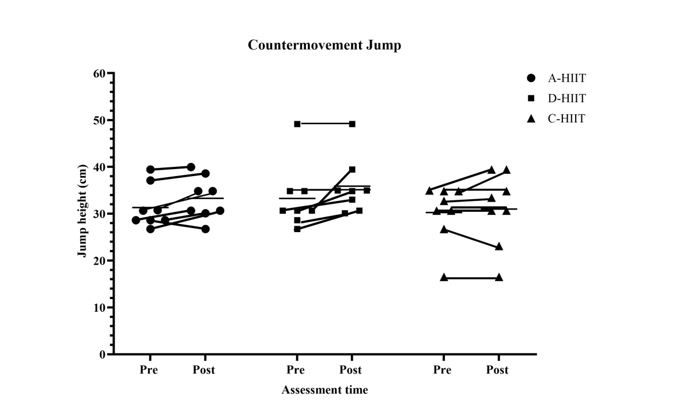
Methods: Twenty-four players were stratified by playing position and randomly allocated to ascending-rest (A-HIIT), descending-rest (D-HIIT), or constant-rest (C-HIIT) groups (n = 8 each). Participants completed eight preseason HIIT sessions, performed twice weekly. Each session comprised two sets of seven 30-s shuttle-running bouts prescribed relative to individual 30–15 Intermittent Fitness Test velocity. Recovery duration increased progressively in A-HIIT, decreased progressively in D-HIIT, and remained constant in C-HIIT, while total work and recovery time were matched across protocols. Countermovement jump (CMJ), 30-m sprint, 5-0-5 change-of-direction (COD), and Wingate peak power were assessed before and after training. Within-group changes were analysed using Wilcoxon signed-rank tests and between-group differences in change scores using Kruskal–Wallis tests, with Holm correction for multiple comparisons.
Results: All participants completed the intervention, although valid observations varied by outcome because of incomplete or unusable post-intervention data. Before correction, nominally significant within-group changes were observed for CMJ height, sprint time, right- and left-leg COD times, and Wingate peak power (unadjusted p = 0.012–0.046). These changes reflected an improvement only in CMJ height in D-HIIT; the significant sprint, COD, and Wingate changes represented performance decrements. However, none remained statistically significant after Holm correction (adjusted p = 0.180–0.460). No significant between-group differences were found for any outcome (p = 0.191–0.914).
Conclusion: Ascending, descending, and constant recovery distributions produced limited and broadly comparable neuromuscular and performance responses, with no evidence that any protocol was superior. Given the small sample, short intervention, and absence of a non-HIIT control group, these findings should be interpreted as preliminary and hypothesis-generating.
Downloads
References
1. Nobari H, Alves AR, Clemente FM, Pérez-Gómez J, Clark CCT, Granacher U, et al. Associations Between Variations in Accumulated Workload and Physiological Variables in Young Male Soccer Players Over the Course of a Season. Front Physiol. 2021 Mar 18;12. doi:10.3389/fphys.2021.638180
2. Rojas Jaramillo A, Kreider RB, Petro JL, Bonilla DA, Gonzalez-Badillo JJ, Rodriguez-Rosell D. Velocity-Based Training in Soccer: A Brief Narrative Review with Practical Recommendations. Journal of Functional Morphology and Kinesiology. Multidisciplinary Digital Publishing Institute (MDPI); 2025. doi:10.3390/jfmk10020106
3. Manzi V, Annino G, Savoia C, Caminiti G, Padua E, Masucci M, et al. Relationship between aerobic fitness and metabolic power metrics in elite male soccer players. Biol Sport. 2022;39(3):599–606. doi:10.5114/BIOLSPORT.2022.106389
4. Belamjahad A, Tourny C, Jebabli N, Clark CCT, Laher I, Hackney AC, et al. Effects of a Preseason Neuromuscular Training Program vs. an Endurance-Dominated Program on Physical Fitness and Injury Prevention in Female Soccer Players. Sports Med Open. 2024;10(1):76. doi:10.1186/s40798-024-00731-7
5. Buchheit M, Laursen PB. High-Intensity Interval Training, Solutions to the Programming Puzzle. Sports Medicine. 2013 May 29;43(5):313–38. doi:10.1007/s40279-013-0029-x
6. Faude O, Steffen A, Kellmann M, Meyer T. The effect of short-term interval training during the competitive season on physical fitness and signs of fatigue: a crossover trial in high-level youth football players. International Journal of Sports Physiology and Performance. 2014;9(6):936–44. doi:10.1123/ijspp.2013-0429 PubMed PMID: 24622685.
7. Thomakos P, Tsekos P, Tselios Z, Spyrou K, Katsikas C, Tsoukos A, et al. Effects of Two In-Season Short High-Intensity Interval Training Formats on Aerobic and Neuromuscular Performance in Young Soccer Players. J Sports Sci Med. 2024 Dec 1;23(4):812–21. doi:10.52082/jssm.2024.812 PubMed PMID: 39649568.
8. Hills SP, Radcliffe JN, Barwood MJ, Arent SM, Cooke CB, Russell M. Practitioner perceptions regarding the practices of soccer substitutes. PLoS One. 2020;15(2):e0228790. doi:10.1371/journal.pone.0228790
9. Buchheit M, Laursen P. Physiological Targets of HIIT. In: Science and Application of High Intensity Interval training. Human Kinetics; 2019. p. 33–50.
10. Higashihara A, Ono T, Kubota J, Okuwaki T, Fukubayashi T. Functional differences in the activity of the hamstring muscles with increasing running speed. J Sports Sci. 2010 Aug 1;28(10):1085–92. doi:10.1080/02640414.2010.494308
11. ÅStrand I, ÅStrand PO, Christensen EH, Hedman R. Intermittent Muscular Work. Acta Physiol Scand. 1960 Aug 1;48(3–4):448–53. doi:https://doi.org/10.1111/j.1748-1716.1960.tb01879.x
12. Buchheit M. The 30-15 Intermittent Fitness Test: A new intermittent running field test for intermittent sport players – Part 1. Approches du Handball. 2005; 87:27–34.
13. Monks MR, Compton CT, Yetman JD, Power KE, Button DC. Repeated sprint ability but not neuromuscular fatigue is dependent on short versus long duration recovery time between sprints in healthy males. J Sci Med Sport. 2017 Jun 1;20(6):600–5. doi:10.1016/j.jsams.2016.10.008
14. Seo MW, Lee JM, Jung HC, Jung SW, Song JK. Effects of Various Work-to-rest Ratios during High-intensity Interval Training on Athletic Performance in Adolescents. Int J Sports Med. 2019;40(8):503–10. doi:10.1055/a-0927-6884 PubMed PMID: 31288289.
15. Liang B, Saha S, Miao H, Chen L, Bialas M. Smart sensors, smarter players: The role of real-time monitoring in football training. PLoS One. 2025 Oct 1;20(10 October). doi:10.1371/journal.pone.0333884
16. Lim CY, In J. Randomization in clinical studies. Korean J Anesthesiol. 2019 Apr 1;72(3):221–32. doi:10.4097/kja.19049
17. Rampinini E, Impellizzeri FM, Castagna C, Abt G, Chamari K, Sassi A, et al. Factors influencing physiological responses to small-sided soccer games. J Sports Sci. 2007 Apr 1;25(6):659–66. doi:10.1080/02640410600811858
18. Stewart Arthur, Marfell-Jones Mike. International standards for anthropometric assessment. Lower Hutt, New Zealand: International Society for the Advancement of Kinanthropometry; 2011. 115 p.
19. Caseiro-Filho LC, Girasol CE, Rinaldi ML, Lemos TW, Guirro RRJ. Analysis of the accuracy and reliability of vertical jump evaluation using a low-cost acquisition system. BMC Sports Sci Med Rehabil. 2023 Dec 1;15(1). doi:10.1186/s13102-023-00718-z
20. Glatthorn JF, Gouge S, Nussbaumer S, et al. Validity and reliability of Optojump photoelectric cells for estimating vertical jump height. J Strength Cond Res. 2011;25(2):556-60. doi:10.1519/JSC.0b013e3181ccb18d.
21. Mildenberger C, Aragona A, Guissani C, Panci N, Delgado-García G. Sprint biomechanics assessment with low-cost systems: a reliability study. Sport Sci Health. 2024 Dec 9;20(4):1325–32. doi:10.1007/s11332-024-01209-5
22. Buchheit M. The 30-15 Intermittent Fitness Test: accuracy for individualizing interval training of young intermittent sport players. J Strength Cond Res. 2008;22(2):365-74. doi: 10.1519/JSC.0b013e3181635b2e
23. Baumgartner TA, Chung H. Confidence Limits for Intraclass Reliability Coefficients. Meas Phys Educ Exerc Sci. 2001 Sep;5(3):179–88. doi:10.1207/S15327841MPEE0503_4
24. Larsen RG, Befroy DE, Kent-Braun JA. High-intensity interval training increases in vivo oxidative capacity with no effect on P i →ATP rate in resting human muscle. American Journal of Physiology-Regulatory, Integrative and Comparative Physiology. 2013 Mar 1;304(5):R333–42. doi:10.1152/ajpregu.00409.2012
25. Edge J, Eynon N, McKenna MJ, Goodman CA, Harris RC, Bishop DJ. Altering the rest interval during high‐intensity interval training does not affect muscle or performance adaptations. Exp Physiol. 2013 Feb 9;98(2):481–90. doi:10.1113/expphysiol.2012.067603
26. HOPKINS WG, MARSHALL SW, BATTERHAM AM, HANIN J. Progressive Statistics for Studies in Sports Medicine and Exercise Science. Med Sci Sports Exerc. 2009 Jan;41(1):3–12. doi:10.1249/MSS.0b013e31818cb278
27. Manuel Clemente F, Ramirez-Campillo R, Nakamura FY, Sarmento H. Effects of high-intensity interval training in men soccer player’s physical fitness: A systematic review with meta-analysis of randomized-controlled and non-controlled trials. J Sports Sci. 2021 Jun 3;39(11):1202–22. doi:10.1080/02640414.2020.1863644
28. Dos’Santos T, Thomas C, Comfort P, Jones PA. Biomechanical Effects of a 6-Week Change of Direction Speed and Technique Modification Intervention: Implications for Change of Direction Side step Performance. J Strength Cond Res. 2022 Oct;36(10):2780–91. doi:10.1519/JSC.0000000000003950
29. Hung CH, Su CH, Wang D. The Role of High-Intensity Interval Training (HIIT) in Neuromuscular Adaptations: Implications for Strength and Power Development—A Review. 2025 Apr 16;15(4):657. doi:10.3390/life15040657
30. Oliver JL, Ramachandran AK, Singh U, Ramirez-Campillo R, Lloyd RS. The Effects of Strength, Plyometric and Combined Training on Strength, Power and Speed Characteristics in High-Level, Highly Trained Male Youth Soccer Players: A Systematic Review and Meta-Analysis. Sports Medicine. 2024 Mar 28;54(3):623–43. doi:10.1007/s40279-023-01944-8
Downloads
Publication Timeline
- Submitted
- Revised
- Accepted