Effects of Combined Cognitive-Motor Training on Agility, Decision-Making, and Match Performance in Competitive Tennis Players: A Randomized Controlled Trial
DOI:
https://doi.org/10.61838/kman.intjssh.5526Keywords:
Cognitive-motor training; Tennis; Reactive agility; Decision-making; Match performanceAbstract
Objective: Modern tennis performance increasingly depends on the integration of perceptual-cognitive and movement-related abilities due to the highly dynamic and unpredictable nature of competitive match play. Although combined cognitive-motor training (CCMT) has gained increasing attention in open-skill sports, evidence regarding its effectiveness in competitive tennis remains limited. Therefore, the present study aimed to investigate the effects of CCMT on reactive agility, decision-making ability, and match performance in competitive tennis players.
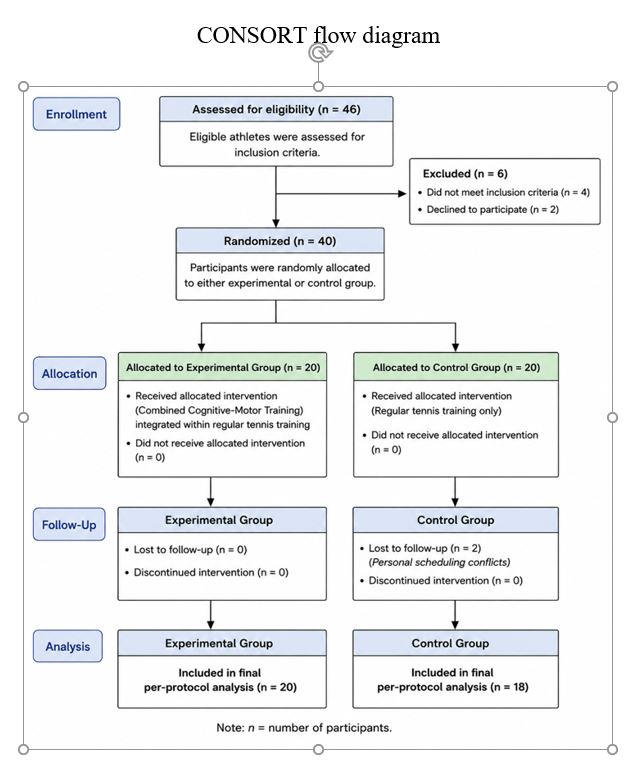
Materials and Methods: An assessor-blinded randomized controlled trial with a parallel-group pretest–posttest design was conducted involving 40 competitive tennis players aged 16–22 years. Participants were randomized into experimental (n = 20) and control groups (n = 20). Following two non-intervention-related withdrawals in the control group, final per-protocol analyses included 38 participants. The experimental group performed combined cognitive-motor training integrated within the regular training schedule for eight weeks, whereas the control group performed regular tennis training only. Reactive agility, tennis-specific decision-making, and match performance were evaluated before and after the intervention period. Data were analyzed using a linear mixed model (p < 0.05).
Findings: The experimental group demonstrated significantly greater improvements in reactive agility performance compared with the control group (F = 18.72, p ≤ 0.001). Significant group × time interaction effects were also identified for decision-making accuracy (F = 16.94, p ≤ 0.001) and response time (F = 14.27, p ≤ 0.001). In addition, the experimental group exhibited greater improvements in match-performance indicators, including winners (F = 11.83, p = 0.002), unforced errors (F = 13.26, p = 0.001), rally success percentage (F = 15.11, p ≤ 0.001), point-winning efficiency (F = 13.02, p = 0.001), and tactical efficiency index (F = 12.48, p = 0.001). No serious adverse events or intervention-related injuries were reported during the intervention period.
Conclusions: Combined cognitive-motor training produced greater improvements in reactive agility, tennis-specific decision-making performance, and competitive match outcomes compared with regular tennis training alone. These findings suggest that integrating cognitive challenges within representative sport-specific movement tasks may provide an effective strategy for enhancing perceptual-cognitive and movement-related performance capacities in competitive tennis players. Future studies should investigate long-term retention effects and explore the underlying mechanisms associated with cognitive-motor adaptation in sport-specific training environments.
Downloads
References
1. Beck D, Hossner EJ, Zahno S. Exploiting Prior Knowledge In Continuous Decision-Making Under Uncertainty: The Case Of Tennis Experts. Experimental Brain Research. 2026;244(5). [PMID: 41984228] [PMCID: PMC13083433] [DOI]
2. Yufei C, Ningning W. The Relationship Between Visual Spatial Working Memory Capacity Of Tennis Players And Visual Information Processing Of Offensive Tactical Decision-Making. Frontiers in Psychology. 2026;17(January). [PMID: 41658389] [PMCID: PMC12875949] [DOI]
3. Zhao Z, Liu Y, Xu K. Optimizing Agility Training In Team Sport Players-The Role Of Perception-Action Coupling: A Systematic Review With Multi-Level Meta-Analysis. Journal of Sports Science and Medicine. 2026(February):84-111. [PMID: 41710443] [PMCID: PMC12912675] [DOI]
4. Huang Z, Wei X, Liu X, Yang Y. Integrating The Dual-System Theory In Motor: Dynamic Framework Construction For Motor Decision-Making. Frontiers in Psychology. 2026;16(January):1-13. [PMID: 41608177] [PMCID: PMC12835366] [DOI]
5. Lucia S, Digno M, Madinabeitia I, Di Russo F. Testing A Multicomponent Training Designed To Improve Sprint, Agility And Decision-Making In Elite Basketball Players. Brain Sciences. 2023;13(7). [PMID: 37508916] [PMCID: PMC10377459] [DOI]
6. Zhang K, Chan WS, Lau HS, Huang D, Chow DH. The Crossover Effects Of Visuomotor Task Complexity In Training Reactive Agility Of Ball Sports Athletes. Journal of Human Kinetics. 2025;100:5-15. [PMID: 41766815] [PMCID: PMC12946877] [DOI]
7. Icemet T, Zhang Z, editors. Improvement Effect Of Repeated Sprint And Cognitive Combined Training On Tennis Players' Performance And High Pressure Decision Making2026.
8. Moca C, Pașcan A, Apostu P. Trends In Agility Development Research Among Tennis Athletes Between 2024 And 2025. Studia Universitatis Babeş-Bolyai Educatio Artis Gymnasticae. 2026:117-27. [DOI]
9. Zwierko M, Jedziniak W, Popowczak M, Rokita A. Reactive Agility In Competitive Young Volleyball Players: A Gender Comparison Of Perceptual-Cognitive And Motor Determinants. Journal of Human Kinetics. 2022;85(1):87-96. [PMID: 36643830] [PMCID: PMC9808806] [DOI]
10. Pavlinović V. Cognitive And Motor Capacities Are Poorly Correlated With Agility In Early Pubertal Children: Gender-Stratified Analysis. Applied Sciences. 2024;14(8). [DOI]
11. Shalom A, Gottlieb R, Calleja-Gonzalez J. Closed Vs. Open-Skill Contexts In Basketball: Insights Into Reactive And Nonreactive Short Distance Sprint Performance More Closely Aligned With Game Demands. Sports. 2026;14(3):1-11. [PMID: 41893605] [PMCID: PMC13030682] [DOI]
12. Mulya G, Nevitaningrum N, Agustryani R, Soraya N, Adi T. Effects Of Technical Drill And Plyometric Training On Shot Accuracy In Tennis Athletes Aged 16-19 With Different Agility Levels. Pedagogy of Physical Culture and Sports. 2025;29:444-53. [DOI]
13. Choo L, Novak A, Impellizzeri FM, Porter C, Fransen J. Skill Acquisition Interventions For The Learning Of Sports-Related Skills: A Scoping Review Of Randomised Controlled Trials. Psychology of Sport and Exercise. 2024;72(February):102615. [PMID: 38401870] [DOI]
14. Habib Qadoori R, Yas QM, Ismaeel SA, Qadoori MH. Evaluating Tennis Player Performance Based On Biomechanical Variables Using Multi Criteria Decision Making Techniques. Pubmedia Jurnal Pendidikan Olahraga. 2025;3(2):1-17. [DOI]
15. Zhu R, Zou D, Wang K, Cao C. Expert Performance In Action Anticipation: Visual Search Behavior In Volleyball Spiking Defense From Different Viewing Perspectives. Behavioral Sciences. 2024;14(3). [PMID: 38540466] [PMCID: PMC10968438] [DOI]
16. Souza L, Rezende A, Carmo J. Instrument For Evaluation And Training Of Decision Making In Dual Tasks In Soccer: Validation And Application. Sensors. 2024;24:6840. [PMID: 39517737] [PMCID: PMC11548540] [DOI]
17. Deng J. Noninvasive Brain Stimulation And Athletic Performance: A Critical Narrative Review. BMC Sports Science, Medicine and Rehabilitation. 2026;18:71. [PMID: 41353370] [PMCID: PMC12882280] [DOI]
18. Esposito G, Ceruso R, Aliberti S, Raiola G. Ecological-Dynamic Approach Vs. Traditional Prescriptive Approach In Improving Technical Skills Of Young Soccer Players. Journal of Functional Morphology and Kinesiology. 2024;9(3):1-12. [PMID: 39311270] [PMCID: PMC11417948] [DOI]
19. Cassidy J, Young W, Gorman A, Kelly V. Merging Athletic Development With Skill Acquisition: Developing Agility Using An Ecological Dynamics Approach. Strength and Conditioning Journal. 2023. [DOI]
20. Li Q, Fu Q, Li L, Wang J. Cognitive-Coordination Training: Impact On Sport-Specific Physical Fitness And Technical Skill Of Adolescent Basketball Athletes. Frontiers in Psychology. 2026;16(January):1-14. [PMID: 41574072] [PMCID: PMC12819253] [DOI]
21. Zhu R, Zheng M, Liu S, Guo J, Cao C. Effects Of Perceptual-Cognitive Training On Anticipation And Decision-Making Skills In Team Sports: A Systematic Review And Meta-Analysis. Behavioral Sciences. 2024;14:919. [PMID: 39457791] [PMCID: PMC11505547] [DOI]
22. Triolet C, Benguigui N. Anticipation Training For Expert Tennis Players When Facing A Specific Player. Frontiers in Psychology. 2025;15. [PMID: 39839935] [PMCID: PMC11747770] [DOI]
Downloads
Publication Timeline
- Submitted
- Revised
- Accepted