Evaluation The Model Fit of Physical Exercise and Resilience: The Mediation Role of Mindfulness
DOI:
https://doi.org/10.61838/kman.intjssh.8.3.4Keywords:
physical exercise, mindfulness, resilienceAbstract
Objective: This study aimed to investigate the mediating role of mindfulness in the relationship between physical exercise and resilience among sport science students.
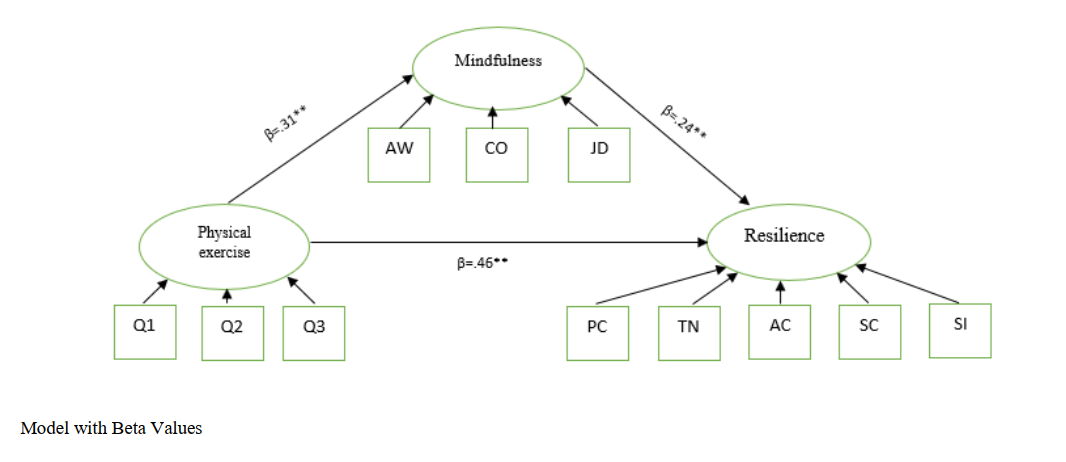
Methods and Materials: A cross-sectional, quantitative design was used to explore the structural relationships among physical exercise, mindfulness, and resilience. The study involved 167 university students (86 males, 87 females; M_age = 20.17, SD = 1.05) from the Faculty of Sport Sciences and Health at the University of Tehran, selected through convenience sampling. Data were collected using three instruments: the Connor-Davidson Resilience Scale (CD-RISC), the Mindfulness Inventory for Sport (MIS), and a self-reported physical activity questionnaire calculating monthly exercise hours. Descriptive statistics were analyzed using SPSS 29, and structural equation modeling (SEM) was conducted in AMOS to assess the model fit and test the hypothesized mediational pathway.
Findings: The SEM analysis supported the hypothesized model, indicating satisfactory fit indices (χ² = 1.85, df = 31, RMSEA = 0.05, CFI = 0.99, GFI = 0.99). Significant positive associations were found between physical exercise and resilience subcomponents, including personal competence (r = .40, p < .01), tolerance to negative affect (r = .20, p < .05), acceptance of change (r = .43, p < .01), and self-control (r = .46, p < .01), but not with spiritual influences. Physical exercise was also significantly correlated with mindfulness subcomponents such as awareness (r = .32, p < .05) and reconcentration (r = .28, p < .05), but not with being non-judgmental. Mindfulness significantly mediated the relationship between physical exercise and resilience (β = .31, p < .01), confirming its intermediary role.
Conclusion: The findings demonstrate that mindfulness plays a significant mediating role in the positive effect of physical exercise on resilience in sport science students. These results underscore the importance of integrated interventions combining physical activity and mindfulness to enhance psychological resilience and overall well-being.
Downloads
References
1. Belcher BR, Zink J, Azad A, Campbell CE, Chakravartti SP, Herting MM. The Roles of Physical Activity, Exercise, and Fitness in Promoting Resilience During Adolescence: Effects on Mental Well-Being and Brain Development. Biological Psychiatry: Cognitive Neuroscience and Neuroimaging. 2021;6(2):225-37. [DOI]
2. Brassington K, Lomas T. Can resilience training improve well-being for people in high-risk occupations? A systematic review through a multidimensional lens. The Journal of Positive Psychology. 2021;16(5):573-92. [DOI]
3. Padesky CA, Mooney KA. Strengths‐based cognitive–behavioural therapy: A four‐step model to build resilience. Clinical psychology & psychotherapy. 2012;19(4):283-90. [DOI]
4. Davydov DM, Stewart R, Ritchie K, Chaudieu I. Resilience and mental health. Clinical psychology review. 2010;30(5):479-95. [DOI]
5. Silverman MN, Deuster PA. Biological mechanisms underlying the role of physical fitness in health and resilience. Interface focus. 2014;4(5):20140040. [DOI]
6. Khanlou N, Wray R. A whole community approach toward child and youth resilience promotion: A review of resilience literature. International journal of mental health and addiction. 2014;12:64-79. [DOI]
7. Deuster PA, Silverman MN. Physical fitness: a pathway to health and resilience. US Army Medical Department Journal. 2013.
8. Robertson I, Cooper CL. Resilience. Stress & Health: Journal of the International Society for the Investigation of Stress. 2013;29(3). [DOI]
9. Niemiec RM. Six Functions of Character Strengths for Thriving at Times of Adversity and Opportunity: a Theoretical Perspective. Applied Research in Quality of Life. 2020;15(2):551-72. [DOI]
10. Shellman A, Hill E. Flourishing through resilience: The impact of a college outdoor education program. Journal of park and recreation administration. 2017;35(4). [DOI]
11. Harms P, Brady L, Wood D, Silard A. Resilience and well-being. Handbook of well-being. 2018:1-12.
12. Soltani E, Shareh H, Bahrainian SA, Farmani A. The mediating role of cognitive flexibility in correlation of coping styles and resilience with depression. Pajoohande. 2013;18(2):88-96.
13. Tsai J, Harpaz-Rotem I, Pietrzak RH, Southwick SM. The role of coping, resilience, and social support in mediating the relation between PTSD and social functioning in veterans returning from Iraq and Afghanistan. Psychiatry. 2012;75(2):135-49. [DOI]
14. Secades XG, Molinero O, Salguero A, Barquín RR, de la Vega R, Márquez S. Relationship between resilience and coping strategies in competitive sport. Perceptual and Motor Skills. 2016;122(1):336-49. [DOI]
15. Nezhad MAS, Besharat MA. Relations of resilience and hardiness with sport achievement and mental health in a sample of athletes. Procedia-Social and Behavioral Sciences. 2010;5:757-63. [DOI]
16. Souri H, Hasanirad T. Relationship between resilience, optimism and psychological well-being in students of medicine. Procedia-Social and Behavioral Sciences. 2011;30:1541-4. [DOI]
17. Day T, Kearney CA. Resilience variables and posttraumatic symptoms among maltreated youth. Journal of Aggression, Maltreatment & Trauma. 2016;25(9):991-1005. [DOI]
18. Lloyd C, Campion DP. Occupational stress and the importance of self-care and resilience: focus on veterinary nursing. Irish veterinary journal. 2017;70:1-7. [DOI]
19. Ho SM, Ho JW, Bonanno GA, Chu AT, Chan EM. Hopefulness predicts resilience after hereditary colorectal cancer genetic testing: a prospective outcome trajectories study. BMC cancer. 2010;10:1-10. [DOI]
20. Zehir C, Narcıkara E. E-service quality and e-recovery service quality: effects on value perceptions and loyalty intentions. Procedia-Social and Behavioral Sciences. 2016;229:427-43. [DOI]
21. Richtnér A, Löfsten H. Managing in turbulence: how the capacity for resilience influences creativity. R&d Management. 2014;44(2):137-51. [DOI]
22. Pidgeon AM, Keye M. Relationship between resilience, mindfulness, and pyschological well-being in University students. International Journal of Liberal Arts and Social Science. 2014;2(5):27-32.
23. Arida RM, Teixeira-Machado L. The contribution of physical exercise to brain resilience. Frontiers in behavioral neuroscience. 2021;14:626769. [DOI]
24. Malm C, Jakobsson J, Isaksson A. Physical activity and sports—real health benefits: a review with insight into the public health of Sweden. Sports. 2019;7(5):127. [DOI]
25. Childs E, De Wit H. Regular exercise is associated with emotional resilience to acute stress in healthy adults. Frontiers in physiology. 2014;5:161. [DOI]
26. Sinha R, Lacadie CM, Constable RT, Seo D. Dynamic neural activity during stress signals resilient coping. Proc Natl Acad Sci U S A. 2016;113(31):8837-42. [PMCID: PMC4978278] [DOI]
27. Tao J, Liu J, Chen X, Xia R, Li M, Huang M, et al. Mind-body exercise improves cognitive function and modulates the function and structure of the hippocampus and anterior cingulate cortex in patients with mild cognitive impairment. Neuroimage Clin. 2019;23:101834. [PMCID: PMC6535682] [DOI]
28. Hughes V. Stress: The roots of resilience. Nature. 2012;490(7419):165-7. [DOI]
29. Ochmann DT, Philippi KFA, Zeier P, Sandner M, Hillen B, Neuberger EWI, et al. Association of innate and acquired aerobic capacity with resilience in healthy adults: Protocol for a randomized controlled trial of an 8-week web-based physical exercise intervention. JMIR Research Protocols. 2021;10(11). [DOI]
30. Stranahan AM, Martin B, Maudsley S. Anti-inflammatory effects of physical activity in relationship to improved cognitive status in humans and mouse models of Alzheimer's disease. Curr Alzheimer Res. 2012;9(1):86-92. [PMCID: PMC4445413] [DOI]
31. Mueller PJ. Exercise training and sympathetic nervous system activity: evidence for physical activity dependent neural plasticity. Clin Exp Pharmacol Physiol. 2007;34(4):377-84. [DOI]
32. McEwen BS. In pursuit of resilience: stress, epigenetics, and brain plasticity. Ann N Y Acad Sci. 2016;1373(1):56-64. [DOI]
33. Mander J, Blanck P. Mindfulness in psychotherapy: Applications in research and practice. Psychotherapeut. 2018;63(3):251-64. [DOI]
34. Kumari D, Davis S, Mukherjee SS, Chaudhury S. Mindfulness: A step ahead in life dolly. A Guide to Clinical Psychology: Therapies2024. p. 31-46
35. May AD, Maurin E. Calm: A Review of the Mindful Meditation App for Use in Clinical Practice. Families, Systems and Health. 2021;39(2):398-400. [DOI]
36. Zsadanyi SE, Kurth F, Luders E. The effects of mindfulness and meditation on the cingulate cortex in the healthy human brain: A review. Mindfulness. 2021;12(10):2371-87. [DOI]
37. Mrazek AJ, Mrazek MD, Cherolini CM, Cloughesy JN, Cynman DJ, Gougis LJ, et al. The future of mindfulness training is digital, and the future is now. Current opinion in psychology. 2019;28:81-6. [DOI]
38. Quaglia JT, Braun SE, Freeman SP, McDaniel MA, Brown KW. Meta-analytic evidence for effects of mindfulness training on dimensions of self-reported dispositional mindfulness. Psychological assessment. 2016;28(7):803. [DOI]
39. Schneider J, Malinowski P, Watson PM, Lattimore P. The role of mindfulness in physical activity: a systematic review. Obesity reviews. 2019;20(3):448-63. [DOI]
40. Stocker E, Englert C, Seiler R. Self-control strength and mindfulness in physical exercise performance: Does a short mindfulness induction compensate for the detrimental ego depletion effect? Journal of Applied Sport Psychology. 2019;31(3):324-39. [DOI]
41. Díaz-Silveira C, Alcover C-M, Burgos F, Marcos A, Santed MA. Mindfulness versus physical exercise: Effects of two recovery strategies on mental health, stress and immunoglobulin A during lunch breaks. A randomized controlled trial. International journal of environmental research and public health. 2020;17(8):2839. [DOI]
42. Sørensen L, Osnes B, Visted E, Svendsen JL, Adolfsdottir S, Binder PE, et al. Dispositional Mindfulness and Attentional Control: The Specific Association Between the Mindfulness Facets of Non-judgment and Describing With Flexibility of Early Operating Orienting in Conflict Detection. Front Psychol. 2018;9:2359. [PMCID: PMC6282922] [DOI]
43. Blair Kennedy A, Resnick PB. Mindfulness and physical activity. American Journal of Lifestyle Medicine. 2015;9(3):221-3. [DOI]
44. Calogero R, Pedrotty K. Daily Practices for Mindful Exercise. In: L’Abate L, editor. Low-Cost Approaches to Promote Physical and Mental Health: Theory, Research, and Practice. New York, NY: Springer New York; 2007. p. 141-60[DOI]
45. Ulmer CS, Stetson BA, Salmon PG. Mindfulness and acceptance are associated with exercise maintenance in YMCA exercisers. Behaviour research and therapy. 2010;48(8):805-9. [DOI]
46. Tang Y-Y, Fan Y, Lu Q, Tan L-H, Tang R, Kaplan RM, et al. Long-term physical exercise and mindfulness practice in an aging population. Frontiers in psychology. 2020;11:358. [DOI]
47. Josefsson T, Gustafsson H, Iversen Rostad T, Gardner FL, Ivarsson A. Mindfulness and shooting performance in biathlon. A prospective study. European journal of sport science. 2021;21(8):1176-82. [DOI]
48. Zhang C-Q, Si G, Duan Y, Lyu Y, Keatley DA, Chan DK. The effects of mindfulness training on beginners' skill acquisition in dart throwing: A randomized controlled trial. Psychology of Sport and Exercise. 2016;22:279-85. [DOI]
49. Bühlmayer L, Birrer D, Röthlin P, Faude O, Donath L. Effects of mindfulness practice on performance-relevant parameters and performance outcomes in sports: A meta-analytical review. Sports medicine. 2017;47:2309-21. [DOI]
50. Brewer JA, Garrison KA. The posterior cingulate cortex as a plausible mechanistic target of meditation: findings from neuroimaging. Annals of the New York Academy of Sciences. 2014;1307(1):19-27. [DOI]
51. Micklitz K, Wong G, Howick J. Mindfulness-based programmes to reduce stress and enhance well-being at work: a realist review. BMJ open. 2021;11(3):e043525. [DOI]
52. Birrer D, Morgan G. Psychological skills training as a way to enhance an athlete's performance in high‐intensity sports. Scandinavian journal of medicine & science in sports. 2010;20:78-87. [DOI]
53. Bahrami Z, Cranney J. Integrated conative model of well-being: From motives to well-being. Journal of Happiness Studies. 2018;19:961-81. [DOI]
54. Connor KM, Davidson JR. Development of a new resilience scale: The Connor‐Davidson resilience scale (CD‐RISC). Depression and anxiety. 2003;18(2):76-82. [DOI]
55. Thienot E, Jackson B, Dimmock J, Grove JR, Bernier M, Fournier JF. Development and preliminary validation of the mindfulness inventory for sport. Psychology of Sport and Exercise. 2014;15(1):72-80. [DOI]
56. Gonzalez SP, Moore EWG, Newton M, Galli NA. Validity and reliability of the Connor-Davidson Resilience Scale (CD-RISC) in competitive sport. Psychology of Sport and Exercise. 2016;23:31-9. [DOI]
57. Bakhshayesh Eghbali B, Pourramzani A, Bahadivand Chegini AH, Mirniam L, Hasanzadeh K, Saadat S. Validity and reliability of connor-davidson resilience scale in patients with multiple sclerosis: a psychometric study in Iran. Avicenna Journal of Neuro Psycho Physiology. 2022;9(2):45-50. [DOI]
58. Hemayat Talab R, Khabiri M, Zare M. Psychometric Properties of Persian Version of Mindfulness Inventory for Sport (MIS). Sport Psychology Studies. 2016;5(18):63-80. [DOI]
59. Yang C-H, Conroy DE. Mindfulness and physical activity: A systematic review and hierarchical model of mindfulness. International Journal of Sport and Exercise Psychology. 2020;18(6):794-817. [DOI]
60. Boat R, Cooper SB. Self-Control and Exercise: A Review of the Bi-Directional Relationship. Brain Plast. 2019;5(1):97-104. [PMCID: PMC6971834] [DOI]
61. Patrick H, Canevello A. Methodological Overview of A Self-Determination Theory-Based Computerized Intervention to Promote Leisure-Time Physical Activity. Psychol Sport Exerc. 2011;12(1):13-9. [PMCID: PMC2900852] [DOI]
62. Teixeira PJ, Carraça EV, Markland D, Silva MN, Ryan RM. Exercise, physical activity, and self-determination theory: A systematic review. International Journal of Behavioral Nutrition and Physical Activity. 2012;9(1):78. [DOI]
63. Rodrigues F, Figueiredo N, Jacinto M, Monteiro D, Morouço P. Social-Cognitive Theories to Explain Physical Activity. Education Sciences. 2023;13(2):122. [DOI]
64. Vansteenkiste M, Soenens B, Ryan RM. Basic psychological needs theory: A conceptual and empirical review of key criteria. The Oxford handbook of self-determination theory. New York, NY, US: Oxford University Press; 2023. p. 84-123[DOI]
65. Fan L, Cui F. Mindfulness, self-efficacy, and self-regulation as predictors of psychological well-being in EFL learners. Front Psychol. 2024;15:1332002. [PMCID: PMC11004504] [DOI]
66. Lev Arey D, Blatt A, Gutman T. A Self-Determination Theory and Acceptance and Commitment Therapy-based intervention aimed at increasing adherence to physical activity. Frontiers in Psychology. 2022;Volume 13 - 2022. [DOI]
67. Tatta J, Willgens AM, Palombaro KM. Mindfulness and Acceptance-Based Interventions in Physical Therapist Practice: The Time Is Now. Phys Ther. 2022;102(3). [DOI]
68. Ludyga S, Gerber M, Pühse U, Looser VN, Kamijo K. Systematic review and meta-analysis investigating moderators of long-term effects of exercise on cognition in healthy individuals. Nature human behaviour. 2020;4(6):603-12. [DOI]
69. Roychowdhury D. Moving Mindfully: The Role of Mindfulness Practice in Physical Activity and Health Behaviours. J Funct Morphol Kinesiol. 2021;6(1). [PMCID: PMC7985766] [DOI]
70. Brandel MG, Lin C, Hennel D, Khazen O, Pilitsis JG, Ben-Haim S. Mindfulness meditation in the treatment of chronic pain. Neurosurgery Clinics. 2022;33(3):275-9. [DOI]
71. Friedman NP, Robbins TW. The role of prefrontal cortex in cognitive control and executive function. Neuropsychopharmacology. 2022;47(1):72-89. [DOI]
72. Voss MW, Heo S, Prakash RS, Erickson KI, Alves H, Chaddock L, et al. The influence of aerobic fitness on cerebral white matter integrity and cognitive function in older adults: Results of a one‐year exercise intervention. Human brain mapping. 2013;34(11):2972-85. [DOI]
Downloads
Additional Files
Publication Timeline
Issue
Section
License
Copyright (c) 2025 Bahrami.Z (Corresponding Author); Cranney.J (Author)

This work is licensed under a Creative Commons Attribution-NonCommercial 4.0 International License.