The Impact of Media Representation on Female Athlete Identity and Self-Perception
DOI:
https://doi.org/10.61838/kman.intjssh.7.3.1Keywords:
Female athletes, media representation, identity construction, self-perception, Istanbul, coping mechanisms, stereotypes, body image, mental healthAbstract
Objective: This study explores the impact of media representation on female athlete identity and self-perception.
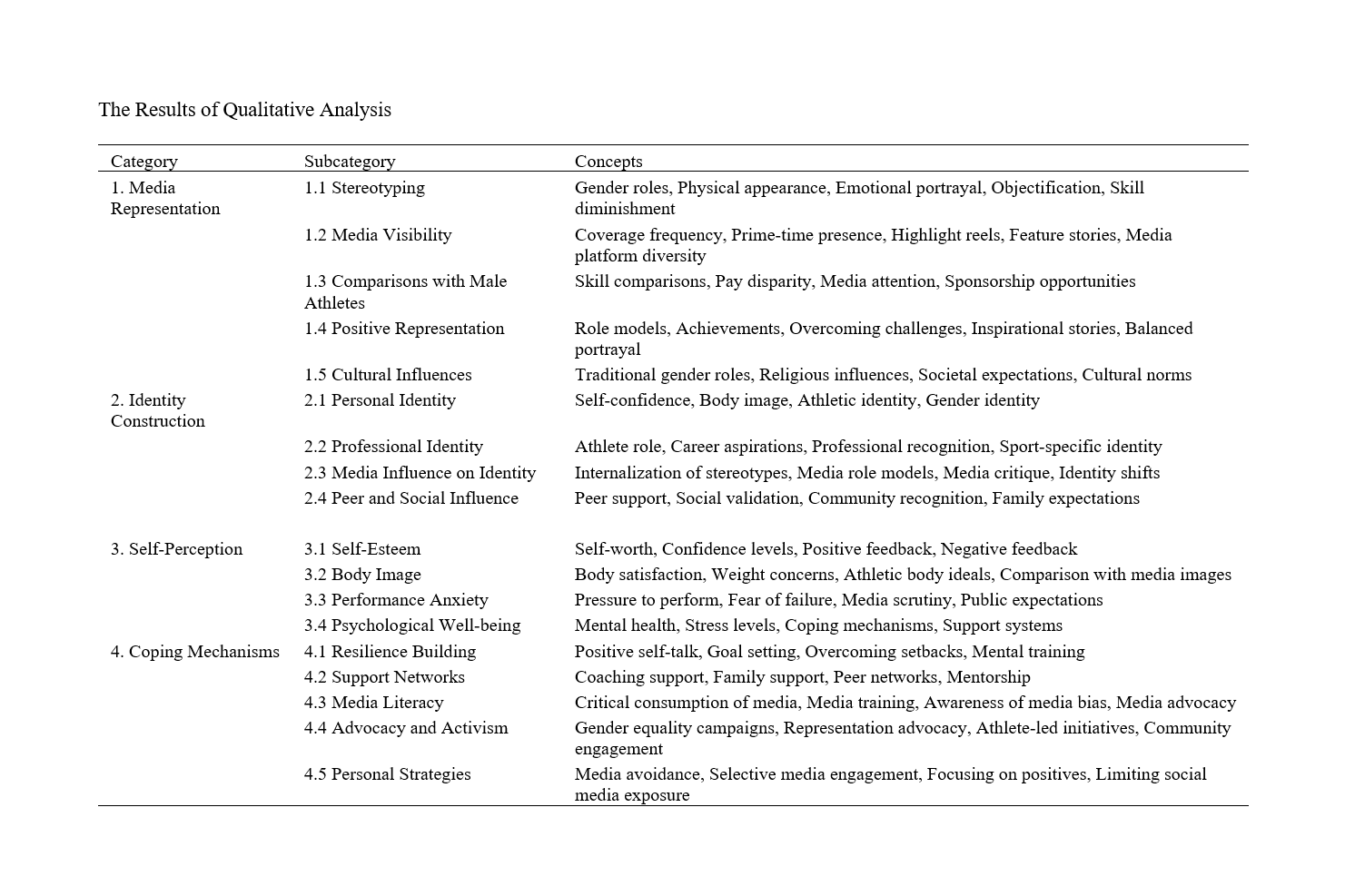
Methods and Materials: A qualitative research design was employed, utilizing semi-structured interviews to collect data. Twenty-four female athletes, aged 18 to 35, from various sports disciplines in Istanbul participated. The interviews, conducted in Turkish, lasted between 60 to 90 minutes and were transcribed verbatim. Thematic analysis was performed using NVivo software, allowing for the identification of key themes and subthemes related to media representation, identity construction, self-perception, and coping mechanisms. The study continued data collection until theoretical saturation was achieved.
Findings: Thematic analysis revealed four main themes: media representation, identity construction, self-perception, and coping mechanisms. Participants reported stereotypical portrayals emphasizing physical appearance and emotional attributes over athletic skills. Media visibility was significantly lower for female athletes compared to their male counterparts, impacting their professional identity and opportunities. The internalization of stereotypes and media-driven body ideals affected their self-esteem and body image, contributing to performance anxiety and mental health challenges. Participants employed various coping mechanisms, including resilience building, support networks, media literacy, advocacy, and personal strategies, to manage the negative impacts of media representation.
Conclusion: Media representation profoundly influences female athletes' identity and self-perception, often reinforcing stereotypes and cultural biases. Equitable media coverage focusing on athletic achievements and personal stories is crucial for fostering positive self-identity among female athletes. Practical steps, including media training, advocacy, and promoting media literacy, are essential to create a more inclusive and supportive media environment.
Downloads
References
1. George C, Hartley AJ, Paris J. The Representation of
Female Athletes in Textual and Visual Media. Corporate
Communications an International Journal. 2001;6(2):94-101.
[DOI]
2. Biscomb K, Matheson H. Are the Times Changing
Enough? Print Media Trends Across Four Decades. International
Review for the Sociology of Sport. 2017;54(3):259-81. [DOI]
3. Antunovic D. “Turned Into The Women’s Journal”:
Representation of Sportswomen in Hungary’s Sports Magazine.
International Review for the Sociology of Sport. 2017;54(1):63-85.
[DOI]
4. Bowes A, Kitching N. ‘Battle of the Sixes’: Investigating
Print Media Representations of Female Professional Golfers
Competing in a Men’s Tour Event. International Review for the
Sociology of Sport. 2019;55(6):664-84. [DOI]
5. Daniels EA, Wartena H. Athlete or Sex Symbol: What
Boys Think of Media Representations of Female Athletes. Sex
Roles. 2011;65(7-8):566-79. [DOI]
6. Kane MJ, LaVoi NM, Fink J. Exploring Elite Female
Athletes’ Interpretations of Sport Media Images. Communication
& Sport. 2013;1(3):269-98. [DOI]
7. Smith L. What’s the Best Exposure? Examining Media
Representations of Female Athletes and the Impact on Collegiate
Athletes’ Self-Objectification. Communication & Sport.
2015;4(3):282-302. [DOI]
8. Kim K, Kwon WH. The Gender Gap on Women’s Sports
Spectatorship. Ijass(international Journal of Applied Sports
Sciences). 2020;32(1):100-13. [DOI]
9. Bissell K. Elite but Struggling: Mediated Narratives of
Women Athletes and Mental Health Disclosures. Journalism &
Communication Monographs. 2024;26(1):4-63. [DOI]
10. Harrison CK, Stone J, Shapiro JR, Sa SLY, Boyd J,
Rullan V. The Role of Gender Identities and Stereotype Salience
With the Academic Performance of Male and Female College
Athletes. Journal of Sport and Social Issues. 2009;33(1):78-96.
[DOI]
11. Krane V, Ross S, Miller M, Rowse JL, Ganoe K,
Andrzejczyk JA, et al. Power and Focus: Self‐representation of
Female College Athletes. Qualitative Research in Sport and
Exercise. 2010;2(2):175-95. [DOI]
12. Ihnat B. Strong Is Beautiful(?): A Multimodal Analysis
of Strength and Beauty in Female and Male Sports Commercials.
2021. [DOI]
13. Laine A. Gender Representation of Athletes in Finnish
and Swedish Tabloids. Nordicom Review. 2016;37(2):83-98.
[DOI]
14. Osborne J, Kavanagh E, Litchfield C. Freedom for
Expression or a Space of Oppression? Social Media and the Female
@Thlete. 2021:157-72. [DOI]
15. Toffoletti K, Thorpe H. Female Athletes' SelfRepresentation on Social Media: A Feminist Analysis of Neoliberal
Marketing Strategies in “Economies of Visibility”. Feminism &
Psychology. 2018;28(1):11-31. [DOI]
16. Toffoletti K, Thorpe H. The Athletic Labour of
Femininity: The Branding and Consumption of Global Celebrity
Sportswomen on Instagram. Journal of Consumer Culture.
2018;18(2):298-316. [DOI]
17. Johnson A. “I’m Not Just a Mother”: A content analysis
of Elite Female Athletes’ Self-Presentation Before and After
Motherhood. Sport Business and Management an International
Journal. 2023;13(5):622-39. [DOI]
18. McGannon KR, McMahon J, Schinke RJ, Gonsalves CA.
Understanding Athlete Mother Transition in Cultural Context: A
Media Analysis of Kim Clijsters’ Tennis Comeback and SelfIdentity Implications. Sport Exercise and Performance Psychology.
2017;6(1):20-34. [DOI]
19. Quinn N, Yoshida K. More Than Sport: Representations
of Ability and Gender by the Canadian Broadcasting Corporation
(CBC) of the 2004 Summer Paralympic Games. Canadian Journal
of Disability Studies. 2016;5(4):103. [DOI]
20. Pearson E, Misener L. Informing Future Paralympic
Media Approaches: The Perspective of Canadian Paralympic
Athletes. Communication & Sport. 2022;12(2):254-76. [DOI]
21. Yang ECL, Hayes M, Chen J, Riot C, Khoo‐Lattimore C.
A Social Media Analysis of the Gendered Representations of
Female and Male Athletes During the 2018 Commonwealth
Games. International Journal of Sport Communication.
2020;13(4):670-95. [DOI]
22. Litchfield C, Kavanagh E. Twitter, Team GB and the
Australian Olympic Team: Representations of Gender in Social
Media Spaces. Sport in Society. 2018;22(7):1148-64. [DOI]
23. Rajan N, Varma P. To Study Gender Differences in
Athlete Identity Among Intercollegiate Level Athletes.
International Journal of Physical Education Sports and Health.
2022;9(5):211-4. [DOI]
24. Yip AYS. Deuce or Advantage? Examining Gender Bias
in Online Coverage of Professional Tennis. International Review
for the Sociology of Sport. 2016;53(5):517-32. [DOI]
25. Shafarenko Y, Volobuieva A. Representation of
Sportswomen in the Online Version of Ukrainian Daily Newspaper
“Segodnya”. Current Issues of Mass Communication. 2021(29):39-
51. [DOI]
26. Daniels EA. Sex Objects, Athletes, and Sexy Athletes.
Journal of Adolescent Research. 2009;24(4):399-422. [DOI]
Downloads
Additional Files
Publication Timeline
Issue
Section
License
Copyright (c) 2024 Ayşe Şahin, Dilek Soylu , Elif Toktas, Neşe Köse (Author)

This work is licensed under a Creative Commons Attribution-NonCommercial 4.0 International License.