The Effect of Exercise Volume on Depressive-Related Behaviors and Levels of Brain-Derived Neurotrophic Factor and Serum Testosterone Levels
DOI:
https://doi.org/10.61838/kman.intjssh.7.3.8Keywords:
Swimming exercise, depression, brain-derived neurotrophic factor, testosterone, training volumeAbstract
Objective: The aim of the present study was to investigate the effect of training volume on depression-related behaviors and serum levels of brain-derived neurotrophic factor (BDNF) and testosterone in mice. Male NMRI mice, approximately 80 days old and weighing 20 to 23 grams, were used in this study.
Methods and Materials: They were kept under a 12-hour light/12-hour dark cycle at a temperature of 23±1°C, with adequate food and water provided. The male NMRI mice, approximately 80 days old and weighing 20 to 23 grams, were kept under a 12-hour light/12-hour dark cycle at a temperature of 23±1°C, with adequate food and water provided. From 90 days old to 118 days old, the animals underwent swimming exercise for 4 weeks. They were divided into two groups: long-term training volume and short-term training volume. The short-term swimming group included one session of short-term training, while the long-term group included three sessions of long-term training with 10-minute swimming periods and 15-minute rest intervals between each session. The water depth and swimming duration gradually increased from 5 to 15 centimeters (second to fourth week) and from 20 (second to third week) to 30 (fourth week) minutes per day. The non-exercised animals were placed in a round tank without water for a duration similar to that of the exercised animals.
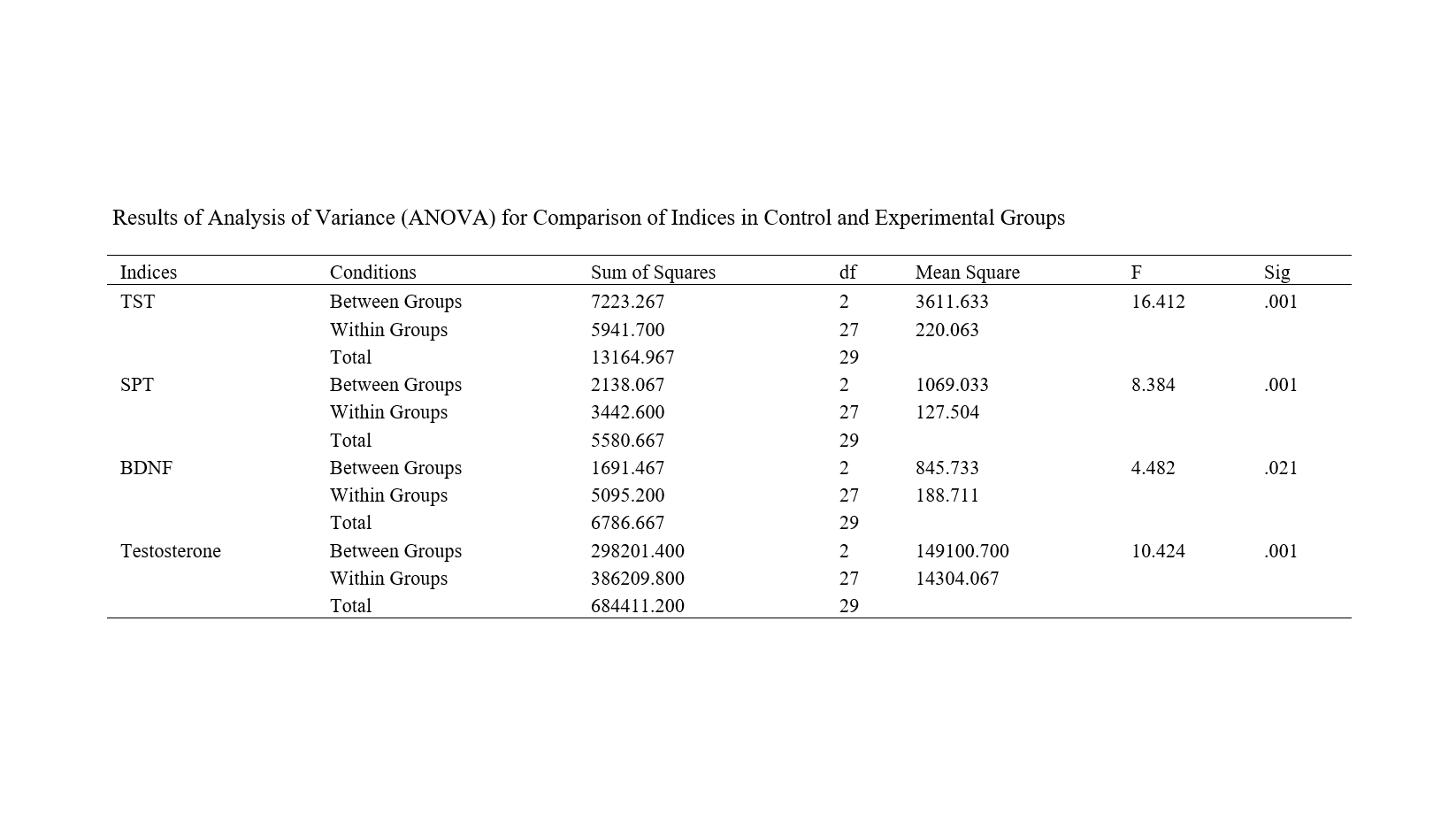
Results: The results showed a significant difference in immobility duration between the control group and the two training groups, as well as between the two training groups (P ≤ 0.05). There was also a significant difference in depression levels between the two training groups and between the long-term training group and the control group (P ≤ 0.05). However, there was no significant difference between the short-term training group and the control group (P ≥ 0.05). Post hoc test results indicated a significant difference in BDNF levels between the control group and the long-term training group (P ≤ 0.05). Furthermore, there was a significant difference in testosterone levels between the control group and both the short-term and long-term training groups (P ≤ 0.05), but no difference between the two training groups (P ≥ 0.05).
Conclusion: Based on the overall results of the study, different training volumes have varying effects on depression and BDNF levels, with long-term training producing greater effects.
Downloads
References
1. Cahuas A, He Z, Zhang Z, Chen W. Relationship of
physical activity and sleep with depression in college students.
Journal of American College Health. 2020;68(5):557-64. [PMID:
30908132] [DOI]
2. Vittengl JR. Does context moderate physical activity's
relations with depression?: A cross-sectional study. Mental Health
and Physical Activity. 2021;20:100374. [DOI]
3. Szuhany KL, Otto MW. Assessing BDNF as a mediator
of the effects of exercise on depression. Journal of Psychiatric
Research. 2020;123:114-8. [PMID: 32065946] [PMCID:
PMC8459326] [DOI]
4. Vu KV, Mitchell P, Dharamdasani Detaram H, Burlutsky
G, Liew G, Gopinath B. Prevalence and risk factors for depressive
symptoms in patients with neovascular age-related macular
degeneration who present for anti-VEGF therapy. Acta
Ophthalmologica. 2021;99(4):e547-e54. [PMID: 32981226] [DOI]
5. Dwivedi Y. Brain-derived neurotrophic factor: role in
depression and suicide. Neuropsychiatric disease and treatment.
2009:433-49. [PMID: 19721723] [PMCID: PMC2732010]
6. Vaynman S, Ying Z, Gomez-Pinilla F. Hippocampal
BDNF mediates the efficacy of exercise on synaptic plasticity and
cognition. European Journal of Neuroscience. 2004;20(10):2580-
90. [PMID: 15548201] [DOI]
7. Kaya HB. Effect of Swimming Exercise in Old Age on
Hopelessness and Depression Levels. African Educational
Research Journal. 2020;8:353-9.
8. Park H-S, Kim T-W, Park S-S, Lee S-J. Swimming
exercise ameliorates mood disorder and memory impairment by
enhancing neurogenesis, serotonin expression, and inhibiting
apoptosis in social isolation rats during adolescence. Journal of
exercise rehabilitation. 2020;16(2):132. [PMID: 32509697]
[PMCID: PMC7248435]
9. Chen Z, Shen X, Tian K, Liu Y, Xiong S, Yu Q, et al.
Bioavailable testosterone is associated with symptoms of
depression in adult men. Journal of International Medical Research.
2020;48(8):0300060520941715. [PMID: 32762464] [PMCID:
PMC7557700] [DOI]
10. Kim NR, David K, Corbeels K, Khalil R, Antonio L,
Schollaert D, et al. Testosterone Reduces Body Fat in Male Mice
by Stimulation of Physical Activity Via Extrahypothalamic ERα
Signaling. Endocrinology. 2021;162(6):bqab045. [PMID:
33674833] [PMCID: PMC8140602] [DOI]
11. Lou S-j, Liu J-y, Chang H, Chen P-j. Hippocampal
neurogenesis and gene expression depend on exercise intensity in
juvenile rats. Brain Research. 2008;1210:48-55. [PMID:
18423578] [DOI]
12. Seifert T, Brassard P, Wissenberg M, Rasmussen P,
Nordby P, Stallknecht B, et al. Endurance training enhances BDNF
release from the human brain. American Journal of PhysiologyRegulatory, Integrative and Comparative Physiology.
2009;298(2):R372-R7. [PMID: 19923361] [DOI]
13. Kowal M, Sorokowski P, Żelaźniewicz A, Nowak J,
Orzechowski S, Żurek A, et al. A positive relationship between
body height and the testosterone response to physical exercise.
Evolution and Human Behavior. 2021;42(3):179-85. [DOI]
14. Krogh J, Saltin B, Gluud C, Nordentoft M. The DEMO
trial: a randomized, parallel-group, observer-blinded clinical trial
of strength versus aerobic versus relaxation training for patients
with mild to moderate depression. Journal of Clinical Psychiatry.
2009;70(6):790. [PMID: 19573478]
15. Shieh PB, Hu S-C, Bobb K, Timmusk T, Ghosh A.
Identification of a Signaling Pathway Involved in Calcium
Regulation of BDNF Expression. Neuron.
1998;20(4):727-40. [PMID: 9581764] [DOI]
16. Currier D, Lindner R, Spittal MJ, Cvetkovski S, Pirkis J,
English DR. Physical activity and depression in men: Increased
activity duration and intensity associated with lower likelihood of
current depression. Journal of Affective Disorders. 2020;260:426-
31. [PMID: 31539676] [DOI]
Downloads
Additional Files
Publication Timeline
Issue
Section
License

This work is licensed under a Creative Commons Attribution-NonCommercial 4.0 International License.