Hydration Status and Self-Esteem as Predictors of Athlete Burnout: A Cross-Sectional Study
DOI:
https://doi.org/10.61838/kman.intjssh.7.3.7Keywords:
Athlete burnout, hydration status, self-esteem, cross-sectional study, sports psychologyAbstract
Objective: This study aims to explore the relationship between athlete burnout, hydration status, and self-esteem. It hypothesizes that both hydration status and self-esteem significantly predict athlete burnout.
Methods and Materials: The study employed a cross-sectional design involving 230 athletes from various sports clubs and institutions. Participants were actively engaged in competitive sports for at least one year, aged between 18 and 35 years, and free from chronic health conditions. Athlete burnout was measured using the Athlete Burnout Questionnaire (ABQ), hydration status was assessed using the Urine Specific Gravity (USG) test, and self-esteem was evaluated using the Rosenberg Self-Esteem Scale (RSES). Data analysis involved Pearson correlation coefficients to assess relationships and multiple linear regression to evaluate predictive values.
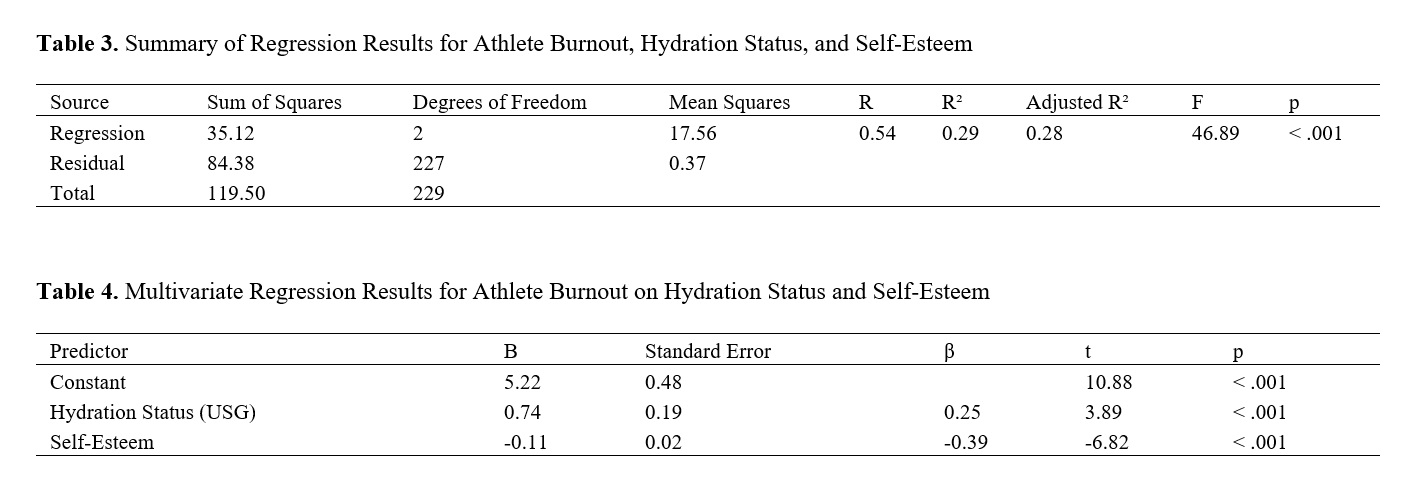
Results: Descriptive statistics indicated a mean score for athlete burnout of 3.10 (SD = 0.65), a mean USG for hydration status of 1.025 (SD = 0.004), and a mean score for self-esteem of 21.85 (SD = 4.72). Correlation analysis showed a positive correlation between athlete burnout and hydration status (r = 0.32, p < .001), a negative correlation between athlete burnout and self-esteem (r = -0.45, p < .001), and a weak negative correlation between hydration status and self-esteem (r = -0.15, p = .021). Regression analysis revealed that hydration status and self-esteem together explained 29% of the variance in athlete burnout, with both being significant predictors.
Conclusion: The findings suggest that higher levels of dehydration and lower self-esteem are associated with increased athlete burnout. Ensuring adequate hydration and fostering self-esteem are crucial for reducing burnout. Interventions should focus on maintaining hydration, enhancing self-esteem, and promoting self-determined motivation.
Downloads
References
1. Lonsdale C, Hodge K, Rose EA. Athlete Burnout in Elite
Sport: A Self-Determination Perspective. Journal of Sports
Sciences. 2009;27(8):785-95. [PMID: 19437185] [DOI]
2. Madigan DJ, Stoeber J, Passfield L. Perfectionism and
Changes in Athlete Burnout Over Three Months: Interactive
Effects of Personal Standards and Evaluative Concerns
Perfectionism. Psychology of Sport and Exercise. 2016;26:32-9.
[PMID: 27383053] [DOI]
3. Madigan DJ, Stoeber J, Passfield L. Motivation Mediates
the Perfectionism–Burnout Relationship: A Three-Wave
Longitudinal Study With Junior Athletes. Journal of Sport and
Exercise Psychology. 2016;38(4):341-54. [DOI]
4. Martin E, Horn TS. The Role of Athletic Identity and
Passion in Predicting Burnout in Adolescent Female Athletes. The
Sport Psychologist. 2013;27(4):338-48. [DOI]
5. Olsson L, Madigan DJ, Hill AP, Grugan M. Do Athlete
and Coach Performance Perfectionism Predict Athlete Burnout?
European Journal of Sport Science. 2021;22(7):1073-84. [PMID:
33840357] [DOI]
6. Barcza-Renner K, Morin AJS, Habeeb CM. Controlling
Coaching Behaviors and Athlete Burnout: Investigating the
Mediating Roles of Perfectionism and Motivation. Journal of Sport
and Exercise Psychology. 2016;38(1):30-44. [PMID: 27018556]
[DOI]
7. Holmberg PM, Sheridan DA. Self-Determined
Motivation as a Predictor of Burnout Among College Athletes. The
Sport Psychologist. 2013;27(2):177-87. [DOI]
8. Hill AP. Perfectionism and Burnout in Junior Soccer
Players: A Test of the 2 × 2 Model of Dispositional Perfectionism.
Journal of Sport and Exercise Psychology. 2013;35(1):18-29.
[PMID: 23404875] [DOI]
9. Choi H, Yunduk J, Kim S-K. The Relationship Between
Coaching Behavior and Athlete Burnout: Mediating Effects of
Communication and the Coach–Athlete Relationship. International
Journal of Environmental Research and Public Health.
2020;17(22):8618. [PMID: 33233544] [PMCID: PMC7699703]
[DOI]
10. Gencer E. The Relationship Between Self-Esteem,
Satisfaction With Life and Coach-Athlete Relationship. Journal of
Educational Issues. 2021;6(2):493. [DOI]
11. Muñoz-Villena AJ, Gómez-López M, GonzálezHernández J. Perfectionism Profiles and Anger Responses: The
Relevant Role of Self-Esteem in Athletes of Professional Quarries.
International Journal of Environmental Research and Public
Health. 2020;17(4):1416. [PMID: 32098354] [PMCID:
PMC7068536] [DOI]
12. Wilczyńska D, Walczak-Kozłowska T, Alarcón D,
Zakrzewska DE, Jaenes JC. Dimensions of Athlete-Coach
Relationship and Sport Anxiety as Predictors of the Changes in
Psychomotor and Motivational Welfare of Child Athletes After the
Implementation of the Psychological Workshops for Coaches.
International Journal of Environmental Research and Public
Health. 2022;19(6):3462. [PMID: 35329149] [PMCID:
PMC8955871] [DOI]
13. Grego F, Vallier J-M, Collardeau M, Rousseu C,
Crémieux J, Brisswalter J. Influence of Exercise Duration and
Hydration Status on Cognitive Function During Prolonged Cycling
Exercise. International Journal of Sports Medicine. 2005;26(1):27-
33. [PMID: 15643531] [DOI]
14. Akhrem A, Gazdowska Z. Analysis of the Athlete
Burnout Phenomenon: The Past, the Present and the Future of
Athlete Burnout Research. Baltic Journal of Health and Physical
Activity. 2016. [DOI]
15. Fan F, Chen J, Chen Y, Li B, Guo L, Shi Y, et al. How
Relationship-Maintenance Strategies Influence Athlete Burnout:
Mediating Roles of Coach–athlete Relationship and Basic
Psychological Needs Satisfaction. Frontiers in Psychology. 2023.
[DOI]
16. Jowett GE, Hill AP, Hall H, Curran T. Perfectionism and
Junior Athlete Burnout: The Mediating Role of Autonomous and
Controlled Motivation. Sport Exercise and Performance
Psychology. 2013;2(1):48-61. [DOI]
17. Morales JC, Arbel R, Dunton GF, Mason TB. The
temporal stability of maternal parenting style and child feeding
practices: A six-wave longitudinal study. Appetite.
2024;195:107231. [PMID: 38246427] [DOI]
18. Sadat Mousavi S, Ebrahimi A. Structural Model of the
Effect of Psychological Capital on Innovative Behavior in
Teaching: The Mediating Role of Conscientiousness Personality
Trait. International Journal of Education and Cognitive Sciences.
2024;4(4):1-10. [DOI]
Downloads
Additional Files
Publication Timeline
Issue
Section
License
Copyright (c) 2024 Erwin A. William, Sefa Bulut, Mehdi Rostami, Sergii Boltivets, Jamel Hajji, Jiantang Yang, Maura McDonnell, Chidinma Chikwe (Author)

This work is licensed under a Creative Commons Attribution-NonCommercial 4.0 International License.