The Impact of the Type of Sport on the Adolescents’ Self-Control
DOI:
https://doi.org/10.61838/kman.intjssh.7.2.7Keywords:
Adolescent, Executive function, psychology, Self-Control, sportsAbstract
Background: Self-control refers to the self-initiated ability to regulate one’s thoughts, emotions, and actions. It plays a crucial role in predicting real-life outcomes. Existing literature highlights self-control as an essential skill that can help individuals achieve their goals and enhance various aspects of their lives.
Objectives: The present study aimed to determine the impact of three different sports—middle-distance running, chess, and kata—on the self-control of adolescents.
Methods and Materials: The study employed a quasi-experimental method with a pretest-posttest control group design. The statistical population consisted of male adolescents aged 13 to 18 in Kermanshah. 48 participants were selected by a purposive sampling method. Subsequently, the sample members were randomly assigned to three intervention groups (middle-distance running, kata, and chess), along with a control group. Before the intervention, a pre-test was conducted. The experimental groups followed specific protocols for each sport over a two-month period, with training sessions held three times a week, each lasting one hour. Post-tests were administered at the end of the intervention, and a follow-up assessment occurred after two weeks. Tthe Tangney, Baumeister, and Boone Self-Control Scale (2004) and a demographic consent form were the research tools.
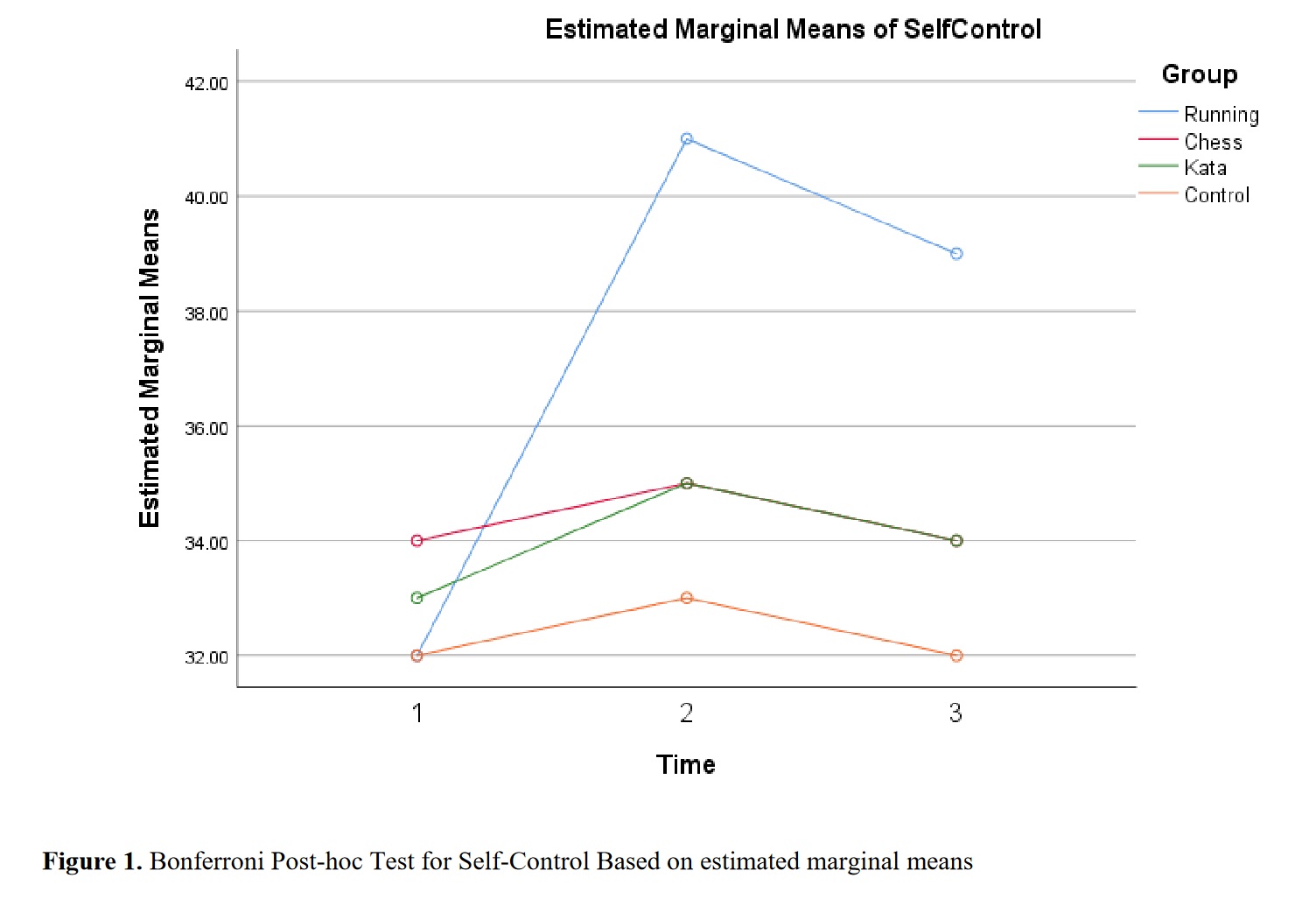
Findings: The study findings indicated significant differences in self-control scores across pre, post, and follow-up time intervals (Wilks’ lambda = 0.311, F(2,43) = 47.65, p < 0.00123). Additionally, there were significant differences in mean self-control scores among the four groups (middle-distance running, chess, kata, and control) (Wilks’ lambda = 0.199, F(9,102.37) = 10.70, p < 0.00000148). Specifically, middle-distance running demonstrated a significant improvement in self-control among adolescents compared to chess and kata (p ≤ 0.05).
Conclusion: Incorporating sports with specific demands, especially middle-distance running, can be an effective intervention for enhancing self-control among adolescents. Engaging in middle-distance running positively impacts self-control, offering young individuals an avenue to develop this essential skill.
Downloads
References
1. Liew J. Effortful Control, Executive Functions, and
Education: Bringing Self-Regulatory and Social-Emotional
Competencies to the Table. Child Development Perspectives.
2012;6(2):105-11. [DOI]
2. Kordnoghabi R, Rashid K, Bayat A. The effect of
training the techniques of first, second, and third waves of
psychotherapy on the self-control of students. Feyz Medical
Sciences Journal. 2019;23(2):125-34.
3. Duckworth AL, Taxer JL, Eskreis-Winkler L, Galla BM,
Gross JJ. Self-Control and Academic Achievement. Annual
Review of Psychology. 2019;70(Volume 70, 2019):373-99.
[PMID: 30609915] [DOI]
4. Duckworth AL, Kern ML. A meta-analysis of the
convergent validity of self-control measures. Journal of Research
in Personality. 2011;45(3):259-68. [PMID: 21643479] [PMCID:
PMC3105910] [DOI]
5. Incekara-Hafalir E, Linardi S. Awareness of low selfcontrol: Theory and evidence from a homeless shelter. Journal of
Economic Psychology. 2017;61:39-54. [DOI]
6. Manuel Sofia R, Cruz JFA. Self-control as a mechanism
for controlling aggression: A study in the context of sport
competition. Personality and Individual Differences. 2015;87:302-
6. [DOI]
7. Moffitt TE, Arseneault L, Belsky D, Dickson N, Hancox
RJ, Harrington H, et al. A gradient of childhood self-control
predicts health, wealth, and public safety. Proceedings of the
National Academy of Sciences. 2011;108(7):2693-8. [PMID:
21262822] [PMCID: PMC3041102] [DOI]
8. Rocheleau GC. Religious bonds, low self-control, and
deviant behavior: a fixed-effects approach. Criminal Justice
Studies. 2021;34(2):235-50. [DOI]
9. Chan DKC, Lentillon-Kaestner V, Dimmock JA,
Donovan RJ, Keatley DA, Hardcastle SJ, et al. Self-Control SelfRegulation, and Doping in Sport: A Test of the Strength-Energy
Model. Journal of Sport and Exercise Psychology. 2015;37(2):199-
206. [PMID: 25996110] [DOI]
10. Englert C. Ego depletion in sports: highlighting the
importance of self-control strength for high-level sport
performance. Current Opinion in Psychology. 2017;16:1-5.
[PMID: 28813329] [DOI]
11. Mischel W, Shoda Y, Rodriguez ML. Delay of
Gratification in Children. Science. 1989;244(4907):933-8. [PMID:
2658056] [DOI]
12. Friese M, Frankenbach J, Job V, Loschelder DD. Does
Self-Control Training Improve Self-Control? A Meta-Analysis.
Perspectives on Psychological Science. 2017;12(6):1077-99.
[PMID: 28846503] [DOI]
13. Baumeister RF, Vohs KD, Tice DM. The Strength Model
of Self-Control. Current Directions in Psychological Science.
2007;16(6):351-5. [DOI]
14. Piquero AR, Jennings WG, Farrington DP, Diamond B,
Gonzalez JMR. A meta-analysis update on the effectiveness of
early self-control improvement programs to improve self-control
and reduce delinquency. Journal of Experimental Criminology.
2016;12(2):249-64. [DOI]
15. Pesce C, Lakes KD, Stodden DF, Marchetti R. Fostering
Self-Control Development With a Designed Intervention in
Physical Education: A Two-Year Class-Randomized Trial. Child
Development. 2021;92(3):937-58. [PMID: 32840871] [DOI]
16. Xiang M-Q, Liao J-W, Huang J-H, Deng H-L, Wang D,
Xu Z, et al. Effect of a Combined Exercise and Dietary Intervention
on Self-Control in Obese Adolescents. Frontiers in Psychology.
2019;10. [PMID: 31316417] [PMCID: PMC6610291] [DOI]
17. Zou Z, Liu Y, Xie J, Huang X. Aerobic Exercise As a
Potential Way to Improve Self-Control after Ego-Depletion in
Healthy Female College Students. Frontiers in Psychology. 2016;7.
[PMID: 27148113] [PMCID: PMC4834755] [DOI]
18. Biddle SJH, Asare M. Physical activity and mental health
in children and adolescents: a review of reviews. British Journal of
Sports Medicine. 2011;45(11):886-95. [PMID: 21807669] [DOI]
19. Hillman CH, Pontifex MB, Castelli DM, Khan NA,
Raine LB, Scudder MR, et al. Effects of the FITKids Randomized
Controlled Trial on Executive Control and Brain Function.
Pediatrics. 2014;134(4):e1063-e71. [PMID: 25266425] [PMCID:
PMC4179093] [DOI]
20. Best JR. Effects of physical activity on children’s
executive function: Contributions of experimental research on
aerobic exercise. Developmental Review. 2010;30(4):331-51.
[PMID: 21818169] [PMCID: PMC3147174] [DOI]
21. Krenn B, Finkenzeller T, Würth S, Amesberger G. Sport
type determines differences in executive functions in elite athletes.
Psychology of Sport and Exercise. 2018;38:72-9. [DOI]
22. Lubans D, Richards J, Hillman C, Faulkner G,
Beauchamp M, Nilsson M, et al. Physical Activity for Cognitive
and Mental Health in Youth: A Systematic Review of Mechanisms.
Pediatrics. 2016;138(3):e20161642. [PMID: 27542849] [DOI]
23. Tangney JP, Boone AL, Baumeister RF. High selfcontrol predicts good adjustment, less pathology, better grades, and
interpersonal success: Routledge; 2018. 173-212 p
24. Mousavimoghadam SR, Houri S, Omidi A, Zahirikhah
N. Evaluation of relationship between intellectual intelligence and
self-control, and defense mechanisms in the third year of secondary
school girls. Medical Science Journal of Islamic Azad UnivesityTehran Medical Branch. 2015;25(1):59-64.
25. Wang C-H, Chang C-C, Liang Y-M, Shih C-M, Chiu WS, Tseng P, et al. Open vs. Closed Skill Sports and the Modulation
of Inhibitory Control. PLOS ONE. 2013;8(2):e55773. [PMID:
23418458] [PMCID: PMC3572130] [DOI]
26. Boat R, Cooper SB. Self-Control and Exercise: A Review
of the Bi-Directional Relationship. Brain Plasticity. 2019;5:97-104.
[PMID: 31970063] [PMCID: PMC6971834] [DOI]
27. Ghorbanzadeh B, Ghorbanian B, Yavari Y, Lotfi M,
Shamiry M, Razmandi F, et al. Effect of Physical Activity on Body
Mass Index and some Physical Fitness Factors in Addicted Women.
Journal of Health Promotion Management. 2017;6(2):43-9. [DOI]
28. Hofmann W, Kotabe H. A General Model of Preventive
and Interventive Self-Control. Social and Personality Psychology
Compass. 2012;6(10):707-22. [DOI]
29. Duckworth AL, Gendler TS, Gross JJ. Situational
Strategies for Self-Control. Perspectives on Psychological Science.
2016;11(1):35-55. [PMID: 26817725] [PMCID: PMC4736542]
[DOI]
Downloads
Additional Files
Publication Timeline
Issue
Section
License
Copyright (c) 2024 Sadegh Ranjbar, Mehdi Shahbazi, Reza Rostami, Fazlollah Bagherzadeh (Author)

This work is licensed under a Creative Commons Attribution-NonCommercial 4.0 International License.