The Impact of Performance Fatigue on Visual Perception, Concentration, and Reaction Time in Professional Female Volleyball Players
DOI:
https://doi.org/10.61838/kman.intjssh.7.2.5Keywords:
Performance fatigue , visual perception, concentration , reaction time, professional volleyball playersAbstract
Objective: This study aimed to investigate the impact of performance fatigue on visual perception, concentration, and reaction time among professional female volleyball players.
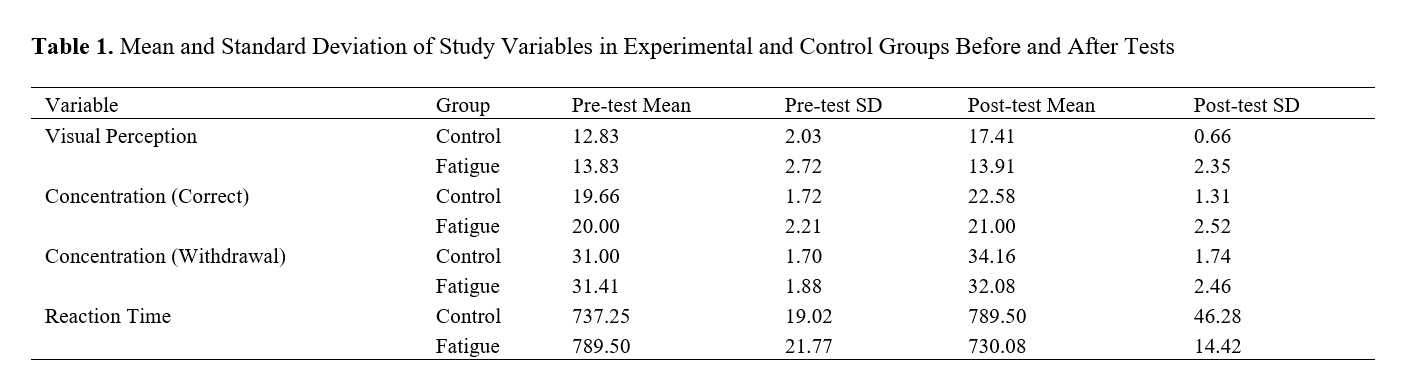
Methods and Materials: The study population consisted of all professional female volleyball players in Qazvin province, with a purposive sampling method employed. A total of 24 eligible volleyball players were voluntarily selected and randomly divided into experimental and control groups. Variables such as visual perception, concentration, and reaction time were assessed as psychomotor variables. The Universal Viena test battery was used to measure these variables. The Shaw training method was employed in the study to induce performance fatigue. Factorial analysis of variance was utilized for data analysis.
Results: The findings indicated that performance fatigue significantly affected the components of visual perception, concentration, and reaction time in professional female volleyball players (p ≤ 0.05).
Conclusion: As observed, fatigue can cause disturbances in psychomotor components such as visual perception, concentration, and reaction time. Therefore, it is essential that training under fatigue conditions be considered by coaches to enhance the psychomotor capacities of athletes.
Downloads
References
1. Enoka RR, Duchateau J. Translating Fatigue to Human
Performance. Medicine & Science in Sports & Exercise. 2016.
[PMID: 27015386] [PMCID: PMC5035715] [DOI]
2. Faghfouriazar M. The Effectiveness of Selected
Perceptual-Motor Exercises on Working Memory and Quality of
Life of Elderly Women. Aging Psychology. 2023;9(3):310-293.
3. Honda J, Chang SH, Kim K-J. The Effects of Vision
Training, Neck Musculature Strength, and Reaction Time on
Concussions in an Athletic Population. Journal of Exercise
Rehabilitation. 2018. [PMID: 30443514] [PMCID: PMC6222152]
[DOI]
4. Barkley RA. Sluggish cognitive tempo (concentration
deficit disorder?): Current status, future directions, and a plea to
change the name. Journal of abnormal child psychology.
2014;42:117-25. [PMID: 24234590] [DOI]
5. Taheri M, Valayi F. Aerobic Exercise Improves
Attention and Quality of Sleep Among Professional Volleyball
Players. Sleep and Hypnosis. 2018. [DOI]
6. Trecroci A, Duca M, Cavaggioni L, Rossi A, Scurati R,
Longo S, et al. Relationship Between Cognitive Functions and
Sport-Specific Physical Performance in Youth Volleyball Players.
Brain Sciences. 2021. [PMID: 33673260] [PMCID: PMC7917811]
[DOI]
7. Ortelli P, Ferrazzoli D, Sebastianelli L, Engl M,
Romanello R, Nardone R, et al. Neuropsychological and
Neurophysiological Correlates of Fatigue in Post-Acute Patients
With Neurological Manifestations of COVID-19: Insights Into a
Challenging Symptom. Journal of the Neurological Sciences. 2021.
[PMID: 33359928] [PMCID: PMC7834526] [DOI]
8. Zwierko M, Jedziniak W, Popowczak M, Rokita A.
Reactive Agility in Competitive Young Volleyball Players: A
Gender Comparison of Perceptual-Cognitive and Motor
Determinants. Journal of Human Kinetics. 2022. [PMID:
36643830] [PMCID: PMC9808806] [DOI]
9. Halson SL. Monitoring Training Load to Understand
Fatigue in Athletes. Sports Medicine. 2014. [PMID: 25200666]
[PMCID: PMC4213373] [DOI]
10. Schiphof-Godart L, Roelands B, Hettinga FJ. Drive in
Sports: How Mental Fatigue Affects Endurance Performance.
Frontiers in Psychology. 2018. [PMID: 30174627] [PMCID:
PMC6107844] [DOI]
11. Guan Y, Bredin SSD, Jiang Q, Taunton J, Li Y, Wu N,
Wu L. The Effect of Fatigue on Asymmetry Between Lower Limbs
in Functional Performances in Elite Child Taekwondo Athletes.
Journal of Orthopaedic Surgery and Research. 2021. [DOI]
12. Sun H, Soh KG, Roslan S, Mohd Rozilee Wazir Norjali
W. Does Mental Fatigue Affect Skilled Performance in Athletes?
A Systematic Review. Plos One. 2021. [PMID: 34648555]
[PMCID: PMC8516214] [DOI]
13. Hadžić V, Sattler T, Veselko M, Marković G, Dervišević
E. Strength Asymmetry of the Shoulders in Elite Volleyball
Players. Journal of Athletic Training. 2014. [PMID: 24673238]
[PMCID: PMC4080589] [DOI]
14. Kölling S, Duffield R, Erlacher D, Venter R, Halson SL.
Sleep-Related Issues for Recovery and Performance in Athletes.
International Journal of Sports Physiology and Performance. 2019.
[PMID: 29651858] [DOI]
15. Rattray B, Argus CK, Martin K, Northey JM, Driller
MW. Is It Time to Turn Our Attention Toward Central Mechanisms
for Post-Exertional Recovery Strategies and Performance?
Frontiers in Physiology. 2015. [PMID: 25852568] [PMCID:
PMC4362407] [DOI]
Downloads
Additional Files
Publication Timeline
Issue
Section
License
Copyright (c) 2024 Fariba Valaei, Jaleh Bagherli, Morteza Taheri (Author)

This work is licensed under a Creative Commons Attribution-NonCommercial 4.0 International License.