The Effect of Various Types of Exercise on Gut Microbiota: A Systematic Review
DOI:
https://doi.org/10.61838/kman.intjssh.7.2.3Keywords:
Combined Training, Resistance Training, Aerobic Exercise, Exercise, Gut MicrobiotaAbstract
Objective: Gut microbiota composition plays a pivotal role in health and emerging evidence supports the ability of exercise training programs to alter the gut microbiota’s composition and function, which could counteract dysbiosis and the effects of chronic diseases. This study aims to investigate the effectiveness of different exercise methods on the composition of intestinal microbiota.
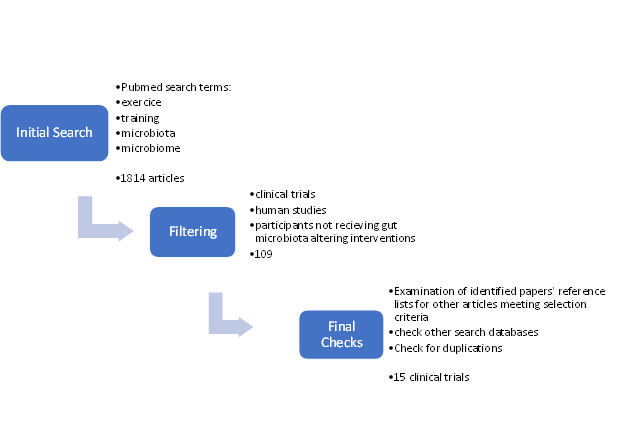
Methods: We searched for published peer-reviewed articles in PubMed and Google Scholar databases up until January 2023. We searched using the terms "exercise", "education", "microbiome" and "microbiota".
Results: By electronic search until January 2023 in the databases with keywords made in Mesh by mentioning Title/Abstract, several 1814 articles were collected. By repeating and performing filtering at each stage, 15 clinical trials were finally left in the study. The results showed varying degrees of efficacy and high inter-individual variations. In conclusion, the baseline microbiome profile was shown to have a decisive role in microbiome responsiveness to training intervention and training dose and duration seem to be a determining factor in all exercise modalities.
Conclusion: In general, can be said that exercise can balance GM. More importantly, exercise is proposed to present a stressor to the gut that stimulates beneficial adaptations and improves long-term gut barrier flexibility over time through regular physical activity. It seems that the GM changes caused by aerobic exercise are reversible after returning to a sedentary lifestyle. Therefore, it is recommended that exercise initially causes a disrupts in GM that, with continued exercise and thus adaptation, revenues to the pre-exercise state.
Downloads
References
1. Fava F, Rizzetto L, Tuohy KM. Gut microbiota and
health: connecting actors across the metabolic system. Proceedings
of the Nutrition Society. 2019;78(2):177-88. [PMID: 30561288]
[DOI]
2. Morita E, Yokoyama H, Imai D, Takeda R, Ota A, Kawai
E, et al. Aerobic Exercise Training with Brisk Walking Increases
Intestinal Bacteroides in Healthy Elderly Women. Nutrients.
2019;11(4):868. [PMID: 30999699] [PMCID: PMC6520866]
[DOI]
3. Resende AS, Leite GSF, Lancha Junior AH. Changes in
the Gut Bacteria Composition of Healthy Men with the Same
Nutritional Profile Undergoing 10-Week Aerobic Exercise
Training: A Randomized Controlled Trial. Nutrients.
2021;13(8):2839. [PMID: 34444999] [PMCID: PMC8398245]
[DOI]
4. Kern T, Blond MB, Hansen TH, Rosenkilde M, Quist JS,
Gram AS, et al. Structured exercise alters the gut microbiota in
humans with overweight and obesity—A randomized controlled
trial. International journal of obesity. 2020;44(1):125-35. [PMID:
31467422] [DOI]
5. Vianna J, Lima J, Saavedra F, Reis V. Aerobic and
anaerobic energy during resistance exercise at 80% 1RM. Journal
of human kinetics. 2011;29(Special-Issue):69-74. [PMID:
23487002] [PMCID: PMC3588899] [DOI]
6. Bycura D, Santos AC, Shiffer A, Kyman S, Winfree K,
Sutliffe J, et al. Impact of Different Exercise Modalities on the
Human Gut Microbiome. Sports. 2021;9(2):14. [PMID: 33494210]
[PMCID: PMC7909775] [DOI]
7. Mach N, Fuster-Botella D. Endurance exercise and gut
microbiota: A review. Journal of Sport and Health Science.
2017;6(2):179-97. [PMID: 30356594] [PMCID: PMC6188999]
[DOI]
8. Motiani KK, Collado MC, Eskelinen J-J, Virtanen KA,
LÖYttyniemi E, Salminen S, et al. Exercise Training Modulates
Gut Microbiota Profile and Improves Endotoxemia. Medicine &
Science in Sports & Exercise. 2020;52(1). [PMID: 31425383]
[PMCID: PMC7028471] [DOI]
9. Zhao X, Zhang Z, Hu B, Huang W, Yuan C, Zou L.
Response of Gut Microbiota to Metabolite Changes Induced by
Endurance Exercise. Frontiers in Microbiology. 2018;9. [PMID:
29731746] [PMCID: PMC5920010] [DOI]
10. Liu Y, Wang Y, Ni Y, Cheung CKY, Lam KSL, Wang
Y, et al. Gut Microbiome Fermentation Determines the Efficacy of
Exercise for Diabetes Prevention. Cell Metabolism. 2020;31(1):77-
91.e5. [PMID: 31786155] [DOI]
11. Shahar RT, Koren O, Matarasso S, Shochat T, Magzal F,
Agmon M. Attributes of physical activity and gut microbiome in
adults: a systematic review. International journal of sports
medicine. 2020;41(12):801-14. [PMID: 32455454] [DOI]
12. Kim SY, Kim KN, Kim DW, Kang MS. Reporting
Quality Analysis of Randomized Controlled Trials in Journal of
Neurosurgical Anesthesiology: A Methodological Assessment.
Journal of Neurosurgical Anesthesiology. 2021;33(2). [PMID:
31702588] [DOI]
13. Barton W, Penney NC, Cronin O, Garcia-Perez I, Molloy
MG, Holmes E, et al. The microbiome of professional athletes
differs from that of more sedentary subjects in composition and
particularly at the functional metabolic level. Gut. 2018;67(4):625-
33.
14. Cronin O, Barton W, Skuse P, Penney NC, Garcia-Perez
I, Murphy EF, et al. A Prospective Metagenomic and Metabolomic
Analysis of the Impact of Exercise and/or Whey Protein
Supplementation on the Gut Microbiome of Sedentary Adults.
mSystems. 2018;3(3):10.1128/msystems.00044-18. [PMID:
29719871] [PMCID: PMC5915698] [DOI]
15. Dupuit M, Rance M, Morel C, Bouillon P, Boscaro A,
Martin V, et al. Effect of concurrent training on body composition
and gut microbiota in postmenopausal women with overweight or
obesity. Med Sci Sports Exerc. 2022;54(3):517-29. [PMID:
34628447] [DOI]
16. Durk RP, Castillo E, Márquez-Magaña L, Grosicki GJ,
Bolter ND, Lee CM, Bagley JR. Gut Microbiota Composition is
Related to Cardiorespiratory Fitness in Healthy. International
Journal of Sport Nutrition and Exercise Metabolism.
17. Taniguchi H, Tanisawa K, Sun X, Kubo T, Hoshino Y,
Hosokawa M, et al. Effects of short-term endurance exercise on gut
microbiota in elderly men. Physiological Reports.
2018;6(23):e13935. [PMID: 30536648] [PMCID: PMC6286434]
[DOI]
18. Donati Zeppa S, Amatori S, Sisti D, Gervasi M, Agostini
D, Piccoli G, et al. Nine weeks of high-intensity indoor cycling
training induced changes in the microbiota composition in nonathlete healthy male college students. Journal of the International
Society of Sports Nutrition. 2021;18(1):74. [PMID: 34922581]
[PMCID: PMC8684107] [DOI]
19. Rettedal EA, Cree JME, Adams SE, MacRae C,
Skidmore PML, Cameron-Smith D, et al. Short-term high-intensity
interval training exercise does not affect gut bacterial community
diversity or composition of lean and overweight men. Experimental
Physiology. 2020;105(8):1268-79. [PMID: 32478429] [DOI]
20. Zhong F, Wen X, Yang M, Lai H-Y, Momma H, Cheng
L, et al. Effect of an 8-week exercise training on gut microbiota in
physically inactive older women. International Journal of Sports
Medicine. 2021;42(07):610-23. [PMID: 33321523] [DOI]
21. Erlandson KM, Liu J, Johnson R, Dillon S, Jankowski
CM, Kroehl M, et al. An exercise intervention alters stool
microbiota and metabolites among older, sedentary adults.
Therapeutic Advances in Infectious Disease.
2021;8:20499361211027067. [PMID: 34262758] [PMCID:
PMC8246564] [DOI]
22. Pan B, Ge L, Xun Y-q, Chen Y-j, Gao C-y, Han X, et al.
Exercise training modalities in patients with type 2 diabetes
mellitus: a systematic review and network meta-analysis.
International Journal of Behavioral Nutrition and Physical Activity.
2018;15(1):72. [PMID: 30045740] [PMCID: PMC6060544] [DOI]
23. Munukka E, Ahtiainen JP, Puigbó P, Jalkanen S, Pahkala
K, Keskitalo A, et al. Six-Week Endurance Exercise Alters Gut
Metagenome That Is not Reflected in Systemic Metabolism in
Over-weight Women. Frontiers in Microbiology. 2018;9. [PMID:
30337914] [PMCID: PMC6178902] [DOI]
24. Montero D, Lundby C. Refuting the myth of non‐
response to exercise training:‘non‐responders’ do respond to higher
dose of training. The Journal of physiology. 2017;595(11):3377-
87. [PMID: 28133739] [PMCID: PMC5451738] [DOI]
25. Moitinho-Silva L, Wegener M, May S, Schrinner F,
Akhtar A, Boysen TJ, et al. Short-term physical exercise impacts
on the human holobiont obtained by a randomised intervention
study. BMC microbiology. 2021;21(1):162. [PMID: 34078289]
[PMCID: PMC8170780] [DOI]
26. Allen JM, Mailing LJ, Niemiro GM, Moore R, Cook MD,
White BA, et al. Exercise alters gut microbiota composition and
function in lean and obese humans. Med Sci Sports Exerc.
2018;50(4):747-57. [PMID: 29166320] [DOI]
27. Cook MD, Allen JM, Pence BD, Wallig MA, Gaskins
HR, White BA, Woods JA. Exercise and gut immune function:
evidence of alterations in colon immune cell homeostasis and
microbiome characteristics with exercise training. Immunology &
Cell Biology. 2016;94(2):158-63. [PMID: 26626721] [DOI]
28. Cataldi S, Poli L, Şahin FN, Patti A, Santacroce L,
Bianco A, et al. The Effects of Physical Activity on the Gut
Microbiota and the Gut–Brain Axis in Preclinical and Human
Models: A Narrative Review. Nutrients. 2022;14(16):3293.
[PMID: 36014798] [PMCID: PMC9413457] [DOI]
29. Quiroga R, Nistal E, Estébanez B, Porras D, JuárezFernández M, Martínez-Flórez S, et al. Exercise training modulates
the gut microbiota profile and impairs inflammatory signaling
pathways in obese children. Experimental & Molecular Medicine.
2020;52(7):1048-61. [PMID: 32624568] [PMCID: PMC8080668]
[DOI]
30. Donati Zeppa S, Sisti D, Amatori S, Gervasi M, Agostini
D, Piccoli G, et al. High-intensity interval training promotes the
shift to a health-supporting dietary pattern in young adults.
Nutrients. 2020;12(3):843. [PMID: 32245173] [PMCID:
PMC7146399] [DOI]
31. Methenitis S. A brief review on concurrent training: from
laboratory to the field. Sports. 2018;6(4):127. [PMID: 30355976]
[PMCID: PMC6315763] [DOI]
Downloads
Additional Files
Publication Timeline
Issue
Section
License
Copyright (c) 2024 Mohammadreza Rabiee, Masoumeh Sadat Mousavi (Author)

This work is licensed under a Creative Commons Attribution-NonCommercial 4.0 International License.