Effect of Three Months Specific Training on Physical Capacities of Iraq Futsal Players
DOI:
https://doi.org/10.61838/kman.intjssh.6.1.3Keywords:
Team Sport, Athletic Performance, Iraq, SeasonAbstract
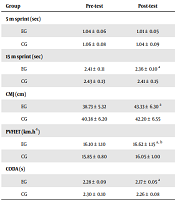
Background: Futsal is a high-intensity team sport taxing both the aerobic and the anaerobic pathways. Thus, this sport requires the development of some specific physical capacities such as: Sprinting, jumping, agility and endurance. Objectives: Examine the effect of three months specific training on physical capacities (speed, explosive strength, agility and endurance) of Iraq futsal players. Methods: Twenty males’ professional futsal players (age: 19.73 ± 1.1 years, height: 172 ± 4.2 cm; body mass: 55.3 ± 8.9 kg) were divided into an experimental group (EG; n = 10) and a control group (CG; n = 10). Participants were selected from a first division team in Iraq. Before and after three months of specific training (at the pre-season phase), 5m and 15m sprint, counter movement jump (CMJ), change of direction [505 agility test (CODA)] and futsal intermittent endurance (FIET) tests were realized. During the three months, the CG continue their usual training and the EG used plyometric as well as technical and physical exercises. Results: For the sprint performance, although no-significant difference was reported between pre- and post-training for the 5 m sprint, the 15 m sprint performance was better at post- compared to pre-training (P < 0.05) for the EG. For jumping performance, CMJ was higher at post- compared to pre-training (P < 0.05) for the EG. Likewise, for agility and endurance, CODA performance and peak velocity during the FIET test were better at post- compared to pre-training (P < 0.05) for the EG. However, except a better performance for 15m sprint and peak velocity during the FIET test for the EG compared to CG at post-training (P < 0.05), no-significant differences were reported between pre- and post-training for the CG and between the two groups at pre- and post-training. Conclusions: In the light of these data, results have shown that improvement in physical capacities take into consideration the characteristics of futsal during training.Downloads
References
1. Rodrigues VM, Ramos GP, Mendes TT, Cabido CE, Melo ES,
Condessa LA, et al. Intensity of official futsal matches. J
Strength Cond Res. 2011;25(9):2482–7. [PubMed ID: 21869629].
https://doi.org/10.1519/JSC.0b013e3181fb4574.
2. Alvarez JC, D’Ottavio S, Vera JG, Castagna C. Aerobic
fitness in futsal players of different competitive level. J
Strength Cond Res. 2009;23(7):2163–6. [PubMed ID: 19855347].
https://doi.org/10.1519/JSC.0b013e3181b7f8ad.
3. Barbero-Alvarez JC, Soto VM, Barbero-Alvarez V, Granda-Vera
J. Match analysis and heart rate of futsal players during
competition. J Sports Sci. 2008;26(1):63–73. [PubMed ID: 17899472].
https://doi.org/10.1080/02640410701287289.
4. Roxburgh A. The technician futsal. Newsletter for coaches, UEFA. 2008.
5. Castagna C, D’Ottavio S, Granda Vera J, Barbero Alvarez
JC. Match demands of professional Futsal: A case study.
J Sci Med Sport. 2009;12(4):490–4. [PubMed ID: 18554983].
https://doi.org/10.1016/j.jsams.2008.02.001.
6. Nogueira FA, de Freitas VH, Nogueira RA, Miloski B, Werneck FZ,
Bara-Filho MG. Improvement of physical performance, hormonal
profile, recovery-stress balance and increase of muscle damage
in a specific futsal pre-season planning. Rev Andal Med Deporte.
2018;11(2):63–8. https://doi.org/10.1016/j.ramd.2015.11.008.
7. Zambak O. Evaluation of the Physical Capacities of Pre-Season ¨
and End-Season Futsal Players. J Educ Issues. 2020;6(1).
https://doi.org/10.5296/jei.v6i1.16993.
8. Matzenbacher F, Pasquarelli BN, Rabelo FN, Dourado AC,
Durigan JZ, Rossi HG, et al. Adaptations in the physical
capacities of U-18 futsal athletes during a competitive
season. Rev Bras Cineantropom Desempenho Hum. 2015;18(1).
https://doi.org/10.5007/1980-0037.2016v18n1p50.
9. Yanci J, Los Arcos A, Mendiguchia J, Brughelli M. Relationships
between sprinting, agility, one-and two-leg vertical and horizontal
jump in soccer players. Kinesiology. 2014;46(2):194–201.
10. Corte JD, Pereira WLM, Corrˆea EELS, de Oliveira JGM, Lima BLP,
de Castro JBP, et al. Influence of power and maximal strength
training on thermal reaction and vertical jump performance in
Brazilian basketball players: A preliminary study. Biomed Hum Kinet.
2020;12(1):91–100. https://doi.org/10.2478/bhk-2020-0012.
11. Alvarez J, Gim ´ ´enez L, Corona P, Manonelles P. Cardiovascular and
metabolic necessities of indoor football: Analysis of the competition.
Apunts Phys Educ Sports. 2002;67:45.
12. de Freitas VH, Miloski B, Bara Filho MG. [Quantification of training
load using session rpe method and performance in futsal].
Rev Bras Cineantropom Desempenho Hum. 2012;14(1). Portuguese.
https://doi.org/10.5007/1980-0037.2012v14n1p73.
13. Miloski B, de Freitas VH, Nakamura FY, de AF, Bara-Filho MG. Seasonal
Training Load Distribution of Professional Futsal Players: Effects
on Physical Fitness, Muscle Damage and Hormonal Status. J
Strength Cond Res. 2016;30(6):1525–33. [PubMed ID: 26605808].
https://doi.org/10.1519/jsc.0000000000001270.
14. Gorostiaga EM, Llodio I, Ib´anez J, Granados C, Navarro I, Ruesta M, ˜
et al. Differences in physical fitness among indoor and outdoor
elite male soccer players. Eur J Appl Physiol. 2009;106(4):483–91.
[PubMed ID: 19322582]. https://doi.org/10.1007/s00421-009-1040-7.
15. Silva JFD, Detanico D, Floriano LT, Dittrich N, Nascimento PC, Santos S,
et al. [Levels of muscle power in soccer and futsal athletes of different
categories and positions]. Motricidade. 2012;8(1):233. Portuguese.
16. Loturco I, Pereira LA, Kobal R, Zanetti V, Gil S, Kitamura K,
et al. Half-squat or jump squat training under optimum
power load conditions to counteract power and speed
decrements in Brazilian elite soccer players during the
preseason. J Sports Sci. 2015;33(12):1283–92. [PubMed ID: 25772972].
https://doi.org/10.1080/02640414.2015.1022574.
17. Meckel Y, Doron O, Eliakim E, Eliakim A. Seasonal Variations in
Physical Fitness and Performance Indices of Elite Soccer Players.
Sports (Basel). 2018;6(1). [PubMed ID: 29910318]. [PubMed Central ID:
PMC5969193]. https://doi.org/10.3390/sports6010014.
18. Loturco I, Contreras B, Kobal R, Fernandes V, Moura N, Siqueira F,
et al. Vertically and horizontally directed muscle power exercises:
Relationships with top-level sprint performance. PLoS One. 2018;13(7).
e0201475. [PubMed ID: 30048538]. [PubMed Central ID: PMC6062113].
https://doi.org/10.1371/journal.pone.0201475.
19. Freitas TT, Pereira LA, Alcaraz PE, Arruda AFS, Guerriero A, Azevedo
P, et al. Influence of Strength and Power Capacity on Change of
Direction Speed and Deficit in Elite Team-Sport Athletes. J Hum
Kinet. 2019;68:167–76. [PubMed ID: 31531142]. [PubMed Central ID:
PMC6724583]. https://doi.org/10.2478/hukin-2019-0069.
20. Svensson M, Drust B. Testing soccer players. J
Sports Sci. 2005;23(6):601–18. [PubMed ID: 16195009].
https://doi.org/10.1080/02640410400021294.
21. Matos J, Aidar FJ, Mendes RR, Lomeu LM, Santos CA, Pains R, et al.
Acceleration capacity in futsal and soccer players. Fit Performance J.
2008;7(4):224–8. https://doi.org/10.3900/fpj.7.4.224.e.
22. Dogramaci SN, Watsford ML, Murphy AJ. Time-motion
analysis of international and national level futsal. J
Strength Cond Res. 2011;25(3):646–51. [PubMed ID: 20543744].
https://doi.org/10.1519/JSC.0b013e3181c6a02e.
23. Travassos B, Araujo D, Vilar L, McGarry T. Interpersonal
coordination and ball dynamics in futsal (indoor football).
Hum Mov Sci. 2011;30(6):1245–59. [PubMed ID: 21683464].
https://doi.org/10.1016/j.humov.2011.04.003.
24. Ayarra R, Nakamura FY, Iturricastillo A, Castillo D, Yanci J. Differences
in Physical Performance According to the Competitive Level in Futsal
Players. J Hum Kinet. 2018;64:275–85. [PubMed ID: 30429918]. [PubMed
Central ID: PMC6231331]. https://doi.org/10.1515/hukin-2017-0201.
25. Maio Alves JM, Rebelo AN, Abrantes C, Sampaio J. Short-term effects
of complex and contrast training in soccer players’ vertical jump,
sprint, and agility abilities. J Strength Cond Res. 2010;24(4):936–41.
[PubMed ID: 20300035]. https://doi.org/10.1519/JSC.0b013e3181c7c5fd.
26. Maulder P, Cronin J. Horizontal and vertical jump
assessment: reliability, symmetry, discriminative and
predictive ability. Physical Therapy in Sport. 2005;6(2):74–82.
https://doi.org/10.1016/j.ptsp.2005.01.001.
27. Ramirez-Campillo R, Gonzalez-Jurado JA, Martinez C, Nakamura
FY, Penailillo L, Meylan CM, et al. Effects of plyometric training
and creatine supplementation on maximal-intensity exercise and
endurance in female soccer players. J Sci Med Sport. 2016;19(8):682–7.
[PubMed ID: 26778661]. https://doi.org/10.1016/j.jsams.2015.10.005.
Downloads
Additional Files
Publication Timeline
Issue
Section
License

This work is licensed under a Creative Commons Attribution-NonCommercial 4.0 International License.