Effect of Wearing the Elevation Training Mask on Physiological Performance in Elite Kayaking Girls
DOI:
https://doi.org/10.61838/kman.intjssh.4.2.7Keywords:
Airflow Restriction, Physical Exercise, Respiratory Muscle Training, Endurance PerformanceAbstract
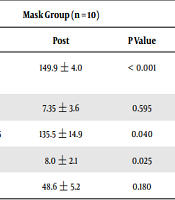
Background: The elevation training mask 2.0 (ETM) has been introduced as a novel tool to allow for respiratory muscle training and altitude exposure during exercise that can improve performance and hematological markers in elite and well-trained athletes. Objectives: The purpose of the present study was to examine the effect of wearing ETM while performing exercise training on erythropoietin (EPO), vascular endothelial growth factor (VEGF), peak oxygen consumption (VO2max), lactate, and 1000-m kayaking performance in elite Kayaking girls. Methods: Thirty elite Kayaking girls (14 to 18-year-old) were equally and randomly assigned into mask, no mask, and control groups. The mask and no-mask groups completed 8 weeks of repeated sprint training, while the control group performed their routine kayaking training programs. Pre- and post-training tests included EPO, VEGF, VO2max, lactate, and 1000-m kayaking performance. Results: We showed that 1000-m time trial significantly decreased for mask (P < 0.001) and control (P = 0.035) groups, and was significantly lower in mask group than control (P = 0.014) and no mask (P = 0.009) groups. EPO did not show any significant changes for all groups. VEGF was increased significantly for mask (P = 0.04) and no mask (P = 0.014) groups. Lactate was decreased significantly for mask group (P = 0.025). VO2max increased significantly for no mask group (P = 0.021). Conclusions: Performing repeated sprint training while wearing ETM has the potential to enhance performance in Kayak racing.Downloads
References
1. Granados J, Gillum TL, Castillo W, Christmas KM, Kuennen MR.
"Functional" Respiratory Muscle Training During Endurance
Exercise Causes Modest Hypoxemia but Overall is Well Tolerated.
J Strength Cond Res. 2016;30(3):755–62. [PubMed ID: 26340471].
https://doi.org/10.1519/JSC.0000000000001151.
2. Porcari JP, Probst L, Forrester K, Doberstein S, Foster C, Cress ML,
et al. Effect of Wearing the Elevation Training Mask on Aerobic
Capacity, Lung Function, and Hematological Variables. J Sports Sci
Med. 2016;15(2):379–86. [PubMed ID: 27274679]. [PubMed Central ID:
PMC4879455].
3. Markov G, Spengler CM, Knopfli-Lenzin C, Stuessi C, Boutellier
U. Respiratory muscle training increases cycling endurance
without affecting cardiovascular responses to exercise. Eur
J
Appl Physiol. 2001;85(3-4):233–9. [PubMed ID: 11560075].
https://doi.org/10.1007/s004210100450.
4. Romer LM, McConnell AK, Jones DA. Inspiratory muscle fatigue
in trained cyclists: effects of inspiratory muscle training.
Med Sci Sports Exerc. 2002;34(5):785–92. [PubMed ID: 11984296].
https://doi.org/10.1097/00005768-200205000-00010.
5. Kido S, Nakajima Y, Miyasaka T, Maeda Y, Tanaka T, Yu W, et
al. Effects of combined training with breathing resistance and
sustained physical exertion to improve endurance capacity and
respiratory muscle function in healthy young adults. J Phys Ther
Sci. 2013;25(5):605–10. [PubMed ID: 24259812]. [PubMed Central ID:
PMC3804987].https://doi.org/10.1589/jpts.25.605.
6. Ke Q, Costa M. Hypoxia-inducible factor-1 (HIF-1). Mol
Pharmacol.
2006;70(5):1469–80.
https://doi.org/10.1124/mol.106.027029.
[PubMed
ID:
16887934].
7. Lee JW, Bae SH, Jeong JW, Kim SH, Kim KW. Hypoxia-inducible
factor (HIF-1)alpha:
its
protein stability and biological
functions. Exp Mol Med. 2004;36(1):1–12. [PubMed ID: 15031665].
https://doi.org/10.1038/emm.2004.1.
8. Wisniewska A, Ploszczyca K, Czuba M. Changes in erythropoietin
and vascular endothelial growth factor following the
use of different altitude training concepts. J Sports Med
Phys
2020;60(5):677–84.
[PubMed ID: 32438783].
https://doi.org/10.23736/S0022-4707.20.10404-3.
9. Borges TO, Dascombe B, Bullock N, Coutts AJ. Physiological
characteristics of well-trained junior sprint kayak athletes. Int J
Sports Physiol Perform. 2015;10(5):593–9. [PubMed ID: 25473923].
https://doi.org/10.1123/ijspp.2014-0292.
10. Kerr R, Spinks W, Leicht A, Sinclair W, Woodside L. Physiological
responses to 1000-m ergometer time-trial performance in outrigger
canoeing. J Sports Sci. 2008;26(11):1219–23. [PubMed ID: 18720204].
https://doi.org/10.1080/02640410802056484.
11. Wahl P, Schmidt A, Demarees M, Achtzehn S, Bloch W, Mester J.
Responsesofangiogenicgrowthfactorstoexercise,tohypoxiaandto
exerciseunderhypoxicconditions.IntJSportsMed.2013;34(2):95–100.
[PubMedID:22918716]. https://doi.org/10.1055/s-0032-1314815.
12. Asano M, Kaneoka K, Nomura T, Asano K, Sone H, Tsurumaru K, et al.
Increase in serum vascular endothelial growth factor levels during
altitude training. Acta Physiol Scand. 1998;162(4):455–9. [PubMed ID:
9597111]. https://doi.org/10.1046/j.1365-201X.1998.0318e.x.
13. ParkHY,LimK.Effectsof HypoxicTrainingversusNormoxicTraining
on Exercise Performance in Competitive Swimmers. J Sports Sci
Med. 2017;16(4):480–8. [PubMed ID: 29238247]. [PubMed Central ID:
PMC5721177].
14. GonzalezAJ,HernandezD,DeVeraA,BarriosY,SalidoE,TorresA,etal.
ACEgenepolymorphismanderythropoietininenduranceathletesat
moderate altitude. Med Sci Sports Exerc. 2006;38(4):688–93. [PubMed
ID: 16679984]. https://doi.org/10.1249/01.mss.0000210187.62672.b3.
15. Mackenzie RW, Watt PW, Maxwell NS. Acute normobaric hypoxia
stimulates erythropoietin release. High Alt Med Biol. 2008;9(1):28–37.
[PubMedID:18331218]. https://doi.org/10.1089/ham.2008.1043.
16. Czuba M, Fidos-Czuba O, Ploszczyca K, Zajac A, Langfort J.
Comparison of the effect of intermittent hypoxic training vs.
the live high, train low strategy on aerobic capacity and sports
performance in cyclists in normoxia. Biol Sport. 2018;35(1):39–48.
[PubMed ID: 30237660]. [PubMed Central ID: PMC6135973].
https://doi.org/10.5114/biolsport.2018.70750.
17. Czuba M, Waskiewicz Z, Zajac A, Poprzecki S, Cholewa J, Roczniok R.
The effects of intermittent hypoxic training on aerobic capacity and
endurance performance in cyclists. J Sports Sci Med. 2011;10(1):175–83.
[PubMedID:24149312]. [PubMedCentralID:PMC3737917].
18. Jagim AR, Dominy TA, Camic CL, Wright G, Doberstein S,
Jones MT, et al. Acute Effects of the Elevation Training Mask
on Strength Performance in Recreational Weight lifters. J
Strength Cond Res. 2018;32(2):482–9. [PubMed ID: 29084093].
https://doi.org/10.1519/JSC.0000000000002308.
19. Barbieri JF, Gaspari AF, Teodoro CL, Motta L, Castano LAA, Bertuzzi
R, et al. The effect of an airflow restriction mask (ARM) on
metabolic, ventilatory, and electromyographic responses to
continuous cycling exercise. PLoS One. 2020;15(8). e0237010.
[PubMed ID: 32780739]. [PubMed Central ID: PMC7418989].
https://doi.org/10.1371/journal.pone.0237010.
20. Bellovary BN, King KE, Nunez TP, McCormick JJ, Wells AD,
Bourbeau KC, et al. Effects of high-intensity interval training
while using a breathing-restrictive mask compared to
intermittent hypobaric hypoxia. J Hum Sport Exerc. 2019;14(4).
https://doi.org/10.14198/jhse.2019.144.11.
21. Biggs NC, England BS, Turcotte NJ, Cook MR, Williams AL. Effects
of Simulated Altitude on Maximal Oxygen Uptake and Inspiratory
Fitness. Int J Exerc Sci. 2017;10(1):127–36. [PubMed ID: 28479953].
[PubMedCentralID:PMC5214464].
22. DevereuxG,LeWintonHG,BlackJ,BeatoM.Effectof ahigh-intensity
short-duration cycling elevation training mask on VO2max and
anaerobic power. A randomized controlled trial. Biol Sport.
2022;39(1):181–7. [PubMed ID: 35173376]. [PubMed Central ID:
PMC8805369].https://doi.org/10.5114/biolsport.2021.102926.
23. George JD, Vehrs PR, Allsen PE, Fellingham GW, Fisher AG. VO2max
estimation from a submaximal 1-mile track jog for fit college-age
individuals. Med Sci Sports Exerc. 1993;25(3):401–6. [PubMed ID:
8455458].
24. Bassett DR, Howley ET. Limiting factors for maximum oxygen
uptake and determinants of endurance performance. Med
Sci Sports Exerc. 2000;32(1):70–84. [PubMed ID: 10647532].
Downloads
Additional Files
Publication Timeline
Issue
Section
License

This work is licensed under a Creative Commons Attribution-NonCommercial 4.0 International License.