Career Termination in Athletes: Identity Loss and Mental Health Strategies
DOI:
https://doi.org/10.61838/kman.hn.3.4.7Keywords:
athletic retirement, identity loss, Mental Health, transition intervention, stress biomarkersAbstract
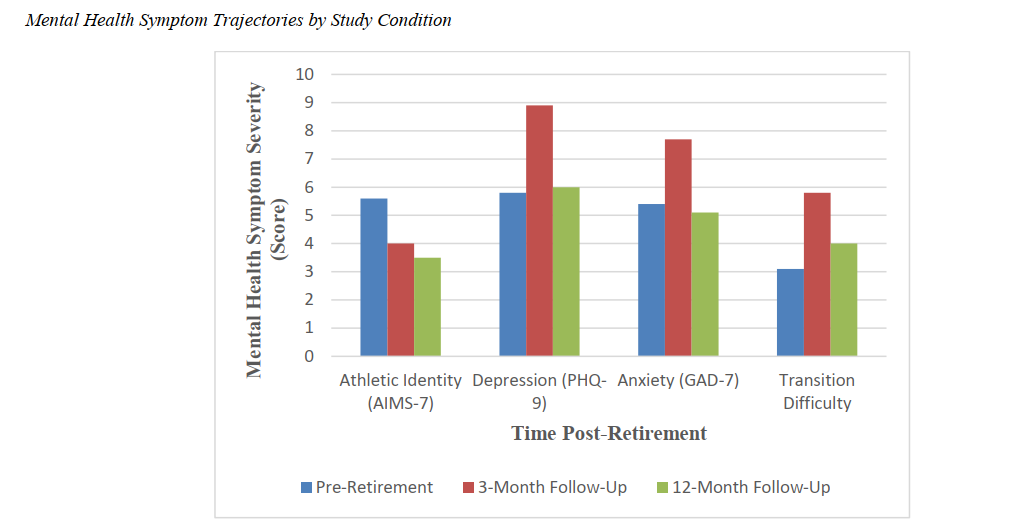
This study examines the psychological and physiological impacts of athletic career termination, focusing on identity loss and mental health trajectories among elite athletes. It evaluates the effectiveness of a multimodal intervention program designed to facilitate post-retirement adjustment through identity reconstruction and lifestyle adaptation strategies. A mixed-methods longitudinal design was employed with 138 retiring elite athletes (72 male, 66 female) across 28 sports disciplines. Participants were assessed at three timepoints (pre-retirement, 3-month, and 12-month post-retirement) using validated measures including the Athletic Identity Measurement Scale (AIMS-7), Depression Anxiety Stress Scales (DASS-21), and physiological markers (cortisol, heart rate variability). The intervention group (n=69) received 18 sessions combining cognitive-behavioral therapy, narrative identity exercises, and lifestyle redesign, while controls (n=69) received standard transition services. Qualitative interviews with 32 participants provided in-depth experiential data. Athletic identity showed a 32% mean reduction (d=1.2) with steepest decline at 3 months post-retirement. Mental health symptoms followed a U-shaped trajectory, peaking at 3 months (depression M=8.7; anxiety M=7.5) before improving. The intervention group demonstrated superior outcomes: 41% lower depression scores among physically active participants (p<0.001) and greater psychological integration (d=0.73). Physiological markers correlated with psychological distress (r=0.47), with faster cortisol normalization (-23% vs -14%) in the intervention group. Individual sport athletes showed 38% identity reduction versus 27% in team sports. Athletic retirement triggers significant identity disruption and mental health challenges, particularly during early transition. Structured interventions addressing identity continuity and lifestyle adaptation effectively mitigate these effects. Sports organizations should implement proactive transition programs combining psychological support with physiological monitoring.
Downloads
References
1. Wylleman P. A developmental and holistic perspective on transiting out of elite sport. In: Anshel MH, Petrie TA, Steinfeldt JA, editors. APA handbook of sport and exercise psychology: Sport psychology: American Psychological Association; 2019. p. 201-16. [DOI]
2. Stambulova NB, Ryba TV, Henriksen K. Career development and transitions of athletes: The International Society of Sport Psychology Position Stand revisited. International Journal of Sport and Exercise Psychology. 2021;19(4):524-50[DOI]
3. Monteiro R, Monteiro D, Torregrossa M, Travassos B. Modeling athletic career of football players: Implications for career management and retirement. International Journal of Sports Science & Coaching. 2023;18(5):1478-86.[PMID: 38558779]. [PMCID: PMC10978592] [DOI]
4. Ronkainen NJ, Schmid MJ, Hlasová H. Closing a chapter? A protocol for a longitudinal mixed methods study on retirement from elite sport. BMC Psychology. 2023;11:376.[PMID: 37936233]. [PMCID: PMC10631078] [DOI]
5. Lochbaum M, Cooper S, Limp S. The Athletic Identity Measurement Scale: A Systematic Review with Meta-Analysis from 1993 to 2021. European Journal of Investigation in Health, Psychology and Education. 2022;12(9):1391-414.[PMID: 36135235]. [PMCID: PMC9497853] [DOI]
6. Brewer BW, Chatterton HA. Athletic Identity and Sport Injury Processes and Outcomes in Young Athletes: A Supplemental Narrative Review. Journal of Functional Morphology and Kinesiology. 2024;9(4):191.[PMID: 39449485]. [PMCID: PMC11503344] [DOI]
7. Castaldelli-Maia JM, Gallinaro JGME, Falcão RS, Gouttebarge V, Hitchcock ME, Hainline B, et al. Mental health symptoms and disorders in elite athletes: a systematic review on cultural influencers and barriers to athletes seeking treatment. British Journal of Sports Medicine. 2019;53(11):707-21.[PMID: 31092400]. [DOI]
8. Gouttebarge V, Castaldelli-Maia JM, Gorczynski P, Hainline B, Hitchcock ME, Kerkhoffs GM, et al. Occurrence of mental health symptoms and disorders in current and former elite athletes: a systematic review and meta-analysis. British Journal of Sports Medicine. 2019;53(11):700-6.[PMID: 31097451]. [PMCID: PMC6579497] [DOI]
9. Montero A, Baranoff J, Adams R, Drummond M. Athletic retirement: factors contributing to sleep and mental health problems. Frontiers in Psychology. 2024;15:1350925[DOI]
10. Putukian M, Yeates KO. Clinical Commentary: Depression and Anxiety in Adolescent and Young Adult Athletes. Journal of Athletic Training. 2023;58(9):681-6.[PMID: 37971042]. [PMCID: PMC11215733] [DOI]
11. Brown DJ, Arnold R, Standage M, Turner JE, Fletcher D. The prediction of thriving in elite sport: A prospective examination of the role of psychological need satisfaction, challenge appraisal, and salivary biomarkers. Journal of Science and Medicine in Sport. 2021;24(4):373-9[DOI]
12. Jones L, Avner Z, Denison J. "After the Dust Settles": Foucauldian Narratives of Retired Athletes' "Re-orientation" to Exercise. Frontiers in Sports and Active Living. 2022;4:901308.[PMID: 35873214]. [PMCID: PMC9304547] [DOI]
13. Wendling E, Sagas M. Is There a Reformation Into Identity Achievement for Life After Elite Sport? A Journey of Identity Growth Paradox During Liminal Rites and Identity Moratorium. Frontiers in Psychology. 2021;12:644839.[PMID: 33935901]. [PMCID: PMC8085321] [DOI]
14. Brett BL, Cohen AD, McCrea MA, Wang Y. Longitudinal alterations in cerebral perfusion following a season of adolescent contact sport participation compared to non-contact athletes. NeuroImage: Clinical. 2023;40:103538.[PMID: 37956583]. [PMCID: PMC10666028] [DOI]
15. McGinley J, Stapleton E, Gale E, Worrall H, Podvin C, Ellis HB, et al. Differences in athletic identity, sport participation, and psychosocial factors following anterior cruciate ligament rehabilitation in youth athletes. Frontiers in Psychology. 2024;14:1303887.[PMID: 38259536]. [PMCID: PMC10800524] [DOI]
16. Kim S, Alahmad ME, Oh T, Love A. Athletic justice: Scale development and validation. Heliyon. 2024;10(2):e24359[DOI]
17. Edison BR, Christino MA, Rizzone KH. Athletic Identity in Youth Athletes: A Systematic Review of the Literature. International Journal of Environmental Research and Public Health. 2021;18(14):7331.[PMID: 34299786]. [PMCID: PMC8305814] [DOI]
18. Chun Y, Wendling E, Sagas M. Identity Work in Athletes: A Systematic Review of the Literature. Sports (Basel, Switzerland). 2023;11(10):203.[PMID: 37888530]. [PMCID: PMC10611030] [DOI]
19. Ghavami A, Moradi H, Ghavami A. The relationship between athletic identity and passion with psychological responses to sport injury in elite karate athletes. Functional Research in Sport Psychology. 2024;1(3):28-39[DOI]
20. Li Y, Schinke RJ, Giffin CE, Steadman EA, Yang X, Qi Z, et al. An Athlete-Centered Career Assistance Intervention Program for the Chinese Sport System: Reflections Into Polyphonics. Journal of Sport Psychology in Action. 2024;16(1):72-85[DOI]
21. Wood RE, Pachana NA. The Role of Meaning in the Retirement Transition: Scoping Review. The Gerontologist. 2025;65(6):gnaf076.[PMID: 39969022]. [PMCID: PMC12082295] [DOI]
22. Low IG, Lavallee D, Lord R. The Emotional Implications of a Hypertrophic Cardiomyopathy Diagnosis in a Retired Athlete: An Autoethnographic Approach. Social Sciences. 2024;13(11):616[DOI]
23. Oulevey M, Lavallee D, Ojio Y, Kohtake N. The design of a career transition psychological support program for retired Olympic athletes in Japan. Asian Journal of Sport and Exercise Psychology. 2024;4(1):7-10[DOI]
24. Voorheis P, Silver M, Consonni J. Adaptation to life after sport for retired athletes: A scoping review of existing reviews and programs. PLoS ONE. 2023;18(9):e0291683.[PMID: 37733723]. [PMCID: PMC10513329] [DOI]
25. Pilkington V, Walton CC, Gwyther K, Rice S, Butterworth M, Burattin N, et al. Mental health service provision in elite sport: An evaluation of the Australian Institute of Sport Mental Health Referral Network. Journal of Applied Sport Psychology. 2025;37(4):397-421[DOI]
26. Aldridge LJ, Islam MR. Cultural differences in athlete attributions for success and failure: the sports pages revisited. International Journal of Psychology. 2012;47(1):67-75.[PMID: 22046996]. [DOI]
27. Mateu P, Inglés E, Torregrossa M, Marques RFR, Stambulova N, Vilanova A. Living Life Through Sport: The Transition of Elite Spanish Student-Athletes to a University Degree in Physical Activity and Sports Sciences. Frontiers in Psychology. 2020;11:1367.[PMID: 32655454]. [PMCID: PMC7325594] [DOI]
28. Shin O, Park S, Kim B, Wu CF. Retirement Transition Sequences and Well-Being Among Older Workers Focusing on Gender Differences. Journal of Gerontological Social Work. 2024;68(4):415-45.[PMID: 39431631]. [DOI]
29. Stevens M, Cruwys T, Olive L, Rice S, Schmid MJ, De Crom L, et al. Understanding and Improving Athlete
Patterns of reasons for retirement in Olympic athletes from Switzerland: a person-oriented study. International Journal of Sport and Exercise Psychology. 2025:1-20[DOI]
30. Schmid MJ, Hlasová H, Ronkainen NJ. Leaving elite sport, abandoning athletic identity? Development and predictors of athletic identity post-retirement. German Journal of Exercise and Sport Research. 2024;54:450-61[DOI]
31. Sabatini S, Rupprecht F, Kaspar R, Klusmann V, Kornadt A, Nikitin J, et al. Successful Aging and Subjective Aging: Toward a Framework to Research a Neglected Connection. The Gerontologist. 2024;65(1):gnae051.[PMID: 38767091]. [PMCID: PMC11879306] [DOI]
32. Stathi A, Greaves CJ, Thompson JL, Withall J, Ladlow P, Taylor G, et al. Effect of a physical activity and behaviour maintenance programme on functional mobility decline in older adults: the REACT (Retirement in Action) randomised controlled trial. The Lancet Public Health. 2022;7(4):e316-e26.[PMID: 35325627]. [DOI]
33. Ladlow P, Western MJ, Greaves CJ, Thompson JL, Withall J, de Koning J, et al. The REtirement in ACTion exercise programme and its effects on elements of long term functionality in older adults. Frontiers in Public Health. 2023;11:1151035.[PMID: 37575112]. [PMCID: PMC10420051] [DOI]
34. Pilkington V, Rice S, Olive L, Walton C, Purcell R. Athlete Mental Health and Wellbeing During the Transition into Elite Sport: Strategies to Prepare the System. Sports Medicine - Open. 2024;10(1):24.[PMID: 38460048]. [PMCID: PMC10924853] [DOI]
35. Purcell R, Pilkington V, Carberry S, Reid D, Gwyther K, Hall K, et al. An Evidence-Informed Framework to Promote Mental Wellbeing in Elite Sport. Frontiers in Psychology. 2022;13:780359.[PMID: 35250720]. [PMCID: PMC8890033] [DOI]
36. Wang W, Schweickle MJ, Arnold ER, Vella SA. Psychological Interventions to Improve Elite Athlete Mental Wellbeing: A Systematic Review and Meta-analysis. Sports Medicine (Auckland, NZ). 2025;55(4):877-97.[PMID: 39815135]. [PMCID: PMC12011916] [DOI]
37. Bu D, Chung PK, Zhang CQ, Liu J, Wang X. Mental Health Literacy Intervention on Help-Seeking in Athletes: A Systematic Review. International Journal of Environmental Research and Public Health. 2020;17(19):7263.[PMID: 33020448]. [PMCID: PMC7579198] [DOI]
38. Bu D, Zhang CQ, Liu JD, Han Z, Wang X, Huang Z. Mental health literacy, mental health experiences and help-seeking behaviours of Chinese elite athletes: a qualitative study. Frontiers in Public Health. 2024;12:1391597.[PMID: 38813417]. [PMCID: PMC11133729] [DOI]
39. Håkansson A, Moesch K, Jönsson C, Kenttä G. Potentially Prolonged Psychological Distress from Postponed Olympic and Paralympic Games during COVID-19—Career Uncertainty in Elite Athletes. International Journal of Environmental Research and Public Health. 2021;18(1):2.[PMID: 33374935]. [PMCID: PMC7792570] [DOI]
Downloads
Additional Files
Publication Timeline
- Submitted
- Revised
- Accepted
License
Copyright (c) 2025 Dr Razvan Sandu Enoiu (Corresponding Author); Dr Felipe J. Aidar (Author)

This work is licensed under a Creative Commons Attribution-NonCommercial 4.0 International License.