Neurofeedback Training for Sharpening Focus in Precision Sports: A Pilot Study
DOI:
https://doi.org/10.61838/kman.hn.3.4.8Keywords:
neurofeedback, precision sports, attentional control, EEG, cognitive trainingAbstract
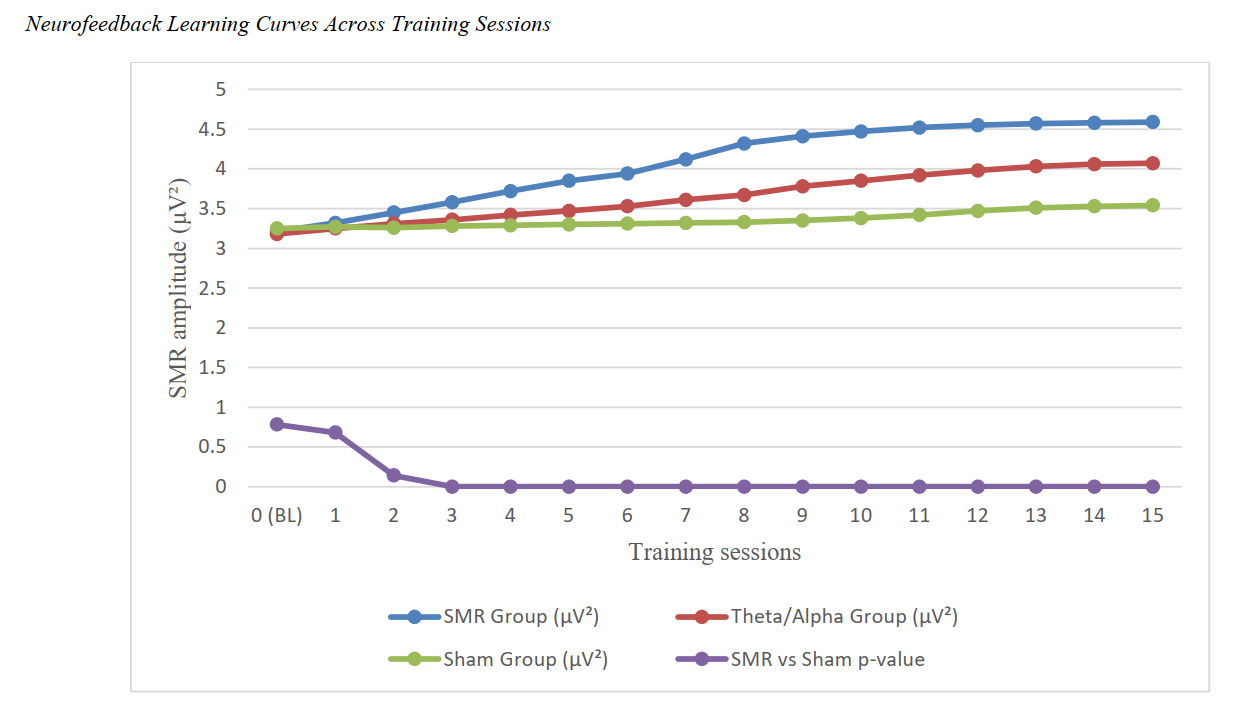
This study investigates the efficacy of neurofeedback training in enhancing focus and attentional control among athletes in precision sports, examining both neural and behavioral outcomes. A pilot intervention was conducted with [X] competitive athletes (e.g., archers, shooters) who underwent [Y] sessions of EEG-based neurofeedback targeting sensorimotor rhythm (SMR) or theta/beta ratio modulation. Pre- and post-training assessments included quantitative EEG analysis, standardized attention tests (e.g., TOVA), and self-reported focus metrics during simulated competition. A control group engaged in sham neurofeedback to account for placebo effects. Participants receiving active neurofeedback demonstrated significant improvements in SMR amplitude (p<0.05) and theta/beta ratio reduction (p<0.01), correlating with enhanced performance accuracy (15% increase, p<0.05) and faster reaction times. Subjective reports confirmed heightened concentration during high-pressure tasks, whereas the control group showed no statistically meaningful changes. EEG coherence analysis revealed strengthened frontoparietal connectivity, suggesting neuroplastic adaptations underlying cognitive gains. Neurofeedback appears effective in sharpening attentional regulation for precision sports, though individual variability and the need for protocol optimization warrant further investigation. These preliminary findings support integrating neurofeedback into athletic training regimens while highlighting the necessity for larger randomized trials to establish standardized protocols.
Downloads
References
1. Woods CT, McKeown I, Rothwell M, Araújo D, Robertson S, Davids K. Sport Practitioners as Sport Ecology Designers: How Ecological Dynamics Has Progressively Changed Perceptions of Skill “Acquisition” in the Sporting Habitat. Frontiers in Psychology. 2020;11:654. [PMID: 32390904] [PMCID: PMC7194200] [DOI]
2. Li S, Kempe M, Brink M, Lemmink K. Effectiveness of Recovery Strategies After Training and Competition in Endurance Athletes: An Umbrella Review. Sports Medicine - Open. 2024;10(1):55. [PMID: 38753045] [PMCID: PMC11098991] [DOI]
3. Gomez-Espejo V, Olmedilla A, Abenza-Cano L, Garcia-Mas A, Ortega E. Psychological readiness to return to sports practice and risk of recurrence: Case studies. Frontiers in Psychology. 2022;13:905816. [PMID: 36211933] [PMCID: PMC9540195] [DOI]
4. Gao Q, Luo N, Sun M, Zhou W, Li Y, Liang M, et al. Neural efficiency and proficiency adaptation of effective connectivity corresponding to early and advanced skill levels in athletes of racket sports. Human Brain Mapping. 2023;44(2):388-402. [PMID: 36053219] [PMCID: PMC9842890] [DOI]
5. Wang D, Hu T, Luo R, Shen Q, Wang Y, Li X, et al. Effect of Cognitive Reappraisal on Archery Performance of Elite Athletes: The Mediating Effects of Sport-Confidence and Attention. Frontiers in Psychology. 2022;13:860817. [PMID: 35529554] [PMCID: PMC9070554] [DOI]
6. Bovolon L, De Fano A, Di Pinto G, Rosito SA, Scaramuzza C, Tanet E, et al. Integrating brain-body-behavior data for performance optimization: Augmented technologies for the next generation of sport psychologists. Psychology of Sport and Exercise. 2025;81:102954. [PMID: 40684896] [DOI]
7. Morrone JM, Pedlar CR. EEG-based neurophysiological indices for expert psychomotor performance - a review. Brain and Cognition. 2024;175:106132. [PMID: 38219415] [DOI]
8. Chen KF, Chueh TY, Hung TM. Differences in visuospatial cognition among table tennis players of different skill levels: an event-related potential study. PeerJ. 2024;12:e17295. [PMID: 38827290] [PMCID: PMC11144390] [DOI]
9. Chmiel J, Nadobnik J. Application of Electroencephalography (EEG) in Combat Sports—Review of Findings, Perspectives, and Limitations. Journal of Clinical Medicine. 2025;14(12):4113. [PMID: 40565858] [PMCID: PMC12194295] [DOI]
10. Afrash S, Saemi E, Gong A, Doustan M. Neurofeedback training and motor learning: the enhanced sensorimotor rhythm protocol is better or the suppressed alpha or the suppressed mu? BMC Sports Science, Medicine & Rehabilitation. 2023;15(1):93. [PMID: 37525277] [PMCID: PMC10392010] [DOI]
11. Autenrieth M, Kober SE, Neuper C, Wood G. How Much Do Strategy Reports Tell About the Outcomes of Neurofeedback Training? A Study on the Voluntary Up-Regulation of the Sensorimotor Rhythm. Frontiers in Human Neuroscience. 2020;14:218. [PMID: 32587509] [PMCID: PMC7299073] [DOI]
12. Weber LA, Ethofer T, Ehlis AC. Predictors of neurofeedback training outcome: A systematic review. NeuroImage: Clinical. 2020;27:102301. [PMID: 32604020] [PMCID: PMC7327249] [DOI]
13. Yu CL, Cheng MY, An X, Chueh TY, Wu JH, Wang KP, et al. The Effect of EEG Neurofeedback Training on Sport Performance: A Systematic Review and Meta-Analysis. Scandinavian Journal of Medicine & Science in Sports. 2025;35(5):e70055. [PMID: 40270441] [PMCID: PMC12019780] [DOI]
14. Bertollo M, Doppelmayr M, Robazza C. Using brain technologies in practice. In: Tenenbaum G, Eklund RC, Boiangin N, editors. Handbook of sport psychology: Social perspectives, cognition, and applications. 4 ed: John Wiley & Sons, Inc.; 2020. p. 666-93. 3_https://doi.org/DOI}
15. Cioffi E, Hutber A, Molloy R, Murden S, Yurkewich A, Kirton A, et al. EEG-based sensorimotor neurofeedback for motor neurorehabilitation in children and adults: A scoping review. Clinical Neurophysiology. 2024;167:143-66. [PMID: 39321571] [PMCID: PMC11845253] [DOI]
16. Cheng MY, Yu CL, An X, Wang L, Tsai CL, Qi F, et al. Evaluating EEG neurofeedback in sport psychology: a systematic review of RCT studies for insights into mechanisms and performance improvement. Frontiers in Psychology. 2024;15:1331997. [PMID: 39156814] [PMCID: PMC11328324] [DOI]
17. Tonin A, Semprini M, Kiper P, Mantini D. Brain-Computer Interfaces for Stroke Motor Rehabilitation. Bioengineering. 2025;12(8):820. [DOI]
18. Badicu G, Silva RM, Brini S, Gonzalez-Fernandes FT, Ardigò LP. The Role of Neurofeedback and Non-Invasive Brain Stimulation (tDCS/rTMS) in Enhancing Athletic Performance and Psychological Resilience in Elite Athletes. Functional Research in Sport Psychology. 2025;2(3):93-105. [DOI]
19. Corrado S, Tosti B, Mancone S, Di Libero T, Rodio A, Andrade A, et al. Improving Mental Skills in Precision Sports by Using Neurofeedback Training: A Narrative Review. Sports. 2024;12(3):70. [PMID: 38535733] [PMCID: PMC10975073] [DOI]
20. Tosti B, Corrado S, Mancone S, Di Libero T, Carissimo C, Cerro G, et al. Neurofeedback Training Protocols in Sports: A Systematic Review of Recent Advances in Performance, Anxiety, and Emotional Regulation. Brain Sciences. 2024;14(10):1036. [PMID: 39452048] [PMCID: PMC11506327] [DOI]
21. Wang KP, Cheng MY, Chen TT, Huang CJ, Schack T, Hung TM. Elite golfers are characterized by psychomotor refinement in cognitive-motor processes. Psychology of Sport and Exercise. 2020;50:101739. [DOI]
22. Chen TT, Wang KP, Chang WH, Kao CW, Hung TM. Effects of the function-specific instruction approach to neurofeedback training on frontal midline theta waves and golf putting performance. Psychology of Sport and Exercise. 2022;61:1-9. [DOI]
23. Vidaurre C, Irastorza-Landa N, Sarasola-Sanz A, Insausti-Delgado A, Ray AM, Bibián C, et al. Challenges of neural interfaces for stroke motor rehabilitation. Frontiers in Human Neuroscience. 2023;17:1070404. [PMID: 37789905] [PMCID: PMC10543821] [DOI]
24. Gkintoni E, Vassilopoulos SP, Nikolaou G, Vantarakis A. Neurotechnological Approaches to Cognitive Rehabilitation in Mild Cognitive Impairment: A Systematic Review of Neuromodulation, EEG, Virtual Reality, and Emerging AI Applications. Brain Sciences. 2025;15(6):582. [PMID: 40563754] [PMCID: PMC12190363] [DOI]
25. Sho'ouri N. Hard Boundary-Based Neurofeedback Training Procedure: A Modified Fixed Thresholding Method for More Accurate Guidance of Subjects Within Target Areas During Neurofeedback Training. Clinical EEG and Neuroscience. 2023;54(3):228-37. [PMID: 35686319] [DOI]
26. de Brito MA, Fernandes JR, Esteves NS, Müller VT, Alexandria DB, Pérez DIV, et al. The Effect of Neurofeedback on the Reaction Time and Cognitive Performance of Athletes: A Systematic Review and Meta-Analysis. Frontiers in Human Neuroscience. 2022;16:868450. [PMID: 35795260] [PMCID: PMC9252423] [DOI]
27. Rydzik Ł, Wąsacz W, Ambroży T, Javdaneh N, Brydak K, Kopańska M. The Use of Neurofeedback in Sports Training: Systematic Review. Brain Sciences. 2023;13(4):660. [PMID: 37190625] [PMCID: PMC10136619] [DOI]
28. Wang KP, Cheng MY, Elbanna H, Schack T. A new EEG neurofeedback training approach in sports: the effects function-specific instruction of Mu rhythm and visuomotor skill performance. Frontiers in Psychology. 2023;14:1273186. [PMID: 38187413] [PMCID: PMC10771324] [DOI]
29. Zhou Q, Cheng R, Yao L, Ye X, Xu K. Neurofeedback Training of Alpha Relative Power Improves the Performance of Motor Imagery Brain-Computer Interface. Frontiers in Human Neuroscience. 2022;16:831995. [PMID: 35463935] [PMCID: PMC9026187] [DOI]
30. Sawai S, Murata S, Fujikawa S, Yamamoto R, Shima K, Nakano H. Effects of neurofeedback training combined with transcranial direct current stimulation on motor imagery: A randomized controlled trial. Frontiers in Neuroscience. 2023;17:1148336. [PMID: 36937688] [PMCID: PMC10017549] [DOI]
31. Calderone A, Latella D, Bonanno M, Quartarone A, Mojdehdehbaher S, Celesti A, et al. Towards Transforming Neurorehabilitation: The Impact of Artificial Intelligence on Diagnosis and Treatment of Neurological Disorders. Biomedicines. 2024;12(10):2415. [PMID: 39457727] [PMCID: PMC11504847] [DOI]
32. Perrey S. Probing the Promises of Noninvasive Transcranial Electrical Stimulation for Boosting Mental Performance in Sports. Brain Sciences. 2023;13(2):282. [PMID: 36831825] [PMCID: PMC9954379] [DOI]
33. Matos FO, Vido A, Garcia WF, Lopes WA, Pereira A. A Neurovisceral Integrative Study on Cognition, Heart Rate Variability, and Fitness in the Elderly. Frontiers in Aging Neuroscience. 2020;12:51. [PMID: 32210785] [PMCID: PMC7068733] [DOI]
34. Ebrahimzadeh E, Saharkhiz S, Rajabion L, Oskouei HB, Seraji M, Fayaz F, et al. Simultaneous electroencephalography-functional magnetic resonance imaging for assessment of human brain function. Frontiers in Systems Neuroscience. 2022;16:934266. [PMID: 35966000] [PMCID: PMC9371554] [DOI]
35. Carmichael DW, Vulliemoz S, Murta T, Chaudhary U, Perani S, Rodionov R, et al. Measurement of the Mapping between Intracranial EEG and fMRI Recordings in the Human Brain. Bioengineering. 2024;11(3):224. [PMID: 38534498] [PMCID: PMC10968112] [DOI]
36. Lim H, Ahmed B, Ku J. Brain-Computer Interface Based Engagement Feedback in Virtual Reality Rehabilitation: Promoting Motor Cortex Activation. Electronics. 2025;14(5):827. [DOI]
37. Ghosh S, Sindhujaa P, Kesavan DK, Gulyás B, Máthé D. Brain-Computer Interfaces and AI Segmentation in Neurosurgery: A Systematic Review of Integrated Precision Approaches. Surgeries. 2025;6(3):50. [DOI]
38. Lochhead L, Feng J, Laby DM, Appelbaum LG. Training vision in athletes to improve sports performance: a systematic review of the literature. International Review of Sport and Exercise Psychology. 2024:1-23. [DOI]
39. Autenrieth M, Kober SE, Wood G. Assessment of the capacity to modulate brain signals in a home-based SMR neurofeedback training setting. Frontiers in Human Neuroscience. 2023;16:1032222. [PMID: 36684842 ] [PMCID: PMC9849904] [DOI]
40. Bernabei L, Leone B, Hirsch D, Mentuccia V, Panzera A, Riggio F, et al. Neuromodulation Strategies in Lifelong Bipolar Disorder: A Narrative Review. Behavioral Sciences. 2024;14(12):1176. [PMID: 39767317] [PMCID: PMC11674029] [DOI]
41. Trambaiolli LR, Tiwari A, Falk TH. Affective Neurofeedback Under Naturalistic Conditions: A Mini-Review of Current Achievements and Open Challenges. Frontiers in Neuroergonomics. 2021;2:678981. [PMID: 38235228] [PMCID: PMC10790905] [DOI]
42. Jacques C, Quiquempoix M, Sauvet F, Le Van Quyen M, Gomez-Merino D, Chennaoui M. Interest of neurofeedback training for cognitive performance and risk of brain disorders in the military context. Frontiers in Psychology. 2024;15:1412289. [PMID: 39734770] [PMCID: PMC11672796] [DOI]
43. Viviani G, Vallesi A. EEG-neurofeedback and executive function enhancement in healthy adults: A systematic review. Psychophysiology. 2021;58(9):e13874. [PMID: 34117795] [PMCID: PMC8459257] [DOI]
44. Eschmann KCJ, Riedel L, Mecklinger A. Theta Neurofeedback Training Supports Motor Performance and Flow Experience. Journal of Cognitive Enhancement. 2022;6:434-50. [PMID: 35966366] [PMCID: PMC9360146] [DOI]
45. Wang KP, Frank C, Hung TM, et al. Neurofeedback training: Decreases in Mu rhythm lead to improved motor performance in complex visuomotor skills. Current Psychology. 2023;42:20860-71. [DOI]
46. Treves I, Bajwa Z, Greene KD, Bloom PA, Kim N, Wool E, et al. Consumer-Grade Neurofeedback with Mindfulness Meditation: Meta-Analysis. Journal of Medical Internet Research. 2025;27:e68204. [PMID: 40246295] [PMCID: PMC12046271] [DOI]
47. Tosti B, Corrado S, Mancone S, Di Libero T, Rodio A, Andrade A, et al. Integrated use of biofeedback and neurofeedback techniques in treating pathological conditions and improving performance: a narrative review. Frontiers in Neuroscience. 2024;18:1358481. [PMID: 38567285] [PMCID: PMC10985214] [DOI]
48. Chang YK, Ren FF, Li RH, Ai JY, Kao SC, Etnier JL. Effects of acute exercise on cognitive function: A meta-review of 30 systematic reviews with meta-analyses. Psychological Bulletin. 2025;151(2):240-59. [PMID: 39883421] [DOI]
49. Da Silva JC, De Souza ML. Neurofeedback training for cognitive performance improvement in healthy subjects: A systematic review. Psychology & Neuroscience. 2021;14(3):262-79. [DOI]
50. Zhou Z, Xu H, Sun Y, Liu G. The Electroencephalogram (EEG) Study for Estimating Endurance Sports Performance Base on Eigenvalues Extraction Method. Brain Sciences. 2024;14(11):1135. [PMID: 39595898] [PMCID: PMC11591843] [DOI]
Downloads
Additional Files
Publication Timeline
- Submitted
- Revised
- Accepted
License
Copyright (c) 2025 Dr Matheus Santos de Sousa Fernandes (Corresponding Author); Dr Eduardo Melguizo-Ibáñez (Author)

This work is licensed under a Creative Commons Attribution-NonCommercial 4.0 International License.