
Understanding User Perceptions of Personalized Feedback in Digital Health Tools
DOI:
https://doi.org/10.61838/kman.hn.3.4.2Keywords:
Personalized feedback, digital health tools, user perceptions, qualitative research, health communication, cultural fit, emotional engagementAbstract
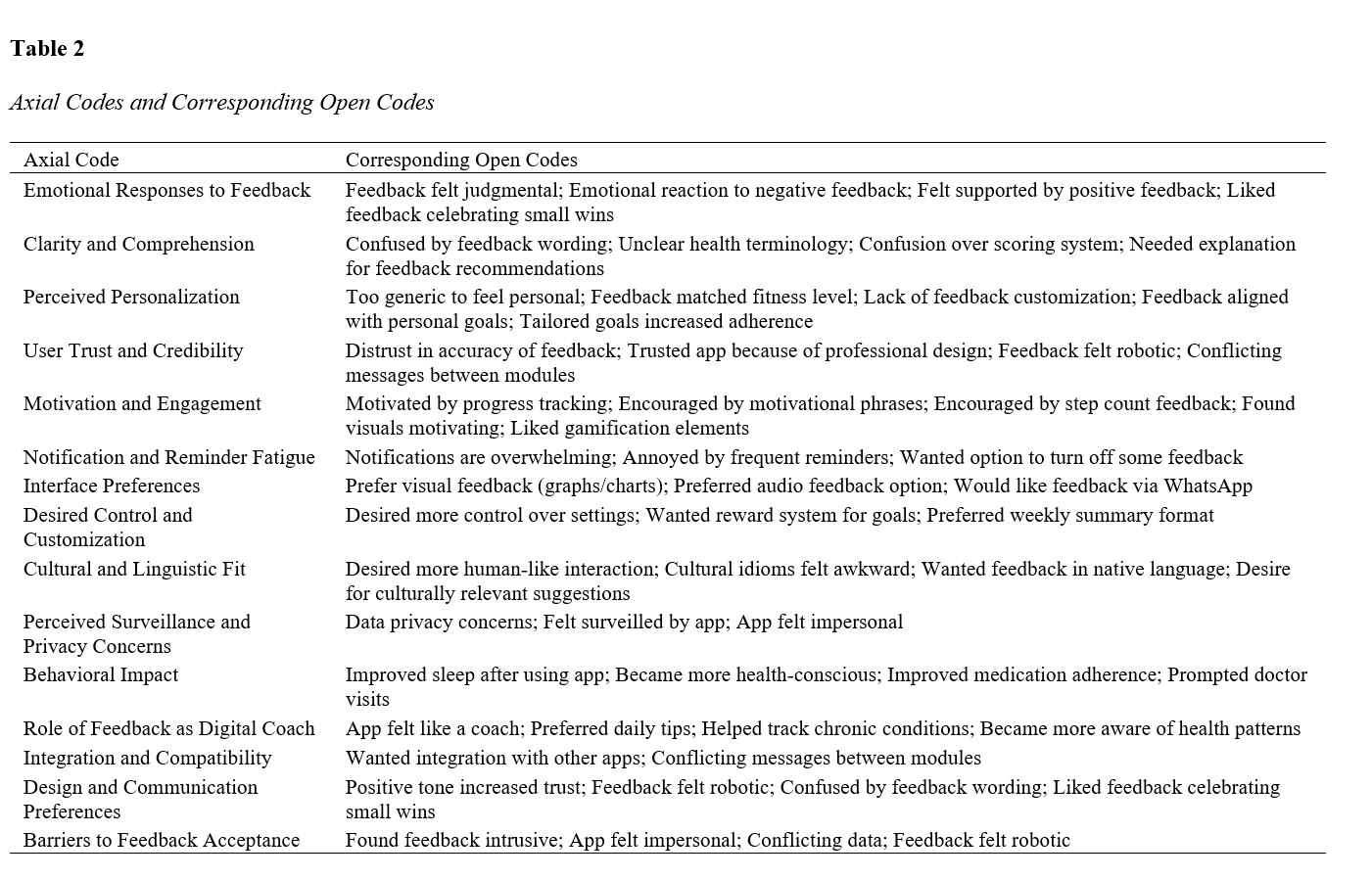
This study aimed to explore how users perceive and emotionally respond to personalized feedback in digital health tools. A qualitative research design was employed using semi-structured interviews with 20 adult participants from Mexico who had experience using digital health tools with personalized feedback features. Participants were selected through purposive sampling, and data collection continued until theoretical saturation was achieved. Interviews were audio-recorded, transcribed, and thematically analyzed using NVivo 14. The coding process followed three stages: open coding, axial coding, and selective coding, ensuring a comprehensive understanding of user experiences and interpretive patterns. Analysis revealed four core themes: perceived effectiveness of feedback, personal relevance and cultural fit, communication and design quality, and trust, privacy, and emotional resonance. Participants valued motivational and positively framed feedback that aligned with their health goals, but criticized messages that were overly generic, intrusive, or lacking emotional intelligence. Users expressed a preference for customizable settings, culturally and linguistically appropriate messages, and visual formats such as graphs or summaries. Trust in the system was strongly influenced by the tone, clarity, and perceived transparency of the feedback, while overly frequent or robotic messages sometimes triggered negative emotional reactions or disengagement. User perceptions of personalized feedback in digital health tools are multifaceted and shaped by emotional, cultural, cognitive, and technological factors. For feedback systems to be effective and engaging, they must be adaptive, empathetic, and contextually relevant. Incorporating user control, emotional intelligence, and cultural sensitivity into feedback design can enhance trust, increase adherence, and ultimately improve digital health outcomes.
Downloads
References
1. Verma AK, Jaiswal AK, Chaudhary A, Singh PK, Singhal A. HEALTHIFY: An AI-Driven MERN Solution for Personalized and Predictive Healthcare. International Journal for Multidisciplinary Research. 2025;7(3).
2. Abass LA, Usuemerai PA, Ibikunle OE, Alemede V, Nwankwo EI, Mbata AO. Enhancing Patient Engagement Through CRM Systems: A Pathway to Improved Healthcare Delivery. International Medical Science Research Journal. 2024;4(10):928-60.
3. P NM. Integrating Patient Feedback Into Personalized Care Strategies. Rojphm. 2025;5(2):17-22.
4. Russell C, Maraccini AM, Salmi T. “Short, Modern, Smart”: Humanizing Healthcare Experiences Through Modernized Feedback. Journal of Patient Experience. 2024;11.
5. Maureal AL, Dano-Hinosolango MA, Mariquit TM, Lorilla FMA. Harnessing DevOps and Microservices for Scalable Teleconsultation — A Case Study on Healthcare Information Management System (HIMS) at USTP. MJST. 2025;22(S1).
6. Tan MJT, Kasireddy HR, Karim HA, AlDahoul N. Health Is Beyond Genetics: On the Integration of Lifestyle and Environment in Real-Time for Hyper-Personalized Medicine. 2024.
7. Shevantikar PA, Udata AP, Korachagao AS. Web Application for Recommendation of Ayurvedic Drugs and Medicine Using ML. JoDPBA. 2024;1(2):13-8.
8. Singleton G, Furber C. Verbal Feedback for Written Assessment: Evaluating a Novel Feedback Communication Strategy. British Journal of Midwifery. 2024;32(11):584-90.
9. Hashish EAA, Alnajjar H. Digital Proficiency: Assessing Knowledge, Attitudes, and Skills in Digital Transformation, Health Literacy, and Artificial Intelligence Among University Nursing Students. BMC Medical Education. 2024;24(1).
10. Strandberg S, Ekstedt M, Fagerström C, Backåberg S. Cocreation of a Video Feedback Tool for Managing Self-Care at Home With Pairs of Older Adults: Remote Experience-Based Co-Design Study (Preprint). 2024.
11. Bizimana RT. The Impact of Digital Health on Improving Patient Outcomes. Nijrms. 2024;5(3):38-41.
12. Agarwal S. Influence of Digital Marketing Strategies on Consumer Engagement in the Healthcare Industry. Shodhkosh Journal of Visual and Performing Arts. 2024;5(2).
13. Nancy R, Venkatesan R, Sundar GN, Jebaseeli TJ. A Framework of Digital Twins for Improving Respiratory Health and Healthcare Measures. Scalable Computing Practice and Experience. 2024;25(4):3214-23.
14. Damar M, Kop O, Şaylan ÖF, Erenay FS. The Place of Mobile Health in the Health Sector, Barriers and Opportunities, Integrated Technologies and Usage Areas Affecting the Development of Mobile Health: A Review of the Literature in All Aspects. Journal of Information Systems and Management Research. 2024;6(2):37-59.
15. Gopi G, Dharani R. Conversational Agents in Healthcare: Design and Implementation. 2025:349-80.
16. Kumar A, Singh RRP, Chatterjee I, Sharma N, Rana V. Neuroadaptive Incentivization in Healthcare Using Blockchain and IoT. Sn Computer Science. 2023;5(1).
17. Singh A. Sentiment Analysis of Patient Reviews to Improve Healthcare in Apollo Hospitals. International Journal for Multidisciplinary Research. 2025;7(3).
18. Priyadharshini K, Dhivya K, Ms K, Prasad SJS, Chakravarthy D, Sudhakar M. Personalized Nutrition in Healthcare Using IoT for Tailored Dietary Solutions. 2025:401-24.
19. Pasupuleti MK. AI-Enhanced Bionics: Bridging Prosthetic Innovation and Viral Detection in the Future of Healthcare. 2024:143-58.
20. Qiao M. Signal Transmission and Feedback Control in Wearable Devices: Review. Te. 2024;1(10).
21. Schlegel L, Ho M, Boyd K, Pugliese R, Shine KM. Development of a Survey Tool: Understanding the Patient Experience With Personalized 3D Models in Surgical Patient Education. Cureus. 2023.
22. Prescott J, Ogilvie L, Hanley T. Student Therapists' Experiences of Learning Using a Machine Client: A Proof‐of‐concept Exploration of an Emotionally Responsive Interactive Client (ERIC). Counselling and Psychotherapy Research. 2023;24(2):524-31.
23. Tunçel K. Enhancing Human-Computer Interaction in Augmented Reality (AR) and Virtual Reality (VR) Environments: The Role of Adaptive Interfaces and Haptic Feedback Systems. Hci. 2024;8(1):9.
24. Ramalingam A, Eraiarasan A. The Future of Wearable Technology and Its Impact on Healthcare. Quing International Journal of Innovative Research in Science and Engineering. 2023;2(2):110-6.
25. Mizna S, Arora S, Saluja P, Das G, Alanesi WA. An Analytic Research and Review of the Literature on Practice of Artificial Intelligence in Healthcare. European Journal of Medical Research. 2025;30(1).
26. Collings M, Brennen R. Telehealth Continence Education Classes: A Feasible Alternative to in-Person Classes. Australian and New Zealand Continence Journal. 2025;28(5):84-8.
27. Pandey P, Maharjan P, Seo M-K, Thapa K, Sohn JI. Recent Progress in Wearable Triboelectric Nanogenerator for Advanced Health Monitoring and Rehabilitation. International Journal of Energy Research. 2024;2024(1).
28. Resch S, Zoufal K, Akhouaji I, Abbou M-A, Schwind V, Völz D. Augmented Smart Insoles – Prototyping a Mobile Application: Usage Preferences of Healthcare Professionals and People With Foot Deformities. Current Directions in Biomedical Engineering. 2023;9(1):698-701.
Downloads
Additional Files
Publication Timeline
- Submitted
- Revised
- Accepted
License
Copyright (c) 2025 Oriana Piskorz-Ryń (Author); Rafael Ballester-Ripoll (Corresponding Author); Daniela Gottschlich , Mehdi Rostami, Sefa Bulut (Author)

This work is licensed under a Creative Commons Attribution-NonCommercial 4.0 International License.