
Identifying Barriers and Enablers to the Adoption of AI-Based Triage Tools in Emergency Departments
DOI:
https://doi.org/10.61838/kman.hn.3.4.1Keywords:
Artificial intelligence, triage tools, emergency department, adoption barriers, enablers, qualitative study, clinical decision support, healthcare technology integrationAbstract
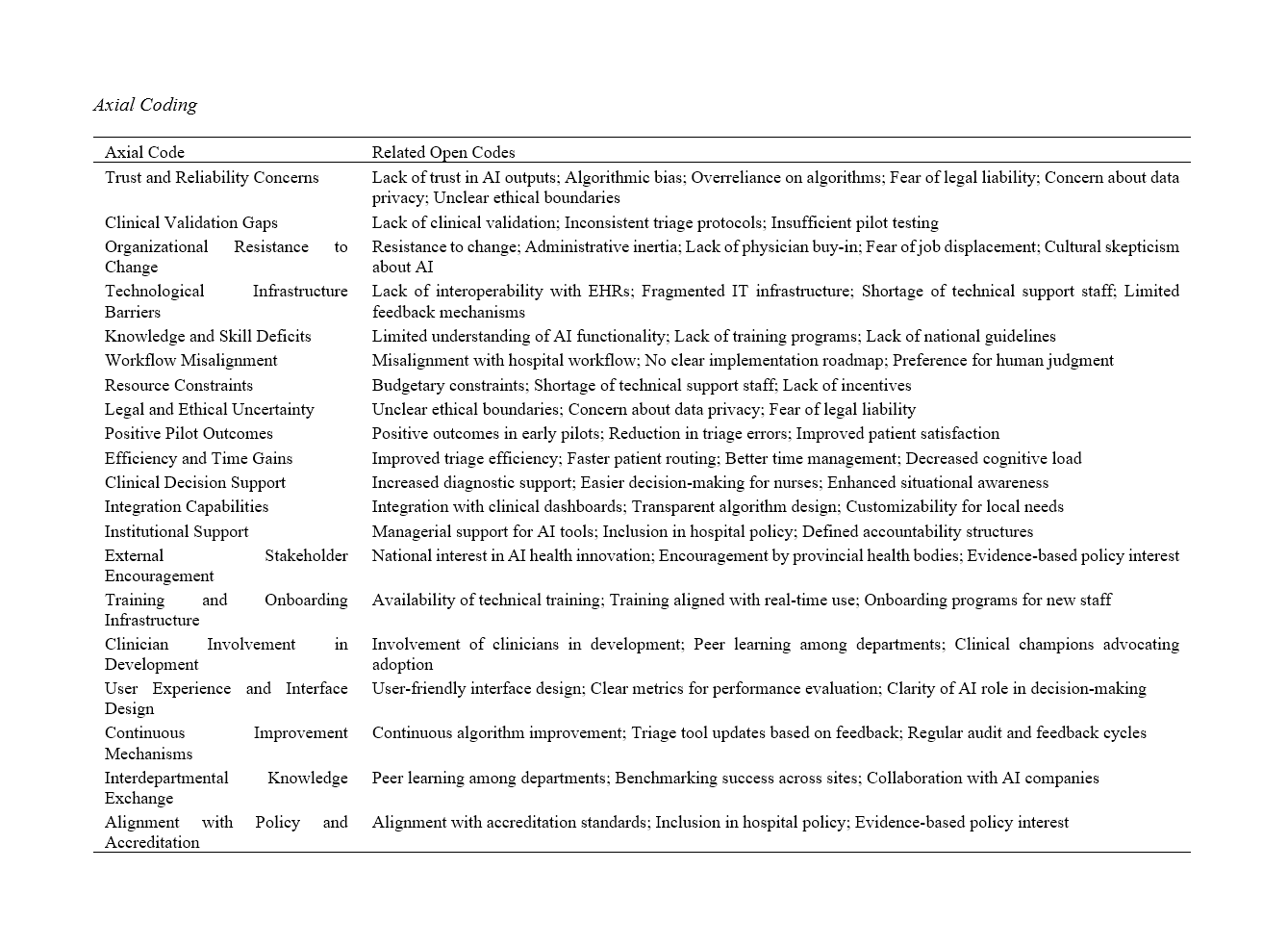
This study aimed to explore the perceived barriers and enablers influencing the adoption of artificial intelligence (AI)-based triage tools in emergency departments (EDs) from the perspective of frontline healthcare professionals. A qualitative research design was employed, utilizing semi-structured interviews with 19 participants—including emergency physicians, triage nurses, department managers, clinical administrators, and health informatics experts—working in emergency departments across Canada. Participants were selected using purposive sampling to ensure diversity in professional roles and institutional settings. Data collection continued until theoretical saturation was reached. Interviews were transcribed verbatim and analyzed using grounded theory methodology. Open, axial, and selective coding were conducted with the assistance of NVivo software to identify emerging themes and construct a conceptual model of AI adoption dynamics. The analysis revealed five core categories shaping AI-based triage adoption: (1) perceived risk and uncertainty, including lack of trust in AI outputs and concerns over legal liability; (2) institutional and organizational readiness, such as infrastructure limitations and workflow misalignment; (3) human capital and knowledge systems, including digital literacy gaps and lack of training; (4) system-level support and governance, highlighting the role of managerial commitment and national policy frameworks; and (5) value proposition and practical benefits, including efficiency gains, clinical decision support, and user-friendly integration. These categories reflected the interplay of technical, organizational, and human factors that either hindered or enabled AI integration in emergency care settings. Adopting AI-based triage tools in emergency departments requires addressing a complex ecosystem of trust, readiness, training, infrastructure, and systemic support. The findings underscore the importance of clinician engagement, targeted education, transparent design, and multi-level policy alignment to ensure effective and sustainable implementation.
Downloads
References
1. Tyler S, Olis M, Aust N, Patel L, Simon LM, Triantafyllidis C, et al. Use of Artificial Intelligence in Triage in Hospital Emergency Departments: A Scoping Review. Cureus. 2024.
2. Magalhães MEA, Ferreira CVL, Oliveira HMd, Ana Beatriz Rodrigues de L, Flores MTS, Leite I, et al. The Use of Artificial Intelligence in Patient Triage in Emergency Departments: An Integrative Review. Revista De Gestão Social E Ambiental. 2024;18(12):e010260.
3. Sitthiprawiat P, Wittayachamnankul B, Sirikul W, Laohavisudhi K. Development and Validation of an AI-Based Emergency Triage Model for Predicting Critical Outcomes in Emergency Department. 2025.
4. Han S, Choi W. Development of a Large Language Model-Based Multi-Agent Clinical Decision Support System for Korean Triage and Acuity Scale (KTAS)-Based Triage and Treatment Planning in Emergency Departments. Advances in Artificial Intelligence and Machine Learning. 2025;05(01):3261-75.
5. Kotovich D, Twig G, Itsekson-Hayosh Ze, Klug M, Ben-Simon A, Yaniv G, et al. The Impact on Clinical Outcomes After One Year of Implementation of an Artificial Intelligence Solution for the Detection of Intracranial Hemorrhage. 2023.
6. Lin T. EDT-MCFEF: A Multi-Channel Feature Fusion Model for Emergency Department Triage of Medical Texts. Frontiers in Public Health. 2025;13.
7. Zhu L, Li X, Zhu H, Xu M, Hou J, Li S, et al. Effect of Emergency Department Triage Model on Door-to-Needle Time in Patients With Acute Ischemic Stroke: A Retrospective Study. 2025.
8. Akeel AS, Aljohani A, Alnasser OM, Alwabel A, Alsaif I, Thabet A, et al. The Use of AI in Predicting Patient Outcomes and Deterioration in the Emergency Department. Journal of Healthcare Sciences. 2023;03(11):510-6.
9. Bartenschlager CC, Grieger M, Erber J, Neidel T, Borgmann S, Vehreschild JJ, et al. Covid-19 Triage in the Emergency Department 2.0: How Analytics and AI Transform a Human-Made Algorithm for the Prediction of Clinical Pathways. Health Care Management Science. 2023;26(3):412-29.
10. Garrido NJ, González-Martínez F, Losada S, Plaza A, Olmo Ed, Mateo J. Innovation Through Artificial Intelligence in Triage Systems for Resource Optimization in Future Pandemics. Biomimetics. 2024;9(7):440.
11. Ahun E, Demir AD, Yiğit Y, Tulgar YK, Doğan M, Thomas DT, et al. Perceptions and Concerns of Emergency Medicine Practitioners About Artificial Intelligence in Emergency Triage Management During the Pandemic: A National Survey-Based Study. Frontiers in Public Health. 2023;11.
12. Avalos M, Cohen D, Russon D, Davids M, Dorémus O, Chenais G, et al. Detecting Human Bias in Emergency Triage Using LLMs. The International Flairs Conference Proceedings. 2024;37.
13. Almulihi Q, Alquraini AH, Almulihi FAA, Alzahid A, Qahtani S, Almulhim M, et al. Applications of Artificial Intelligence and Machine Learning in Emergency Medicine Triage - a Systematic Review. Medical Archives. 2024;78(3):198.
14. Nasser L, Morris E, Mathias I, Hall JN. Considerations for Emergency Department Virtual Triage. Healthcare Management Forum. 2024;38(2):108-13.
15. Hamadeh WA. Artificial Intelligence in Emergency Medicine: A Narrative Review. Ijsr. 2024:1-5.
16. Elhilali A, Brügger V, Tschannen I, Hautz WE, Krummrey G. AI-Enhanced Speech Recognition in Triage. 2025.
17. Zaboli A, Brigo F, Brigiari G, Turcato G. Exploring the Variability in Triage Nursing Workload: Insights From a Multicentre Observational Study. Journal of Advanced Nursing. 2024.
18. Ali Aziz Eldin Mohamed A. Perception and Satisfaction of Nursing Staff Regarding Triage Application in the Emergency Department. Helwan International Journal for Nursing Research and Practice. 2024;3(5):264-84.
19. Almadhyan A, Aljamaan S, Alsubhi R, Alzaidi F, Alharbi T, Alamer F, et al. Awareness of Triage System in Emergency Departments Among the General Public in Saudi Arabia. International Journal of Medicine in Developing Countries. 2023:1.
20. Defilippo A, Veltri P, Lió P, Guzzi PH. Leveraging Graph Neural Networks for Supporting Automatic Triage of Patients. Scientific Reports. 2024;14(1).
21. Hunter OF, Perry F, Salehi M, Bandurski H, Hubbard A, Ball CG, et al. Science Fiction or Clinical Reality: A Review of the Applications of Artificial Intelligence Along the Continuum of Trauma Care. World Journal of Emergency Surgery. 2023;18(1).
22. Yi N, Baik D, Baek G. The Effects of Applying Artificial Intelligence to Triage in the Emergency Department: A Systematic Review of Prospective Studies. Journal of Nursing Scholarship. 2024;57(1):105-18.
23. Sitarek G, Żerek M. Artificial Intelligence in Emergency Medicine: A Literature Review. Quality in Sport. 2024;33:55839.
24. Kuttan N, Pundkar A, Gadkari C, Patel A, Kumar A. Transforming Emergency Medicine With Artificial Intelligence: From Triage to Clinical Decision Support. Multidisciplinary Reviews. 2025;8(10):2025285.
25. Aydın ÖF. The Potential Role of Artificial Intelligence in Emergency Medicine and Medical Education. Istanbul Yeni Yuzyil Universitesi Yeni Yuzyil Journal of Medical Sciences. 2024.
26. Baviskar A, Rajpal D, Sharma A, Hajir AI. Artificial Intelligence in Patient Triage: A Comprehensive Literature Review in Emergency Departments. Ijsr. 2023:69-71.
Downloads
Additional Files
Publication Timeline
- Submitted
- Revised
- Accepted
License
Copyright (c) 2025 Seyed Milad Saadati (Corresponding Author); Armin Khadem Fini (Author)

This work is licensed under a Creative Commons Attribution-NonCommercial 4.0 International License.