200 Meters Freestyle Responses and Strategy Differences During Different Competition Rounds in Youth Competitive Swimmers
DOI:
https://doi.org/10.61838/kman.hn.3.3.14Keywords:
swimming, competition, strategy, blood lactate, rate of perceived exertion, heart rateAbstract
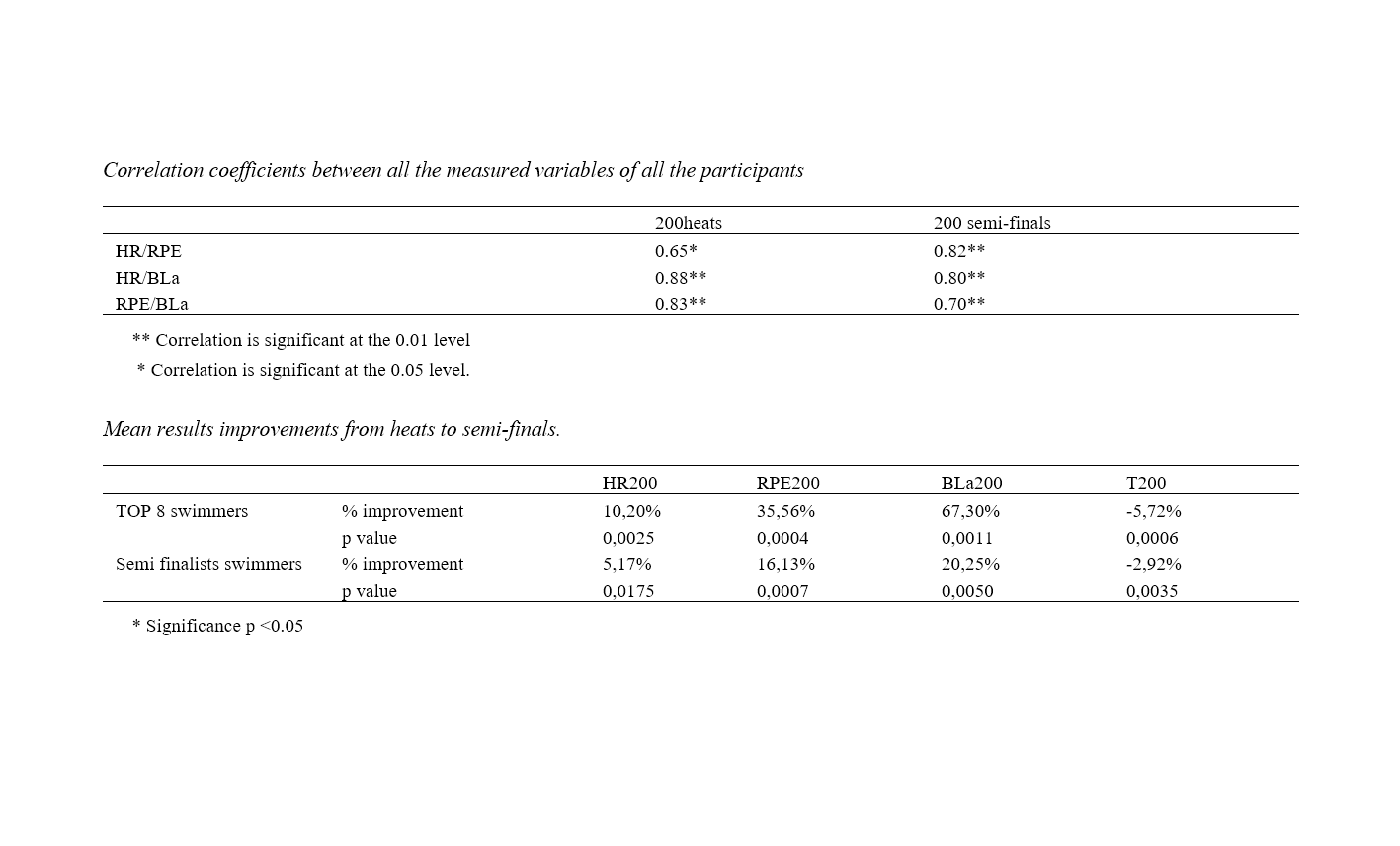
The aims of the study were to analyze the physiological and perceptual responses, performances and strategy differences between competition rounds in youth competitive swimmers by examining possible differences between heats and semi-finals within the same competition day during the 200 meters freestyle event. Twenty-Two male swimmers volunteered to participate in this study. Only thirteen out of the sixteen qualified semi-finalists (age 16.8±0.6 years; weight 69.8±2.2 kg; height 178.3±3.9 cm) were taken into account for data analysis. Significant differences within and between groups were found for T200, HR, RPE and BLa (p < 0.001). From heats to semi-finals, Top 8 swimmers improved their performance by 5.72% with an increased value of HR (10.20%), RPE (35.56%) and BLa (67.30%), However, the remaining semi-finalists only saw a 2.92% improvement in timing and with an increased value of HR (5.17%), RPE (16.13%) and BLa (20.25%). These findings demonstrated that while the Top 8 swimmers swam more slowly in the heats, they exerted more effort in the semi-finals. This might be a tactic to conserve energy in order to provide their best effort in the semi-finals and rank in top to advance to the finals.
Downloads
References
1. Smith DJ, Norris SR, Hogg JM. Performance evaluation of swimmers. Scientific tools. Sports Med. 2002;32:539-54.
2. Avlonitou E. Maximal lactate values following competitive performance varying according to age, sex and swimming style. J Sports Med Phys Fitness. 1996;36:24-30.
3. Bonifazi M, Martelli G, Marugo L, Sardella F, Carli G. Blood lactate accumulation in top level swimmers following competition. J Sports Med Phys Fitness. 1993;33:13-8.
4. Bonifazi M, Sardella F, Lupo C. Preparatory versus main competitions: differences in performances, lactate responses and pre-competition plasma cortisol concentrations in elite male swimmers. Eur J Appl Physiol. 2000;82:368-73.
5. Sawka MN, Knowlton RG, Miles DS, Critz JB. Post-competition blood lactate concentrations in collegiate swimmers. Eur J Appl Physiol Occup Physiol. 1979;41:93-9.
6. Gastin PB. Energy system interaction and relative contribution during maximal exercise. Sports Med. 2001;31:725-41.
7. Wells GD, Selvadurai H, Tein I. Bioenergetic provision of energy for muscular activity. Paediatr Respir Rev. 2009;10:83-90.
8. Vescovi JD, Falenchuk O, Wells GD. Blood Lactate Concentration and Clearance in Elite Swimmers during Competition. International Journal of Sports Physiology and Performance. 2011;6:106-17.
9. Graef FI, Kruel LFM. Heart rate and perceived exertion at aquatic environment: differences in relation to land environment and applications for exercise prescription - a review. Rev Bras Med Esporte. 2006;12(4):11.
10. Svedenhag J, Seger J. Running on land and in water: comparative exercise physiology. Med Sci Sports Exerc. 1992;10:1155-60.
11. Town GP, Bradley SS. Maximal metabolic responses of deep and shallow water running in trained runners. Med Sci Sports Exerc. 1991;2:238-41.
12. Borg G. Borg's perceived exertion and pain scales: Human Kinetics; 1998.
13. Maglisho EW. Nadando ainda mais rápido. São Paulo: Manole; 1999.
14. Aquatic Exercise A. Manual do profissional de fitness aquático. Rio de Janeiro: Shape; 2001.
15. Ueda T, Kurokawa T. Relationships between perceived exertion and physiological variables during swimming. Int J Sports Med. 1995;6:385-9.
16. Thompson KG, Donald PM, Maclaren AL, Atkinson G. The effects of changing pace on metabolism and stroke characteristics during high-speed breaststroke swimming. Journal of Sports Sciences. 2004;22:149-57.
17. Pyne D, Trewin C, Hopkins W. Progression and variability of competitive performance of Olympic swimmers. J Sports Sci. 2004;22:613-20.
18. Thompson KG. Differences in blood lactate concentrations in national standard breaststroke swimmers following heats and finals. Journal of Sports Sciences. 1998;16:63-4.
19. Mohamed TJ, Zied A, Francisco CF, Abderraouf BA. Physiological, perceptual responses, and strategy differences in age-group swimmers between heats and semi-finals in the 400 metres freestyle event. International Journal of Performance Analysis in Sport. 2021;21(6):953-64.
20. Anderson M. Performance and physiological monitoring of highly trained swimmers 2006.
21. Zacca R, Lopes AL, Teixeira BC, da Silva LM, de Matos CC, de Souza Castro FA, editors. Lactate peak in youth swimmers: Quantity and time interval for measurement after 50-1500 maximal efforts in front crawl. XIIth International Symposium for Biomechanics and Medicine in Swimming; 2014.
22. Keskinen O, Keskinen K, Mero A. Effect of Pool Length on Blood Lactate, Heart Rate, and Velocity in Swimming. International Journal of Sports Medicine. 2007;28(5):407-13.
23. McMaster WC, Stoddard T, Duncan W. Enhancement of blood lactate clearance following maximal swimming. Effect of velocity of recovery swimming. Am J Sports Med. 1989;17:472-7.
24. McGibbon K, Pyne D, Shephard M, Thompson K. Pacing in Swimming: A Systematic Review. Sports Medicine. 2018:1-13.
25. Skorski S, Faude O, Caviezel S, Meyer T. Reproducibility of pacing profiles in elite swimmers. International Journal of Sports Physiology and Performance. 2014;9(2):217-25.
26. Figueiredo P, Rouard A, Vilas-Boas J, Fernandes R. Upper-and lower-limb muscular fatigue during the 200-m front crawl. Applied Physiology, Nutrition, and Metabolism. 2013;38(7):716-24.
27. Conceição A, Silva A, Barbosa T, Karsai I, Louro H. Neuromuscular fatigue during 200 m breaststroke. Journal of Sports Science & Medicine. 2014;13(1):200-10.
28. Thompson K, MacLaren D, Lees A, Atkinson G. The effect of even, positive and negative pacing on metabolic, kinematic and temporal variables during breaststroke swimming. European Journal of Applied Physiology. 2003;88(4):438-43.
29. Stirn I, Jarm T, Kapus V, Strojnik V. Evaluation of muscle fatigue during 100-m front crawl. European Journal of Applied Physiology. 2011;111(1):101-13.
Downloads
Additional Files
Publication Timeline
- Submitted
- Revised
- Accepted
License
Copyright (c) 2025 Jed mohamed Tijani, Ali Aloui, Ahmed Said Hammed, Amal Salhi (Author); Abderraouf Ben Abderrahman (Corresponding Author)

This work is licensed under a Creative Commons Attribution-NonCommercial 4.0 International License.