The Effectiveness of Acceptance and Commitment Therapy on Social Anxiety, Academic Performance, and Homesickness among International Students at Imam Khomeini International University
DOI:
https://doi.org/10.61838/kman.hn.3.3.15Keywords:
Acceptance and commitment therapy, Social Anxiety, Academic Performance, HomesicknessAbstract
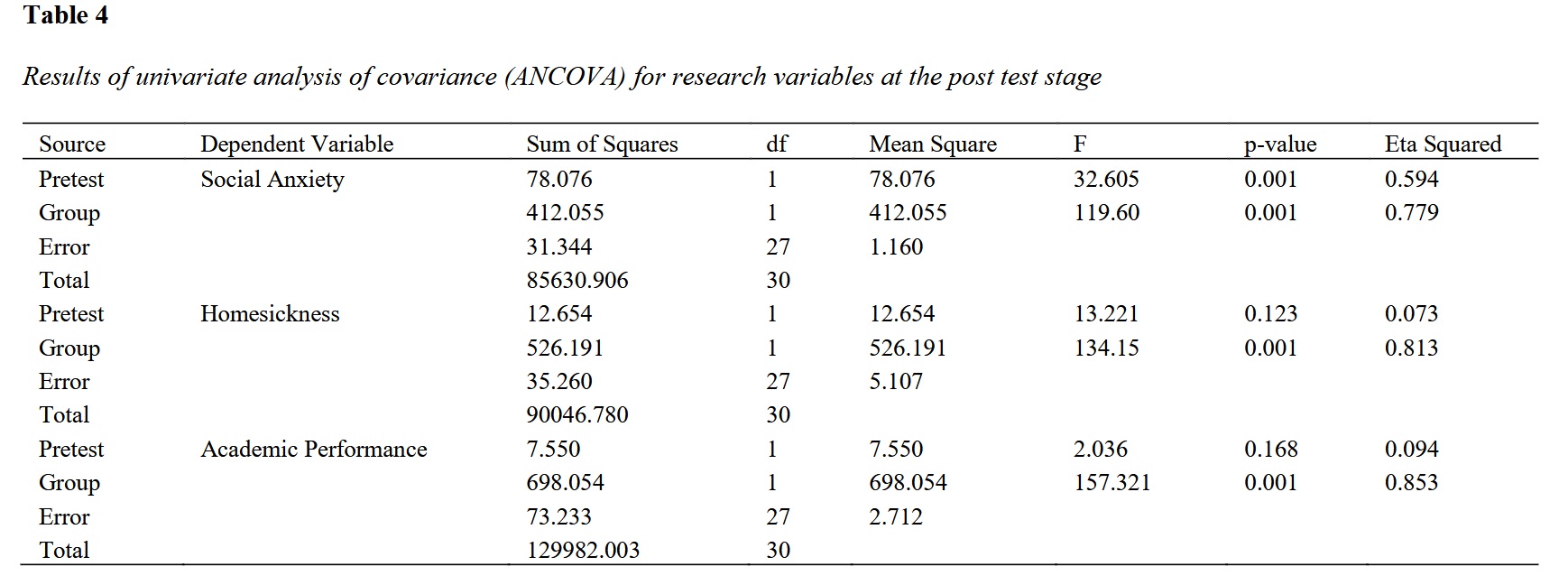
The present study aimed to investigate the effectiveness of Acceptance and Commitment Therapy (ACT) in reducing social anxiety, improving academic performance, and alleviating homesickness among students. This research employed a quasi-experimental design with pre-test and post-test and a control group. The statistical population consisted of students at Imam Khomeini International University. Using purposive sampling, 30 students with high levels of social anxiety and homesickness were selected and randomly assigned to experimental and control groups. The experimental group received ACT-based intervention in eight 90-minute sessions, while the control group did not receive any intervention. The findings, analyzed using analysis of covariance, indicated that Acceptance and Commitment Therapy significantly reduced social anxiety and homesickness and improved the academic performance of students in the experimental group compared to the control group (p<0.05). The results of this study demonstrate the efficacy of the Acceptance and Commitment Therapy approach in enhancing students’ mental health and academic adjustment, particularly in facing the psychological challenges of university life. Accordingly, the use of ACT is recommended as an effective intervention in student counseling centers.
Downloads
References
1. Javaheri M, Navidi-Moghadam M. Effectiveness of Acceptance and Commitment Therapy on Social Anxiety and Family Communication Pattern in university students of Qom city. Journal of Social Health. 2024;11(1):20-30. [DOI]
2. Brandolin F, Lappalainen P, Gorinelli S, Muotka J, Räsänen P, Lappalainen R. The effectiveness of a five-session workshop on the distress of international students in Finland-a pilot study. British Journal of Guidance & Counselling. 2023;51(6):865-82. [DOI]
3. Shadowen NL, Williamson AA, Guerra NG, Ammigan R, Drexler ML. Prevalence and correlates of depressive symptoms among international students: Implications for university support offices. Journal of International Students. 2019;9(1):130-49. [DOI]
4. Forbes-Mewett H, Sawyer AM. International students and mental health. Journal of International Students. 2016;6(3):661-77. [DOI]
5. Deng X, Xiaomin C, Zhang L, Gao Q, Li X, An S. Adolescent social anxiety undermines adolescent-parent interbrain synchrony during emotional processing: A hyper scanning study. International Journal of Clinical and Health Psychology. 2022;22(3):100329. [PMID: 36111264] [PMCID: PMC9449656] [DOI]
6. Xin S, Sheng L. Changes of social anxiety in Chinese adolescents during 2002 -2020: An increasing trend and its relationship with social change. Children and Youth Services Review. 2022;116(11):105-59. [DOI]
7. Rezapour Mirsaleh R, Ahmadi Ardakani Z, Shiri M. The effectiveness of acceptance and commitment based treatment on the academic performance of veteran children. Veterans Engineering and Medical Sciences Research Institute. 2017;10(1):33-9. [DOI]
8. Jury M, Smeding A, Court M, Darnon C. When first generation students succeed at university: On the link between social class, academic performance, and performance avoidance goals. Contemporary Educational Psychology. 2015;41:25-36. [DOI]
9. Sun J, Hagedorn LS, Zhang Y. Homesickness at college: its impact on academic performance and retention. Journal of College Student Development. 2016;57(8):943-57. [DOI]
10. Bardelle C, Lashley C. Pining for home: Studying crew homesickness aboard a cruise liner. Research in Hospitality Management. 2015;5(2):207-14. [DOI]
11. Saravanan C, Alias A, Mohamad M. The effects of brief individual cognitive behavioural therapy for depression and homesickness among international students in Malaysia. Journal of Affective Disorders. 2017;220:108-16. [PMID: 28618312] [DOI]
12. Hayes SC, Strosahl KD. A practical guide to acceptance and commitment therapy: New York: Springer Press; 2010.
13. Christodoulou F, Flaxman PE, Lloyd J. Acceptance and commitment therapy in group format for college students. Journal of College Counseling. 2021;24(3):210-23. [DOI]
14. Sharif Ara B, Khosropour F, Molayi Zarandi H. Effectiveness of Acceptance and Commitment Therapy (ACT) on Emotional Processing, Irrational Beliefs and Rumination in Patients with Generalized Anxiety Disorder. Journal of Adolescent and Youth Psychological Studies. 2023;4(4):34-44. [DOI]
15. Chegeni S, Karimi J, Vajdian MR. The Effectiveness of Acceptance and Commitment Therapy (ACT) on Academic Buoyancy and Psychological Capital of Female Students with Low Academic Performance. Journal of Health Promotion Management. 2025;13(5):41-52. [DOI]
16. Valizade M, Manshaee GH, Kareshki H. Effectiveness of acceptance and commitment group therapy on the symptoms of homesickness, anxiety and emotional regulation in college students. Journal of Research in Clinical Psychology and Counseling. 2022;8(2):43-60. [DOI]
17. Levin ME, MacLane C, Daflos S, Seeley JR, Hayes SC, Biglan A, et al. Examining psychological inflexibility as a transdiagnostic process across psychological disorders. Journal of Contextual Behavioral Science. 2014;3(3):155-63. [PMID: 29057212] [PMCID: PMC5650239] [DOI]
18. Sam Daliri S. A study on the Validity and Reliability of the Social Anxiety Questionnaire by Jarabek: Master's Thesis, Allameh Tabatabai University; 2002.
19. Pham LB, Taylor SE. From Thought to Action: Effects of Process- Versus Outcome-Based Mental Simulations on Performance. Society for Personality and Social Psychology. 1999;25(2):250-60. [DOI]
20. Yazdani Baghmaleki A, Mehri M, Elahi Najaf Abadi S. Evaluation of the effectiveness of acceptance and commitment-based therapy on academic performance and exam anxiety of female high school students. Journal of New Approach to Children's Education. 2022;4(2):40-8. [DOI]
Downloads
Additional Files
Publication Timeline
- Submitted
- Revised
- Accepted
License
Copyright (c) 2025 Somayeh Keshavarz (Corresponding Author)

This work is licensed under a Creative Commons Attribution-NonCommercial 4.0 International License.