Examining the Relationship Between the Effectiveness of Compassion-Focused Therapy and Emotion-Focused Therapy on Enhancing Flexibility in Individuals with Psychoactive Substance Intoxication
DOI:
https://doi.org/10.61838/kman.hn.3.2.3Keywords:
Compassion-Focused Therapy, Emotion-Focused Therapy, Flexibility, Individuals with Psychoactive Substance IntoxicationAbstract
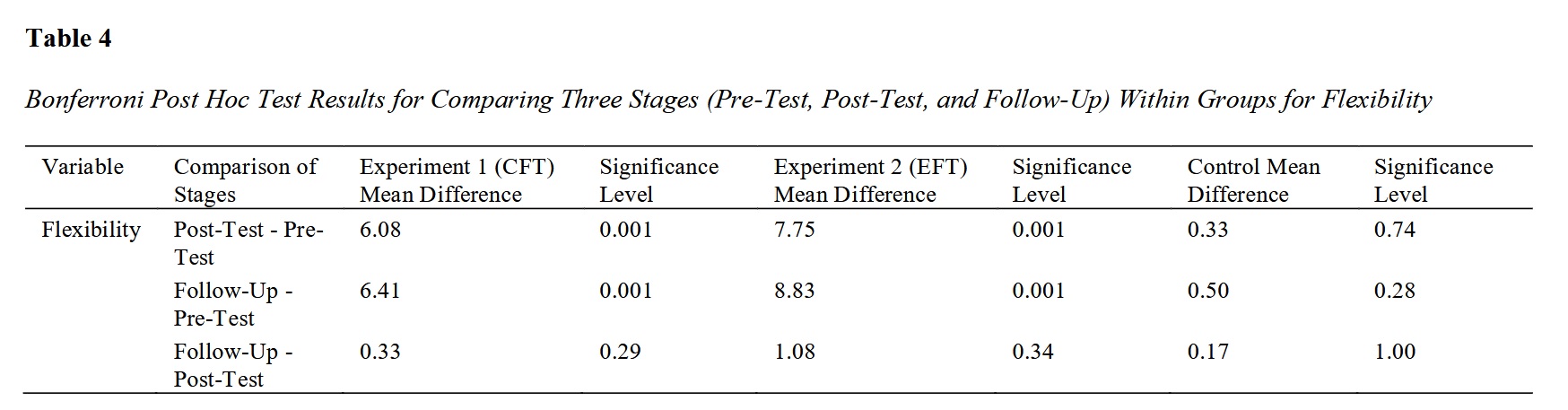
The present study aims to compare the effectiveness of Compassion-Focused Therapy (CFT) and Emotion-Focused Therapy (EFT) on flexibility in individuals with psychoactive substance intoxication in Ahvaz. This study is an experimental research with a pre-test, post-test, and follow-up design with a control group. The statistical population of this study includes all individuals dependent on psychoactive substances who visited outpatient addiction treatment centers in Ahvaz and were admitted to these centers. Based on the research objective, a sample of 45 individuals was selected from the target population using purposive sampling, considering inclusion and exclusion criteria. The participants were randomly assigned to three groups: experimental group 1 (CFT), experimental group 2 (EFT), and a control group. The measurement instrument used in the study was the second version of the Acceptance and Action Questionnaire developed by Bond et al. (2011). The first experimental group underwent a compassion-focused therapy intervention based on Gilbert’s (2009, as cited in Golpour et al., 2014) compassion-focused therapy protocol, which consisted of eight weekly 60-minute sessions. The second experimental group received emotion-focused therapy based on the EFT protocol by Greenberg and Watson (2006, as cited in Salasi, Ramazani, & Jahan, 2022) over twelve 60-minute sessions. The control group did not receive any training during this period. A pre-test was administered to all 45 participants before the intervention, and a post-test was conducted after the completion of the sessions in all three groups. The results indicated that there was no significant difference between the effectiveness of Compassion-Focused Therapy and Emotion-Focused Therapy in improving flexibility in individuals with psychoactive substance intoxication in Ahvaz.
Downloads
References
1. Webb JR, Boye CM. Self-Forgiveness and Self-Condemnation in the Context of Addictive Behavior and Suicidal Behavior. Substance Abuse and Rehabilitation. 2024:21-30. [PMID: 38524663] [PMCID: PMC10961012] [DOI]
2. Abadie R, Habecker P, Carrasco KG, Chiou KS, Fernando S, Bennett SJ, et al. Employing respondent driven sampling (RDS) to recruit people who inject drugs (PWID) and other hard-to-reach populations during COVID-19: lessons learned. Frontiers in Psychiatry. 2022;13:990055. [PMID: 36262631] [PMCID: PMC9574048] [DOI]
3. MirarabRazi M, Shariatnia K, Hoseiniai A. Comparing the efficacy of treatment based on acceptance and commitment and short-term solution-oriented treatment on marital intimacy of addicted men's wives in Azadshahr city. Rooyesh-e-Ravanshenasi Journal (RRJ). 2024;13(1):133-42.
4. Sevari K, Terahi R. Comparison of Family Functioning, Social Support and Irrational Beliefs in Addicted Addicts Undergoing Compulsory Treatment and Self-Reported Addicts in Treatment Centers. Social Psychology Research. 2024;13(52):85-98.
5. Aurora P, Coifman KG. Unpacking social avoidance and substance use in social anxiety: does extraversion explain behavior variability? Journal of Psychopathology and Behavioral Assessment. 2021;43(2):281-92. [DOI]
6. Magill M, Ray L, Kiluk B, Hoadley A, Bernstein M, Tonigan JS, et al. A meta-analysis of cognitive-behavioral therapy for alcohol or other drug use disorders: Treatment efficacy by contrast condition. Journal of Consulting and Clinical Psychology. 2019;87(12):1093. [PMID: 31599606] [PMCID: PMC6856400] [DOI]
7. Kadri R, Husain R, Omar SHS. Impact of spiritual meditation on drug addiction recovery and wellbeing: A systematic review. International Journal of Human and Health Sciences. 2020;4(4):237-50. [DOI]
8. Wellman RJ, Chaiton M, Morgenstern M, O'Loughlin J. Untangling influences in the longitudinal relationship between depressive symptoms and drinking frequency in high school. Journal of Adolescent Health. 2020;66:308-14. [PMID: 31727551] [DOI]
9. American Psychiatric Association. Diagnostic and statistical manual of mental disorders: DSM-5-TR: Washington, DC: American psychiatric association; 2022.
10. Tracy K, Wallace SP. Benefits of peer support groups in the treatment of addiction. Substance Abuse and Rehabilitation. 2016:143-54. [PMID: 27729825] [PMCID: PMC5047716] [DOI]
11. Paz-Ramos MI, Cruz SL, Violante-Soria V. Amphetamine-type stimulants: novel insights into their actions and use patterns. Revista de Investigación Clínica. 2023;75(3):143-57. [PMID: 37441770] [DOI]
12. Corkery JM, Orsolini L, Papanti D, et al. From concept(ion) to life after death/the grave: the 'natural' history and life cycle(s) of novel psychoactive substances (NPS). Human Psychopharmacology. 2017;32(3). [PMID: 28657188] [DOI]
13. Field M, Heather N, Murphy JG, Stafford T, Tucker JA, Witkiewitz K. Recovery from addiction: Behavioral economics and value-based decision making. Psychology of Addictive Behaviors. 2020;34(1):182. [PMID: 31599604] [DOI]
14. Frostadottir AD, Dorjee D. Effects of mindfulness based cognitive therapy (MBCT) and compassion focused therapy (CFT) on symptom change, mindfulness, self-compassion, and rumination in clients with depression, anxiety, and stress. Frontiers in Psychology. 2019;10:1099. [PMID: 31164849] [PMCID: PMC6534108] [DOI]
15. Hakimi Dezfouli ZS, Ebrahimpour G. The role of psychological flexibility, emotional empathy and spiritual experiences in predicting marital satisfaction of married women. Studies in Islam and Psychology. 2024.
16. Farzad V, Mardani F. Influences of Impulsivity and Psychological Flexibility on Empathic Abilities: A Quantitative Analysis. Journal of Personality and Psychosomatic Research (JPPR). 2024;2(1):10-5. [DOI]
17. Yang X, Ebo TO, Wong K, Wang X. Relationships Between Psychological Flexibility and Internet Gaming Disorder Among Adolescents: Mediation Effects of Depression and Maladaptive Cognitions. Plos One. 2023;18(2):e0281269. [PMID: 36735753] [PMCID: PMC9897526] [DOI]
18. Mendes AL, Canavarro MC, Ferreira C. The roles of self-compassion and psychological flexibility in the psychological well-being of adolescent girls. Current Psychology. 2023;42(15):12604-13. [DOI]
19. Roehler DR, Guy Jr GP, Jones CM. Buprenorphine prescription dispensing rates and characteristics following federal changes in prescribing policy, 2017-2018: A cross-sectional study. Drug and Alcohol Dependence. 2020;213:108083. [PMID: 32505044] [PMCID: PMC9590643] [DOI]
20. Bond FW, Hayes, Steven C, Baer, Ruth A, Carpenter, Kenneth M, Guenole, Nigel, Orcutt, Holly K, Waltz, Tom, Zettle, Robert D. Preliminary Psychometric Properties of the Acceptance and Action Questionnaire–II: A Revised Measure of Psychological Inflexibility and Experiential Avoidance. Behavior Therapy. 2011;42(4):676-88. [PMID: 22035996] [DOI]
21. Shiralinia K, Abdollahi Musavi H, Khojastemehr R. The effectiveness of of Group Acceptance and Commitment Therapy (ACT)-Based Training on Parenting Stress and Psychological Flexibility in Mothers of Children with Autism Spectrum Disorderr. Psychology of Exceptional Individuals. 2018;7(28):21-44. [DOI]
22. Asadi H, Mohammadi M, Naziri G, Davoodi A. Comparing of Clinical Efficacy of ACT Matrix with ACT Focused on Compassion and Hofmann's CBT on Social Anxiety Disorder. Applied Psychology. 2023;17(2):61-33. [DOI]
23. Guillen KM. Evaluating the Impact of a Compassion Focused Therapy Group on Parent and Caregiver Psychological Flexibility: The University of Western Ontario (Canada); 2022.
24. Alizadeh A, Afkaneh S, Banisi P. The Effectiveness of Emotion-Focused Therapy on Psychological Flexibility, Vitality, and Happiness in Couples. Journal of Psychology and Educational Sciences in the Third Millennium. 2022(15).
25. Ardestani SY, Shakib N, Yousefi S. The Effectiveness of Emotion-Focused Cognitive Therapy on Cognitive Flexibility and Rumination of Adolescents With Practical Obsessive-Compulsive Disorder. Journal of Studies and Psychological in Adolescents and Youth. 2021;2(1):160-70. [DOI]
Downloads
Additional Files
Publication Timeline
- Submitted
- Revised
- Accepted
License
Copyright (c) 2025 Navid Shirmardi (Author); Parviz Asgari (Corresponding Author); Farshad Bahari (Author)

This work is licensed under a Creative Commons Attribution-NonCommercial 4.0 International License.