Comparing the Effect of Traditional Educational Model and Game-Based Learning Approach on Self-Efficacy in Adolescent Boys
DOI:
https://doi.org/10.61838/kman.hn.3.1.15Keywords:
Game-Based Learning, traditional education, self-efficacy, adolescent boys, educational strategies, interactive learningAbstract
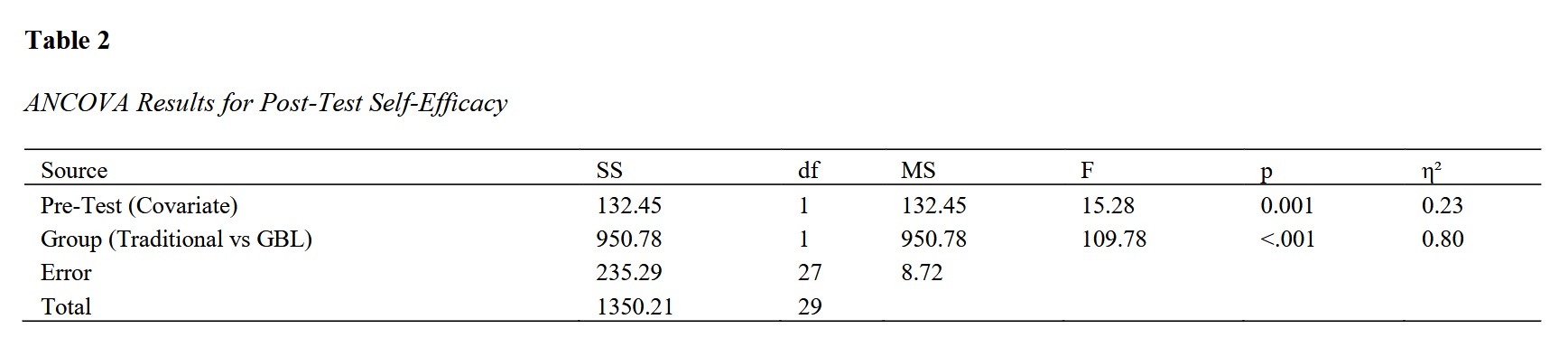
This study aimed to compare the effects of the traditional educational model and the Game-Based Learning (GBL) approach on self-efficacy in adolescent boys. A quasi-experimental design was used with a pre-test and post-test model. Thirty male students aged 10 to 13 years from Mashhad were selected using convenience sampling and randomly assigned to two groups: one receiving traditional instruction and the other exposed to GBL. Self-efficacy was measured using the Self-Efficacy Questionnaire for Children and Adolescents (SEQ-C). The intervention spanned eight weeks, with the traditional group focusing on teacher-led, structured activities, while the GBL group engaged in interactive, game-based tasks designed to enhance cognitive and emotional skills. Data were analyzed using descriptive statistics and ANCOVA to evaluate differences between groups. The results revealed that the GBL approach significantly improved self-efficacy compared to the traditional educational model. Participants in the GBL group exhibited a larger mean increase in self-efficacy scores (M = 19.52) compared to the traditional group (M = 6.86). ANCOVA confirmed the effectiveness of GBL, with a large effect size (\u03b72 = 0.80). These findings align with previous studies emphasizing the role of interactive and engaging learning environments in fostering self-efficacy. Game-Based Learning proved to be a more effective approach than traditional instruction in enhancing self-efficacy among adolescent boys. These findings highlight the potential of GBL as a transformative educational strategy, particularly for fostering confidence, motivation, and autonomy in students. Future research should explore long-term effects and applicability across diverse populations.
Downloads
References
1. Wang LH, Chen B, Hwang GJ, Guan JQ, Wang YQ. Effects of digital game-based STEM education on students' learning achievement: a meta-analysis. International Journal of STEM Education. 2022;9(1):1-13. [DOI] [DOI]
2. Hosseini A, Ashkouri A, Majidi N. The Effectiveness of Game-Based Education on Learning and Motivation in Arabic Language Students. Language Studies. 2020;11(2):23-56.
3. Fatimah S, Murwani FD, Farida IA, Hitipeuw I. Academic self-efficacy and its effect on academic engagement: Meta-analysis. International Journal of Instruction. 2024;17(1):271-94. [DOI]
4. Liu S. A Cross-Sectional Study on the Moderating Effect of Self-Efficacy on the Relationship Between Sociodemographic Variables and Nutrition Literacy Among Older Adults in Rural Areas of North Sichuan. Frontiers in Nutrition. 2024;10. [PMID: 38260079] [PMCID: PMC10800664] [DOI]
5. Hoseinkhani K, Ghasemi M, Hejazi M. The effectiveness of educational package based on cognitive components of critical thinking, problem-solving,and metacognition on students' self-efficacy and academic vitality. icss. 2022;23(4):48-60. [DOI]
6. Coleman TE, Money AG. Student-centred digital game–based learning: a conceptual framework and survey of the state of the art. Higher Education. 2020;79(3):415-57. [DOI]
7. Sofia M, Aranha PR. Effectiveness of game-based learning on anxiety and postoperative self-efficacy among children undergoing surgery. Journal of Health and Allied Sciences. 2022;13(1). [DOI] [DOI]
8. Behnamnia N, Kamsin A, Ismail MAB, Hayati A. The effective components of creativity in digital game-based learning among young children: A case study. Children and Youth Services Review. 2020;116:105227. [DOI]
9. Vasalou A, Khaled R, Holmes W, Gooch D. Digital games-based learning for children with dyslexia: A social constructivist perspective on engagement and learning during group game-play. Computers & Education. 2017;114:175-92. [DOI]
10. Coffey L, Davis A. The Holistic Approach to Academia: Traditional Classroom Instruction and Experiential Learning of Student-Athletes. Education Sciences. 2019;9(2):125. [DOI]
11. Gosper M, McNeill M. Implementing Game-Based Learning: The MAPLET Framework as a Guide to Learner-Centred Design and Assessment. In: Ifenthaler D, Eseryel D, Ge X, editors. Assessment in Game-Based Learning: Foundations, Innovations, and Perspectives. New York, NY: Springer New York; 2012. p. 217-33[DOI]
12. Dortaj F. Comparing the effects of game-based and traditional teaching methods on students’ learning motivation and math. Journal of School Psychology. 2014;2(6-24/4):62-80.
13. Xu M, Luo Y, Zhang Y, Xia R, Qian H, Zou X. Game-based learning in medical education. Frontiers in Public Health. 2023;11:1113682. [PMID: 36935696] [PMCID: PMC10020233] [DOI]
14. Shiralinejad F, Ghasemi M, Emamipour S. The comparison of the effectiveness of traditional and combined (electronic and traditional) training on the cognitive load theory of girls’stuents in the seconds of level high school in kerman city. Journal of Adolescent and Youth Psychological Studies (JAYPS). 2022;3(2):197-212. [DOI] [DOI]
15. Forootan K, Hashemi SA, Qaltash A, Mashinchi AA. The effect of using the reverse class approach on learning the experimental sciences of elementary school students. Journal of Psychological Science. 2022;21(119):2285-302. [DOI]
16. Chao-Fernández R, Gisbert-Caudeli V, Vázquez-Sánchez R. Emotional Training and Modification of Disruptive Behaviors through Computer-Game-Based Music Therapy in Secondary Education. Applied Sciences [Internet]. 2020; 10(5).
17. Kiafar MS, Asghari Nekah SM. Effectiveness of Creativity Developing Program Using Game-based Group Activities in the Components of Pre-Elementary School Children’s Creativity. Educational Technologies in Learning. 2014;1(1):61-83. [DOI]
18. Shariati F, Niazazari K, Jabbary N. Presenting a Model for Virtual Education Considering Educational Equity with a Phenomenological Approach in Schools of Golestan Province. Iranian Journal of Educational Sociology. 2024;7(1):66-78. [DOI] [DOI]
19. Brown BA. Teaching approaches, social support, and student learning in non-traditional classrooms in higher education. The Emerald Handbook of Higher Education in a Post-Covid World: New Approaches and Technologies for Teaching and Learning: Emerald Publishing Limited; 2022. p. 71-106[DOI]
20. Plass JL, Homer BD, Kinzer CK. Foundations of game-based learning. Educational psychologist. 2015;50(4):258-83. [DOI]
21. Kiili K. Digital game-based learning: Towards an experiential gaming model. The Internet and Higher Education. 2009;12:145-52.
Downloads
Additional Files
Publication Timeline
- Submitted
- Revised
- Accepted
License
Copyright (c) 2025 Meysam Rezaei , Elnaz Ebrahimi Khayat, Armin Farokhi (Author); Mahdi Najafian Razavi (Corresponding Author)

This work is licensed under a Creative Commons Attribution-NonCommercial 4.0 International License.